

World Birds IUCN statusLC · Least ConcernGlobal IUCN category. BirdLife v10 (2025); taxon matching: AviList 2026 / IOC 15.2; checked: 29.10.2026. The list year is not the species assessment date. Source and method · BirdLife OrderColumbiformesGüvercinler FamilyColumbidaeColumbidae
White-headed Fruit-Dove
Ptilinopus eugeniae
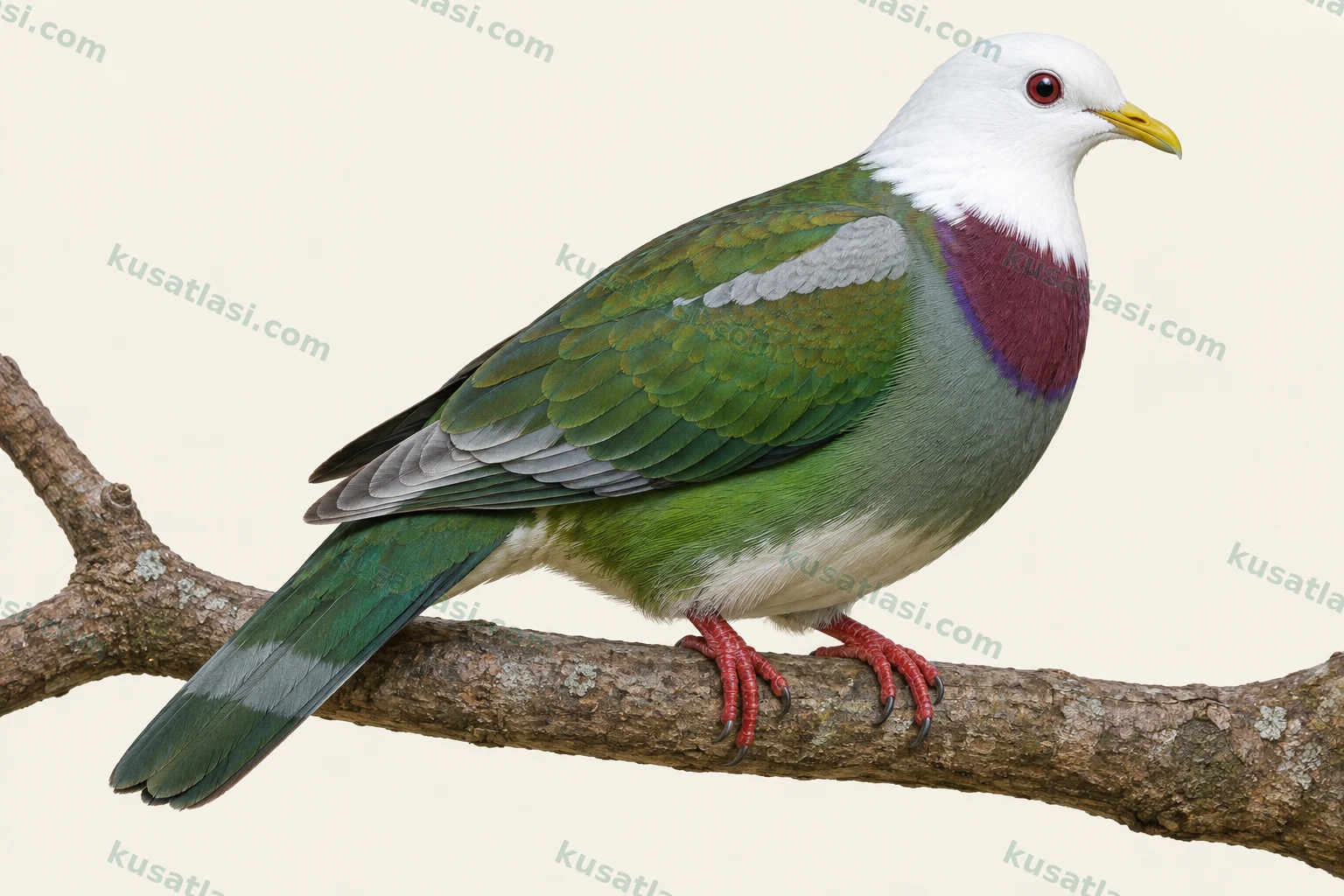
A fruit dove native to Makira and nearby small islands. Adults are distinguished by their entirely white head, green body and broad reddish-purple breast patch.
Biometrics
Length
Male18–22 cm
Female18–22 cm
Shared species value
Wing length
Male11.52 cm
Female11.52 cm
Shared species value
Weight
Male93.5–130 g
Female93.5–130 g
Shared species value
White-headed Fruit-Dove
Makira and nearby small islands in the southeastern Solomon IslandsObservation guide in its natural range
Look for three features together
Do not rely on a single featureExtensively pure white in adults. In young birds the white may be limited to the forehead and chin.
Green upperparts with a bronze sheen and a broad reddish-purple patch on the upper breast.
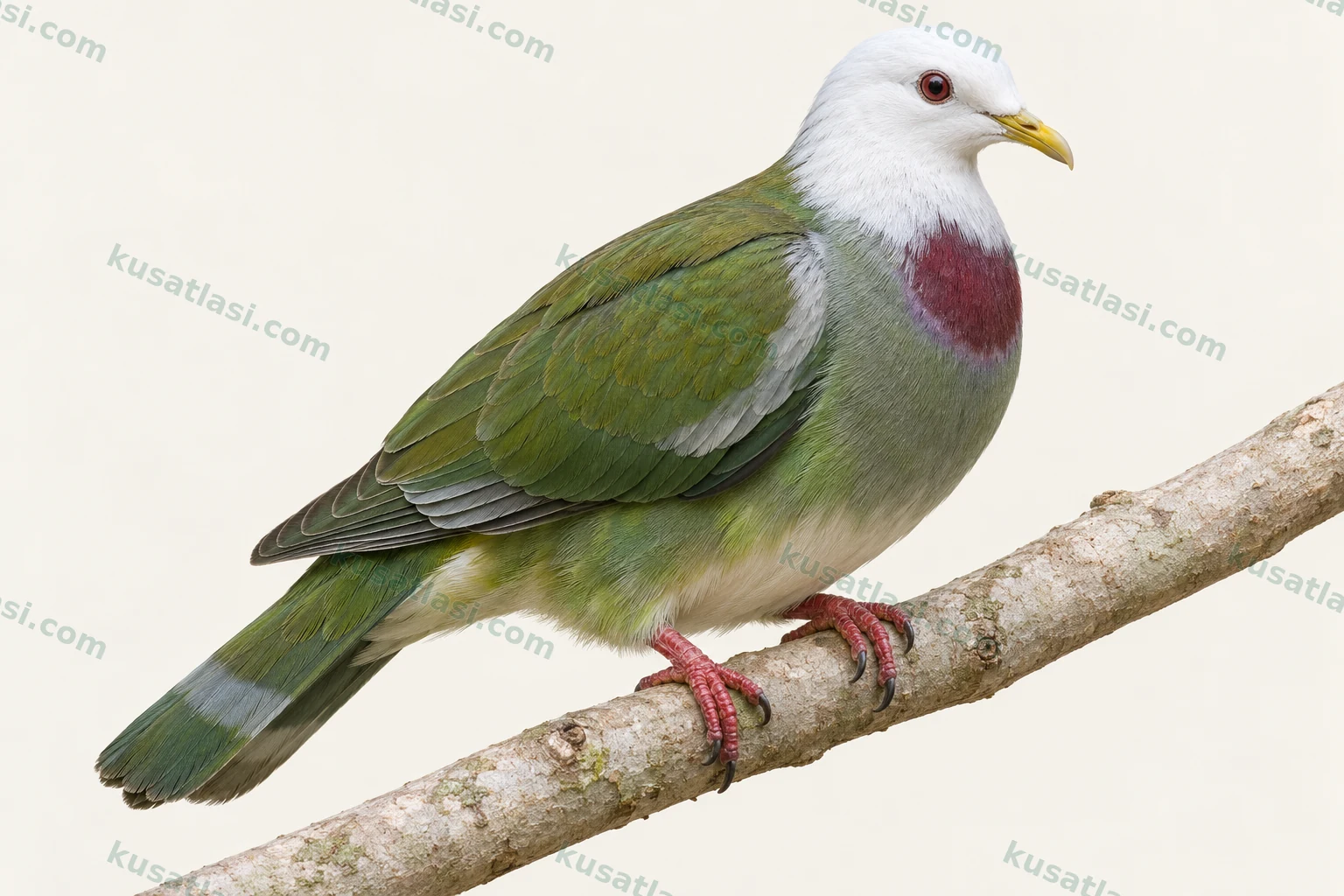
In the original museum description, the adult female resembles the male.
Compare male and female
 FemaleMale
Adult males and females look alike. The old description of a young bird gives a white forehead and chin, with the rest of the head greenish ash-grey.
Where to look in its natural range?
Forest, patches of disturbed woodland and trees around villages.
No verified monthly nesting calendar is available for this species. Fieldwork months are not marked as breeding months.
All months: The specialist account treats the species as non-migratory. No measured seasonal route between islands was found. No verified regional date is given for this month. This does not imply local absence.
January
February
March
April
May
June
July
August
September
October
November
December
Nest, egg and incubation
Nest structure, egg count, incubation duration and the duration of chick development were not verified.
The dove gives a two-part call with a more distinct second syllable.
Do not play recordings to attract birds; observe quietly, especially near nests.
Species information
Quick identification
The White-headed Fruit-Dove Ptilinopus eugeniae is a small green pigeon restricted to Makira and nearby small islands in the southeastern Solomon Islands. The adult’s bright white head and broad reddish-purple patch on the upper breast make the strongest identification combination. The white extends well beyond a small spot on the forehead. Look for the pale head, green body and dark breast patch on the same individual.
The head is often the first part seen between branches, but a glimpse of white on the head is insufficient. Another pale pigeon, a leaf gleaming in sunlight or the bird’s white belly can give the same impression in a brief view. The adult pattern is distinctive when the bird’s natural occurrence on Makira, its small fruit-dove build and the position of each colour on its body are considered together.
General appearance and posture
The head is pure white. The reddish-purple area on the upper breast may have a duller purple border. The lower breast is greyish green, the belly more whitish and the sides green. The area from behind the nape across the back, rump and upper tail coverts looks green with a bronze sheen. The sheen may disappear in shade, so it need not be equally bright in every view.
The upperwing is green, and the long flight feathers look darker. The original museum description recorded a pale grey band on the small wing coverts and grey marks near the tips of the long inner feathers. These details are less visible at a distance than the breast patch and white head. A single grey spot on a green wing is not sufficient. Look at the whole bird.
The tail is green above with a broad grey-green band near the tip. It is darker grey below, where the broad pale terminal band may look almost white. The whitish undertail coverts were also described with yellow edges and green areas. The whole tail is not white. A closed tail and a spread tail viewed from below show the same pattern differently.
The original specimen notes describe a red iris, reddish feet and a yellowish bill. Light and distance affect the appearance of these small areas in the field. Foot colour cannot substitute for the head and breast pattern.
Males, females and young birds
Salvadori’s original museum account explicitly describes the adult female as resembling the male. A white head and broad reddish-purple breast patch do not make a bird male by colour alone. The same adult pattern on the female does not diminish its value for species identification. Identifying the species and determining sex are separate tasks.
For the young bird, the same account describes a bird that has left the nest with only the chin and forehead white. The rest of the head is greenish ash-grey. The outer edges of the greater coverts and the inner flight feathers are pale yellow. This old specimen-based description differs from the wholly white head of an adult. A partly hidden head is not evidence of youth. Check where the white actually occurs.
A detailed moult calendar for all ages has not been verified. Limited head white does not establish an exact age in months or the bird’s sex. Young birds may also resemble other green fruit-doves. A nearby adult and directly observed feeding provide stronger age context than two birds on the same branch. Being seen together alone does not establish a parent–young relationship.
Appearance in flight
In flight, the white head and green back may show briefly. From below, the pale belly, coloured breast patch and pale terminal tail band become more important. The colours of the upper and lower surfaces are kept distinct. A green back seen in flight does not justify describing the underwing as white, which the original description does not support. If the breast patch is not visible during a fast passage, identification is less certain.
A flight between trees does not show regular migration between islands. The sources examined give no measured annual migration route for the species. One movement over open sea cannot stand in for the whole population’s travel pattern. Direction, duration and colours seen can be recorded separately, and details that were missed are left open.
Voice and behaviour
The call is a two-part dove sound with a more prominent second syllable. Cornell’s specialist identification account describes this two-note call as distinctive. It can draw attention before the bird is seen among leaves, and following the sound to its branch may help find the white head. If the individual making the sound is not seen, the call does not identify all nearby pigeons as this species.
On Makira the bird can also be found in villages and disturbed forest patches, beyond intact forests far from people. Its use of these sites does not show that it can live without the functions of forest. Observe natural calls and spontaneous movements rather than repeatedly playing back a recording to draw it out.
Similar species
The Yellow-bibbed Fruit Dove Ptilinopus solomonensis, which can occur alongside it on Makira, is also a small green pigeon. Check the full head and breast pattern. The adult White-headed Fruit-Dove is distinguished by the combination of an extensively white head and a reddish-purple breast patch. Young birds may lack those strong adult marks, so a green body alone does not establish the species.
World distribution
Its natural range covers Makira and nearby small islands in the southeastern Solomon Islands. Makira may appear as San Cristobal or San Cristoval in older publications. Those names do not represent additional occurrences on another continent. Historical specimens recorded under the name Ugi also support this local island distribution. Finding the species named in an older text does not establish that it uses the entire Solomon archipelago.
Status within its natural range
The current taxonomic record gives Least Concern as its conservation category. A modern field survey on Makira recorded it at more than one site. These observations do not give an exact count for the island. The Cornell account also mentions disturbed forest patches and villages. Being easy to see at a suitable site does not turn a narrow island range into a broad global distribution.
Studies of Makira’s bird community treat forest loss and introduced predators as important conservation issues. The community-level result does not establish an attack at a particular White-headed Fruit-Dove nest or a specific rate of current population decline. No complete current island census for the species is presented here.
Migration
The specialist compilation does not classify it as migratory and treats it as resident in its natural island range. Verified breeding events for every month and tracked routes between islands are unavailable, so the map does not show a seasonal travel line. Local movements to find fruit do not establish a timetable in which all birds move to the same island on the same date.
Breeding habitat
Forested areas of Makira form its natural habitat. A modern field list documents it at different survey sites, and the Cornell account also includes disturbed forests and villages. Seeing a bird in these settings does not show that it nests at every observation point. The particular tree species used for breeding and an elevation range representative of the whole population were not verified in this review.
Nest site
The accessible original sources did not sufficiently verify the structure of a directly examined nest, usual clutch size, incubation duration or the time young take to prepare for flight. Branch platforms, single eggs or development periods from other pigeons are not transferred to this species. A juvenile appearance described in an old museum account does not establish a development period measured from hatching.
Daily habitat use
The green body is less conspicuous among leaves, while the broad white head stands out through gaps between branches. Forest edges and village trees can be useful places to look, but gardens vary in food and nesting conditions. When watching fruiting trees, leave the bird on its branch and avoid searching near an unknown nest. Use of the same tree for several days does not establish a home-range size that remains constant all year.
What does it eat?
The White-headed Fruit-Dove eats fruit, as supported by the species-level ecological classification in AVONET. The original sources examined do not establish the plant species eaten or dietary proportions in all seasons. Fruit from a particular fig tree or other tree is not treated as verified food simply because the plant grows on Makira. A largely fruit-based diet does not mean the bird can eat only one kind of plant.
How does it forage?
To understand its feeding, watch what the bird actually takes in its bill while in the tree. A brief view through green leaves may not reveal the fruit species or whether the fruit was swallowed. Such an observation can be recorded as local context for the known fruit-based diet. Unseen seeds and insects are left unidentified.
Use of villages and disturbed forests does not show that it relies on human food or no longer needs natural fruit. A fruit-eating bird may contribute to forest regeneration, but the sources examined did not measure germination success or dispersal distance for any seed carried by this species. Observing feeding and establishing an ecological effect require separate evidence.
A museum label can be mistaken
A 2016 museum study re-examined Ramsay’s Solomon Islands specimens and found historical confusion about names and sex. A record in which another fruit-dove was mistaken for a female White-headed Fruit-Dove cannot be used to identify this species’ female as green-headed. Rechecking original specimens can test a label that has been repeated for a long time. A current species account requires more than repeating an old name as printed.
Old island names do not enlarge the range
Seeing the name San Cristobal for Makira does not mean that two island populations exist. Likewise, a general Solomon Islands label in a museum account does not establish that a bird is found throughout the archipelago. Read current place information alongside the island where an individual specimen was collected. For a restricted-range bird, this distinction keeps the map from exaggerating the natural range.
White on the head is more restricted in young birds
The 1893 museum account describes a young bird that had left the nest with white only on the forehead and chin and greenish ash-grey on the rest of the head. Applying the adult’s broad white head to every age can lead to young birds being mistaken for another species. The old description does not give an exact age in months, the number of days that moult takes or the shade shown by every bird of the same age.
Local visibility and global range are different
Occurrence in villages and disturbed woodland on Makira corrects the idea that the bird must be sought only in remote untouched forest. Its entire natural range nevertheless remains confined to a small island area. Easy observation in one village does not establish the same number of individuals on every island. Conservation assessment treats ease of local observation, the size of the range and change in population over time as separate information.