

World Birds IUCN statusLC · Least ConcernGlobal IUCN category. BirdLife v10 (2025); taxon matching: AviList 2026 / IOC 15.2; checked: 29.10.2026. The list year is not the species assessment date. Source and method · BirdLife OrderGruiformesCranes and allies FamilyHeliornithidaeHeliornithidae
African Finfoot
Podica senegalensis
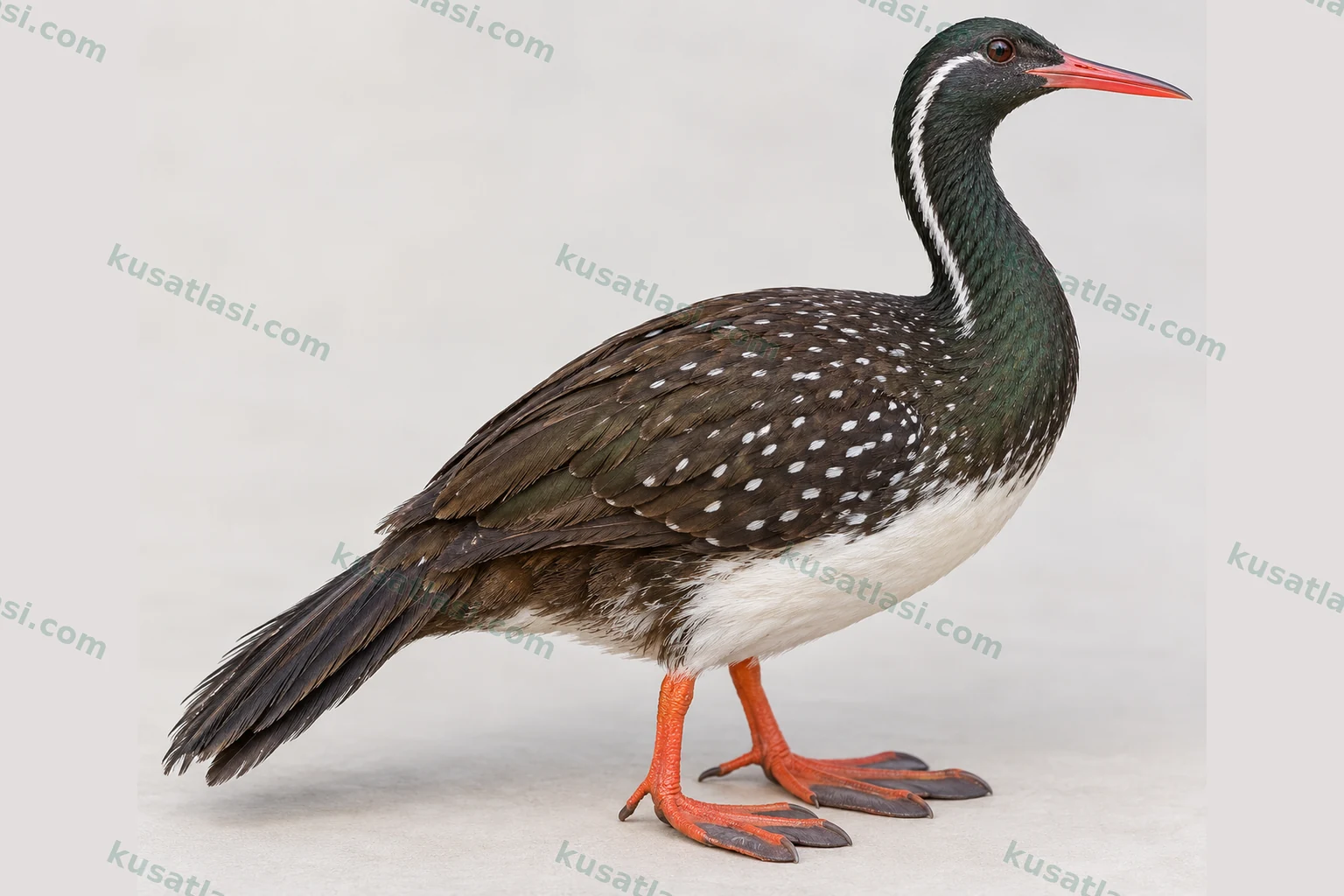
The adult combines a red bill, large orange feet, a long tail and a dark body riding low in the water. It is shy along sheltered, densely vegetated watersides.
Biometrics
Length
Male35–59 cm
Female35–59 cm
Shared species value
Wing length
Male18.62 cm
Female18.62 cm
Shared species value
Weight
Male340–880 g
Female338 g
African Finfoot
Sheltered watersides of sub-Saharan AfricaObservation guide in its natural range
Look for three features together
Do not rely on a single featureFeet may be submerged; unseen does not mean absent. Young birds can have darker bills.
Compare cormorant and darter resemblance through the whole body, bill and head-neck pattern.
Swims beside plants collecting prey; may quickly disappear into cover.
Compare male and female
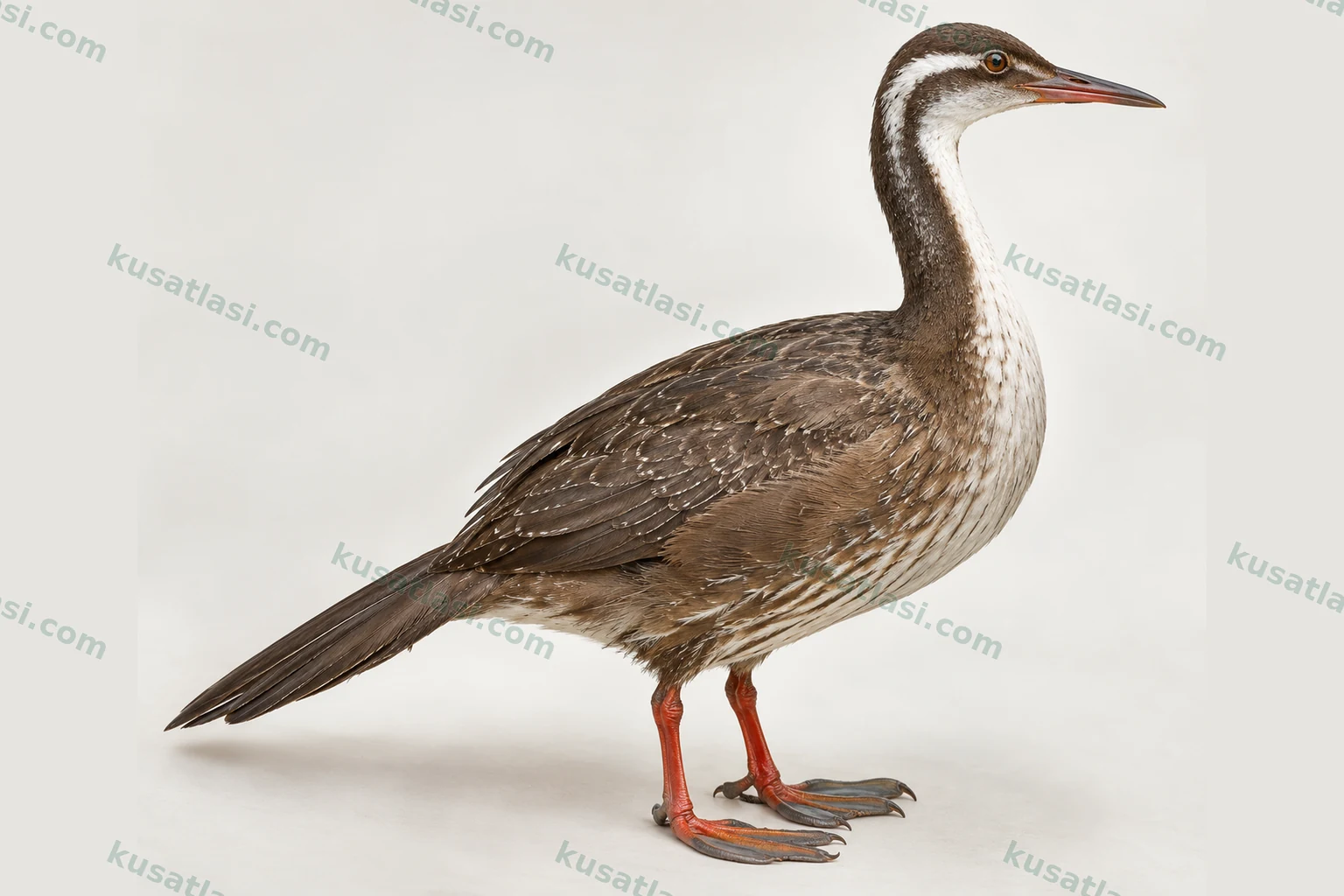 FemaleMale
The male generally appears larger and darker, the female paler with a more distinct facial pattern. Breeding appearance, subspecies and lighting prevent definite sexing from one pale-throat feature alone.
Where to look in its natural range?
Quietly scan densely vegetated margins of permanent rivers and streams. Overhanging branches and suitable cover matter. A lone lake or river sighting does not prove breeding there.
Mainly resident. A specialist South African account gives laying August–April, peaking September–March; water and rain may change timing elsewhere. These regional months are not a fixed African calendar.
January
Generally resident. South African regional breeding example: a reported peak laying month.
February
Generally resident. South African regional breeding example: a reported peak laying month.
March
Generally resident. South African regional breeding example: a reported peak laying month.
April
Generally resident. South African regional breeding example: within the laying period.
May
Generally resident. South African regional breeding example: outside the stated main laying period; this does not mean local absence or absence of breeding.
June
Generally resident. South African regional breeding example: outside the stated main laying period; this does not mean local absence or absence of breeding.
July
Generally resident. South African regional breeding example: outside the stated main laying period; this does not mean local absence or absence of breeding.
August
Generally resident. South African regional breeding example: within the laying period.
September
Generally resident. South African regional breeding example: a reported peak laying month.
October
Generally resident. South African regional breeding example: a reported peak laying month.
November
Generally resident. South African regional breeding example: a reported peak laying month.
December
Generally resident. South African regional breeding example: a reported peak laying month.
Nest, egg and incubation
A plant-material nest may sit on overwater branches, flood debris or suitable reed support. The specialist South African account gives 1–3 eggs and at least three weeks of female-only incubation. This lower bound does not mean exactly 21 days measured in all nests. Young may leave within a few days of hatching, without being flighted or independent. Do not disturb the site or cover.
A specialist regional guide describes rarely heard sharp short-beat calls. Resemblance to some African Darter calls is not diagnostic alone. Assess source, shoreline habitat and appearance together.
Do not play recordings to attract birds; observe quietly, especially near nests.
Species information
Quick Identification
African Finfoot is a shy waterbird recognised by its low-floating body, long tail and adult's conspicuous red bill. Assess the large orange-to-reddish feet, dark brown body and head-neck pattern together. From a distance it may suggest a cormorant or darter, but the neck is shorter and thicker and the bill more distinctly red. Seeing it immediately beside overhanging trees and shrubs is an important clue.
When sitting low, only the head, neck and a narrow strip of back may show. The long tail can lie near the surface. Disappearing behind shoreline plants does not necessarily mean diving. Note where the head reappears, cover structure and movement tracked over water. Record tail, face pattern and whole body shape rather than relying solely on a red bill.
General Appearance and Posture
Upperparts may range from brown to nearly black; white spotting and underpart paleness differ among regional forms. Males generally appear darker-headed and darker-bodied. A thin pale line may show along the head and neck sides. Female pale throat and stronger face pattern help comparison in a good view. Since these vanish easily on a distant shaded bank, an unseen mark is not treated as absent.
The long straight pointed bill is bright or coral red in adults. Small head, thickish neck and long body help explain resemblance to cormorants. The tail matters when moving through bankside cover. On land the body can look flatter and duck-like. This land appearance may not be understood from just head and neck on water; views in both settings complement each other.
Toes have separate lateral lobes, rather than being fully joined by one broad duck-like web. Visible feet provide supporting evidence, but normally submerged feet may conceal the detail. Driving the bird ashore or approaching it by boat to expose its feet is not an identification method. Recording visible features is preferable to forcing a view of hidden anatomy.
Males, Females and Young Birds
Males may be larger and darker than females. Female pale head-neck sides, throat and facial pattern may differ from the male. Subspecies, breeding appearance and light affect assessment. A pale throat outside breeding does not establish female sex alone. A scientific field note likewise leaves some birds as female or non-breeding male, illustrating the need for caution with borderline appearances.
Young can resemble duller females, with weaker head-neck pattern and bill darker than the adult's bright red. Pale-dark arrangement changes with age; chicks are not expected to match adult plates exactly. A dark bill alone does not identify another species. Body and face pattern should also be visible when assessing age.
Appearance in Flight
Most waterside identifications concern swimming, brief land passages or moving through vegetation. Ability to fly does not mean every disturbance triggers a long flight over open water. A bird disappearing into cover is not proof of flightlessness.
Assess visible bill colour, neck structure and tail shape with appropriate geography.
Voice and Behaviour
A specialist regional guide describes an infrequently heard sharp call in short beats. Some African Darter calls may sound similar; similarity alone is not diagnostic. A written imitation does not represent the whole variety. A call in cover does not prove nesting either. Where possible record the sound's location and visible bird features together.
Usually alone or paired, it forages near overhanging branches. It may swim in open water but readily uses dense cover and is easily missed in short watches. Continental breadth does not make it common at every apparently suitable shore. Picking small prey among hanging plants differs from a cormorant repeatedly diving in open water. Quiet distant watching is preferable to driving this shy bird out of cover.
Similar Species
1. African Darter (Anhinga rufa) can confuse through a low-floating dark body and long bill. Compare its much thinner longer neck, yellowish bill and head-neck pattern. African Finfoot should show a shorter thicker neck, bright red bill and, if visible, large orange feet.
2. Microcarbo africanus, a relative of small cormorants, can appear on the same bank as a small dark swimmer. Compare bill shape and colour, face-neck pattern and tail together. Frequent diving in cormorants can help, but a brief disappearance alone does not prove a dive.
Natural Range
African Finfoot has a broad but patchy range along suitable warm humid watersides in sub-Saharan Africa. Records extend from West Africa through suitable Central and East African systems to southern river basins. Waterways around Senegal and The Gambia, the Congo basin and Zambezi and Save systems exemplify this breadth. Presence depends on sheltered banks, not simply country boundaries.
Regional Status
The 2025 regional assessment for South Africa, Lesotho and Eswatini lists it Vulnerable, while the 2024 global assessment gives Least Concern. These are different geographic scales, not contradictory scores. Global status does not make local bank-habitat loss unimportant. Regional sightings and waterbird counts help assess local populations; few records at one observation site do not prove a species-wide decline.
Movements and Reading the Map
Largely resident. Moves towards more permanent water during drought are reported; no unsupported intercontinental route or distance is invented. A local river movement does not prove whole-population migration in fixed months. Breeding timing is also assessed with regional water levels and conditions.
Shyness and dense banks can cause it to be overlooked. Empty map cells do not confirm absence. Modelled areas estimate suitable range; cells show selected licensed records. Recent observations, historical specimens and regional breeding information are not the same evidence. A point is not automatically a native-range boundary or breeding site.
Breeding Habitat
Rivers and streams with dense bankside plants are principal habitat. Overhanging branches, reeds and wooded banks offer cover and food-searching space. Suitable lake and pond margins, flooded forests and some mangroves are also reported. Open-water area alone is not the criterion: a large bare lake may be less suitable than a small sheltered waterway.
Nest Site
A nest of reeds, grass, twigs and similar plants may sit on branches above water, flood debris or suitable reed support. Accounts describe a loose platform or a more cup-shaped structure, so not every nest is assumed identical. Changing water levels can alter conditions. A nest on a nearby branch is no reason to clear the shore or remove its support.
Daily Space Use
Swimming beneath or beside overhanging plants, it may collect prey from water and vegetation. Even after entering open water it can return to cover. Plant removal, excessive water extraction and riverbank degradation matter together. Dense invasive aquatic growth does not provide the same openings and access as natural bank cover. Quietly scan from existing permitted routes without clearing cover; do not steer boats across its escape route.
What Does It Eat?
Insects and other invertebrates are important. Crustaceans, spiders, small molluscs and fish are also reported. Small-vertebrate records do not imply that every bird constantly eats that group. Regional prey lists are not turned into fixed percentages for the whole species. A small surface prey item is not identified to insect species or life stage without sufficient detail.
How Does It Forage?
Moving beside overhanging plants, it may pick surface and plant prey with its bill. Neck stretches and short strikes show it need not always submerge completely to find food. Watching head and bill direction before small shoreline movements helps distinguish swimming from capture. Even a feeding-like bill movement may not reveal prey.
A Senegal field note observed foraging on a hippopotamus's back. The observers could not identify the small items taken. This is therefore not described as proven parasite cleaning or an obligatory association. It is a different recorded foraging behaviour alongside ordinary bankside feeding, not evidence that all African Finfoots seek hippos.
The Hippopotamus-Back Observation
On 22 February 2018 at Wassadou on the Gambia River in eastern Senegal, an African Finfoot foraged around and on a hippopotamus. Researchers documented repeated climbs onto its back. Because prey was unseen, the suggestion of small arthropods is interpretation, not confirmed identification. The animal appearing undisturbed does not establish an obligatory beneficial relationship from one event. The note illustrates the distinction between observation and possible explanation.
Wide Geography, Local Vulnerability
A wide African range does not mean frequent occurrence on every bank. The Vulnerable assessment for South Africa, Lesotho and Eswatini is read alongside global Least Concern. Local habitat and population protection are not postponed because the global range is broad. A coloured country or modelled area does not prove equal occurrence on all its waterways.
Interpreting an Unseen Bird
A shy bird among overhanging branches is easily missed during brief watches. Two observers recording different totals at the same bank do not necessarily show proportional changes in bird numbers. Duration, visibility and route affect records. Regular counts are valuable for comparable methods and conditions; random record totals cannot replace them.