

World Birds IUCN statusLC · Least ConcernGlobal IUCN category. BirdLife v10 (2025); taxon matching: AviList 2026 / IOC 15.2; checked: 29.10.2026. The list year is not the species assessment date. Source and method · BirdLife OrderGruiformesCranes and allies FamilyRallidaeRallidae
African Rail
Rallus caerulescens
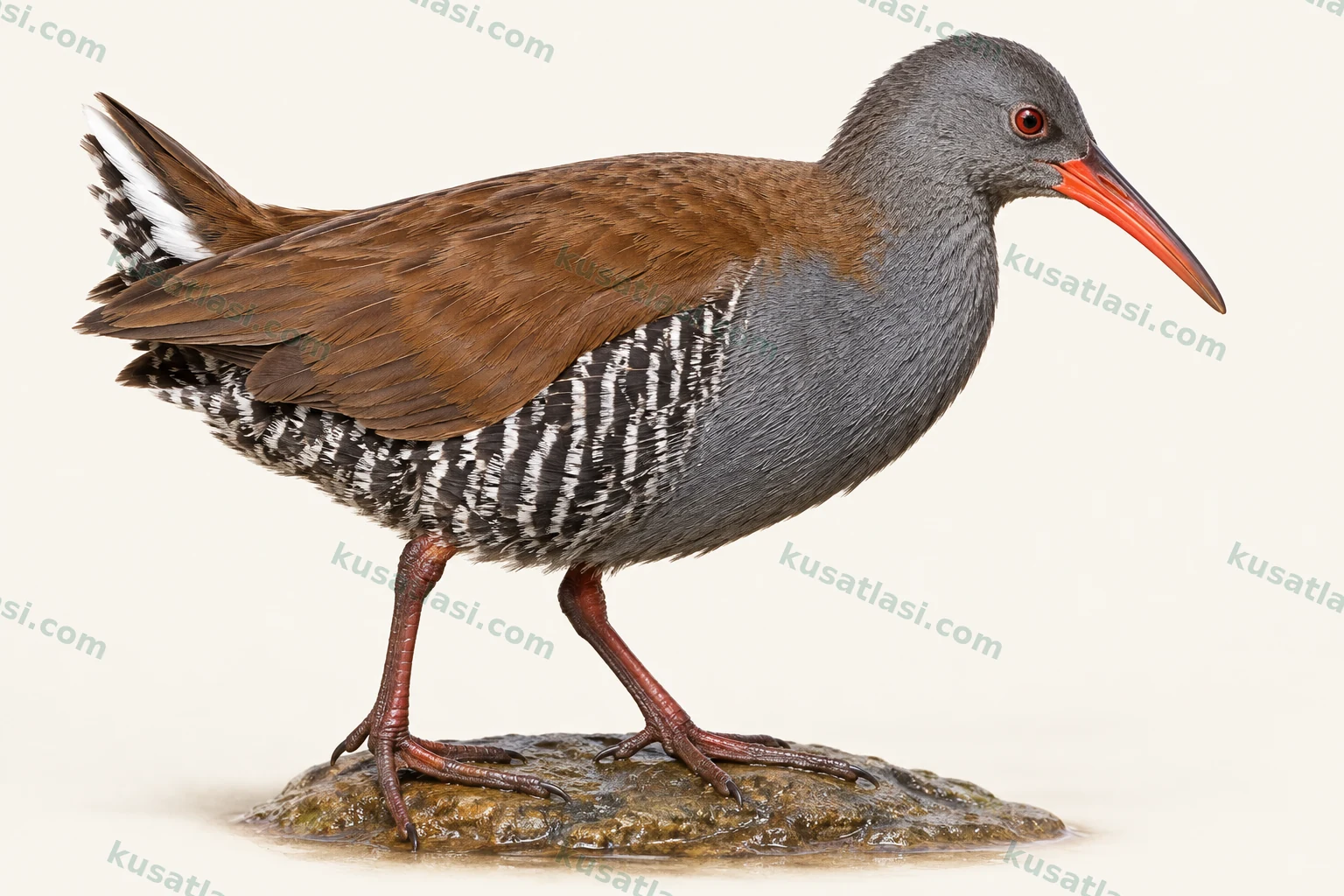
A long red bill and red legs, grey face and breast, brown back and black-and-white barred flanks. It lives secretively in dense wetland cover.
Biometrics
Length
Male27–28 cm
Female27–28 cm
Shared species value
Wing length
Male11.9 cm
Female11.9 cm
Shared species value
Weight
Male146–205 g
Female120–170 g
African Rail
Densely vegetated wetlands of sub-Saharan AfricaObservation guide in its natural range
Look for three features together
Do not rely on a single featureDistinguish the adult’s long red bill from short-billed reedbed birds.
See the grey front and cross-barred flanks on the same individual.
Not hearing calls does not mean absence; not seeing a red bill cannot rule out the species without considering age.
Compare male and female
 FemaleMale
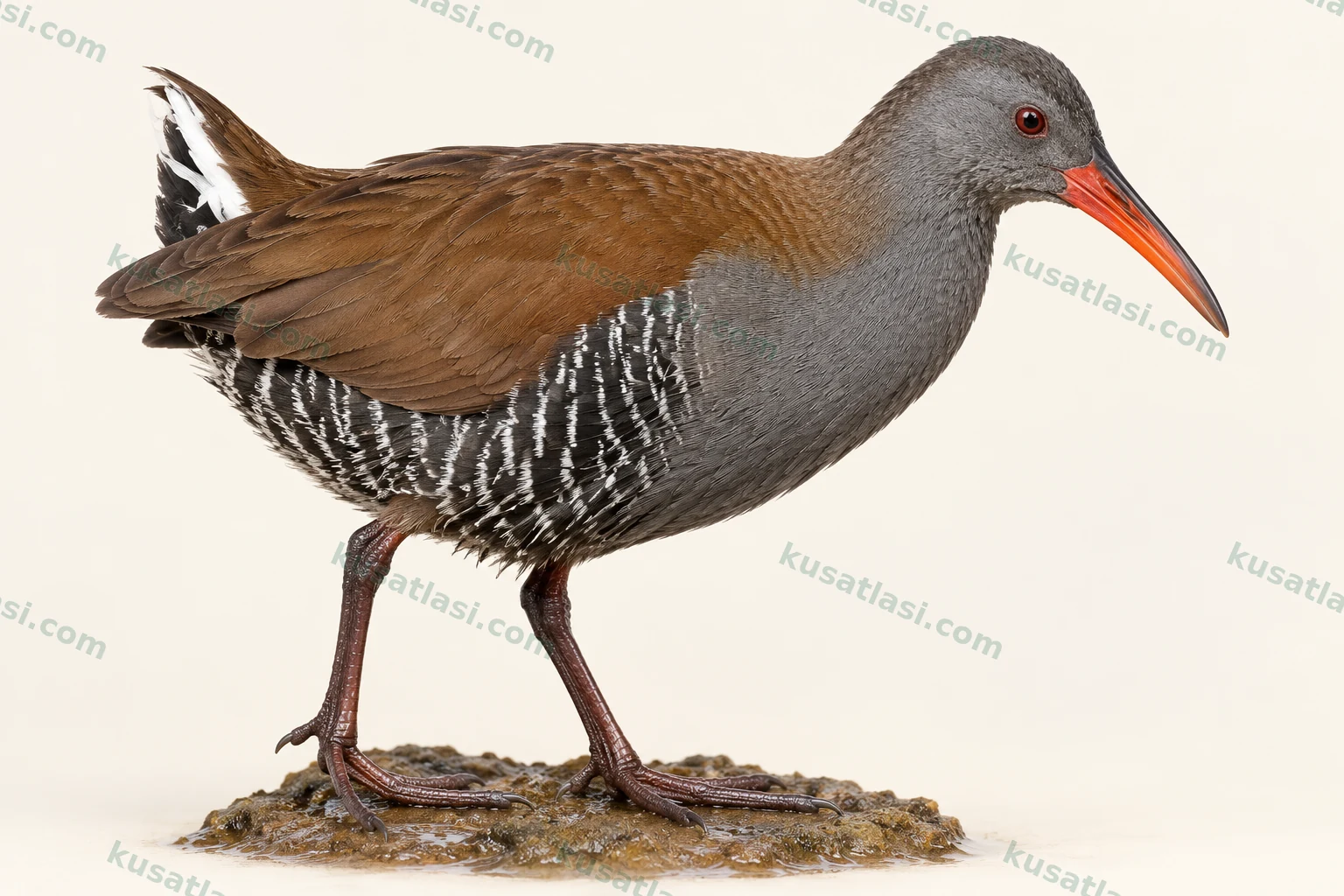
Adult sexes have similar basic plumage; small differences in body size and bill length do not allow certain sexing from one photograph. Young have dark bills and legs.
Where to look in its natural range?
Watch shallow water and mud at reed edges without parting the cover.
These are regional breeding records from the dated atlas of southern Africa, not solely egg-laying or a common period for the whole continent.
January
Usually resident; local movements may occur with changes in water and cover. Calling alters the likelihood of a record. Zimbabwe, SABAP1: regional breeding records are reported. Former Transvaal, SABAP1: regional breeding records are reported. KwaZulu-Natal, SABAP1: regional breeding records are reported.
February
Usually resident; local movements may occur with changes in water and cover. Calling alters the likelihood of a record. Zimbabwe, SABAP1: regional breeding records are reported. Former Transvaal, SABAP1: regional breeding records are reported. KwaZulu-Natal, SABAP1: regional breeding records are reported.
March
Usually resident; local movements may occur with changes in water and cover. Calling alters the likelihood of a record. Zimbabwe, SABAP1: regional breeding records are reported. KwaZulu-Natal, SABAP1: regional breeding records are reported.
April
Usually resident; local movements may occur with changes in water and cover. Calling alters the likelihood of a record. Zimbabwe, SABAP1: regional breeding records are reported.
May
Usually resident; local movements may occur with changes in water and cover. Calling alters the likelihood of a record. Zimbabwe, SABAP1: regional breeding records are reported.
June
Usually resident; local movements may occur with changes in water and cover. Calling alters the likelihood of a record. No verified regional date specific to this month was given; this does not mean local absence.
July
Usually resident; local movements may occur with changes in water and cover. Calling alters the likelihood of a record. No verified regional date specific to this month was given; this does not mean local absence.
August
Usually resident; local movements may occur with changes in water and cover. Calling alters the likelihood of a record. No verified regional date specific to this month was given; this does not mean local absence.
September
Usually resident; local movements may occur with changes in water and cover. Calling alters the likelihood of a record. Former Transvaal, SABAP1: regional breeding records are reported. KwaZulu-Natal, SABAP1: regional breeding records are reported.
October
Usually resident; local movements may occur with changes in water and cover. Calling alters the likelihood of a record. Former Transvaal, SABAP1: regional breeding records are reported. KwaZulu-Natal, SABAP1: regional breeding records are reported.
November
Usually resident; local movements may occur with changes in water and cover. Calling alters the likelihood of a record. Former Transvaal, SABAP1: regional breeding records are reported. KwaZulu-Natal, SABAP1: regional breeding records are reported.
December
Usually resident; local movements may occur with changes in water and cover. Calling alters the likelihood of a record. Former Transvaal, SABAP1: regional breeding records are reported. KwaZulu-Natal, SABAP1: regional breeding records are reported.
Nest, egg and incubation
The shallow cup of leaves, reeds and grass lies within cover; the specialist account gives 2–6 eggs and about 20 days of incubation by both partners. First flight is at six–seven weeks; early walking is not independence.
Loud distinctive calls come from cover; joint calling by partners is reported.
Do not play recordings to attract birds; observe quietly, especially near nests.
Species information
Quick identification
African Rail Rallus caerulescens lives among dense wetland plants and has a long red bill. In adults, brown upperparts, a grey face and breast, and black-and-white barring on the flanks are seen together. Legs and feet are red. When only a head emerges from the reeds, assess the bill, face and visible body on the same bird. Not all small, secretive birds beside water are the same rail species.
The long slender bill may curve slightly downwards; this helps distinguish it from other reedbed birds with short, thick bills. The arrangement of the brown back and flank barring also matters. The bird may remain briefly on open mud before returning to cover. Rather than inventing a flank pattern that has not been seen, wait for it to emerge naturally. Its presence is often revealed by its distinctive voice, but check separately that the sound really comes from the same bird.
General appearance and posture
Crown, back, rump and wings are dark brown. The forehead and head sides are grey; chin and throat are pale, and foreneck and breast grey. Dark-and-pale cross-barring on the flanks, around the belly and beneath the tail forms a different arrangement from the grey front. Grey becoming darker in shade does not mean the breast is black. The direction of the bars helps in comparisons with other reedbed birds bearing dark longitudinal streaks on the back.
The body can give a laterally compressed impression suited to moving through narrow gaps in vegetation. Head and neck extend forwards while it walks on open mud, whereas it looks more crouched under cover. Long toes can draw attention as it moves on soft ground or plants. When the legs are in water, do not take the visible part as their entire length. Lines cast on the body by reed shadows should also be distinguished from actual transverse plumage markings.
Males, females and young birds
Males and females are very similar in their basic plumage pattern. Specialist accounts describe the female as slightly smaller with a shorter bill; this average difference is insufficient for certain sexing from one photograph. Bill lengths of two heads viewed at different angles cannot be compared.
Young birds may have browner underparts than adults; the bill looks blackish and legs dark brown. Requiring the adult red bill at every age is therefore wrong. A pale bill alone does not establish youth either; light and photographic colour balance must be considered. Seeing head, underparts and bare areas together strengthens age interpretation. Species identification and age identification do not substitute for one another.
Although a chick can move after hatching, it does not have the same independence as an adult. Seeing young near a nest does not show strong flight or an end to food assistance. First flight is reported at six–seven weeks of development in the regional specialist account; this must not be confused with the first day outside the nest. The appearance of a bird whose hatch date is unknown does not provide a precise age in days.
Appearance in flight
Flight may be seen when crossing gaps in cover rather than in long, conspicuous circuits above the reeds. Regional specialist accounts note that the legs may hang down during low flight. A brief view of an open wing may not reveal the whole body pattern. Not every dark-winged wetland bird is African Rail; if possible, also see the bill, grey front and barred flanks after it lands.
The direction of a bird crossing a reedbed describes daily movement. It is not direct evidence of distant migration or a change in seasonal route. No established pattern of regular intercontinental migration has been demonstrated for the species, so a few local flights are not used to draw arrows through countries on a map. Interpreting wing colour without specifying whether upper or lower surfaces are visible is also inappropriate.
Voice and behaviour
Despite remaining under cover, it can be detected by loud, distinctive calls. Joint calling by partners and territorial defence are reported. Do not automatically associate a sound from bushes with a different reedbed bird being seen at that moment. Following its direction and repetition can help; playing recordings to lure the bird out or entering the vegetation is unnecessary. A silent visit does not prove absence.
It can be active at twilight, but also moves during daylight. It may advance cautiously under cover, with longer, more regular steps in the open. Freezing or retreating into plants in danger shows the importance of concealment. Tail movements and extension of the head can give the same individual different silhouettes during a short observation. Assigning another species from one momentary posture can mislead.
Swimming and climbing plant stems are also reported. This does not make it a waterbird spending all its time on open water; its dependence on dense cover remains. A pair may defend a territory, but a few calls alone do not indicate the number of pairs. One individual calling from different places, or exchanges between partners, can cause overcounting during a brief visit.
Similar species
1. African Crake Crecopsis egregia is compared by its shorter grey bill with a reddish base, grey legs and prominently dark-streaked upperparts. African Rail’s long red adult bill, brown back and red legs differ. If only the head is visible, the back pattern is not guessed; remember that young rails may lack adult bill colour.
2. Black Crake Zapornia flavirostra is a smaller, dark-bodied species that may occur in the same wetlands; the yellow bill is seen together with red legs. African Rail’s grey front and barred flanks complement its long red adult bill. Red legs in both species are not sufficient for identification; bill colour and body pattern are needed together.
3. Water Rail Rallus aquaticus can cause confusion in names and photographic comparisons because of its similar build. The natural ranges are not copies of the same broad geography; African Rail is a sub-Saharan African bird. Nevertheless, identity is not inferred from geography alone. Head, throat and upperpart differences noted in specialist accounts are compared in good views; two grey-breasted photographs taken in different light do not provide a certain match.
World distribution
African Rail is native to sub-Saharan Africa. Its main distribution runs from the eastern Democratic Republic of the Congo to Kenya and suitable wetlands farther south, reaching the Cape region of South Africa. Sparser, local populations are reported in West Africa and Ethiopia. Distribution is not read as complete coverage of a country: there may be large gaps where densely vegetated waterbodies are absent.
Status within the natural range
The Zimbabwe highlands, Okavango and associated swamps, water networks of northeastern Namibia and various inland and coastal South African wetlands are regional examples in the dated atlas. Fewer records in dry areas do not establish absence from every small waterbody there. The atlas also records some dry-region water sites. Because the bird is secretive, numbers of sightings are not a direct measure of actual individuals.
Its global assessment is Least Concern. Loss of natural wetlands and changes in cover still matter to local populations. Using small artificial wetlands does not demonstrate that all lost reedbeds can be replaced with the same function. The map’s model represents potential distribution, whereas openly licensed observation examples indicate approximate positions of dated records; neither is a verified nest census at every point.
Movements and migration
No common pattern supporting regular large-scale seasonal migration is known. Local changes such as water level, burning or loss of cover, and dispersal of young, can affect visibility in some places. Less calling outside breeding also reduces detectability; fewer records do not automatically mean that all birds migrated. An unverified monthly route or sequence of countries is therefore not drawn on the map; possible local movement is kept separate from actual tracking evidence.
Breeding habitat
Marshes with reeds, canes and dense aquatic grasses are the principal setting. Suitable seasonal water areas can be used as well as permanent wetlands. Dense cover along rivers, lakes, pools and dams provides concealment and nest support that open deep water alone does not offer. Mud, shallow water and floating plants can be used in feeding. Suitability requires considering continuity of marginal cover, not merely the presence of water.
Nest site
The nest is a shallow cup of leaves, reeds and grasses. It is placed within vegetation, in some specialist examples about 40 cm above water. The regional account gives 2–6 eggs, about 20 days of incubation by both partners and first flight at six–seven weeks (southern African specialist information for African Rail). Leaving the nest, flying and independent feeding are distinct developmental stages. One reported height is not assumed to be fixed for all nests.
Daily use of space
It moves on muddy and shallow surfaces close to dense cover; it may also be reported in altered settings such as rice fields or seasonally wet sugarcane beside marshes. This does not make dry farmland the same habitat as a reedbed. Use occurs when water and plant structure are suitable together. Probing by a concealed bird may be visible; if food is not seen fully, only the behaviour is recorded.
Burning, drying and cutting dense vegetation can alter the temporary suitability of the same small area. A bird being silent on a later visit where it was heard before does not prove departure. Parting reeds to search damages cover and changes behaviour. Waiting quietly and repeating observations at different times and dates helps distinguish presence from detectability.
What does it eat?
Insects, worms and other small invertebrates form an important part of its food. Regional specialist lists include spiders, crustaceans, small frogs and fish, and some seeds. Occasional use of carrion is also reported. This diversity does not mean every individual eats all groups in the same proportions every day. Prey availability, water depth and cover structure can affect access to different foods.
When compiling a mixed food list, directly observed prey is distinguished from food reported generally by a source. A bird putting its head into water has not necessarily caught a fish; it may seek other small creatures in water or mud. Linking the long bill only to fishing overlooks its search for invertebrates under cover.
How does it feed?
It may probe mud and shallow water with its long bill and gather small prey among plants or around floating cover. In some situations it puts its head underwater. A brief bill movement among plants is not necessarily a successful capture. If taking and swallowing prey are seen, this is recorded separately; search time alone does not substitute for the number of prey caught.
It may feed briefly on an exposed surface and hide again. Returns to the same point may show the combined use of nearby cover for safety and finding prey; they do not yield a particular daily range area. Young birds feeding with adult assistance are distinguished from obtaining prey themselves. A waterside observer should watch natural movement without supplying food to hold the bird in view or changing the cover where it hides.
Silence is not absence
Calling makes this hidden rail easier to find. Lower vocal activity outside breeding can contribute to fewer records at the same site. Hearing it less in a month is therefore not equivalent to all birds leaving the region then. In interpreting seasonal record changes reported by the atlas, detection probability and actual movement are considered together; no fixed migration calendar is made without separating them.
The value of a small waterbody
Even a small waterbody with dense vegetation can be used. Small size alone does not make it insignificant; connections, surrounding cover and seasonal water continuity matter too. Conversely, a sighting in an artificial waterbody is not experimental proof of tolerance to all natural wetland loss. Evaluating habitat function requires more than a brief view of one bird.
A walking chick and a flying juvenile
Movement by a newly hatched chick does not mean development is finished. Nest departure and first flight are different stages; adult food support must also be followed separately. When comparing young in the same family on different days, precise age in days is not given without a known starting date. A waterbird walking on the ground is not assumed to have adult feeding ability.
What regional breeding records mean
The southern African atlas gives different breeding intervals for Zimbabwe, the former Transvaal and KwaZulu-Natal. They are not reduced to one continental calendar; breeding records may also cover stages from egg-laying to chick care. Some regions have few records. Instead of treating blank months as impossible for breeding, verified regional examples must be named explicitly. The calendar thereby retains actual observation scope without inventing the unknown.