

World Birds IUCN statusVU · VulnerableGlobal IUCN. BirdLife v10 (2025); taxon matching AviList 2026 / IOC 15.2; checked: 29.10.2026. The list year is not the species’ assessment date. Source and method · BirdLife OrderGruiformesCranes, rails and allies FamilyGruidaeGruidae
Hooded Crane
Grus monacha
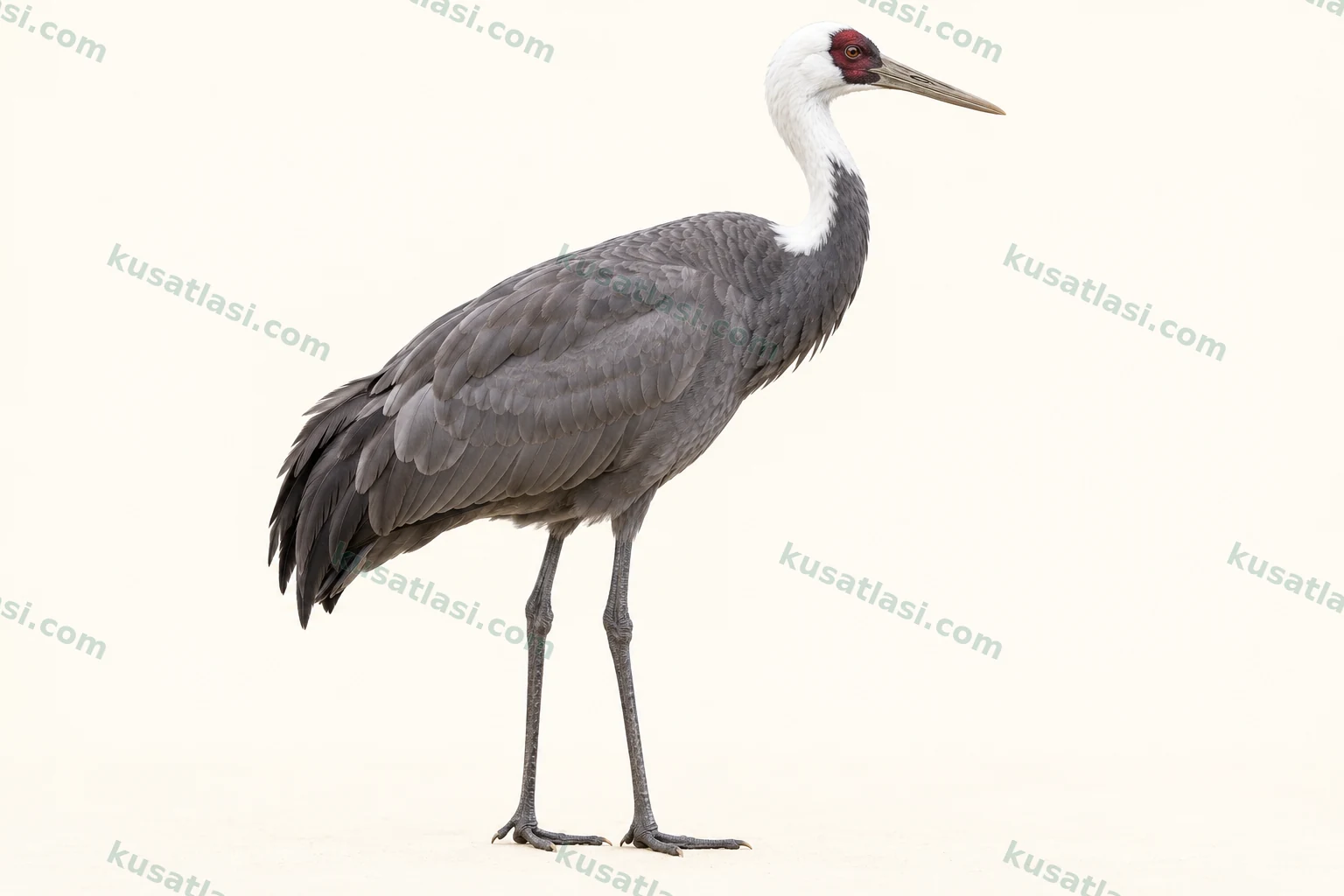
A crane with a dark-grey body, extensive white head and neck and a small red forehead patch; it breeds in Russia and northeastern China and winters farther south in East Asia.
Biometrics
Length
Male100 cm
Female100 cm
Shared species value
Wingspan
Male160–180 cm
Female160–180 cm
Shared species value
Weight
Male3.28–4.87 kg
Female3.397–3.737 kg
Hooded Crane
Russia, northeastern China; East Asian wintering areasObservation guide in its natural range
Look for three features together
Do not rely on a single featureExtensive white head and neck; a small red forehead patch.
Dark grey, with black flight feathers and tail.
Brownish head and neck; the red forehead patch is indistinct.
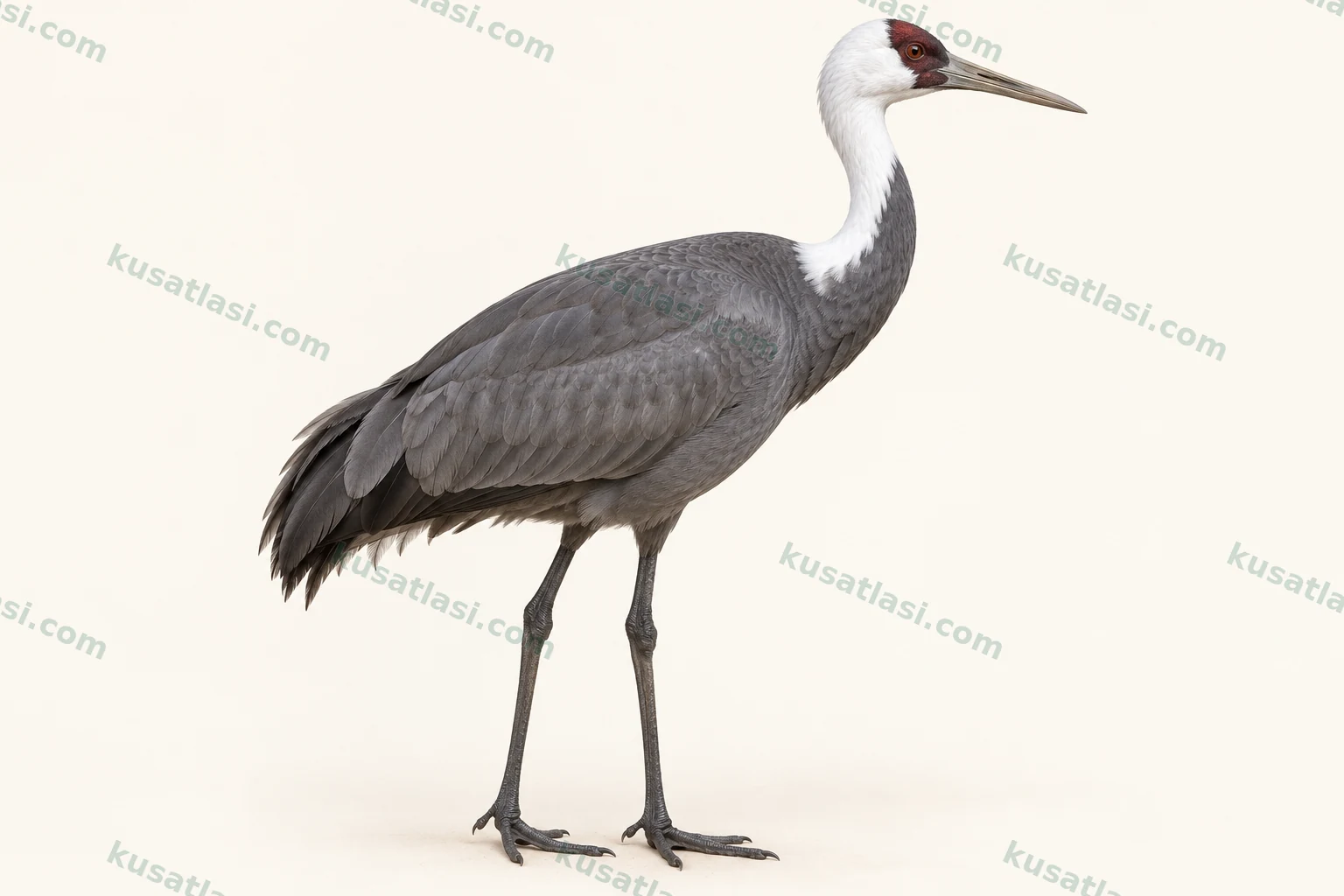
Compare male and female
 FemaleMale
Adult plumage is similar; the male is usually slightly larger. Young birds have a brownish head and neck and a less distinct forehead patch.
Where to look in its natural range?
Wooded marshes during breeding; shallow wetlands and fields in winter.
Regional months from Chinese field records and winter behaviour research; the dates are not identical for every population.
January
Migratory; north in spring and towards wintering areas in autumn. Shengjin Lake, China, two winter studies: winter behaviour observations in November–February 2012–2013 and 2013–2014.
February
Migratory; north in spring and towards wintering areas in autumn. Shengjin Lake, China, two winter studies: winter behaviour observations in November–February 2012–2013 and 2013–2014.
March
Migratory; north in spring and towards wintering areas in autumn. No verified regional date specific to this month was given; this does not mean local absence.
April
Migratory; north in spring and towards wintering areas in autumn. Xiao Xing’an, China, 2002–2006: April arrival and egg-laying records in late April–early May.
May
Migratory; north in spring and towards wintering areas in autumn. Xiao Xing’an, China, 2002–2006: April arrival and egg-laying records in late April–early May.
June
Migratory; north in spring and towards wintering areas in autumn. No verified regional date specific to this month was given; this does not mean local absence.
July
Migratory; north in spring and towards wintering areas in autumn. No verified regional date specific to this month was given; this does not mean local absence.
August
Migratory; north in spring and towards wintering areas in autumn. No verified regional date specific to this month was given; this does not mean local absence.
September
Migratory; north in spring and towards wintering areas in autumn. Xiao Xing’an, China: the regional field report records departure from the breeding area in early September.
October
Migratory; north in spring and towards wintering areas in autumn. No verified regional date specific to this month was given; this does not mean local absence.
November
Migratory; north in spring and towards wintering areas in autumn. Shengjin Lake, China, two winter studies: winter behaviour observations in November–February 2012–2013 and 2013–2014.
December
Migratory; north in spring and towards wintering areas in autumn. Shengjin Lake, China, two winter studies: winter behaviour observations in November–February 2012–2013 and 2013–2014.
Nest, egg and incubation
The plant-material nest is on marsh ground. The Chinese field sample had two eggs in nine nests, both sexes incubating and a duration of at least 30.5 days; compilations give 27–30 days and about 75 days to flight. Regional figures are not made identical.
Loud, sharp calls and the pair’s coordinated display; in a crowded flock, check which individual is calling.
Do not play recordings to attract birds; observe quietly, especially near nests.
Species information
Quick identification
Hooded Crane Grus monacha is an East Asian crane recognised by the contrast between its dark-grey body and pale head-and-neck area. The adult has a small patch of bare red skin on the forehead, a yellowish-brown bill and black legs. The white may not extend equally far down the front and back of the neck. Examining head, neck and dark body together gives a stronger identification than a distant pale patch alone.
The English name Hooded Crane matches Grus monacha in current taxonomy. Although small among cranes, it is still a tall bird. It generally breeds in the north and winters farther south. Winter flocks in southern Japan, Korea and eastern China and breeding pairs in Russia’s forested marshes show the same species’ life in different seasons. A field holding a large winter flock is not automatically a nesting habitat.
General appearance and posture
Long legs and neck define the upright stance. The adult’s pale head-and-neck area meets a dark-grey body; the flight feathers and tail are black. In some light the upper body may look paler, grey-brown. When the bird lowers its head, the edge of the white neck area appears shorter or disappears among the feathers. Views with the head raised and lowered during feeding should therefore be considered together.
It brings its head close to the ground to forage, then straightens to scan its surroundings. This can make the same bird show very different neck proportions in photographs. An adult in a flock may scan more often than the young bird beside it. A behaviour study over two winters at Shengjin Lake found differences associated with age, group size and human activity. That does not mean all birds everywhere keep watch in the same way.
Males, females and young birds
Male and female share the same basic plumage. The specialist institution’s account says the male is usually slightly larger, but this difference is unreliable without a good comparison. The bird holding its head higher is not simply assigned as male. Posture, ground level and distance in the image alter apparent size. Adult plates are not expected to show unsupported differences in head colour or breast pattern.
The young bird’s head and neck are brownish. A dark, less distinct area may replace the adult’s red forehead patch. Feathering on the head and a dirty-brown wash over the white are useful for age assessment. Brown-grey tones may also appear on the body. One dirty feather patch is not evidence of youth without checking head, neck and forehead features.
In winter, family groups can occur within larger gatherings. Two nearby adults and one or two young are a useful starting point for observation, but neighbouring birds are not always assumed to be one family. Young-bird numbers are not a direct equivalent of spring egg numbers either. Eggs, hatched chicks and young reaching winter are separate stages of the life cycle, each recorded with its own date and observation context.
Appearance in flight
Dark flight feathers, grey body and pale head-and-neck area support identification in the air. Even if the head looks small, the pale neck can stand out against the dark body. Identifying the bird from a wingtip alone is difficult; similar cranes have dark wingtips too. When comparing size with nearby species, the birds should be at the same distance in the image plane.
Voice and behaviour
Loud, sharp crane calls may be heard in flight and within groups. Pairs give coordinated calling displays and may raise their heads and point their bills upwards. The Smithsonian account reports that male and female wing postures can differ during this display. Interpretation of sex requires checking that call sequence and posture actually belong to the same individual. Separating a winter flock’s calls into individual birds is not always possible.
In the Shengjin study, birds scanned more in fields with high human activity and changed the time allocated to feeding and other activities. A distant group continuing to feed is not necessarily undisturbed merely because it has not flown away. If birds repeatedly raise their heads, increase the observation distance. Flushing groups does not help explain migration or feeding behaviour.
Similar species
1. Common Crane Grus grus differs through the adult’s black-and-white head pattern. Hooded Crane has a more continuous pale head-and-neck area and a dark-grey body. Young cranes have not completed the adult head pattern, so age features are checked together. The Russian research also recorded a breeding mixed pair of the two species; not every unusually marked bird is hastily treated as a pure-species example.
2. White-naped Crane Antigone vipio is compared through its pale pearl-grey body, red facial area and white stripe extending from the head down the rear of the neck. Hooded Crane’s darker body and extensive white head-and-neck area form a different pattern. Both may occur together in winter flocks. In good light, check whether red is confined to the forehead or occupies more of the face; brown tones can complicate identification of young birds.
World distribution
It breeds in forest-marsh regions of central and southeastern Russia and northeastern China. The full detail of its Russian nesting distribution is still unknown. The 2020 research reports clear breeding areas in the middle Aldan basin and more scattered records in other broad basins. Not every apparently suitable taiga marsh is filled in as a confirmed nest site. Summer observations in Mongolia do not replace confirmed breeding evidence in the current assessment.
Status within its natural range
The 2025 global assessment classifies the species as Vulnerable. It reports an increasing overall population trend; declining trends on older institutional pages are not repeated as current. Izumi in southern Japan, Suncheon in Korea and wetlands of China’s Yangtze basin are important wintering areas. Concentration in a few places maintains habitat and disease-related conservation needs even when the total increases.
Migration
It moves north in spring and south to wintering areas in autumn. Satellite-tracking research has shown the importance of stopover sites. The data for the two species addressed in Harris and colleagues’ 2000 paper are not the same sample; one tracked Hooded Crane is represented. That individual’s path is not drawn as the entire population’s single route. The map presents general geographic scope and an observation layer; new migration arrows are not added to a model lacking monthly information.
Breeding habitat
Forested marshes bordered by scattered trees and shrubs are important. Small waterlogged openings in the taiga can be missed on a broad geographic map. Degtyarev’s fieldwork assessed tree cover and marsh structure together. Similarity to suitable habitat alone does not prove a nest; direct evidence of pairs, young or nests is kept separate. The openness of winter fields does not mean breeding habitat must be treeless.
Nest site
The nest of plant material lies on the marsh ground. Field observations in China’s Xiao Xing’an region in 2002–2006 reported two eggs in nine occupied nests. Both sexes participated in incubation, given as at least 30.5 days in that regional research report; it is not averaged with the 27–30 days of general compilations. Specialist accounts report about 75 days to flight, not an exact duration shared by all measured nests. Chicks walking out of the nest early are not flying.
Daily use of space
Feeding in winter fields and roosting in shallow water are different uses of space. Flooded rice fields in Japan, sheltered mudflats in Korea and shallow lake areas in China can be used for resting. Safe access from daytime feeding areas to night sites must also be maintained. A human-provisioned feeding station does not have the same conditions as a natural wetland. Families and roosting groups should be watched from a distance without flushing them.
What it eats
Roots and other underground plant parts, seeds and grains are among its foods. Reported animal foods include insects, other small invertebrates and amphibians. Chinese breeding observations recorded worms and tadpoles being brought to chicks. Grain at managed winter feeding areas in Japan and Korea does not by itself represent the natural diet in every season.
A Poyang Lake study comparing the winters of 2017 and 2018 examined plant DNA in 19 faecal samples from this species. Prominent plant groups differed between winters. DNA proportions detected by this method are not weighed percentages of food consumed. The result provides evidence of regional dietary flexibility, not grounds for declaring those plants the main food throughout Russian breeding areas.
How it obtains food
It picks food from the ground with its bill or searches down into the soil. Shallow water, mudflat and field can supply different foods. The item taken may not be visible when the bill is lowered; indistinguishable pieces are not assigned an arbitrary prey name. Water level, vegetation and human activity affect the feeding surface. A field with suitable food is not therefore a replacement for every natural wetland.
Why are breeding areas difficult to find?
Pairs can be scattered across Russia’s vast, hard-to-access forest-marsh country. The 2020 research distinguishes habitat resemblance from direct nesting evidence. Surveying many suitable areas does not justify declaring certain absence everywhere the bird was unseen. Conversely, finding a pair does not turn the surrounding entire basin into a dense breeding area. This careful distinction preserves the map’s meaning.
Sharing food does not always mean conflict
The Poyang study found that plant foods of Hooded and White-naped Cranes could overlap extensively. Without considering food abundance, overlap cannot be interpreted as directly measured severe competition. The researchers discuss this limit too. DNA work shows which plant groups are used, but does not automatically prove that birds chase one another at every encounter or that one species excludes the other from the area.
Two sides of crowded wintering grounds
Dense winter flocks can make observation easier, while the same concentration creates risks from disease spread and deterioration of one site. Crane specialists’ conservation approach considers safe feeding and roosting areas together. Many birds at one site do not mean the species’ entire conservation problem is solved. Protecting different wintering areas and migration stopovers is important together.
Eggs and young birds are not the same count
The nine Chinese nests with two eggs describe clutch size in that field sample. Seeing one young bird the following winter does not imply a single egg in its nest. Hatching, chick growth and survival to migration are separate processes. A winter observation cannot reconstruct the entire history of an unseen summer nest; dated field records support one another while preserving these limits.