

World Birds IUCN statusCR · Critically EndangeredGlobal IUCN. BirdLife v10 (2025); taxon matching AviList 2026 / IOC 15.2; checked: 29.10.2026. The list year is not the species’ assessment date. Source and method · BirdLife OrderPodicipediformesGrebes FamilyPodicipedidaePodicipedidae
Hooded Grebe
Podiceps gallardoi
A rare Patagonian grebe with white forehead, golden crown and black head; it breeds on inland lakes and winters at coastal estuaries.
Biometrics
Length
Male32 cm
Female32 cm
Shared species value
Wing length
Male14.14 cm
Female14.14 cm
Shared species value
Weight
Male420–740 g
Female420–740 g
Shared species value
Hooded Grebe
Southern Patagonia — Santa Cruz lakes and the Atlantic coastObservation guide in its natural range
Look for three features together
Do not rely on a single featureWhite forehead, black head and fine golden-rufous crown feathers are distinctive together.
A yellow crescent of bare skin lies behind the red eye.
Largely white in flight; assess it with the head pattern.
Compare male and female
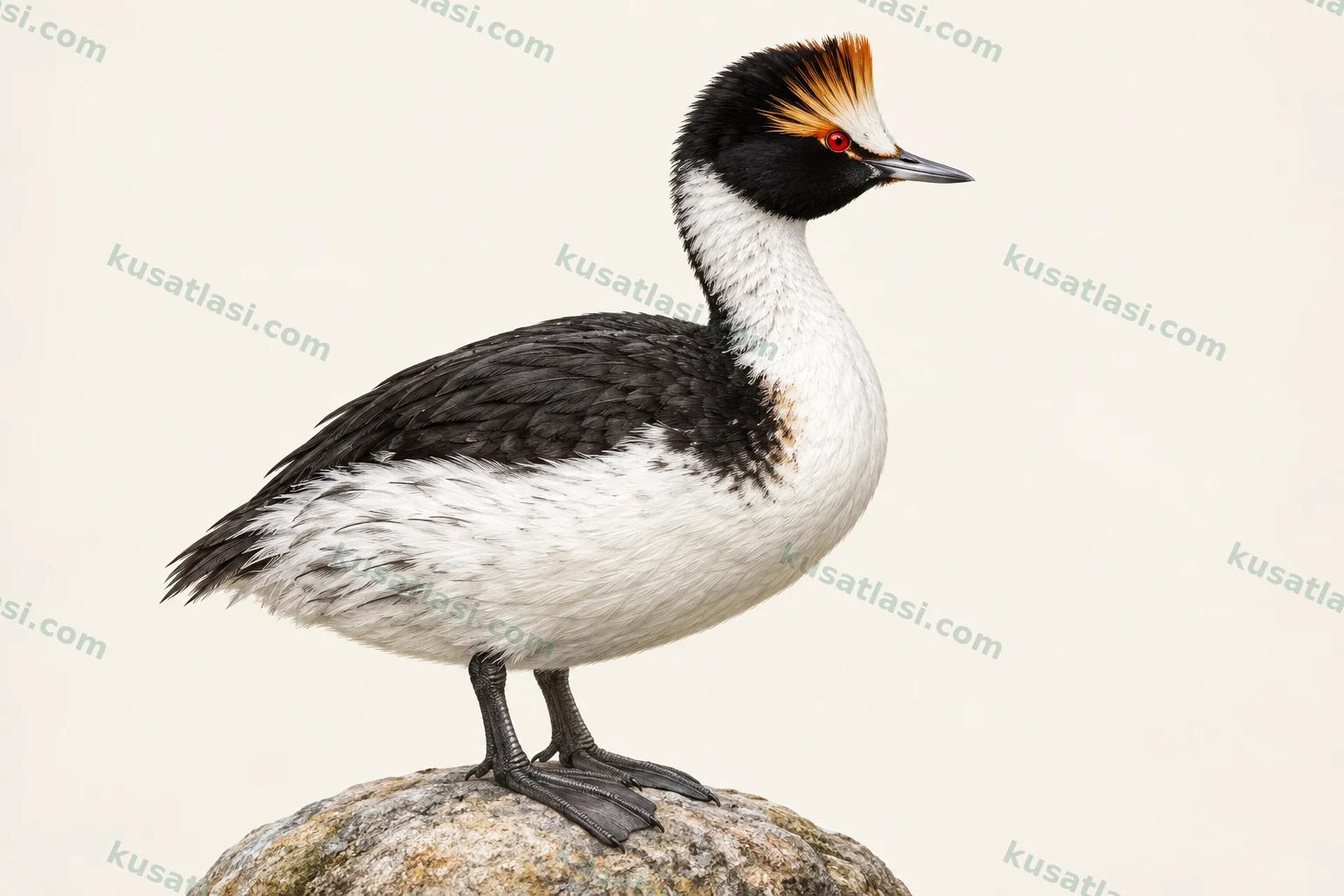 FemaleMale
Adult plumage patterns are similar. The study found males heavier with longer bills; the sex of one distant bird is not determined with certainty.
Where to look in its natural range?
On suitable plateau lakes; in winter at the Coyle, Gallegos and Santa Cruz–Chico estuaries.
Verified periods for Santa Cruz; dates can vary with lake conditions and year.
January
It moves seasonally from inland lakes to coastal wintering grounds. Santa Cruz plateaus: lakes are used during the breeding period; this does not mean that every lake has nests in every month. Colonies on Santa Cruz lakes: the main nesting period reported in studies.
February
It moves seasonally from inland lakes to coastal wintering grounds. Santa Cruz plateaus: lakes are used during the breeding period; this does not mean that every lake has nests in every month. Colonies on Santa Cruz lakes: the main nesting period reported in studies.
March
It moves seasonally from inland lakes to coastal wintering grounds. Santa Cruz plateaus: lakes are used during the breeding period; this does not mean that every lake has nests in every month. Santa Cruz — transition to the coast: autumn movements depend on lake conditions.
April
It moves seasonally from inland lakes to coastal wintering grounds. Santa Cruz — transition to the coast: autumn movements depend on lake conditions.
May
It moves seasonally from inland lakes to coastal wintering grounds. Santa Cruz — transition to the coast: autumn movements depend on lake conditions.
June
It moves seasonally from inland lakes to coastal wintering grounds. No verified regional date specific to this month was given; this does not mean local absence.
July
It moves seasonally from inland lakes to coastal wintering grounds. No verified regional date specific to this month was given; this does not mean local absence.
August
It moves seasonally from inland lakes to coastal wintering grounds. No verified regional date specific to this month was given; this does not mean local absence.
September
It moves seasonally from inland lakes to coastal wintering grounds. No verified regional date specific to this month was given; this does not mean local absence.
October
It moves seasonally from inland lakes to coastal wintering grounds. Santa Cruz plateaus: lakes are used during the breeding period; this does not mean that every lake has nests in every month.
November
It moves seasonally from inland lakes to coastal wintering grounds. Santa Cruz plateaus: lakes are used during the breeding period; this does not mean that every lake has nests in every month. Colonies on Santa Cruz lakes: the main nesting period reported in studies.
December
It moves seasonally from inland lakes to coastal wintering grounds. Santa Cruz plateaus: lakes are used during the breeding period; this does not mean that every lake has nests in every month. Colonies on Santa Cruz lakes: the main nesting period reported in studies.
Nest, egg and incubation
The nest is a floating platform anchored to aquatic plants. The typical clutch has two eggs, incubated for 20–21 days. Usually one chick is reared; replacement laying can follow loss. Age at first flight was not verified.
Melodic whistles, sounds resembling clicking during courtship, and repeated powerful two-note calls.
Do not play recordings to attract birds; observe quietly, especially near nests.
Species information
Quick identification
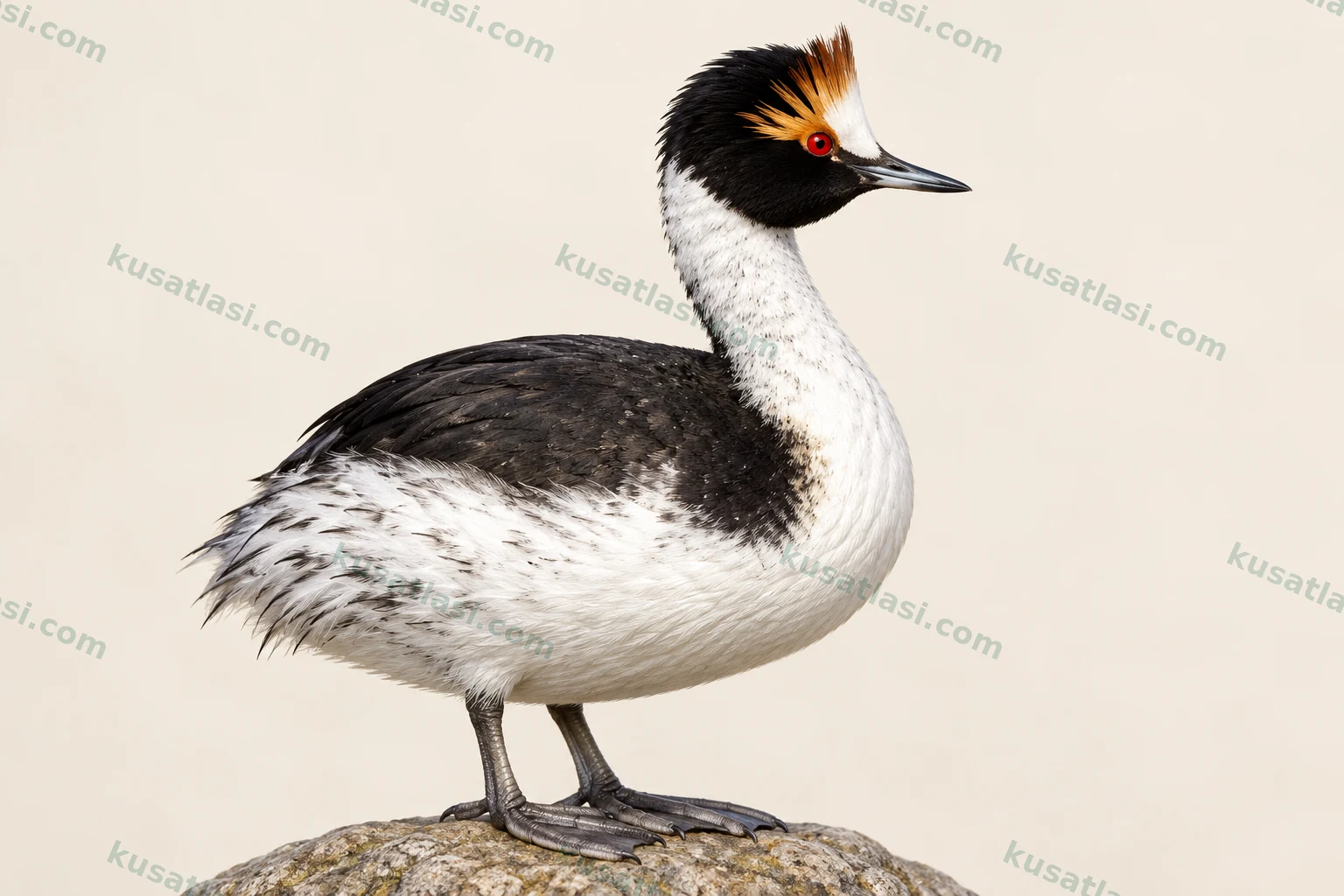
Hooded Grebe Podiceps gallardoi is a small Patagonian grebe recognised by its black, white and gold head pattern. The white forehead forms a conspicuous pale patch in front of the black head. Immediately behind it, fine feathers that can be raised range from golden yellow to reddish orange. A yellow crescent of bare skin lies behind the red eye. This yellow patch is not the colour of the eye itself. On a swimming bird, this head pattern is assessed together with the white neck and dark back.
Its breeding grounds are lakes on the plateaus of Argentina’s Santa Cruz Province. In winter it also descends to river estuaries on the Atlantic coast. Silvery Grebe can occur on the same waters, so small size or a pale body alone is insufficient. The combination of white forehead, more sharply defined black head and golden crown feathers distinguishes Hooded Grebe. When only a distant white flash is visible, wait for the bird to surface again so that the whole head can be seen.
General appearance and posture
The back and upperparts look dark slate-grey to black. The front and sides of the neck, breast and belly are silvery white; dark spots may be visible on the flanks. A narrow black central line runs down the back of the neck. The ear region, lower face and upper throat are black. The white forehead and fine orange-tinged crown feathers do not form a cap that makes the whole head white. Turning the head changes the visible proportions of dark and pale areas.
The pointed bill is bluish grey. The legs are dark and the feet leaden blue, with lobes along the sides of the toes that assist swimming. This foot structure differs from the continuous web joining a duck’s toes. Much of the body remains submerged when swimming, making the neck and head more conspicuous. Raising the body during courtship differs from the low posture of a quietly feeding bird.
Males, females and young birds
Adult males and females have similar basic plumage patterns. Roesler and colleagues’ study published in 2025 found males to be heavier and to have longer bills. Nevertheless, the apparent size of one distant swimming bird does not reliably establish its sex. Posture, distance and the age of any bird used for comparison also affect apparent size. No separate male colour pattern or different female forehead patch is described.
Colour measurements in the study concerned the breast and belly of six specimens; no significant sex difference was found in those areas. This does not mean that every part of the head was examined by the same method. The observational description of adults applies to the head pattern, while the breast and belly results retain the study’s measured scope. The red eye and yellow skin behind it are adult identification features used for both sexes.
The newly hatched chick has sparse soft grey down, dark stripes on the head and back, and paler underparts. The stripes gradually diminish after the first week. A young bird whose flight feathers are developing has a largely dark slate-grey head and back. The white forehead may begin to appear at about four weeks; this does not mean that adult appearance or flight ability is fully attained that day.
The young bird’s eye is initially dark. Individuals older than five months have been seen with dark red eyes and a duller yellow eye surround than adults. The study reports that adult plumage appearance is completed at about seven months. This is not the age at first flight. Rather than turning one feather or white patch into an exact age in days, assess the development of forehead, head, eyes and body together.
Appearance in flight
Cornell’s account describes the wings as largely white in flight. This more extensive white is useful beside the rear white area on Silvery Grebe’s darker wing. Flight is seldom observed, however, and an open wing is not expected at every encounter. Once the bird returns to the water, check the white forehead, black head and golden feathers again. One blurred flight image is insufficient to determine sex and age.
Moult partly overlaps the breeding period. The 2025 study states that females can begin replacing wing feathers earlier than males and that both sexes undergo this process on the breeding grounds. Flight ability is not the same at every stage of wing-feather renewal. Moving elsewhere after breeding is distinguished from a separate movement specifically for moult; the study did not identify a distinct specialised moult migration.
Voice and behaviour
The specialist description mentions melodic whistles, sounds resembling mechanical clicking during courtship, and repeated powerful two-note calls. Voice can help locate distant birds, but the sound is matched to a visible bird because another grebe on the lake may be calling. Watching head movements and sounds together helps interpret courtship.
Courting individuals raise their bodies, turn their heads from side to side and may quiver their wings. Displays in which partners move rapidly together over the water are striking. Similar displays have also been reported on the wintering grounds, showing that courtship is not confined to the days when a nest is being built. The beauty of a display is no reason to approach the birds or play sounds to provoke their behaviour.
Hooded Grebe nests in colonies and dives for food. Whether a lake can be used depends on open water, sufficient prey and vegetation capable of supporting nests together. Changes in water level can lead birds to move to other lakes on the same plateau. Observing these movements is more meaningful than assuming that one lake supports a colony of identical size every year.
Similar species
The southern form of Silvery Grebe Podiceps occipitalis can occur on the same waters, with a pale body and silvery-yellow head feathers. Its pale-headed appearance differs from Hooded Grebe’s sharply contrasting white forehead, black head and golden crown. Head ornaments are reduced in winter and juvenile plumage, so no single ornamental feather should be treated as compulsory for identification. If the wings open, Hooded Grebe’s extensive white provides an additional comparison.
Young Hooded Grebes may not yet show the adult’s vivid head colours. Requiring an adult’s bright red eye in a dark-eyed young bird can wrongly exclude the species. Age, feather development and the complete head pattern are assessed together. Being beside an adult on a breeding lake provides useful context; it does not automatically prove that every neighbouring young bird belongs to the same species.
World distribution
Confirmed breeding is associated with plateau lakes in Santa Cruz Province in southern Argentine Patagonia. The Buenos Aires, Strobel and Siberia plateaus are important research areas. The range is not continuous habitat covering the entire surface of these plateaus; suitable lakes are separated. Records also exist from Chile’s Magallanes region, but the 2025 genetic study states that breeding has not been confirmed in that country.
Wintering grounds lie on Santa Cruz’s Atlantic coast. The Coyle and Gallegos estuaries and the Santa Cruz–Chico system are prominent. Giving Santa Cruz and Chico together does not mean that there are four independent wintering areas. Inland lakes and coastal brackish waters represent different environments used through the year.
Status within its natural range
The conservation category is Critically Endangered. The 2025 genetic study refers to a population of about 700 adults; this dated estimate is not a new count for 2026. An earlier study compared counts on the same 58 lakes in 1984–1985 and 2010–2011 and found an approximately 80 percent decline. This demonstrates a strong historical decrease, but is not used to assign the same rate of decline to every year.
American mink, gulls that can eat eggs and chicks, trout introduced to lakes, water loss and severe weather are important threats. Large numbers concentrated on a few lakes can be exposed together to one weather event or an invading predator. Protecting colonies and maintaining suitable lakes therefore cannot be considered separately.
Migration
After breeding, birds move from inland lakes to coastal wintering grounds. Departure can extend from late March to May in the southern autumn, depending on lake conditions. Freezing lakes and changing water levels provide the context for movement. Genetic similarity supports connections between lakes; it does not trace the exact route followed by each individual. Observations and estimated areas on the map are therefore not interpreted as verified migration routes.
Breeding habitat
Breeding lakes mostly lie on Patagonian plateaus at elevations of 500–1,500 metres. Open water, suitable small aquatic prey and dense aquatic vegetation are important. Research particularly emphasises fish-free lakes. Rocky walls on at least one side can provide shelter from wind; nevertheless, severe storms can break up floating nests. A lake’s suitability in one year does not show that it remains unchanged after drought or a change in water level.
Nest site
The nest is a floating platform made from aquatic plants and anchored to vegetation. Scientific studies describe Myriophyllum quitense as supporting these nests. A plant’s role in supporting the nest does not mean that it is eaten as a principal food. Several pairs can form a colony on one lake; colony size and location vary between years.
The typical clutch contains two eggs. In the breeding information compiled by the 2012 study, incubation lasts 20–21 days; usually only one chick is reared after asynchronous hatching. Success of the second egg or chick is limited; two eggs should not be counted as two independent young birds. Replacement laying can follow nest loss. Age at first flight was not established in the checked sources. Do not approach a colony; entering the water and pressing birds from the shore can reduce the safety of eggs and chicks.
Daily habitat use
Feeding takes place in open water and areas where underwater prey can be found. Nest-supporting vegetation and water used for diving fulfil different requirements. In winter, brackish estuaries and coastal environments are used. Conservation involves more than enclosing the summer nesting lake; movement between lakes and coastal habitats also meet this same species’ needs through the year.
What does it eat?
A small aquatic snail named Lymnaea diaphana in scientific publications is among the principal prey on breeding lakes. Other small aquatic invertebrates are also consumed. The 2012 population study describes the importance of snails by reviewing earlier dietary studies. This does not mean that the entire diet consists of the same snail on every lake in every month. Details of food used on the coast in winter are less well documented than those on the breeding lakes.
New chicks receive smaller prey, including aquatic developmental stages of small flies, tiny crustaceans, water beetles and insect larvae. Provision of larger prey such as snails has been reported after about two weeks. This dietary transition does not mean that a chick can fly at the same age.
How does it hunt?
The bird dives to search for prey and collects it with its pointed bill. Underwater animal communities and vegetation influence foraging. Introduced trout can alter the food community and reduce conditions suitable for the grebe. Aquatic plants supporting nests and invertebrates providing food have separate functions. A colony’s success depends both on adults finding prey and on suitable prey being available for small chicks.
Genes reveal connections between lakes
The 2025 study compared genetic samples from 71 individuals on the Buenos Aires, Strobel and Siberia plateaus. Nuclear DNA analysis did not identify three sharply separate groups corresponding to these areas, although some mitochondrial comparisons showed small differences. The result does not support the idea of three populations completely isolated for a long time. A genetic sample is not, however, a tracking device showing which river valley a bird flew through or on what date. The researchers identify flexible site choice in response to lake conditions as one possible explanation.
One predator can affect an entire colony
In March 2011, the death of 33 adults was documented in an attack associated with an American mink at El Cervecero Lake. The incident shows the importance of a single predator intrusion for a small species already in decline. The outcome on one lake is not an identical mortality rate for every lake. The conservation programme combines colony guardians, predator control and lake monitoring because threats do not come from only one source.
Wind above the nest also matters
Patagonia’s strong winds can break apart floating nests and cause egg loss. In trials of wave-reducing devices by the conservation team, equipment drifting towards the colony in the wind created an additional hazard. This experience shows that not every device installed with good intentions is beneficial. Its actual effects on birds, nests and changing lake conditions must be observed.
Adult plumage at seven months is not a first-flight date
Young birds acquire adult head colours gradually. The adult appearance at about seven months described in the 2025 study does not mean that the bird cannot fly until that point and then suddenly takes flight. The white forehead may begin to appear at about four weeks, while eye colour changes later. Different developmental stages are not treated as the same calendar event. This is why head and eyes are assessed together when interpreting age from a photograph.