

World Birds IUCN statusLC · Least ConcernGlobal IUCN category. BirdLife v10 (2025); taxon matching: AviList 2026 / IOC 15.2; checked: 29.10.2026. The list year is not the species assessment date. Source and method · BirdLife OrderCharadriiformesShorebirds, gulls and allies FamilyHaematopodidaeHaematopodidae
African Oystercatcher
Haematopus moquini
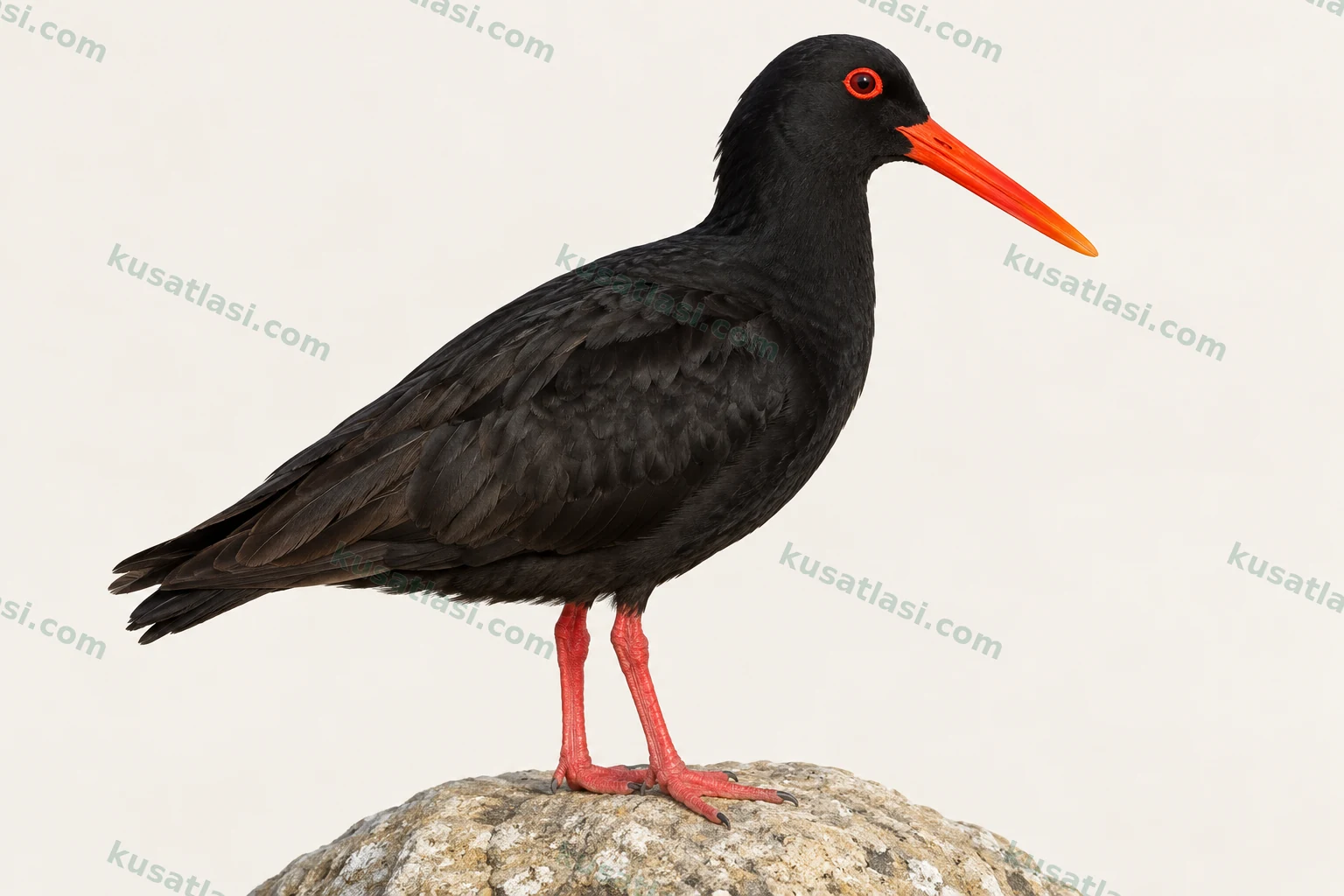
The adult has entirely black plumage, a strong red bill and reddish legs; young birds have duller feathers and a pale bill. It is a bird of a narrow sea-coast belt.
Biometrics
Length
Male42–45 cm
Female42–45 cm
Shared species value
Wing length
Male26.72 cm
Female26.72 cm
Shared species value
Weight
Male582–757 g
Female646–800 g
African Oystercatcher
The sea coasts of Namibia and South AfricaObservation guide in its natural range
Look for three features together
Do not rely on a single featureAdults lack a white belly and a broad white wing stripe.
Observe the powerful red bill and reddish legs together.
Dull feathers and pale bare parts in young birds are assessed on the same individual.
Compare male and female
 FemaleMale
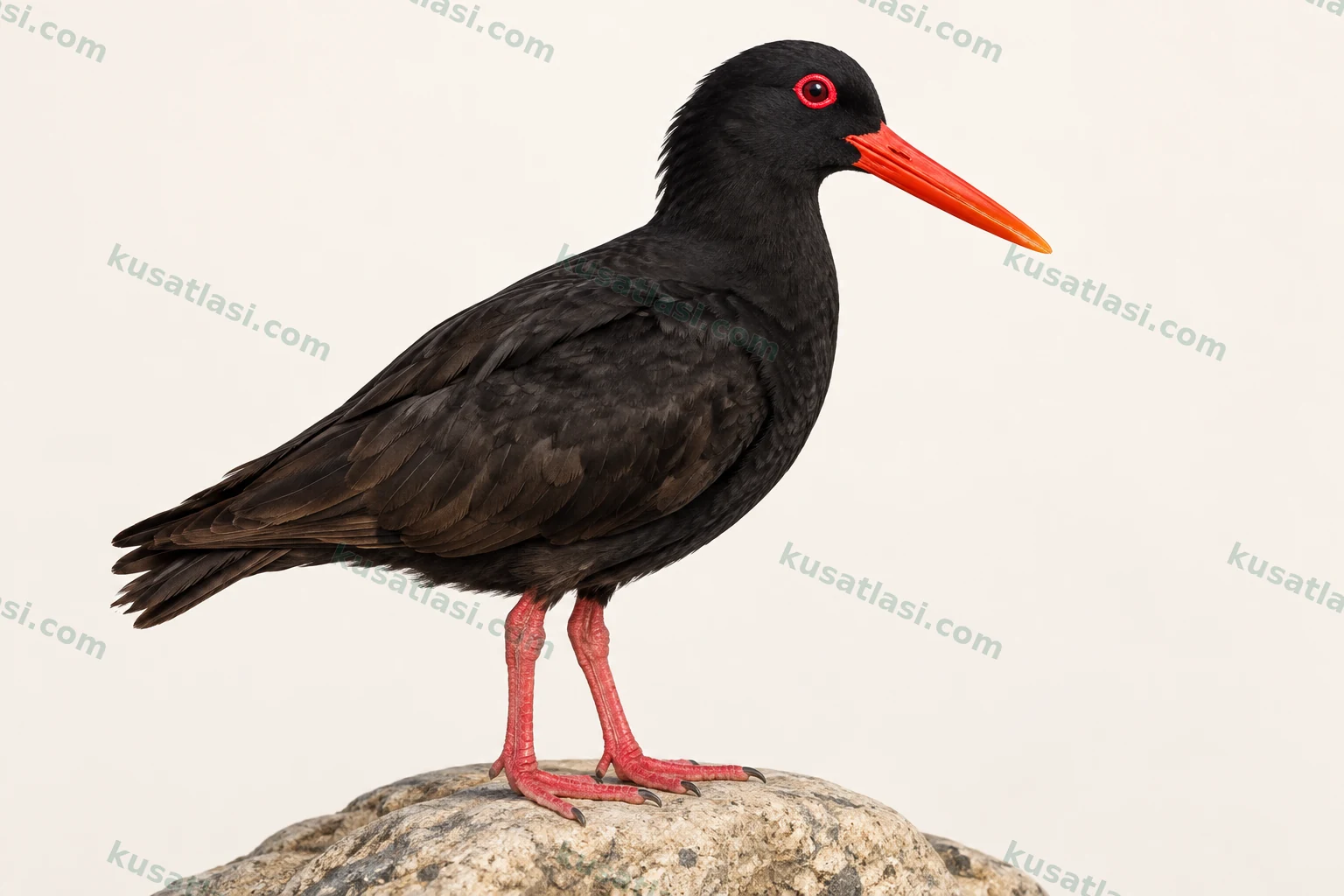
Adult sexes have similar plumage colours; size and bill length in one photograph do not determine sex with certainty.
Where to look in its natural range?
Observe rocks and beaches exposed by the tide without approaching families.
The principal egg-laying months reported for South Africa are shown; Namibia does not simply copy the same months.
January
Adults are mostly resident; young dispersing along the coast represent a separate movement stage. South Africa, BDI specialist account: this is within the principal egg-laying period. South African regional Roberts account: this is within the reported broader egg-laying interval.
February
Adults are mostly resident; young dispersing along the coast represent a separate movement stage. South Africa, BDI specialist account: this is within the principal egg-laying period. South African regional Roberts account: this is within the reported broader egg-laying interval.
March
Adults are mostly resident; young dispersing along the coast represent a separate movement stage. South African regional Roberts account: this is within the reported broader egg-laying interval.
April
Adults are mostly resident; young dispersing along the coast represent a separate movement stage. South African regional Roberts account: this is within the reported broader egg-laying interval.
May
Adults are mostly resident; young dispersing along the coast represent a separate movement stage. No verified regional date specific to this month was provided; this does not mean local absence.
June
Adults are mostly resident; young dispersing along the coast represent a separate movement stage. No verified regional date specific to this month was provided; this does not mean local absence.
July
Adults are mostly resident; young dispersing along the coast represent a separate movement stage. No verified regional date specific to this month was provided; this does not mean local absence.
August
Adults are mostly resident; young dispersing along the coast represent a separate movement stage. No verified regional date specific to this month was provided; this does not mean local absence.
September
Adults are mostly resident; young dispersing along the coast represent a separate movement stage. South African regional Roberts account: this is within the reported broader egg-laying interval.
October
Adults are mostly resident; young dispersing along the coast represent a separate movement stage. South African regional Roberts account: this is within the reported broader egg-laying interval.
November
Adults are mostly resident; young dispersing along the coast represent a separate movement stage. South Africa, BDI specialist account: this is within the principal egg-laying period. South African regional Roberts account: this is within the reported broader egg-laying interval.
December
Adults are mostly resident; young dispersing along the coast represent a separate movement stage. South Africa, BDI specialist account: this is within the principal egg-laying period. South African regional Roberts account: this is within the reported broader egg-laying interval.
Nest, egg and incubation
The nest is a simple coastal scrape, usually with 1–2 eggs and rarely three. Both partners incubate; specialist accounts give about a month and the Roberts-based compilation gives 27–39 days. Chicks walk early; first flight and independent feeding are separate later stages.
It gives sharp, repeated whistling calls, with noisy displays involving mates and neighbours during territorial defence.
Do not play recordings to attract birds; observe quietly, especially near nests.
Species information
Quick identification
The African Oystercatcher, Haematopus moquini, is a shorebird of southern African coasts whose adult plumage is black from head to tail. A thick, long red bill, pinkish-red legs and red eye surround contrast strongly with the black body. On a bird walking along rocks, first check whether the entire body is genuinely dark, then examine bill shape. White portions of another shorebird may look dark in shade, so a distant black silhouette alone is insufficient.
The adult’s bill is unlike a thin heron bill. It is strong, long and flattened from side to side, used to open and extract shell-bearing animals attached to rocks. At rest the bill may be hidden among shoulder feathers. Rather than excluding the species because no red bill is visible, wait for it to raise its head naturally. Coastal position, body colour, legs and the distinctive bill must be read together.
General appearance and posture
The adult’s back, neck and underparts are black. Reflected light may make some areas look brownish or more glossy; this does not mean a separate coloured patch occurs on the head or back. In its upright walk, the body looks strong and the head and bill extend forwards. The red eye and surrounding bare skin can be distinguished at close range. Sea foam, wet feathers and strong sunlight alter both black tones and red intensity in photographs.
The bird need not appear identical on sand and rock. Feet sink partly into soft ground; on rock it may rest with one foot raised. The visible leg length changes as it approaches seawater. A photograph showing short-looking legs is not a reliable measurement for a different species or a smaller sex. Several postures at the same place allow a better assessment of body proportions and bill structure.
Males, females and young birds
Adult males and females share the same basic black plumage. The female being larger and longer-billed on average does not make a long-billed bird in one photo certainly female. Posture, camera angle and individual variation affect apparent size. The two adult plates on this page describe the sexes’ shared appearance; no definitive colour key is created where a visible plumage difference is absent.
Young birds may be duller, brownish-black rather than the adult’s plain black. Bill and leg colours are paler, and the adult’s prominent eye surround is not yet developed. Assess these marks together. Weak red areas can lead a young bird to be mistaken for another oystercatcher, while an adult in poor light can also look dull. Age assessment needs bill, eye surround and body feathers seen on the same individual.
A newly hatched chick is not a miniature black adult. Grey-brown mottled down helps hide it among sand and rocks. Walking or swimming does not mean it can open shellfish with its own bill. Adults carry food to chicks and give them small pieces. A nearby calling adult may suggest a chick hidden on the ground; approaching rocks to expose it is inappropriate.
Appearance in flight
The adult retains its dark body and wing pattern in flight. The conspicuous white wing stripe and white underparts of Eurasian Oystercatcher Haematopus ostralegus are absent from a normal adult African Oystercatcher. Do not mistake light-catching feather edges for a broad white stripe; check which wing area is genuinely pale as the bird turns. A brief distant flight may not reveal eye or bill colour.
Flights along the coast to feeding sites or resting rocks are part of daily space use. Several birds moving in one direction do not prove an annual migration route. Resident adults and young dispersing to much farther coasts must be distinguished. Recording direction is useful, but one sighting of unknown-age birds does not establish the movement pattern of the entire population.
Voice and behaviour
Sharp, repeated whistling calls draw attention on the coast. During territorial defence, birds may lower their bills, raise their shoulders and perform noisy displays. A pair calling simultaneously may be in a different social situation from an ordinary feeding call. Follow which bird produces the sound and whether it is addressing a neighbour, mate or approaching danger.
Tides strongly regulate feeding and resting times. Rock surfaces exposed at low water may be used, and groups may rest on safe rocks as water rises. The bird can also feed at night during suitable low water. All birds resting at midday does not therefore make it a morning-only hunter. Watching the same coast through different tidal phases is more informative than choosing observation time only by the clock.
Similar species
1. Eurasian Oystercatcher, Haematopus ostralegus, can initially look similar through its black head and back; white underparts and the broad white wing stripe in flight support separation. Uncommon visitors can occur on South African coasts. It is inappropriate either to exclude every white-marked individual solely by geography or to call every unusually pale-feathered African Oystercatcher another species. Pattern arrangement and bill structure are compared together.
2. Dark crows on the shore can be confused at a distance through the black body, especially at rest. The oystercatcher’s conspicuous long, red, laterally flattened bill and reddish legs differ. If the bill is hidden, wait for normal walking and a raised head. Standing on rocks or feeding by the sea alone does not identify an oystercatcher.
Global distribution
The central natural range is the sea coast of Namibia and South Africa. Atlases and later specialist evaluations describe a narrow coastal belt, not a broad area covering all land. Nearby islands, suitable rocks, beaches and some estuary surroundings form parts of this belt. An inland area inside a country is not natural habitat simply because the species occurs in that country.
Status within its native range
The main breeding range in the older southern African atlas and newer observations are not maps from the same date. Later studies report breeding-range expansion towards the KwaZulu-Natal coast. Distant records also occur on Angolan and Mozambican coasts; not all can be marked as resident breeding populations. Nor does one unusual inland record remove the coastal specialisation and establish a broad natural inland range.
The current global category is Least Concern. Near Threatened headings in old sources belong to their assessment dates and are not silently copied into the current heading. A global category does not say that nests are safe on every beach or that human pressure is absent. Coastal use can affect chicks and eggs, particularly when breeding overlaps the summer holiday period.
Migration
Adults with established breeding territories are largely resident and territorial. Young dispersing along the coast after independence represent a different life stage; some young of South African origin may use immature-bird areas in Namibia and Angola. This phase lasting several years does not mean every adult follows the same north–south route annually. Openly licensed observation examples on the map show approximate positions of actual records; the coloured model is not an exact breeding boundary. An annual route is not drawn without age information and a sequence of tracking evidence.
Breeding habitat
The intertidal sea coast is the main environment. Beaches with suitable shell-bearing prey may be used as well as rocky shores. Areas where waves strike directly against steep cliff bases do not offer the same opportunities as sheltered shores exposing broad feeding surfaces. Presence depends on accessible food and safe resting places as well as coastline length. An inland lake or broad lawn is not equivalent to this coastal habitat.
Nest site
The nest is a simple scrape in sand or a suitable firm coastal surface, potentially surrounded by shell fragments and small stones. Being above the reach of high spring tides matters, but a nest site far from the shore may also face a different risk from nearby predators. Usually 1–2 eggs and less often three are reported. Both partners incubate. Specialist accounts give about a month: approximately 32 days in SANBI’s account and 27–39 days in a regional Roberts-based compilation, different specialist accounts for African Oystercatcher whose values have not been averaged here.
Daily space use
Chicks may leave the nest about a day after hatching; this does not end family care. First flight is reported at about 35–40 days, while obtaining shelled prey independently develops later. Adults may therefore continue feeding young after first flight. A chick of unknown starting date is not assigned an exact age. Watch the direction of food-carrying adults from afar without approaching the nest or hidden chick.
Low-water feeding rock, high-water resting place and nest area complement one another. A vehicle on the beach does more than disturb visible adults; it may endanger sand-coloured eggs and hidden chicks. If a bird calls and draws the observer towards another part of the shore, leave rather than follow and further pressure the family. Safe observation does not require discovering the chick’s exact position.
What does it eat?
Mussels and other coastal invertebrates are among the main foods. Specialist accounts also include small shell-bearing animals attached to rock, marine snails, shore worms and bivalves in sand. The oyster reference in its English name does not mean an oyster-only diet. A rocky-shore prey list does not imply the same organisms are eaten daily by a beach-feeding bird; the two substrates offer different food opportunities.
The relationship between proliferation of an introduced mussel and available food has been studied on the west coast. That mussel became important in some local populations. This example is not extended to claim that every alien organism benefits nature or all African Oystercatchers depend on the same mussel. Food-change effects are evaluated according to the coast, prey accessibility and breeding conditions.
How does it forage?
Its powerful bill can dislodge shelled prey, enter between two valves or probe sand. Not every shell has to be opened with the same movement. A short strike on rock, deeper probing in sand and appropriately turning captured prey are distinct actions. If prey cannot be identified from a distance, recording the observed process is more accurate than giving a specific mussel name.
Tides affect when prey is exposed and how long birds can reach it. Feeding beginning as the tide falls does not alone measure abundance; successful captures and the surface used must also be watched. The adult must meet its own needs and provide small pieces of prey that the chick cannot open. A chick walking on the ground does not prove independent feeding. Distinguish capture from food transfer when following a family.
The coastal belt’s width on a map
A range following a country’s sea boundary may appear as a thick coloured strip. The shore used daily by African Oystercatchers is much narrower. A country-scale map cannot resolve the distinction between tidal line and nest scrape. Mistaking colour for extensive inland habitat leads to looking for a coastal bird in the wrong place. Map scale and the surface actually used must be considered separately.
Flying and opening shells
A chick’s first flight is not the sole endpoint of development. As its bill grows, the ability to open and dislodge prey also changes; a newly flying young bird may still take food from adults. Equating first flight around forty days with later independent feeding loses this relationship. Different specialist accounts of independence do not mean every young bird on every coast is ready on the same day.
A resident adult and a wandering immature
An adult defending the same breeding area for a long time does not conflict with a young bird occurring on a distant coast. Ringing information, age and date together reveal different life stages. Records of immature areas in the north are insufficient to draw a fixed migration route for the entire population. If only two endpoints are known, the intervening sequence and stops are not thereby known.
The date of a conservation category
Near Threatened in an old source and Least Concern in the current list need not mean one source describes the wrong bird; the assessment year has changed. Global risk and nesting success on a particular island are also different measures. Older work on coastal pressure and chick care may remain valuable while the current category is used. An old population estimate is not presented as a current census; its date and geographical scope are retained.