

World Birds IUCN statusAccording to the source taxonGlobal IUCN. BirdLife v10 (2025); taxon matching AviList 2026 / IOC 15.2; checked: 29.10.2026. The list year is not the species’ assessment date. Source and method OrderCharadriiformesShorebirds, gulls and allies FamilyRecurvirostridaeRecurvirostridae
Pied Stilt
Himantopus leucocephalus
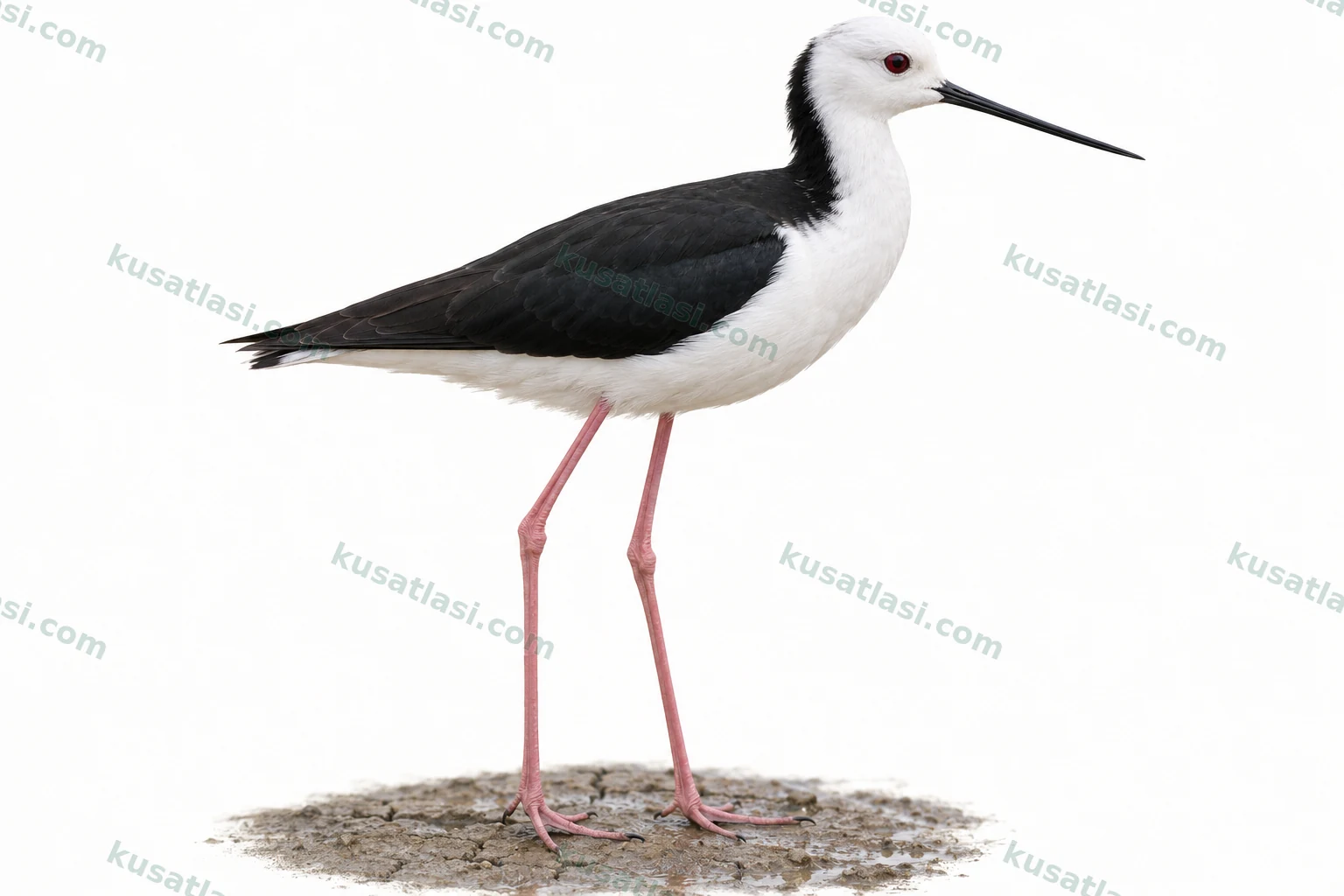
An Australasian stilt with a white head and underparts, a dark nape, black wings, a slender black bill and very long pink legs.
Biometrics
Length
Male35–40 cm
Female35–40 cm
Shared species value
Wing length
Male22.2 cm
Female22.2 cm
Shared species value
Weight
Male138–208 g
Female138–208 g
Shared species value
Pied Stilt
Philippines–Indonesia, New Guinea, Australia and New ZealandObservation guide in its natural range
Look for three features together
Do not rely on a single featureThe adult has a white head and a black area from the back of the head to the nape.
The very long pink legs project behind the tail in flight.
The crown and nape are grey-brown, and the upperpart feathers have pale edges.
Compare male and female
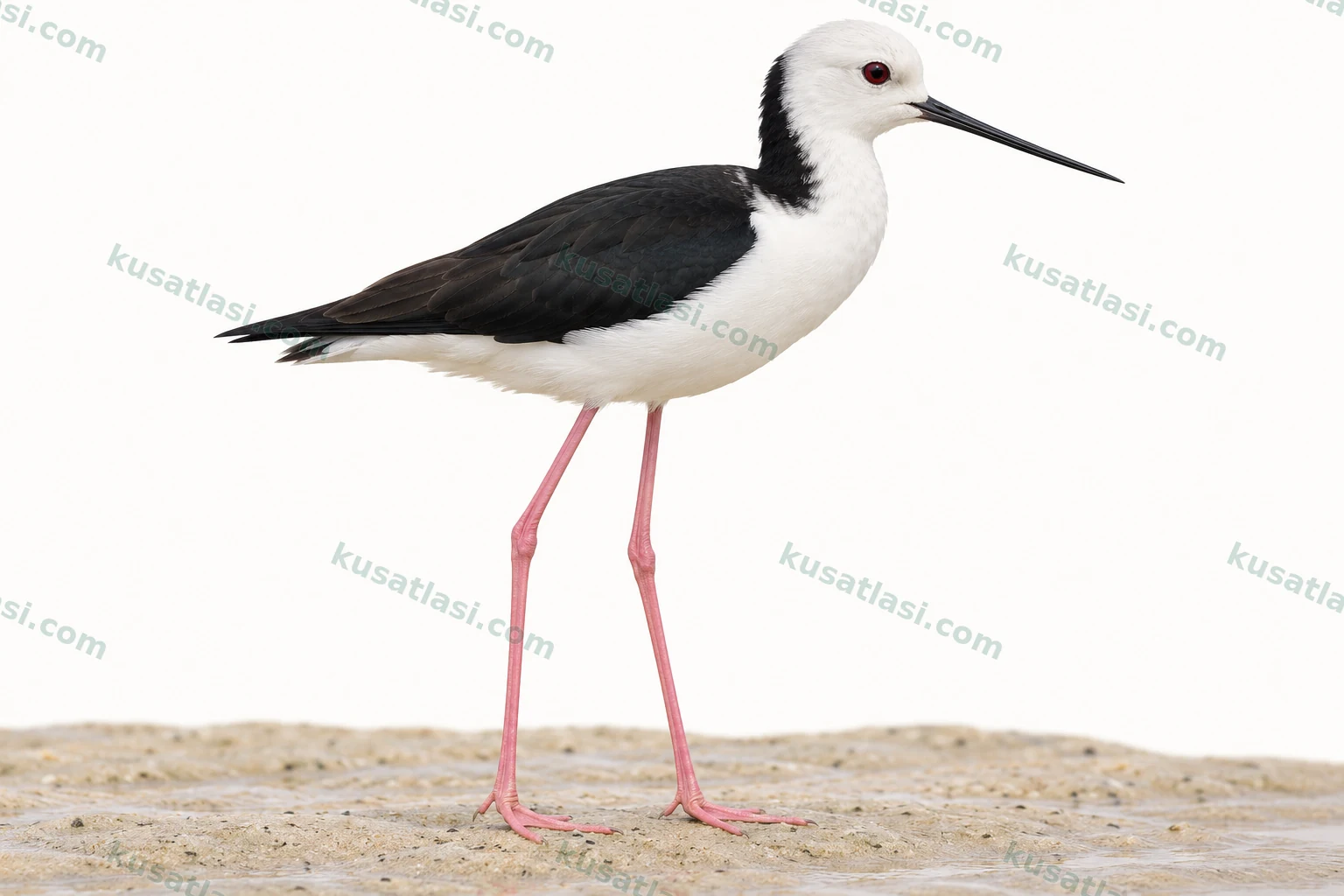 FemaleMale
Adults have a similar colour pattern. The male’s fresh upperparts may be glossier black. A worn male can resemble a female, so one photograph cannot determine sex with certainty.
Where to look in its natural range?
Shallow wetlands, stream margins, tidal mudflats and flooded grassland.
These regional breeding records come from HANZAB. Water conditions can shift the dates, and the calendar does not apply uniformly across the range.
January
Seasonal movements and shifts in response to water conditions vary among populations. No verified regional date was specified for this month. This does not imply local absence.
February
Seasonal movements and shifts in response to water conditions vary among populations. No verified regional date was specified for this month. This does not imply local absence.
March
Seasonal movements and shifts in response to water conditions vary among populations. No verified regional date was specified for this month. This does not imply local absence.
April
Seasonal movements and shifts in response to water conditions vary among populations. No verified regional date was specified for this month. This does not imply local absence.
May
Seasonal movements and shifts in response to water conditions vary among populations. No verified regional date was specified for this month. This does not imply local absence.
June
Seasonal movements and shifts in response to water conditions vary among populations. No verified regional date was specified for this month. This does not imply local absence.
July
Seasonal movements and shifts in response to water conditions vary among populations. No verified regional date was specified for this month. This does not imply local absence.
August
Seasonal movements and shifts in response to water conditions vary among populations. This is within the main period of breeding records in southern and eastern Australia. Breeding can also occur in other months when conditions are favourable. It falls within the regional peak in egg-laying in northern New Zealand. The earliest clutches may precede it.
September
Seasonal movements and shifts in response to water conditions vary among populations. This is within the main period of breeding records in southern and eastern Australia. Breeding can also occur in other months when conditions are favourable. It falls within the regional peak in egg-laying in northern New Zealand. The earliest clutches may precede it. Regional egg-laying records in southern New Zealand also cluster in this period. There is no single date for the entire country.
October
Seasonal movements and shifts in response to water conditions vary among populations. This is within the main period of breeding records in southern and eastern Australia. Breeding can also occur in other months when conditions are favourable. It falls within the regional peak in egg-laying in northern New Zealand. The earliest clutches may precede it. Regional egg-laying records in southern New Zealand also cluster in this period. There is no single date for the entire country.
November
Seasonal movements and shifts in response to water conditions vary among populations. This is within the main period of breeding records in southern and eastern Australia. Breeding can also occur in other months when conditions are favourable.
December
Seasonal movements and shifts in response to water conditions vary among populations. This is within the main period of breeding records in southern and eastern Australia. Breeding can also occur in other months when conditions are favourable.
Nest, egg and incubation
The nest is a shallow scrape or a structure of plant material. In Manawatū in 1970, 45 of 48 clutches contained four eggs. Both sexes incubate. In 15 nests the interval from the last egg laid to the last hatch was 22–28 days. Specialist accounts put first flight at 28–32 days of age. Chicks leave the nest on foot earlier.
The short, sharp calls resemble barks. Softer contact calls are also heard. Warning calls are heard at breeding sites.
Do not play recordings to attract birds; observe quietly, especially near nests.
Species information
Quick identification
Pied Stilt Himantopus leucocephalus is a shorebird that walks in shallow water on very long pink legs and has a slender black bill. The adult has a white head and underparts and black back and wings. The black area from the rear of the head down to the nape may be hard to see from the front. The white head, dark nape and slender bill together make a more reliable starting point than long legs alone. Water can hide the lower legs; the same bird may look much longer-legged when it steps ashore.
Its current English name is Pied Stilt. Older Australian and New Zealand publications also treat it under Himantopus himantopus. The population studied must be checked in work published under that broad name. The characteristics of European, African or American stilts are not all transferred to this species. Locality and sample information from New Zealand and Australia help match the old name to the current taxon.
General appearance and posture
The body is slender, the neck distinct and the bill long and straight. The white breast and belly are visible below the black back. The thin legs contribute to its distinctive outline by holding the body high above shallow water. It lowers its neck and head forwards while feeding and reaches towards the water with small bill movements. While resting it may tuck its head into its feathers or hide one leg; part of its normal proportions is then obscured.
The adult eye is reddish. The legs may look brighter red-pink in the breeding season and paler pink at other times. Light, reflections from water and distant photography affect colour assessment. The black wing’s sheen is not the same in every photograph. Whether the dark area behind the head is actually visible is judged alongside the direction in which the bird is looking.
Males, females and young birds
Adult sexes share the same basic black-and-white pattern. The Australian in-hand guide describes the male’s fresh upperpart feathers as glossy black and the female’s as more brownish black. It also notes that worn male feathers can resemble the female’s. A single brownish-wing view is therefore not enough to determine a female with certainty. Feather freshness, lighting angle and several views matter together.
The crown and rear of the neck of a young bird may have grey-brown areas; the adult’s distinct black nape pattern has not yet formed. Pale edges on upperpart feathers can make the back look scaled. Young eyes may be darker brown and the legs paler pink, sometimes yellowish. A white-headed bird is not declared adult merely from the pale head; back feather edges and eye colour are also examined when assessing age.
Pale edges may wear away. Such a young bird can then have more uniformly dark upperparts than one in fresh plumage. Birds in the same flock are not assumed to be the same age. Chicks leaving the nest on foot do not thereby have adult plumage or the ability to fly. Size differences within the family and feather development are recorded separately.
Appearance in flight
Black wings, white head and neck and white underparts form a clear contrast in flight. The long legs project behind the tail and contribute to its elongated flight silhouette. The upper or lower wing surface becomes visible as it turns. Rather than assign a definite colour to an edge unclear in one image, compare several views from the flight sequence.
Voice and behaviour
Calls are described as short, sharp and bark-like. Warning calls can become conspicuous when a breeding site is disturbed. Quiet contact calls are softer, and sounds may be heard at night as well. In a crowded wetland, seeing the calling bird strengthens identification by voice. Another species calling simultaneously can make matching sounds at a distance harder.
Pairs, families and larger groups outside the breeding season can be seen. The spacing between birds feeding by shallow water is not the same as the area defended around a nest. Chicks begin collecting their own food; parents provide protection and warmth. Passing among warning birds to approach a chick turns the observation itself into a disturbance. Watching from the shore at a distance better preserves natural family behaviour.
Similar species
1. Banded Stilt Cladorhynchus leucocephalus is an important comparison in Australia. The adult’s chestnut band across the breast and belly region is distinctive; it can be absent in young birds. In flight, compare its conspicuous broad white trailing edge to the wing with Pied Stilt’s dark wing. The two scientific names share leucocephalus, but the genera and taxa are different.
2. Black Stilt Himantopus novaezelandiae is compared in New Zealand. The adult is entirely black; young birds can have white head, neck and breast, so colour alone is insufficient. Dark around the eye, leg and bill proportions, age and locality are assessed together. Historical hybridisation is also considered for an unusually patterned bird; not every mottled bird is automatically a hybrid.
World distribution
The current taxon naturally ranges across the Philippines, Indonesia, the New Guinea region, Australia and New Zealand. Tasmania, the main New Zealand islands and some outlying islands are included. Distribution among island chains and wetlands does not mean continuous occupation of every land surface. The European and African range in older broad Himantopus himantopus accounts is not added to this map.
Status within its natural range
The New Zealand specialist account regards it as Not Threatened nationally. That regional category is not substituted for a completed global IUCN assessment of the currently separate taxon. The taxonomy record lists no global assessment for the separate species. A population estimate from the early 1990s in the specialist account is not shown as a current count. Sampled observation cells on the map are not a census of every bird or nest.
Movements
Movement to New Zealand breeding areas can be reported from June–July in lowlands and from August–October inland. Families and groups move to coastal feeding areas after breeding. In Australia, filling or receding water can alter movements, with local and wider shifts responding to rain. This variability is not drawn as a single route followed by every bird each year. A dated coastal record is not egg-laying evidence at that site.
Breeding habitat
The edges of shallow fresh, brackish and salt water, marshes, flooded grassland and stream surroundings are used. New Zealand’s braided rivers are important as well. Bare or short-vegetated ground close to water helps small chicks reach feeding areas. Breeding sometimes occurs in loose groups, sometimes in more separated pairs. A suitable-looking wetland does not prove a nest there every year.
Nest site
The nest may be a shallow ground scrape or a structure marked out with plant material. In New Zealand’s 1970 field study, 45 of 48 clutches had four eggs, two had three and one had two. In the same study, 22–28 days were recorded in 15 nests followed from the laying of the last egg to the hatching of the last chick (McConkey 1971, Manawatū sample). Both sexes incubate. Specialist accounts give first flight at about one month, 28–32 days; early nest departure on foot is not the age at flight.
Daily use of space
Available mudflats on tidal shores affect feeding times. Resting groups and feeding birds can do different things in the same place. Shallow edges exposed by receding water may be used. When warning calls near a nest increase, move away instead of continuing to approach. Blocking the escape direction of small chicks or separating them from their family is not an acceptable way to get a better photograph.
What it eats
Aquatic insects and their larvae, small molluscs, worms and other aquatic invertebrates are among the foods. The New Zealand specialist account records different small prey at coasts and inland waters. A study of stomach contents from 21 birds on northern Australia’s Magela floodplain also found diverse aquatic invertebrates. Fish remains in six stomachs do not mean the species eats mainly fish everywhere. Plant material formed a small share in that sample.
How it obtains food
It walks in shallow water, taking small items from the surface or bottom with its bill. The New Zealand account also describes searching by touch in low light. It sometimes pursues flying insects. The technique may change with water depth, substrate and prey accessibility. A few brief movements of its slender bill may not reveal the prey’s identity at a distance.
In the Magela study, mollusc dry mass included the shell. A high share under that method is not a direct percentage of energy obtained. The researchers also discuss how faster digestion of soft prey could affect the result. A regional stomach-content study is not treated as equivalent to dietary proportions for the whole year and range.
Two different birds can share one part of their names
Himantopus leucocephalus and Cladorhynchus leucocephalus share the second word of their scientific names. They are nevertheless separate species in different genera. Checking the full scientific name and the study locality together helps distinguish the two.
Four eggs are typical, but not every nest is the same
Nests from the Manawatū study itself and additional records collected from other observers are not combined as if they were one sample. This prevents a high total in a compilation from being mistaken for the number of nests the researcher followed personally.
Walking and flying are different stages of development
Chicks that leave the nest early can move to feeding areas under parental protection. Collecting their own food does not by itself show they can fly. Flight-feather development and sustained flight should be observed separately. A small chick walking behind an adult on the shore is not assigned a flight age merely because it is active.
Rain can change what the calendar means
The specialist breeding review mainly reports August–December records in southern and eastern Australia, with other months in northern regions. Suitable water conditions can allow breeding outside the usual period in some places. Regional New Zealand records are considered separately. A month marked in the calendar does not mean the same event occurs throughout Australasia then; locality is an inseparable part of the calendar.