

World Birds IUCN statusLC · Least ConcernGlobal IUCN category. BirdLife v10 (2025); taxon matching: AviList 2026 / IOC 15.2; checked: 29.10.2026. The list year is not the species assessment date. Source and method · BirdLife OrderCharadriiformesShorebirds, gulls and allies FamilyCharadriidaeCharadriidae
African Wattled Lapwing
Vanellus senegallus
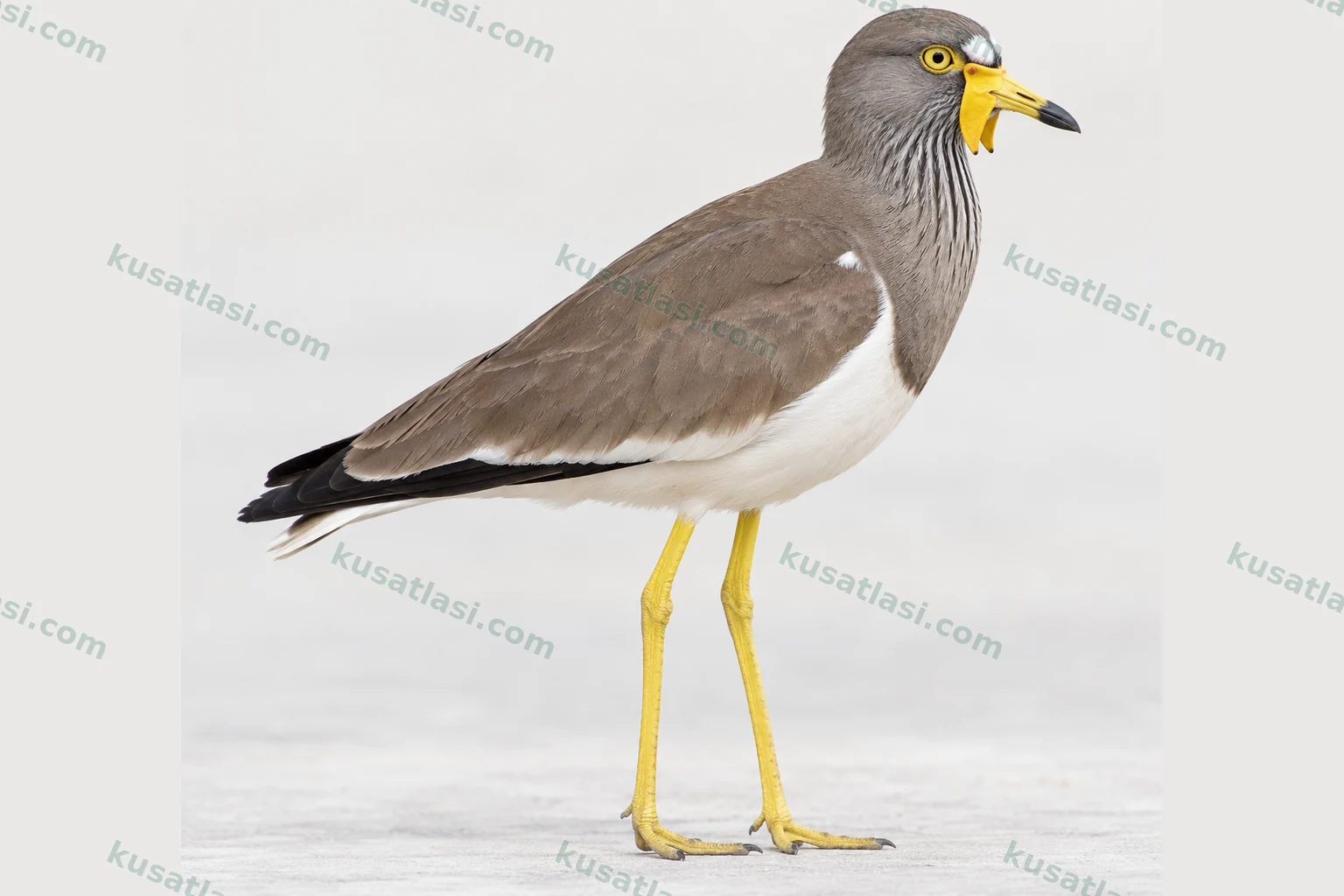
Long yellow legs, a white forehead and hanging yellow facial wattles with red bases; a grey-brown lapwing.
Biometrics
Length
Male34 cm
Female34 cm
Shared species value
Wing length
Male22.52 cm
Female22.52 cm
Shared species value
Weight
Male197 g
FemaleData unavailable
African Wattled Lapwing
Open grasslands and wetland surroundings of sub-Saharan AfricaObservation guide in its natural range
Look for three features together
Do not rely on a single featureLook for the white forehead and yellow wattles with red bases together.
Distinguish the positions of white coverts and black flight feathers.
A small facial wattle does not mean a different species.
Compare male and female
 FemaleMale
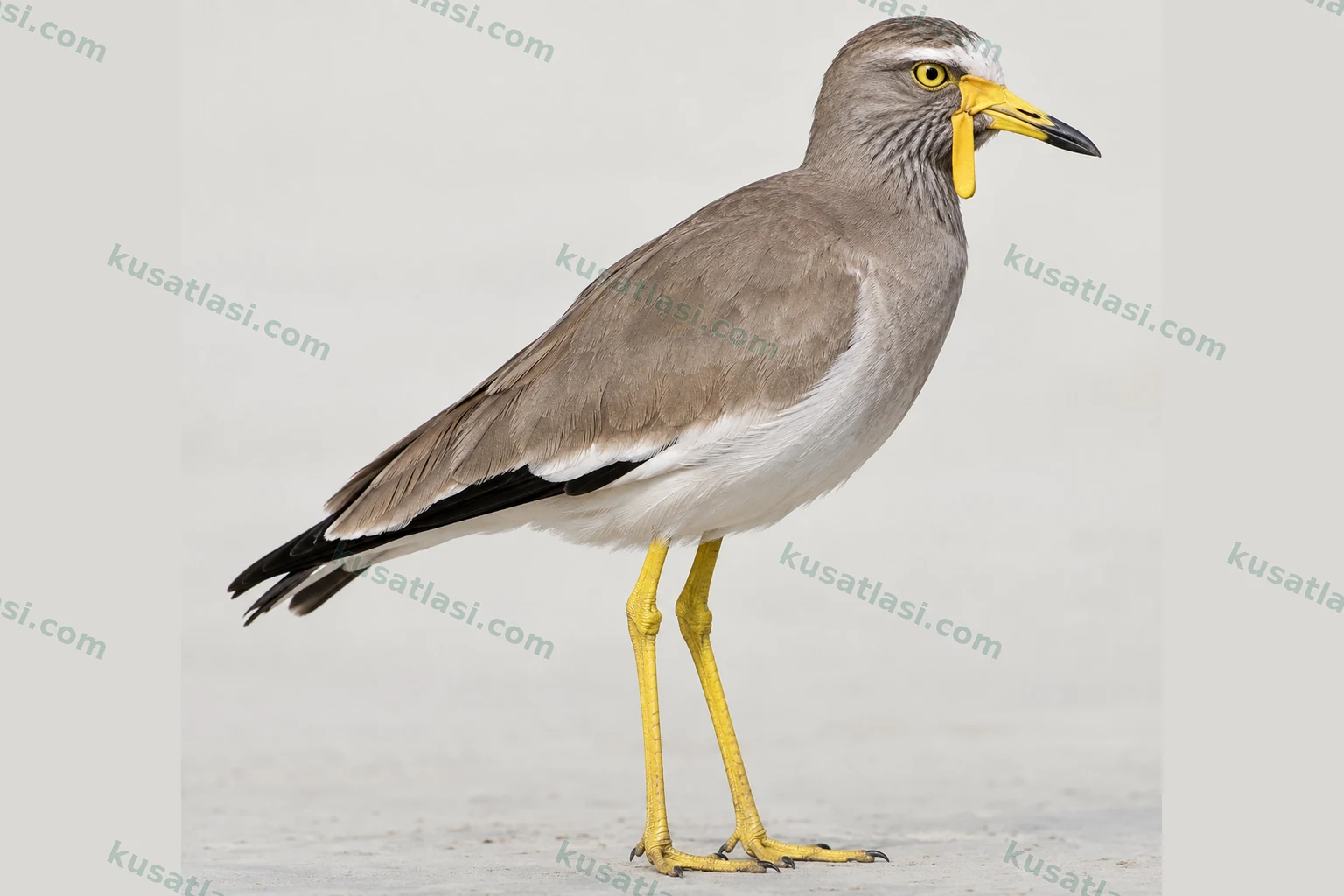
Adults are similar; facial wattles and the white forehead are less developed in young birds. The throat patch does not allow certain sexing.
Where to look in its natural range?
Scan damp short-grass ground, floodplains and watersides from a distance.
Egg-laying in southern Africa and breeding records from the southern African atlas are shown as separate events.
January
It is resident in most regions; regional movements associated with water and food may occur. Southern African atlas region: atlas breeding observations, concentrated in October–November.
February
It is resident in most regions; regional movements associated with water and food may occur. No verified regional date specific to this month was provided; this does not mean local absence.
March
It is resident in most regions; regional movements associated with water and food may occur. No verified regional date specific to this month was provided; this does not mean local absence.
April
It is resident in most regions; regional movements associated with water and food may occur. No verified regional date specific to this month was provided; this does not mean local absence.
May
It is resident in most regions; regional movements associated with water and food may occur. No verified regional date specific to this month was provided; this does not mean local absence.
June
It is resident in most regions; regional movements associated with water and food may occur. No verified regional date specific to this month was provided; this does not mean local absence.
July
It is resident in most regions; regional movements associated with water and food may occur. Southern African region: egg-laying in the Roberts account, concentrated in September–October.
August
It is resident in most regions; regional movements associated with water and food may occur. Southern African region: egg-laying in the Roberts account, concentrated in September–October.
September
It is resident in most regions; regional movements associated with water and food may occur. Southern African region: egg-laying in the Roberts account, concentrated in September–October. Southern African atlas region: atlas breeding observations, concentrated in October–November.
October
It is resident in most regions; regional movements associated with water and food may occur. Southern African region: egg-laying in the Roberts account, concentrated in September–October. Southern African atlas region: atlas breeding observations, concentrated in October–November.
November
It is resident in most regions; regional movements associated with water and food may occur. Southern African region: egg-laying in the Roberts account, concentrated in September–October. Southern African atlas region: atlas breeding observations, concentrated in October–November.
December
It is resident in most regions; regional movements associated with water and food may occur. Southern African region: egg-laying in the Roberts account, concentrated in September–October. Southern African atlas region: atlas breeding observations, concentrated in October–November.
Nest, egg and incubation
The nest is a shallow ground scrape that may be lined with plant fragments and small stones. The southern African account gives 2–4 eggs and approximately 28–32 days of incubation by both parents; chicks leave the nest during the first day and fly at about 40 days of age.
Calls are short, thin and nasal; assess contact and alarm contexts together with behaviour.
Do not play recordings to attract birds; observe quietly, especially near nests.
Species information
Quick identification
African Wattled Lapwing Vanellus senegallus is a large, generally grey-brown lapwing with long yellow legs. The adult's hanging yellow facial wattles, their red upper portion near the bill base and the white forehead are conspicuous. Fine pale-and-dark neck streaks, a dark throat and a yellow bill with a dark tip complete the combination. A yellow facial wattle alone is insufficient: White-crowned Lapwing has wattles too. Assess the forehead, belly colour and pattern of the open wing together.
The English names Wattled Lapwing and African Wattled Lapwing are used for this taxon. An old record called Wattled Plover may also refer to it. Senegal Lapwing, however, names Vanellus lugubris; the resemblance to the scientific epithet senegallus does not make the two the same species. Senegal alone in a photograph's caption does not identify the bird. Confirming the scientific name is particularly important to avoid importing breeding information from another lapwing.
General appearance and posture
Rather than strong black-and-white body blocks, the bird has a more uniform, pale brownish-grey appearance. Pale-edged feathers with dark streaks on the head and neck become visible at closer range. The white mark is principally on the forehead; it should not be described as a broad white stripe over the whole crown. The dark chin and throat contrast with this paler, streaked setting. With the wing closed, a small white triangle may show near the shoulder. White beneath the tail is another detail that does not alter the predominantly grey-brown impression.
Long yellow legs accentuate the bird's height among short damp grasses. Changes of posture may hide part of the legs behind the grass.
The yellow bill's dark tip may show differently with lighting and local form. Assess the hanging yellow wattle, its red base above and the eye itself separately. Vivid yellow around the eye is not iris colour; the specialist account describes a grey-blue iris. All these small details need not be visible from afar. Record overall shape and head pattern first, supporting them with facial details when a closer view becomes available.
Males, females and young birds
Adult males and females share the same basic appearance. A female's dark throat area may be more restricted, but posture, feather cover and viewing angle also change its apparent extent. The throat patch alone does not provide certain sexing. Nor should a larger-looking bird be declared male and a smaller one female. The tasks of a pair around a nest cannot be named from a single behaviour without prolonged observation.
Young birds have less-developed facial wattles. The throat may be paler and dark-streaked, and the white forehead mark may look smaller than in an adult. A bird lacking all the adult facial features should therefore not immediately be assigned to another species. Check leg colour, body shape and wing pattern alongside nearby adults. A small developing wattle does not necessarily indicate poor nutrition or illness; it may be related to age.
A newly hatched chick and a flying young bird are not at the same developmental stage. The Roberts account states that chicks leave the nest within the first day, whereas flight begins at about forty days of age. A small chick following an adult on the ground and not flying is therefore not, by that fact alone, injured. Picking it up and moving it while its parents remain nearby can separate the family. Keep your distance and do not walk towards the short grass or stones where it hides.
Appearance in flight
A white band crosses between the brown upperwing coverts and the long black flight feathers. Beneath the wing, white coverts contrast with dark flight feathers. The underwing is not entirely white. The broad black band at the tip of the white tail is separate from the wing pattern. A white flash as the wing opens and closes may not reveal which row of feathers carries it. Identification is stronger when the head and tail are visible as well.
Compare the same wing surface when assessing White-crowned Lapwing's much larger white areas. Comparing one species' upperwing with the other's underwing can make patterns misleadingly similar. A short flight may lead between feeding sites or away from a threat; calling it migration requires separate movement evidence.
Voice and behaviour
Short, thin, nasal calls can be heard both on the ground and in flight. Repeated calling relates to contact within a pair or an alarm context; harshness alone does not establish which event is occurring. Watch where the bird is looking and how nearby birds behave. If a warning adult suddenly takes off, approaching simply for a better sound recording is inappropriate. You may be the source of the alarm.
Pairs defend their areas during breeding; reciprocal calls and chases involving other African lapwings may be seen. Non-breeding feeding gatherings are not the nest area continuously shared by the same pair. Many birds on one meadow do not prove that they all nest there. When nest defence is observed, withdrawing rather than tracing the bird's direction to search for its nest both keeps behaviour natural and protects chicks concealed on the ground.
Similar species
White-crowned Lapwing Vanellus albiceps also carries long yellow facial wattles. Its broad white central head stripe, whiter belly and strong black-and-white wing pattern help distinguish it. Sandy surroundings of large rivers provide useful context but do not identify it alone. In African Wattled Lapwing, assess the white forehead, streaked grey-brown head and yellow wattles with red bases together. Young birds can have small wattles, so do not rely on a single detail.
Spur-winged Lapwing Vanellus spinosus shows stronger black, white and brown blocks. Compare African Wattled Lapwing's more uniform grey-brown appearance in the same light. Long legs, short grass or an alarm call alone do not separate the two. One bird being near water and the other in a field does not complete identification; their habitats can overlap. If the head, underparts and wing pattern were not seen adequately, the record can remain uncertain.
World distribution
The species is widely distributed in suitable open places south of the Sahara, from western to eastern Africa and into the continent's southern parts. Closed equatorial rainforest and extremely arid regions, however, are not used to the same extent. The southern African atlas and Roberts account show a strong presence around Zimbabwe, the Okavango and Caprivi, as well as northeastern South Africa and neighbouring regions. Countries should not be imagined as wholly occupied blocks; the distribution of rivers and grasslands affects local occurrence.
Status within the natural range
Damp open places with short grass, watersides and some agricultural areas offer suitable places to look. A widespread species is not necessarily present at every small wetland. Historical atlas recording frequency is not the same as current population size. Regularly visited roadsides can produce more records, while hard-to-reach meadows remain less visible. A global Least Concern assessment does not make the loss of a local wetland unimportant.
Movements and migration
It is resident through much of its range; in some regions, movements relate to rain, water and feeding areas. The southern African atlas describes seasonal occurrence near Carolina and periodic increases in Zimbabwe records. These do not establish that individuals follow precisely the same route; proposed connections are not tracked flight paths. Arrival in September and departure in March from one area cannot be used as a calendar shared by the whole continent. Likewise, moving to another wetland during rains does not mean every individual makes long-distance migrations.
Breeding habitat
Damp short grasslands, floodplains, marsh edges and open ground near water can form breeding surroundings. Some pairs use burned short grass or agricultural ground. These records do not show that birds benefit from intensive human activity in every situation. Short vegetation provides visibility, but ground nests and chicks may also be exposed to people and vehicles using the same area. Change your route when a nest-defending adult is seen.
Nest site
The nest is a shallow scrape in the ground; dry plant fragments, small stones and similar material may be present. The Roberts account describes a female choosing one of the scrapes made by a male. The same regional account reports 2–4 eggs and both parents incubating for approximately 28–32 days. These figures do not imply one exact duration throughout the continent. As chicks can disperse during the first day, a seemingly empty nest does not by itself show breeding failure.
Daily use of space
Feeding may take place between the edge of shallow water and drier grassy ground. A sighting in a pool does not prove that the bird spends all day in water. Available open surfaces change with rain and water level. Following the same pair's feeding site separately from its nest surroundings clarifies habitat needs. Many individuals gathering to feed does not mean the opening is a permanent breeding colony.
What does it eat?
Terrestrial insects are important foods. Grasshoppers, beetles, termites and caterpillars, along with worms and grass seeds, are among the foods recorded in the species account. This list does not mean that identical proportions are eaten everywhere. An association with wetlands does not make the bird a fish hunter dependent only on aquatic prey. During close feeding observations, distinguish a morsel actually taken from a bill merely directed at the ground. Do not guess the identity of prey disappearing into the grass.
How does it feed?
Slow walking, a short pause and movement towards visible prey can follow one another. The bird sometimes disturbs the ground with a foot. This action may not appear in every observation; feeding does not consist of one technique alone. A pause with the head upright may serve to watch the surroundings as well as search for prey. To understand the behaviour, follow what happens before and after it.
A gathering arriving at grassland after rain may show that food is accessible at that moment; one visit cannot measure the site's annual productivity. When an adult near a nest begins giving alarm calls, do not continue approaching to watch it feed. Disturbance that shortens foraging time cannot be said to affect every family equally, but natural observation should aim not to change behaviour. Giving food or digging insects out of the ground does not produce a record of natural hunting.
Being able to fly does not mean independence
Leaving the nest, first flight and departure from the family are different events. The Roberts account states that African Wattled Lapwing chicks leave the nest during the first day and start flying at about forty days. It also describes family association lasting until the next breeding period. Thus, a forty-day-old flying young bird is not automatically independent of its family. A large young bird beside an adult is not a chick that left the nest that day either.
The event behind an atlas date
The southern African atlas breeding records occur especially from September to January, with concentrations in October–November. The Roberts account's July–December period and September–October concentration concern egg-laying. Although the intervals look different, they do not measure the same event; dates of eggs, incubation and chick observations need not coincide. Rather than combine them into a new average season, retain the event and region together. A filled calendar month does not mean that every individual lays eggs then.
Misleadingly similar names
The scientific name Vanellus senegallus and the English name Senegal Lapwing may initially suggest the same bird. The latter, however, is used for Vanellus lugubris. Confusion can go beyond a heading and cause one species' shorter chick-development period to be transferred to the other. Reading the original section's scientific name is safer than choosing a species from a picture or a file's sequence number.
Around the yellow wattle
The hanging yellow facial tissue is conspicuous, but less developed in young birds. Assessing eye surroundings, red base, white forehead and overall body colour together reduces errors caused by age differences. A wattle appearing dark in shadow does not prove a new colour form. Distinguishing the iris from the surrounding bare skin matters too: not every yellow area in the picture is the eye.
Recording the overall appearance helps identification as much as close details. A head photograph may show the face well but hide wing pattern; a flight photograph may not resolve the wattle. Complementary brief observations can provide more identification information with less disturbance than one detailed view obtained by approaching a nest. If chicks or an alarm-calling adult are present, an incomplete view should remain an uncertainty.