

World Birds IUCN statusLC · Least ConcernGlobal IUCN. BirdLife v10 (2025); taxon matching AviList 2026 / IOC 15.2; checked: 29.10.2026. The list year is not the species’ assessment date. Source and method · BirdLife OrderCharadriiformesShorebirds and allies FamilyCharadriidaeCharadriidae
White-fronted Plover
Anarhynchus marginatus
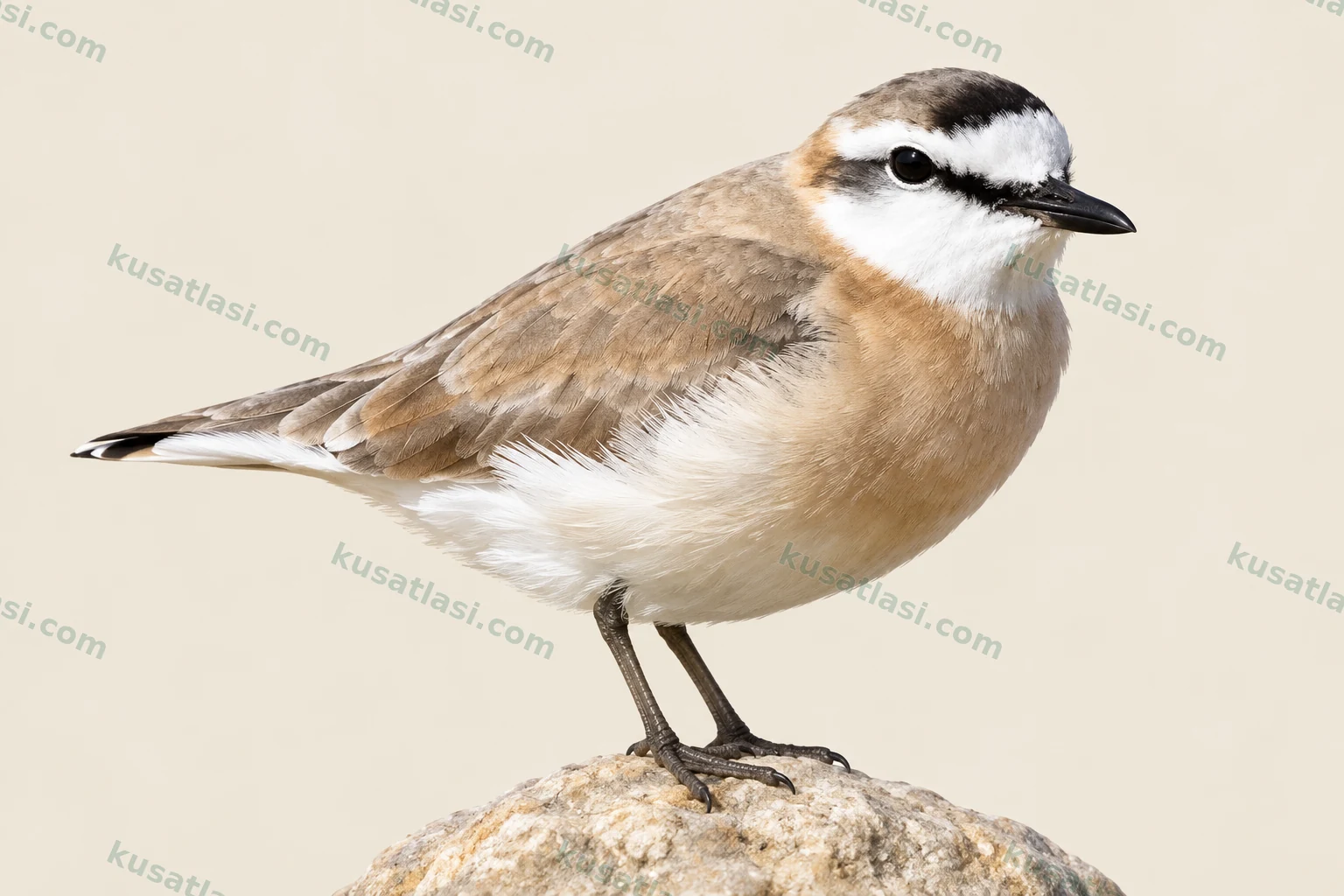
A small African plover with sandy back, white forehead and white neck collar; mostly resident on coasts, with flood-related movements at some inland waters.
Biometrics
Length
Male18 cm
Female18 cm
Shared species value
Wing length
Male10.9 cm
Female10.9 cm
Shared species value
Weight
Male45.4 g
Female46.8 g
White-fronted Plover
Sandy coasts and inland shores of sub-Saharan Africa and MadagascarObservation guide in its natural range
Look for three features together
Do not rely on a single featureWhite forehead and pale face; adults can have a narrow dark forehead band.
A white collar passes around the hindneck; underparts are mostly white.
Short, straight and rather stout; compare its proportions with sandpipers.
Compare male and female
 FemaleMale
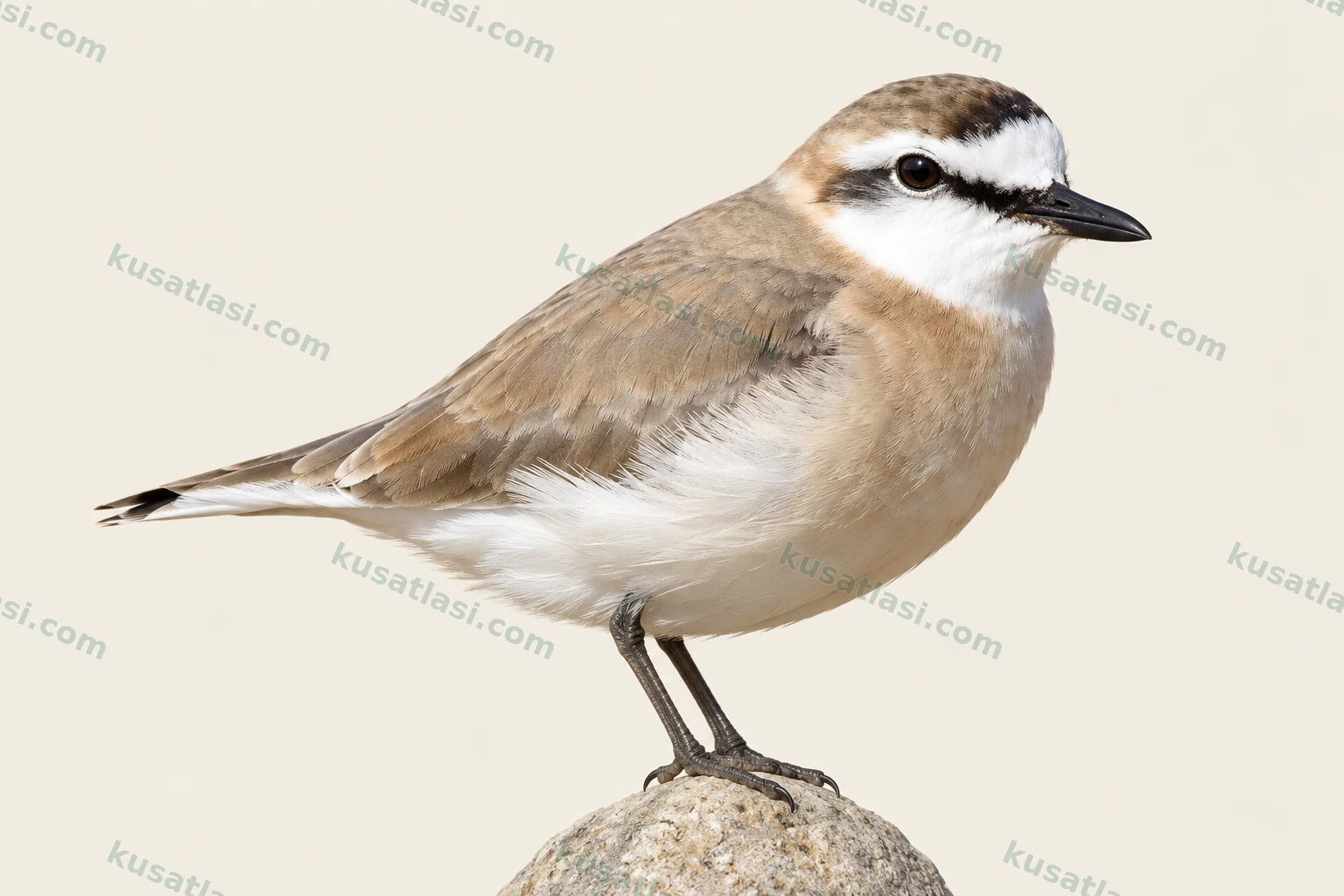
The sexes share the same basic pattern. The female’s dark forehead band may be weaker, but is not a certain sex character alone. Young birds lack the black forehead band.
Where to look in its natural range?
Sandy beaches, river and lake banks, and estuaries; assess the head-neck pattern in birds running and stopping to find small prey.
Local breeding examples from southern Africa; not one calendar for the entire continent.
January
Mostly resident on coasts; some inland populations move seasonally to the coast after flooding. Namibia — Roberts account: regional breeding peak.
February
Mostly resident on coasts; some inland populations move seasonally to the coast after flooding. No verified regional date specific to this month was given; this does not mean local absence.
March
Mostly resident on coasts; some inland populations move seasonally to the coast after flooding. No verified regional date specific to this month was given; this does not mean local absence.
April
Mostly resident on coasts; some inland populations move seasonally to the coast after flooding. No verified regional date specific to this month was given; this does not mean local absence.
May
Mostly resident on coasts; some inland populations move seasonally to the coast after flooding. No verified regional date specific to this month was given; this does not mean local absence.
June
Mostly resident on coasts; some inland populations move seasonally to the coast after flooding. No verified regional date specific to this month was given; this does not mean local absence.
July
Mostly resident on coasts; some inland populations move seasonally to the coast after flooding. KwaZulu-Natal — Roberts account: regional breeding peak. Inland southern Africa: the regional breeding period given by Roberts.
August
Mostly resident on coasts; some inland populations move seasonally to the coast after flooding. KwaZulu-Natal — Roberts account: regional breeding peak. Inland southern Africa: the regional breeding period given by Roberts.
September
Mostly resident on coasts; some inland populations move seasonally to the coast after flooding. Western Cape — Roberts account: months of concentrated breeding, not absence in other months. Inland southern Africa: the regional breeding period given by Roberts.
October
Mostly resident on coasts; some inland populations move seasonally to the coast after flooding. Western Cape — Roberts account: months of concentrated breeding, not absence in other months. Inland southern Africa: the regional breeding period given by Roberts.
November
Mostly resident on coasts; some inland populations move seasonally to the coast after flooding. Western Cape — Roberts account: months of concentrated breeding, not absence in other months.
December
Mostly resident on coasts; some inland populations move seasonally to the coast after flooding. Namibia — Roberts account: regional breeding peak.
Nest, egg and incubation
The nest is a shallow ground scrape with 1–3 eggs, usually 2. Both partners share incubation. Southern African sources give 26–33/27–33 days; Madagascar research gives a regional mean of 28.5 days. Age at first flight in southern Africa is 35–38 days.
Short soft contact whistles and harsher vibrating alarm calls. Assess voice together with a visible bird.
Do not play recordings to attract birds; observe quietly, especially near nests.
Species information
Quick identification
White-fronted Plover Anarhynchus marginatus is a small shorebird of Africa’s sandy coasts and some inland waters. Pale sandy upperparts, white forehead, white neck collar and mostly white underparts are assessed together. The bill is short, straight and rather stout, as is typical of plovers. Running a few quick steps over sand, stopping and then taking small prey from the ground is a characteristic feeding movement. Its pale face looks simpler than that of many strongly patterned small plovers.
A white forehead alone is insufficient for identification. The shape of the dark line on the upper head, breast-side pattern, bill proportions and age are considered together. An adult can have a dark line around the eye; this does not make the entire head black. Warm light reflected by sand can make pale feathers look yellowish. Reliable identification rests on the complete head-and-body pattern rather than a single hue.
General appearance and posture
It is a compact-bodied bird with a low stance. Pale feather edges may be visible on the brown-sandy back, shoulders and wing coverts. The crown is similarly coloured to the back. A white collar around the hindneck creates a pale boundary between head and back.
In breeding appearance, a narrow dark band may lie above the white forehead. A dark eye-line contrasts with the otherwise pale face. The underparts are white; breast and flanks can have a cream or pale rufous-sandy wash. In some birds this is confined to small patches at the sides of the breast. Such subtle differences alone do not establish another species or a certain sex.
When the bird stands quietly on sand, its upper feathers blend well with the ground. The white collar, forehead and underparts become more noticeable in movement. Dark wingtip and tail sections should not give the impression of an entirely dark back. The sunlit and shaded sides can look different, so several views of the white head boundaries are useful.
Males, females and young birds
Both sexes share the same basic sandy-and-white pattern. The female’s dark forehead band can be narrower or less clear. Outside breeding appearance, the black head areas become browner; the forehead band may disappear in some females. Season and individual variation also affect these features, however, so band thickness alone cannot determine every bird’s sex with certainty.
The young bird has a white forehead but lacks the adult black forehead band. A dark facial line may be visible in front of the eye. Broad pale sandy edges to upper feathers create a more scaled appearance; warm rufous tones may also occur on nape and shoulders. The underparts are mostly white or cream. A young bird without a forehead band is not immediately assigned to another species because it fails to match an adult male.
Newly hatched chicks are not small copies of adult appearance. They are grey-sandy above with dark spots, and dark lines may run over head and back. Chicks walk and seek their own food after hatching but still need adult vigilance and defence. A chick walking alone is not presumed independent or abandoned; watch a nearby adult’s behaviour from a distance.
Appearance in flight
Pale areas among dark flight feathers and the white underwing may be noticed in flight. The tail centre is dark and the outermost feathers white. Open wings and tail create stronger light-dark contrast than the resting appearance. Many small shorebirds show a pale wing line, so this alone does not identify the species; head, neck and breast are checked again after landing.
A short flight from a coastal resting place to a feeding site does not imply migration. Coastal populations are mostly resident, while seasonal flood-related movements of some inland populations are known separately. A few birds progressing along the coast with rapid wingbeats do not make the whole species a long-distance migrant.
Voice and behaviour
The repertoire includes short soft contact calls and harsher alarm sounds. Specialist accounts describe short whistled calls and dry vibrating sounds under tension. Wind and surf can mask them. When a call is heard, observe its producer; one short syllable does not reliably separate it from other plovers on the same sand.
During breeding, pairs defend the nest surroundings. Short chases or low threat postures can drive other birds away. A disturbed adult may perform injury-feigning that diverts attention from chicks. If this is seen, withdraw along the way you came rather than continuing to approach. Eggs and chicks on sand can be so well concealed that people fail to notice them.
Outside breeding, pairs, small groups or larger gatherings can be seen. Quick runs and short pauses alternate during feeding; the bird sometimes vibrates a foot to expose small prey in the substrate. Not every pause is rest. Lowering the head to inspect the ground followed by a quick bill pick shows where feeding actually occurs.
Similar species
Kittlitz’s Plover Anarhynchus pecuarius can share open coasts and inland waters. White-fronted Plover has a simpler-looking face; its white forehead and collar are compared together with the dark head lines. Juvenile and non-breeding birds may have weaker dark head marks. One pale-faced photograph does not settle the identification.
Non-breeding sand plovers generally appear larger with different breast-to-head proportions. Cornell’s specialist account separates White-fronted Plover from them by smaller size and its white neck collar. Distance can distort comparison of two birds’ sizes, so stance on the same ground, bill structure and head pattern also matter. Caspian Plover Anarhynchus asiaticus is clearly larger.
Small sandpipers usually have different bill proportions from this species’ short, straight, rather stout bill. Running on sand or eating small invertebrates alone does not make them the same species. Bill proportions, posture and head-neck pattern are considered together; the type of coast alone does not name the bird.
World distribution
Its natural range includes sub-Saharan African coasts, large rivers and lakeshores, and Madagascar. Populations occur in Senegal and more southerly West African regions, on suitable sandy coasts and inland shores of central and eastern Africa, and from Angola to South Africa in the south. Current taxonomy includes the Madagascan form tenellus within this species. This broad continental range does not mean continuous presence at every water’s edge.
Coastal and inland distributions differ. While it may be widespread on open sandy sea coasts, inland occurrence can be more local, tied to suitable lake and river shores. Not seeing a bird where rising water has submerged sand does not alone place that country outside the natural range.
Status within its natural range
The global category is Least Concern. The 2025 regional assessment for South Africa, Lesotho and Eswatini gives the same category, but regional monitoring reports a slight decline and marked local changes on some coasts. The category does not mean unchanged numbers on every beach or immunity to human pressure. Coastal use, vehicles, dogs, floods and high tides can affect nesting success.
Movements
Most coastal populations are resident; short movements to more sheltered coast sections may occur seasonally. Some inland populations in the north and northwest of the southern African region move to the east coast after floods beginning in December and can remain there until May. This regional information is not one migration calendar for all Africa and Madagascar. Daily feeding flights, escape from flooding and regular distant migration are distinguished.
Breeding habitat
Sandy sea coasts, coastal dunes, sandbanks of large rivers and lakeshores are the main environments. Estuarine mudflats, salt flats and some stony shores can also be used. Nest and feeding site need not be the same small spot. Shallow water margins provide small prey, while a drier open sand patch may suit egg-laying.
Nest site
The nest is a shallow ground scrape. It often lacks an obvious lining; small stones, shell fragments, dry seaweed or thin twigs can occur around some nests. Coastal sand above the high-tide line, dunes or riverbanks are used. The typical clutch contains two eggs; southern African specialist accounts report 1–3. Male and female share incubation.
Roberts’ southern African account gives 27–33 days of incubation, while the 2025 regional account gives 26–33. Madagascar research from 2009–2020 reports a mean of 28.5 days for 100 nests; this regional mean does not predict hatching at precisely that time in every nest. The southern African account gives an age at first flight of 35–38 days. These periods differ from chicks walking and collecting prey immediately after hatching.
Daily habitat use
The bird searches for food on damp sand, muddy margins and shallow pools left by tides. It can rest on drier sand. Because unseen eggs and chicks may be stepped on, do not walk towards an alarming adult. Vehicle tracks and free-running dogs can reduce safe feeding and nesting space for these small birds.
What does it eat?
Insects and other small invertebrates form the basic diet. Specialist accounts list flies, grasshoppers, termites and mosquito developmental stages, as well as small crustaceans, snails, bivalve molluscs and worms. Prey encountered on coasts and inland shores differ. The list is not read as one stomach study showing identical foods in identical proportions everywhere.
How does it forage?
It runs a few quick steps on sand or mud, stops to inspect the ground and picks up visible prey with its bill. Short bill movements can probe the damp surface. Sometimes foot vibration makes small prey move at the surface. Capture of winged termites in brief aerial sallies is also reported; this does not make the bird a constant aerial hunter.
Feeding is not restricted to daytime; Roberts also describes nocturnal foraging. Tide and water level change the available damp surface. The number resting in one place may differ from the number actually collecting prey. Watching the sequence of running, stopping and picking is more informative than merely seeing a bird beside water.
It can cover eggs before leaving the nest
The southern African specialist account describes adults covering eggs with sand as a threat approaches. This changes the appearance of exposed eggs. It does not mean that the bird covers its nest at the same time every morning or that temperature regulation is the covering’s sole function. The circumstances of nestside behaviour matter; deliberately frightening the bird to observe it is inappropriate.
Less fleeing does not mean greater safety
Baudains and Lloyd’s 2007 study compared two breeding areas with different levels of human activity. Where more people were present, birds responded later to approach and returned to nests sooner. Nest loss and chick loss did not change in the same direction: chick mortality was higher in the heavily used area, with predation by domestic dogs proposed as a possible explanation. The findings show why overall breeding success cannot be inferred from one behaviour; they do not support harmlessness of people and dogs everywhere.
Plovers living together can differ in care
Research in Madagascar during 2009–2020 followed 2,077 nests of three species, including 565 White-fronted Plover nests. Both parents participated in incubation care in this species, whereas the care arrangement could differ in Kittlitz’s Plover. The study examined nest success during incubation only; it did not measure survival to adulthood of every hatched chick. Sample size and the life stage observed are essential to understanding the result.
A climate association is not a proven sole cause
The same Madagascan study assessed nest age, egg number, year and El Niño/La Niña conditions. Although climate state appeared in some supported models, its effect was not statistically significant. Failure in one year should therefore not be attributed solely to a climate event. Flooding, predation, desertion and trampling were also examined as routes to nest loss; conditions in different years are considered together.