

World Birds IUCN statusLC · Least ConcernGlobal IUCN category. BirdLife v10 (2025); taxon matching: AviList 2026 / IOC 15.2; checked: 29.10.2026. The list year is not the species assessment date. Source and method · BirdLife OrderCharadriiformesShorebirds, gulls and allies FamilyJacanidaeJacanidae
African Jacana
Actophilornis africanus
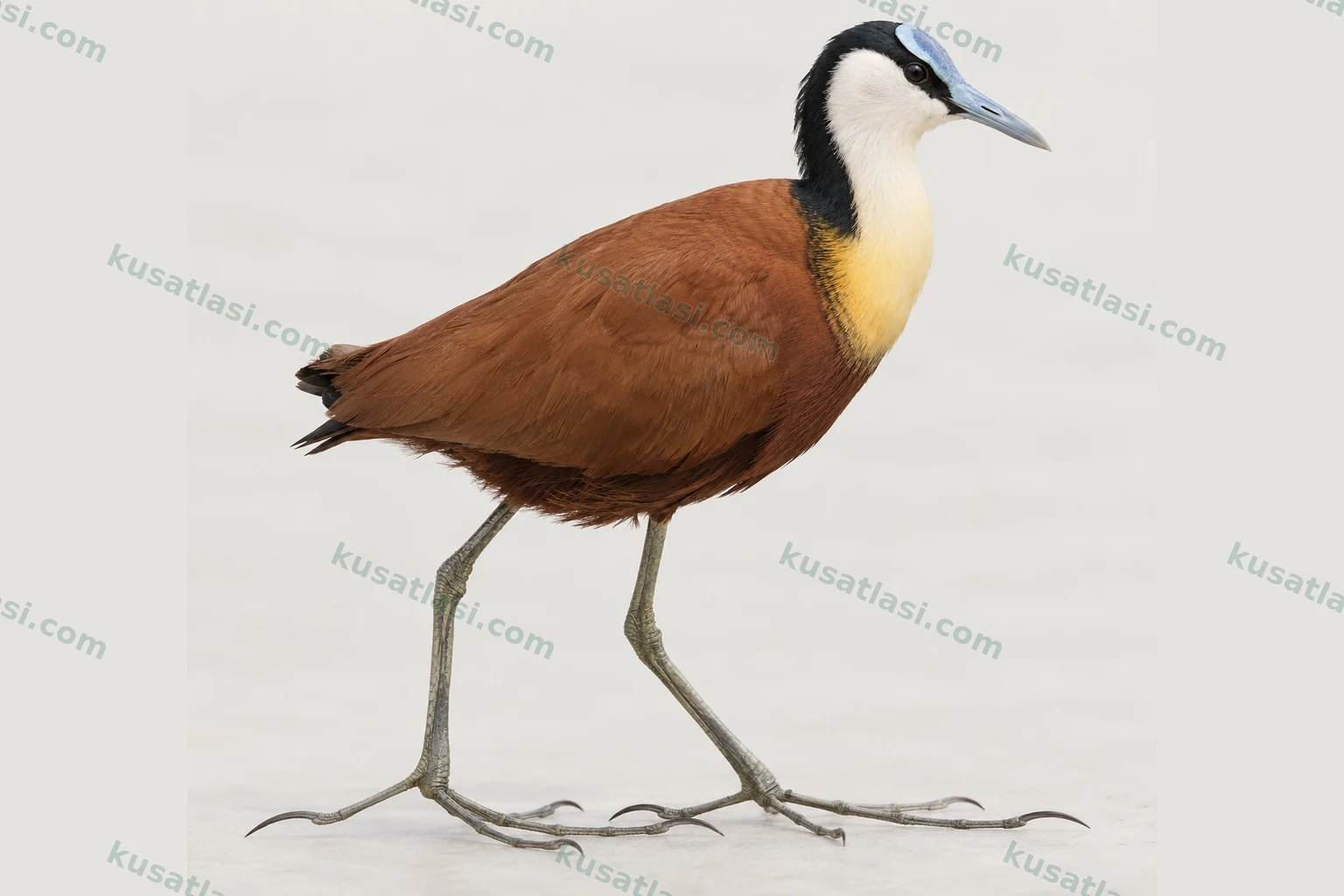
Blue bill and frontal shield, white front of the neck, chestnut body and exceptionally long toes spread over floating plants. The young bird’s blue bill has not yet developed.
Biometrics
Length
Male23–31 cm
Female23–31 cm
Shared species value
Wing length
Male15.6 cm
Female15.6 cm
Shared species value
Weight
Male115–224 g
Female167–290 g
African Jacana
Vegetated freshwater areas of sub-Saharan AfricaObservation guide in its natural range
Look for three features together
Do not rely on a single featureCompare the blue bill, black crown, white front of the neck and chestnut underparts together.
Exceptionally long toes support the bird on plants; it does not walk on bare water.
White underparts, a white stripe above the eye and a browner head; absence of blue alone does not rule out the species.
Compare male and female
 FemaleMale
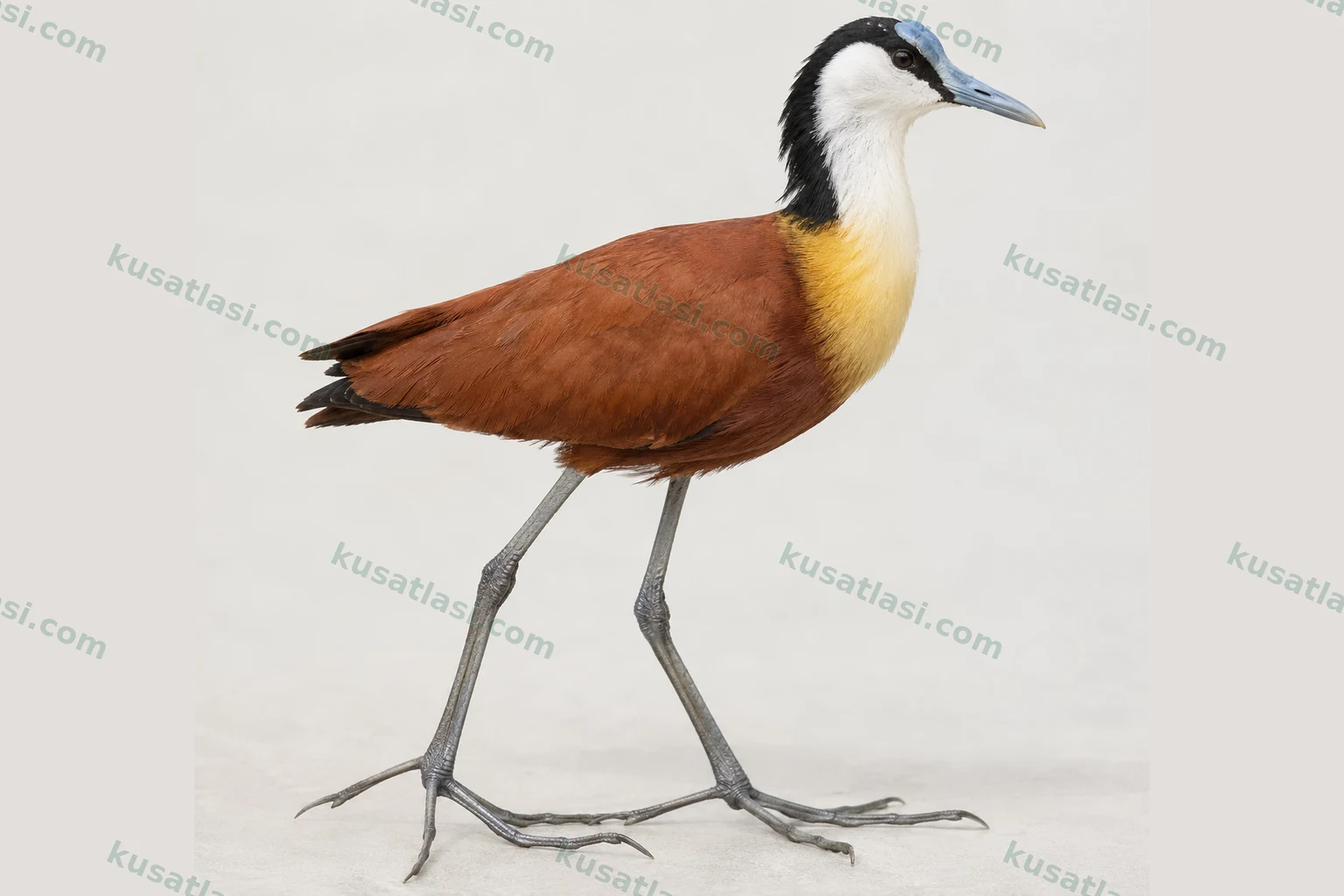
Adults share the same basic colours; females are generally larger. A blue bill is not exclusive to males, and the size of a single bird does not establish its sex with certainty.
Where to look in its natural range?
From afar, watch the head pattern and feet spread over leaves at a shallow water-lily margin.
There are no shared breeding months for all Africa. SABAP1’s egg-laying example for South Africa/KwaZulu-Natal peaks in November–March; breeding stages and peaks in the atlas’s other regions are not assumed to be the same.
January
Residency and movements depend on water; continuous presence does not mean that the same individual never moves. KwaZulu-Natal, South Africa, SABAP1: this month falls within the regional peak in egg laying.
February
Residency and movements depend on water; continuous presence does not mean that the same individual never moves. KwaZulu-Natal, South Africa, SABAP1: this month falls within the regional peak in egg laying.
March
Residency and movements depend on water; continuous presence does not mean that the same individual never moves. KwaZulu-Natal, South Africa, SABAP1: this month falls within the regional peak in egg laying.
April
Residency and movements depend on water; continuous presence does not mean that the same individual never moves. No verified regional date specific to this month was supplied; this does not imply local absence.
May
Residency and movements depend on water; continuous presence does not mean that the same individual never moves. No verified regional date specific to this month was supplied; this does not imply local absence.
June
Residency and movements depend on water; continuous presence does not mean that the same individual never moves. No verified regional date specific to this month was supplied; this does not imply local absence.
July
Residency and movements depend on water; continuous presence does not mean that the same individual never moves. No verified regional date specific to this month was supplied; this does not imply local absence.
August
Residency and movements depend on water; continuous presence does not mean that the same individual never moves. No verified regional date specific to this month was supplied; this does not imply local absence.
September
Residency and movements depend on water; continuous presence does not mean that the same individual never moves. No verified regional date specific to this month was supplied; this does not imply local absence.
October
Residency and movements depend on water; continuous presence does not mean that the same individual never moves. No verified regional date specific to this month was supplied; this does not imply local absence.
November
Residency and movements depend on water; continuous presence does not mean that the same individual never moves. KwaZulu-Natal, South Africa, SABAP1: this month falls within the regional peak in egg laying.
December
Residency and movements depend on water; continuous presence does not mean that the same individual never moves. KwaZulu-Natal, South Africa, SABAP1: this month falls within the regional peak in egg laying.
Nest, egg and incubation
The nest is a simple platform on aquatic plants. The South African expert account gives three–five eggs, usually four; only the male incubates for about 23–27 days and protects the chicks. Early nest departure does not mean flight or independence.
The bird gives coarse, repeated nasal-sounding calls and hurried, rasping notes, also heard in flight. This describes the natural bird voice.
Do not play recordings to attract birds; observe quietly, especially near nests.
Species information
Quick identification
The African Jacana Actophilornis africanus is a wetland bird with a chestnut breast and body, pale blue bill and white neck. Its most striking feature is the exceptionally long toes spread widely over floating leaves. In adults, the blue of the bill continues onto the bare frontal shield. The black crown and rear of the neck meet the white cheeks and front of the neck in a sharp pattern. A yellowish-golden area on the upper breast grades downwards into darker chestnut. Assess this colour arrangement together with the long toes and walking on plants in shallow water; do not rely on a patch that merely looks blue.
This bird cannot walk on bare water. Its foot rests on a water-lily leaf, plant stem or similar support; widely spread toes help distribute weight over a larger area. Water between leaves can give a shore observer the impression that the bird is standing on nothing. A photograph with the support outside the frame may create the same illusion. First checking the placement of the foot and pale blue bill, then the black-and-white head pattern, is more reliable.
General appearance and posture
Long legs lift the relatively small body above the vegetation. The bird may stretch its neck forwards while walking; leaning over a leaf makes the body appear more horizontal, whereas it raises its head to watch its surroundings. The dark back and wings join the chestnut tones of the breast. In strong light these areas may show redder or golden reflections; in shade the same bird can look darker brown. The white head area and pale blue bill offer a more useful starting point than this variable body colour.
Males, females and young birds
Adult males and females have a similar basic plumage pattern; females are generally larger. Neither the blue bill nor the chestnut body is exclusive to males. Even when birds stand together, age, posture and distance affect size comparisons.
Young birds have not developed the adult's completely blue bill and conspicuous frontal shield. The head is browner, the white stripe above the eye more noticeable and the underparts much whiter; the yellowish breast band does not replace the adult's extensive chestnut body. It is therefore wrong to reject a jacana immediately as another species because it lacks a blue bill. Very small chicks show pale and dark brown stripes above and white areas below; their feet also look large relative to their bodies. Juvenile appearance must not be presented as the normal plumage of an adult female.
Appearance in flight
Moving between nearby clumps of vegetation usually involves short flights low over the water. Long legs and toes may be visible behind the body, sometimes hanging down. With wings open, the dark flight feathers, chestnut body tones and white neck appear in different proportions. Because the leg length conspicuous on a walking bird may seem to disappear in flight, consider both postures together. Awkward-looking short flights do not mean that the species cannot travel between wetlands; ringed birds seen at other sites have been documented separately.
The rear edge of the wing is especially useful when distinguishing a young African Jacana from a Lesser Jacana. The latter's conspicuous white trailing edge and pale upperwing areas are not the same pattern as the adult African Jacana's dark flight feathers. Looking only at hanging legs in a brief, blurred flight image does not separate the two species. If you have not seen the wing pattern, consider the observation incomplete; do not flush the bird to make it open its wings. Disturbing a male that is foraging or guiding his chicks creates unnecessary disturbance for identification.
Voice and behaviour
The African Jacana gives repeated, coarse, nasal-sounding calls and more hurried, rasping notes; it may also be heard in flight. Written imitations vary between people, and one syllable does not provide certain identification. A better approach is to look for the long-toed bird, head pattern and movement where the sound originates. A call heard in flight does not by itself demonstrate daily presence on the same shore or breeding there; record the date and behaviour separately.
During breeding, a female may mate with more than one male; each male incubates his own eggs and cares for the young. Males associated with the same female must not be imagined as a team sharing incubation at one nest. Territorial defence by males and the female's pair relationships cannot be understood from one feeding moment. A male carrying chicks beneath his wings may present an unusual sight, with short legs dangling beneath his body. Do not misinterpret the carrier's anatomy; the extra feet may belong to chicks.
Similar species
1. The Lesser Jacana Microparra capensis is a genuine comparison to seek in the same vegetated wetlands. It is smaller and shorter-billed; its bill does not become the pale blue of an adult African Jacana. Its rufous crown and breast sides and white underparts can particularly resemble a young African Jacana. A white trailing edge to the wing helps in flight. Size alone is insufficient; combine the visible patterns of bill, head and wing.
2. The Lesser Moorhen Paragallinula angulata is a small moorhen of vegetated, seasonally flooded areas. The adult's mainly yellow bill and yellow legs and narrow white flank line are important. Young birds can be browner, so body colour alone misleads. Compare the jacana's blue bill-and-forehead area, white front of the neck and exceptionally long toes spread across leaves together. For a young bird whose feet are hidden by dense plants, wait for a better view rather than giving a definite identification.
World distribution
The African Jacana's natural range comprises suitable wetlands in sub-Saharan Africa. It extends broadly from the Senegal region in the west to Ethiopia in the east and onwards to water-dependent areas in the south of the continent. This broad geography does not imply presence on every piece of land in between. Desert, dry interiors or continuous closed forest are not equivalent to vegetated shallow freshwater margins. A coloured country on a map does not establish suitable habitat throughout that country either.
Status within its natural range
The southern African atlas highlights suitable wetlands of the Okavango, Zimbabwe, northeastern Namibia, Mozambique and eastern South Africa. These are regional findings from a historical atlas, not current individual counts or a ranking of abundance for all Africa. The current expert assessment places both global and South African regional status at low risk. Nevertheless, water management, drainage and loss of vegetation may affect local sites. A low-risk conservation category does not make a small wetland unimportant.
Observation points on the map show where the bird has been recorded; they are not accepted as breeding areas without eggs, young or verified nest information. The predicted range layer does not resolve every shore or temporary flood in detail either. Isolated records outside the natural breeding belt in particular require separate assessment before being added to the core range.
Movements
It may move among temporary wetlands as water levels change. Historical ringing records document an adult seen 186 km from its original site in Zimbabwe and another 300 km away in the former Transvaal; these are not annual migration routes followed by every bird. Seasonal models in the same atlas did not provide a regular return calendar across the continent. A definite African route drawn month by month is therefore not presented. Year-round presence at a pond and every individual there never moving are separate matters.
Breeding habitat
Shallow freshwater, aquatic plants that support walking and cover where chicks can hide are important for breeding. Seasonal floodplains, vegetated ponds and quiet margins of slow-flowing rivers may be used. Deep, unvegetated open water does not provide the same conditions as a water-lily margin. Rather than treating the presence of water alone as sufficient, look for leaves, stems and sheltered edges together.
Nest site
The nest is a simple heap of vegetation built on aquatic plants; its proximity to the water exposes it to level changes. The South African expert account reports three–five eggs, usually four, and approximately 23–27 days of incubation by the male. Different durations in other expert accounts are not merged by inventing a new average. Young leave the nest early; this does not mean that they can fly or live without a parent. Local breeding examples appear with their region in the calendar; common months are not imposed on all Africa.
Daily habitat use
Feeding mostly takes place on floating plants; the bird walks among leaves and sometimes reaches another patch by a short swim or flight. Taller plants can provide cover. Use of newly flooded areas does not make them permanent habitat; birds may leave when they dry out. Rather than approaching the shore to drive out a hidden chick, watch through existing openings. Do not enter the vegetation to see eggs or the platform; this easily disturbed little area must not be altered for an image.
What does it eat?
The African Jacana feeds mainly on insects. Diet records include small invertebrates in water and on plants, including some crustaceans, molluscs and spiders. Small fish have also been recorded, but the species must not be narrowly classified as a fish-eating bird. Some expert descriptions also mention seeds. Recording a food item does not imply equal frequency in every wetland or a fixed percentage of the diet.
How does it forage?
It spreads its long toes over plant surfaces as it moves and picks up small prey it sees with its bill. Leaf surfaces, stems and places near the water surface are feeding locations. Do not assume that every bill movement as the head dips and rises captures prey; selection and searching movements may also be seen. Gathering food from floating leaves differs from diving for fish in open water.
After leaving the nest, chicks begin collecting their own food while the male guides and protects them. This role must not be described as an adult putting every mouthful into the chick's mouth. Watching little chicks move over the plants helps reveal their own searching with their bills. There is no need to leave food or clear shoreline vegetation to make feeding easier; preserve the natural surface and cover the bird uses.
What the long toes do
The African Jacana's feet initially seem disproportionately large. Spreading the toes widely allows movement over floating plants. The support is the leaf; an explanation claiming that water's surface tension holds up the adult is incorrect. Chicks' large-looking feet make this habitat-adapted structure noticeable early in life. The difference between open and plant-covered water can matter at a finer scale when searching for this bird than a coloured range map shows.
Incubation does not always mean warming
Warwick Tarboton's 1993 study shows that males change their behaviour at the nest with temperature. Shading eggs with the body in hot conditions differs from sitting on them in cold conditions. Controlled observations of egg temperature in the study also demonstrated the importance of shade. A male not sitting on the eggs must therefore not immediately be considered to have abandoned the nest. The researcher's suggestion that a warm climate may have facilitated the evolution of this care system is an explanatory proposal, not presented with the same certainty as directly observed behaviour.
One female, males with separate broods
The mating system does not mean that males share shifts at the same nest. A female may associate with several males; the father tending eggs and chicks cares for his own brood. Studies of territorial defence between males, pair relationships and nest losses show that this arrangement cannot be explained by one snapshot. Several chick feet visible beneath a wing are an unusual but real view of carried chicks, not evidence that the adult has extra legs.
Nest departure, first flight and independence
The South African expert synthesis states that chicks can leave the nest shortly after hatching and first fly at approximately 39–44 days of age. Earlier flight or longer care periods reported in other accounts do not justify selecting one average age. Nest departure, first flight and independence from parents are distinct stages. A tiny chick walking along the shore should not immediately be judged in need of help because it appears alone; the nearby male may be within the vegetation.