

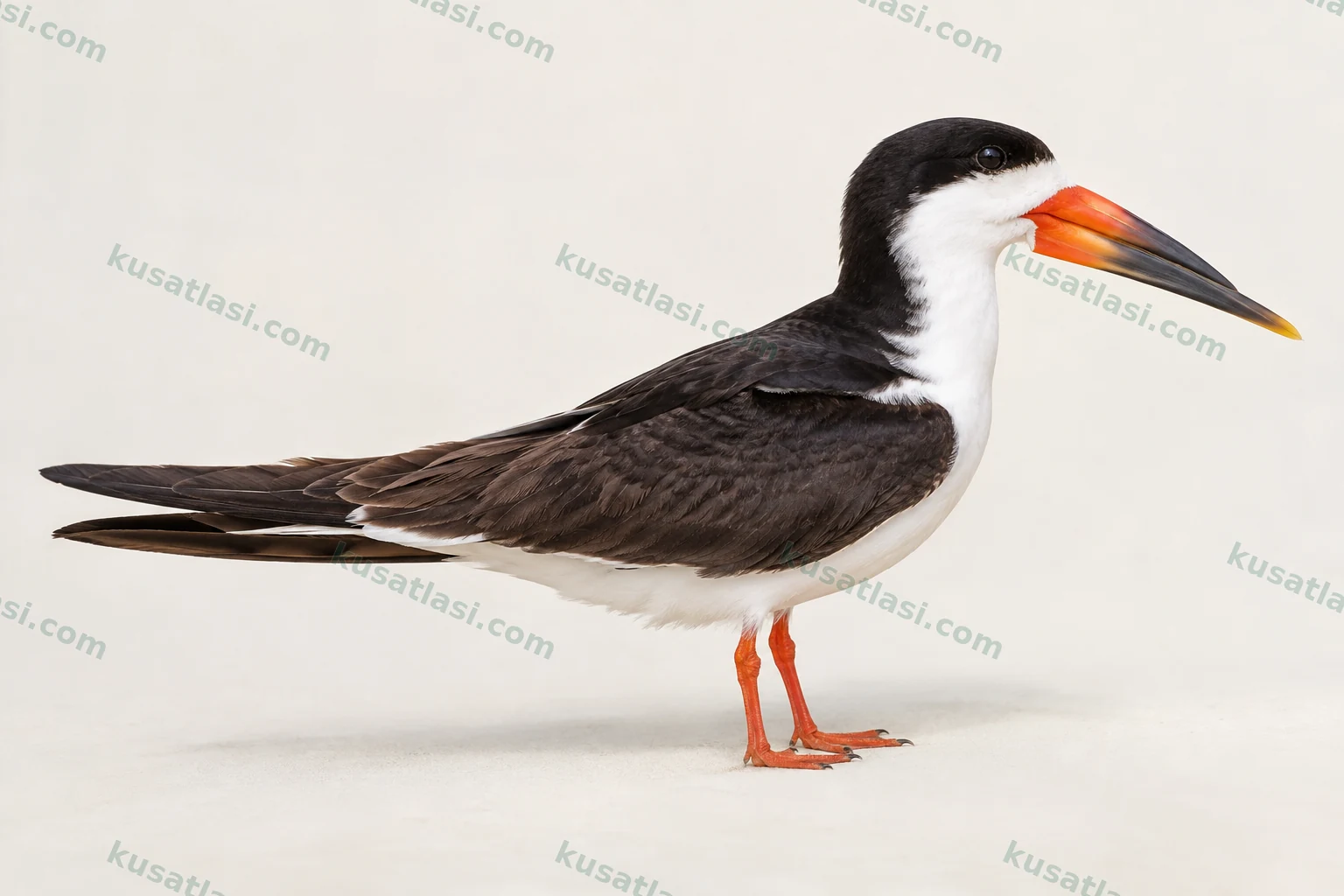
World Birds IUCN statusLC · Least ConcernGlobal IUCN category. BirdLife v10 (2025); taxon matching: AviList 2026 / IOC 15.2; checked: 29.10.2026. The list year is not the species assessment date. Source and method · BirdLife OrderCharadriiformesShorebirds, gulls and allies FamilyLaridaeLaridae
African Skimmer
Rynchops flavirostris
A river bird with a lower bill longer than the upper, dark upperparts and white underparts; it flies close to the water surface and catches small fish by touch.
Biometrics
Length
Male36–42 cm
Female36–42 cm
Shared species value
Wingspan
Male106 cm
Female106 cm
Shared species value
Weight
Male190–225 g
Female111–153 g
African Skimmer
Suitable sandbanks of large rivers and lakes in sub-Saharan AfricaObservation guide in its natural range
Look for three features together
Do not rely on a single featureThe lower part is distinctly longer; a side view is diagnostic.
White underwings and a white band at the rear of the upperwing.
Open sandbanks on large waters; not every record is nest evidence.
Compare male and female
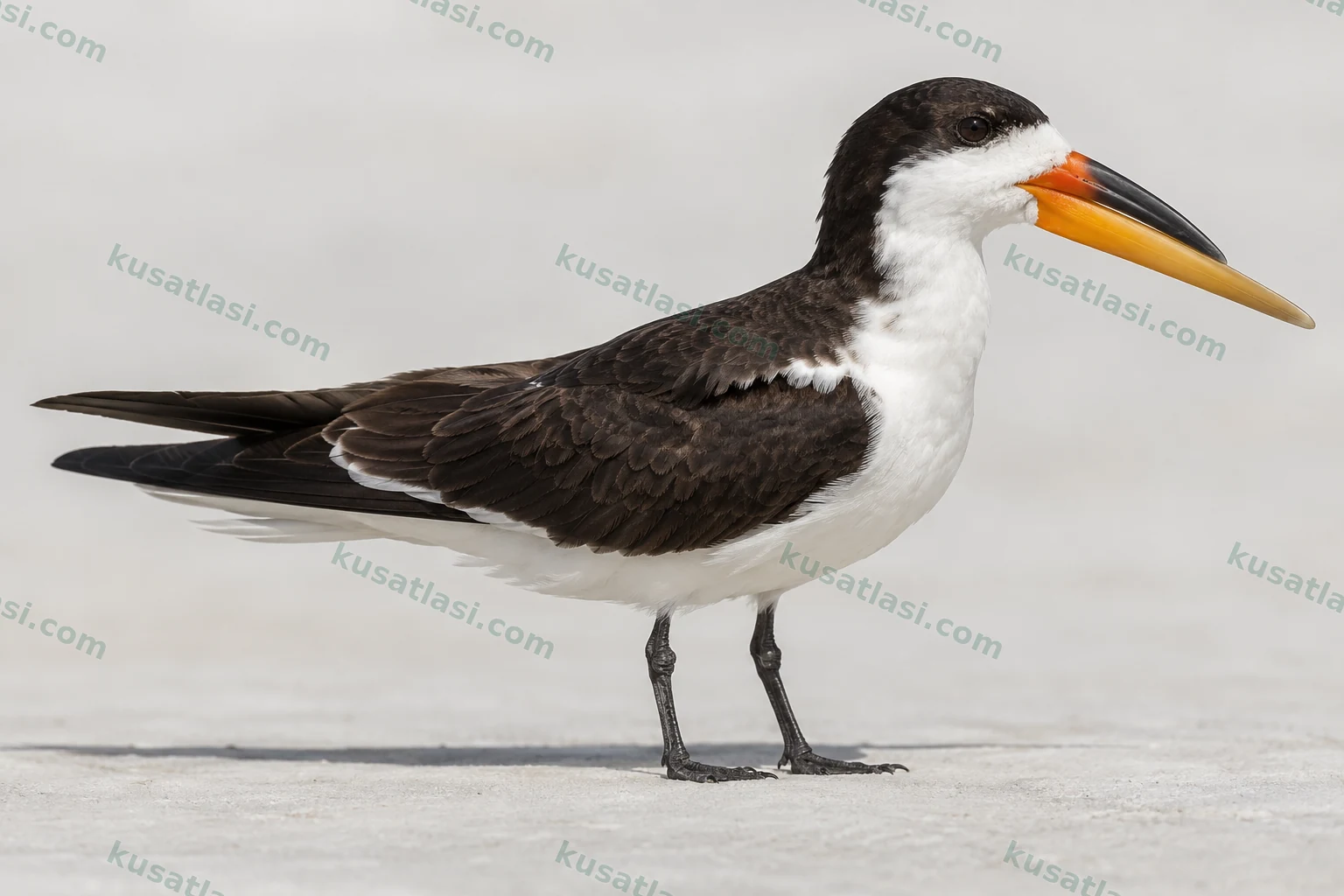 FemaleMale
Adults share their colour pattern; distant size comparisons do not reliably determine sex. Leaving the nest scrape does not mean a chick can fly.
Where to look in its natural range?
Watch sandbanks from the shore at a distance; do not approach resting or nesting groups.
Breeding activity and egg laying in the southern African atlas are shown separately; they are not generalised to other regions.
January
It moves within Africa in response to water regimes; regular individual routes have not been verified. No verified regional date specific to this month was provided; this does not imply local absence.
February
It moves within Africa in response to water regimes; regular individual routes have not been verified. No verified regional date specific to this month was provided; this does not imply local absence.
March
It moves within Africa in response to water regimes; regular individual routes have not been verified. No verified regional date specific to this month was provided; this does not imply local absence.
April
It moves within Africa in response to water regimes; regular individual routes have not been verified. No verified regional date specific to this month was provided; this does not imply local absence.
May
It moves within Africa in response to water regimes; regular individual routes have not been verified. No verified regional date specific to this month was provided; this does not imply local absence.
June
It moves within Africa in response to water regimes; regular individual routes have not been verified. No verified regional date specific to this month was provided; this does not imply local absence.
July
It moves within Africa in response to water regimes; regular individual routes have not been verified. Southern African atlas: breeding activity.
August
It moves within Africa in response to water regimes; regular individual routes have not been verified. Southern African atlas: breeding activity. Zambezi 1986–1987 research: egg observations.
September
It moves within Africa in response to water regimes; regular individual routes have not been verified. Southern African atlas: breeding activity. Zambezi 1986–1987 research: egg observations.
October
It moves within Africa in response to water regimes; regular individual routes have not been verified. Southern African atlas: breeding activity. Zambezi 1986–1987 research: egg observations.
November
It moves within Africa in response to water regimes; regular individual routes have not been verified. Southern African atlas: breeding activity.
December
It moves within Africa in response to water regimes; regular individual routes have not been verified. Southern African atlas: breeding activity.
Nest, egg and incubation
The nest is a scrape in sand; the Zambezi study mostly recorded two to three eggs. Roberts gives two to four eggs and about 20–22 days of incubation by both adults; leaving the scrape in the first days, first flight at five to six weeks and later continued feeding are separate stages.
A short, muffled call; separately verify the identity of the calling bird on the same sandbank.
Do not play recordings to attract birds; observe quietly, especially near nests.
Species information
Quick identification
African Skimmer Rynchops flavirostris is a black-and-white waterbird recognised on river and lake sandbanks by its long wings and unusual bill. The lower bill is distinctly longer than the upper one. When feeding, it flies just above the water, dipping the lower bill into the surface to catch small fish by touch. This differs from an ordinary tern’s plunge into water. A black head and pale body alone are insufficient; the long lower bill, wing pattern and movement across the water are assessed together.
The English name African Skimmer matches this taxon. Black Skimmer Rynchops niger is a separate American species; sharing a feeding method is no reason to transfer its measurements or breeding information to the African bird. A distant black-and-white bird on an African river should first be compared with local terns. Recording a flight silhouette as a definite skimmer without seeing the bill profile creates needless certainty, especially against the light.
General appearance and posture
The upperparts are dark and the underparts white; the long wings stand out beside the body when resting. The orange bill may look more yellowish towards the tip. A side view of its two parts reveals the distinctive difference in length; a front view can hide it. Sand or another bird may conceal the bill of an individual holding its head down. Do not exclude the species because the lower bill seems absent before the viewing angle changes.
Resting on sand and feeding at the surface involve different postures. The short tail and long wings of a standing bird may not give the same proportions as the slim body in flight. Wet feathers also change the shine of dark areas and tone of white ones. Backlighting may turn the whole body into a black shape; record wing, neck and bill proportions rather than colours in that case. Terns resting on the same bank help compare apparent size only if they are at a similar distance.
Males, females and young birds
Adult colours are shared by both sexes. Seeing an apparently larger bill, body or wing from a distance is not reliable sexing; no independently sourced threshold for sex is being used. Both adults incubate and care for the young. The bird at the nest must not automatically be labelled female and the one bringing fish male. If an individual’s identity is known during a care event, it can be recorded; otherwise it is described as a caring adult.
A chick and a flying young bird are not at the same developmental stage. Zambezi studies recorded flightless chicks separately from flying young beside adults. Leaving the nest scrape early also does not mean having learned to fly or feed independently. A young bird’s exact age in days must not be calculated from apparent size alone. Using a broader description such as chick or young bird when detailed age plumage cannot be verified does not reduce the record’s value.
The Roberts specialist account states that chicks leave the nest scrape within the first days, first fly at about five to six weeks and continue receiving food from adults for some time afterwards. These stages are not interchangeable. A small chick walking on the shore may still be flightless; appearing alone does not mean it has been abandoned either. People blocking parental approach may change the natural care behaviour rather than observe it.
Appearance in flight
Long wings and a short tail create a tern-like but distinctive flight appearance. The Cornell account notes the strongly white underwing and white band along the rear of the upperwing. Upper and lower surfaces must be considered separately: whiteness seen below does not make the whole upperwing white. A turning bird may show both in sequence; noting which surface appears in a photograph helps interpret the pattern.
Feeding flight is very close to the water. The lower bill travelling at the surface, the bill closing after contact with a small fish and continued flight form a behavioural sequence. Not every pass across the surface catches prey. A short movement towards the water does not alone show the complete sequence. A few circuits around a resting island are not long-distance migration; the scale and purpose of movement need separate assessment.
Voice and behaviour
The Cornell account describes a short, muffled call. Sounds heard in flight or beside a group may help, but other waterbirds also call on the same sandbank. Do not assign a sound definitely without seeing the bird open its bill or another observation linking the sound to it. A verbal sound description helps understand natural behaviour; another skimmer species’ voice must not be used under the same name.
It may rest and nest in small groups. Birds close together on sand do not mean that every individual has a nest there. Specialist sources describe twilight and night feeding as well as daytime resting; hunting by day may also occur while feeding chicks. One hour of observation therefore does not represent its entire daily activity. Birds taking off as people approach the bank may show that observation has changed behaviour, not that the area is unused.
Similar species
Hydroprogne caspia is one of the most realistic comparisons at a distance or in poor light. Its thick red bill is conspicuous, but the lower part is not extended as in a skimmer. Its upperparts look paler grey and it captures prey by plunging into the water. A reddish bill alone does not establish African Skimmer; bill profile, dark upperparts and feeding action must be seen together.
Sterna hirundo has a slimmer bill and a pale grey body; an adult’s black cap does not mean a black back. Pale upperwings and ordinary proportions of the two bill parts distinguish it from a skimmer. Non-breeding and young plumages may differ from the adult breeding cap. Flying over the same water or carrying fish is shared behaviour; without seeing the long lower bill, behaviour alone does not determine the species.
Global distribution
The species is patchily distributed across suitable large rivers, lakes and lagoons of sub-Saharan Africa. It extends from western Africa towards Sudan and eastern Africa, and south to the Zambezi, Chobe and Okavango systems. It does not form a waterbird belt covering most of each country; birds gather where usable sandbanks and prey access are suitable. Old Egyptian records or rare visitors farther south do not make every intervening area a regular breeding range.
Status within its natural range
The South African surroundings lie at the southern edge of the main populations. The older atlas describes historical loss of breeding, whereas the 2025 regional assessment also considers later rare attempts. An older extinction statement must therefore not be read as the entire species being extinct today. Global Least Concern and the vulnerability of a small irregular regional population operate at different scales. The safety of a few local pairs does not become unimportant because the global category is low.
Migration and movements
Within-continent movements relate to river water regimes. The southern regional atlas describes arrivals in Zimbabwe in late April–May, in the Okavango area in June, and later departures when rain floods sandbanks. These are dated regional examples, not the same day every year or one route throughout the continent. Map observation points do not separate feeding, resting and breeding. Without individual tracking, no migration line is added between them.
Breeding habitat
Open sandbanks and low islands exposed as water recedes provide nest sites. A large lake alone is insufficient; suitable ground, accessible fish and the level of disturbance all matter. The 2017 study around Kariba compared these features at different sampling points. Findings belong to that study area; a particular sand moisture or fish density is not made an obligatory threshold throughout Africa.
Nest site
The nest is a scrape in sand. The 1986–1987 Zambezi study found two to three eggs in most clutches and recorded care by two adults. The Roberts account gives a broader two to four eggs and about 20–22 days of incubation by both sexes; the two sources are not combined into a new range. Chicks leave the scrape within the first days, but adults shade and feed them. Walking on open sand may harm unnoticed eggs and chicks.
Daily use of space
A resting sandbank and feeding water may lie together but serve different functions. Sudden water-level changes, boat wash and human or animal traffic may affect low nests. Adults taking off together or showing defence are sufficient reason to stop approaching. Watching movements along feeding shores from afar is safer than entering the sandbank to see the same behaviour closer.
What does it eat?
Small fish form the basis of the diet. Different fish records in the Roberts account show that it is not specialised on a single species; availability may vary by region and water conditions. A photograph cannot identify the fish species of every small item taken at the surface. Carrying a fish is a reliable feeding event, but that event alone cannot establish a whole group’s daily intake or proportions of prey types.
How does it hunt?
In flight it draws its long lower bill through the water surface, closing the bill to seize prey upon contact. This differs from terns plunging fully into water. Night and twilight feeding are also described; daytime foraging may occur during care of young. Catching by touch does not mean it has no need to see its surroundings. Safe low flight and access to prey matter too.
The Kariba study found an association between bird numbers and local fish access; human fishing also concentrated in the same fish-rich areas. This does not mean the bird follows every fisher or that human traffic is beneficial. Food and disturbance may coexist at one site. Recording hunting success, water conditions and human activity separately prevents these different effects from being confused.
Bill parts of unequal length
The long lower bill explains the bird’s name and feeding method. This part travels through the water surface and contacts prey; the upper part closes to hold it. The difference is not merely an ornament or sex character. A head turn can hide the proportions, so one frontal photograph may not show the whole structure. Assessing bill profile with behaviour helps explain how this special structure works.
Parental care on hot sandbanks
The 1986–1987 Zambezi study recorded adults drinking, wetting their belly feathers and shading small chicks in hot conditions. This is a direct observation of African Skimmer, not a transfer from an experiment on a skimmer on another continent. Protecting chicks on sand involves more than bringing food. Disturbance preventing adults from remaining nearby may interrupt other aspects of care too.
Seeing young and verifying nests
The 2017 Kariba paper describes young birds and limited breeding signs, while also discussing that active nesting groups were not found during the research. The distinction matters. Flying young may have grown up elsewhere, while a flightless chick’s location provides stronger local evidence. The researchers’ assessment cannot be expanded to make every counting point a definite nest site. What accumulated records do not show must be retained along with what they show.
The same river, a different shore over time
Dams, floods and developing bank vegetation can alter sandbank shape. An old atlas nest point may no longer have the same suitable ground years later. Current records therefore need comparison with older information. Retaining the country name alone does not guarantee preservation of local habitat. A global conservation category and change along one river answer different questions; they should not be turned into one judgement under the same heading.