

World Birds IUCN statusNT · Near ThreatenedGlobal IUCN. BirdLife v10 (2025); taxon matching AviList 2026 / IOC 15.2; checked: 29.10.2026. The list year is not the species’ assessment date. Source and method · BirdLife OrderCharadriiformesShorebirds, gulls and allies FamilyLaridaeLaridae
White-fronted Tern
Sterna striata
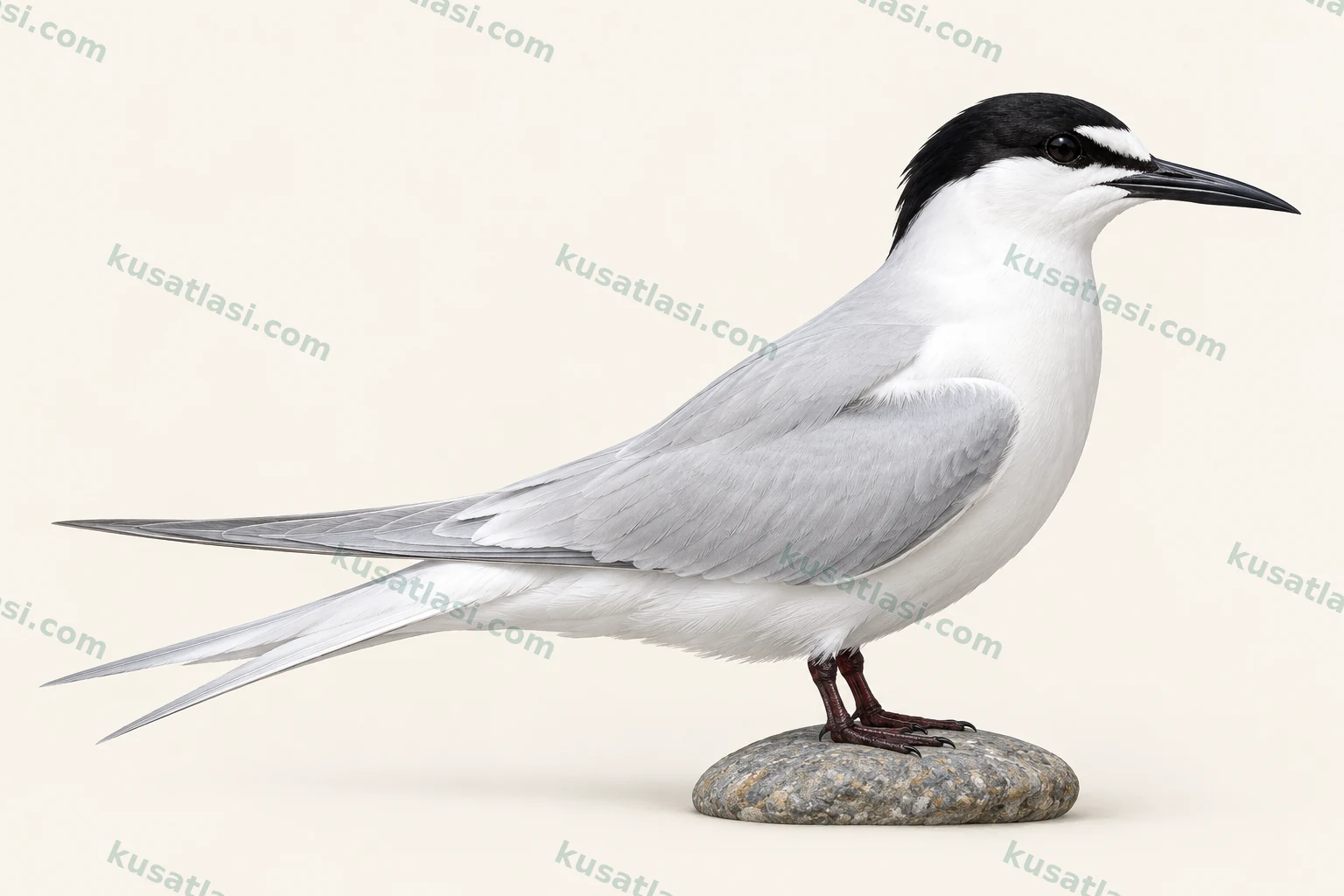
A pale marine tern of New Zealand and nearby islands; in breeding plumage a narrow white forehead strip remains between black bill and black crown.
Biometrics
Length
Male39–42 cm
Female39–42 cm
Shared species value
Wingspan
Male79–82 cm
Female79–82 cm
Shared species value
Weight
Male103–160 g
Female103–160 g
Shared species value
White-fronted Tern
New Zealand, surrounding islands and southeastern Australian coastsObservation guide in its natural range
Look for three features together
Do not rely on a single featureNarrow white strip in breeding plumage; more extensive white outside breeding.
Very pale-grey upperparts and white underparts, sometimes with a temporary pink tinge.
Long and deeply forked; outer feathers are shorter in young birds.
Compare male and female
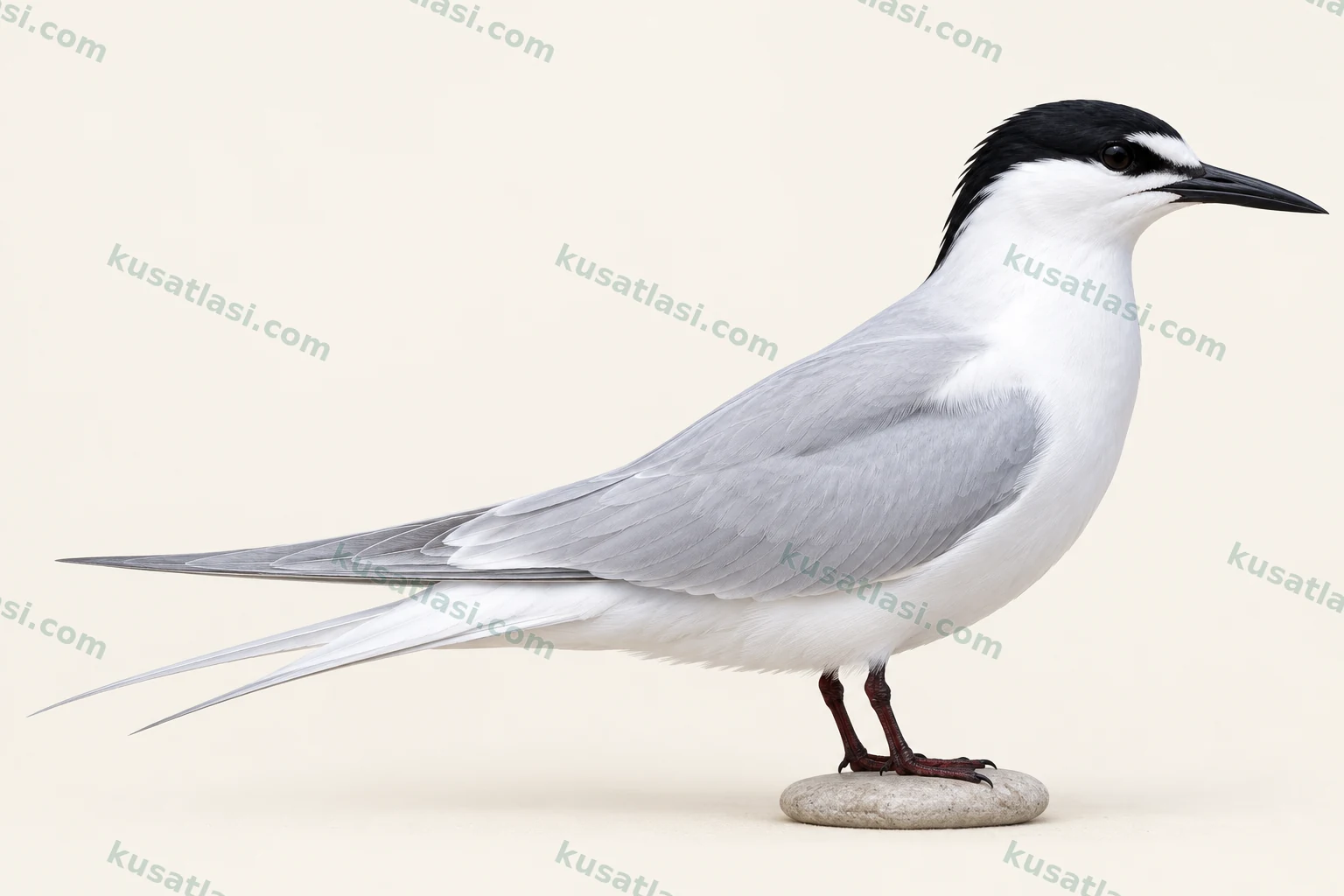 FemaleMale
Adult sexes are similar; a pink lower body can occur in both. Young birds are dark-streaked above and have shorter tails.
Where to look in its natural range?
Coastal sea, fish shoals, lagoons and gravel shores; observe without approaching the colony.
Australasian sources give October–February as the broad breeding period; some New Zealand studies emphasise October–January.
January
Most remain in New Zealand; some, especially immature birds, disperse to Australia in autumn. New Zealand and the Tasmanian region — specialist museum account: a broad breeding period, with local variation in start and end.
February
Most remain in New Zealand; some, especially immature birds, disperse to Australia in autumn. New Zealand and the Tasmanian region — specialist museum account: a broad breeding period, with local variation in start and end.
March
Most remain in New Zealand; some, especially immature birds, disperse to Australia in autumn. No verified regional date specific to this month was provided; this does not mean local absence.
April
Most remain in New Zealand; some, especially immature birds, disperse to Australia in autumn. No verified regional date specific to this month was provided; this does not mean local absence.
May
Most remain in New Zealand; some, especially immature birds, disperse to Australia in autumn. No verified regional date specific to this month was provided; this does not mean local absence.
June
Most remain in New Zealand; some, especially immature birds, disperse to Australia in autumn. No verified regional date specific to this month was provided; this does not mean local absence.
July
Most remain in New Zealand; some, especially immature birds, disperse to Australia in autumn. No verified regional date specific to this month was provided; this does not mean local absence.
August
Most remain in New Zealand; some, especially immature birds, disperse to Australia in autumn. No verified regional date specific to this month was provided; this does not mean local absence.
September
Most remain in New Zealand; some, especially immature birds, disperse to Australia in autumn. No verified regional date specific to this month was provided; this does not mean local absence.
October
Most remain in New Zealand; some, especially immature birds, disperse to Australia in autumn. New Zealand and the Tasmanian region — specialist museum account: a broad breeding period, with local variation in start and end.
November
Most remain in New Zealand; some, especially immature birds, disperse to Australia in autumn. New Zealand and the Tasmanian region — specialist museum account: a broad breeding period, with local variation in start and end.
December
Most remain in New Zealand; some, especially immature birds, disperse to Australia in autumn. New Zealand and the Tasmanian region — specialist museum account: a broad breeding period, with local variation in start and end.
Nest, egg and incubation
The nest is a shallow ground scrape, sometimes with stones, shell fragments or plant pieces. It holds 1–2 eggs, rarely three; incubation lasts 24–27 days and first flight occurs at 29–35 days. Both parents provide care.
It gives a thin high contact call and harsher scraping sounds in colony defence.
Do not play recordings to attract birds; observe quietly, especially near nests.
Species information
Quick identification
White-fronted Tern Sterna striata is a pale seabird with a long forked tail from New Zealand and surrounding areas. In breeding plumage, a narrow white forehead strip remains between black crown and black bill. Pale-grey upperparts, white underparts, thin dark bill and long tail support identification together. A white forehead alone is insufficient; other terns can also have pale foreheads outside breeding plumage.
On a resting coastal bird, the outer tail feathers can extend beyond the closed wingtip. Slender wings and forked tail become clearer in flight. Its widespread occurrence in New Zealand may assist identification, but not every tern on the same shore is assumed to be this species. Head, bill, upperparts and tail are checked on the same individual.
General appearance and posture
The head is conspicuous relative to the body; the bill is long, thin and mostly straight. Back and upperwings are very pale grey, underparts white. In bright light, the upperparts may look nearly white. A thin dark line lies along the leading edge of the outer flight feather when seen at a suitable angle. This does not mean that the whole wing carries an extensive black surface.
A faint pink tinge sometimes develops on the lower body in breeding plumage and can occur in both sexes. It is not expected equally strongly in every bird or regarded as female-only. Wear in dark feathers can make the wingtips more evident. The actual feather pattern is distinguished from translucence caused by backlighting.
Males, females and young birds
Adult males and females have similar general plumage. Although the specialist account describes females as slightly smaller, the distant size of one bird does not reliably establish its sex. Bill colour or the forehead strip does not give a definite male–female identification. Food presentation can be observed during courtship; a guess based on appearance and an observed behaviour are recorded separately.
In breeding plumage, the black cap reaches behind the nape, but a narrow white strip remains between it and the bill base. Outside breeding, the black retreats, leaving a broader white forehead. This is seasonal adult plumage, not an automatic indication of female sex or young age. Legs may vary from blackish to dark reddish brown.
Recently fledged birds have fine dark streaks and pale-brown spotting on the back and wing coverts. Their tails do not yet carry the adult’s long outer feathers and may not project as far beyond the closed wingtip. Growing, moulting young birds gradually acquire appearances resembling nonbreeding adults. Tail length alone is not turned into a precise age in days or months during these stages.
First flight and first breeding are separate events. Young birds can still receive food from parents after they can fly. Flying alone does not mean that a young bird is a fully independent, breeding-capable adult.
Appearance in flight
Long narrow wings combine with a deeply forked tail. The tail may be spread to varying degrees during turns and approaches to small fish. The upperwing is pale grey and underwing mostly white, with possible thin dark marks at the outer tips. Darkness may increase slightly in worn feathers. One shaded flight frame does not establish broad black wingtips or certain sex.
The bird can hover briefly while searching over water and plunge towards the surface. A group circling over the sea may be feeding, not tracing a migration route directly. Flight far from shore does not necessarily indicate breeding in the open ocean either. Following where it lands or takes food helps explain the context.
Voice and behaviour
It gives a thin high contact call and harsher scraping sounds in nest defence. Many birds calling together in a colony can create conspicuous noise. It may react to an approaching person or predator with diving attacks, indicating that an observer has come too close to nests. Increase distance instead of provoking repeated defence for photographs.
Courtship feeding in which a male offers a small fish to a female can be seen before laying. Pair bonds can persist between seasons, but an unchanged lifelong partnership is not a certain rule for every pair. Dense breeding colonies and feeding flocks over the sea are different communities. Hundreds of birds together do not establish an equal number of nests at that point.
Similar species
Sterna hirundo and Sterna paradisaea may show similarly pale foreheads, especially outside breeding. White-fronted Tern gives a larger, paler impression; bill, tail, wing pattern and extent of head black are compared together. A white forehead alone is not decisive in every season.
Sterna dougallii can also be very pale and long-tailed. The narrow white forehead strip in breeding plumage should be seen together with bill and wing edges. A faint pink underside is not treated as one species’ certain signature. Tail projection alone is insufficient when the viewing angle is incomplete.
New Zealand’s Chlidonias albostriatus looks smaller and darker. Hydroprogne caspia is much larger with a powerful red bill. These proportional and bill differences help in mixed coastal groups, but one distant bright spot is still not assumed to establish identity.
World distribution
Breeding centres on New Zealand’s coasts and surrounding islands, including Stewart, Chatham and Auckland islands. Breeding also occurs on Flinders and Cape Barren islands in the Furneaux group of Bass Strait. The species is therefore not described as endemic only to New Zealand. Southeastern Australian coasts are important, particularly for postbreeding birds.
Status within its natural range
The global category is Near Threatened. Its declining classification under New Zealand’s own conservation system is a separate assessment; the two systems are not merged as one label. Although large gatherings are sometimes seen on coasts, breeding populations have declined in some regions. Unverified older high population estimates are not used as a current total.
Australian records extend from southern Queensland to coastal New South Wales and Victoria, Tasmania and parts of the South Australian coast. Feeding can also be observed over New Zealand’s large Canterbury rivers, although the species generally remains near the coast. One inland-water record does not establish breeding throughout the country’s interior.
Migration
Most New Zealand birds remain in the region in winter. Some, especially juvenile and immature birds, disperse to southeastern Australia in autumn. Describing every individual as an obligatory migrant or every individual as completely immobile is therefore incomplete. Movements of Tasmanian breeders are left uncertain in the specialist museum account. No exact monthly route is drawn over sea without observations.
Breeding habitat
Coastal sand, gravel river islets, rock ledges, small islands and coastal cliffs can support colonies. Nests on bare ground in dense colonies contain eggs that can be difficult to notice. October–February is given as the broad breeding period; some New Zealand studies emphasise October–January. Local dates and breeding stages are not used as though all coasts begin on the same day.
Nest site
The nest is usually a shallow scrape in sand or soil, sometimes containing small stones, shell fragments or plant pieces. More developed plant structures have also been recorded on rocks. Typical clutches contain one egg or two, with three rare. The handbook gives about 24 or 25–27 days of incubation from different sources; the verified 24–27-day scope is retained here. First flight is recorded at 29–35 days. Do not enter between nests or obstruct parents’ protection of eggs and chicks.
Daily habitat use
Coastal sea, bays, lagoons and sometimes river surfaces are used when searching for fish. A colony can change site the next year even after a successful season. Floods and high water affect short-lived nesting areas. This variability prevents concluding that an entire region has been abandoned from one apparently empty former site. Keep dogs out of nesting areas and leave natural passage routes open.
What does it eat?
Small fish and fish larvae are the principal food. It can forage at sea, in lagoons and on rivers. At sea, gatherings over dense fish concentrations with kahawai fish, gulls and shearwaters have been recorded. This does not imply constant fish theft from other birds or dependence on one fish species throughout the year.
How does it hunt?
It searches over water, can hover briefly, and takes fish by plunging to the surface or probing it. Specialist sources describe dives from about 5–10 metres, but every attempt need not start at the same height. Rough water, rocks and reef surroundings can be feeding areas. Seeing the moment a fish is taken distinguishes an attempt from successful feeding.
Offering fish in courtship and carrying fish to young are behaviours distinct from an adult feeding itself. A bird returning shoreward with a fish may suggest chick care, but no certain breeding record is made without seeing the recipient. The forked tail’s contribution to steering also shows the value of watching flight posture for identification.
The scientific name comes from the young bird’s streaks
The name striata refers to fine dark streaks on the upperparts of newly flying young. The historical description was based on a young bird. Expecting the same conspicuous streaks on an adult’s plain pale-grey back would be wrong. Knowing which age appearance a name describes helps assess adults and young separately.
The colony may not return to the same place every year
New Zealand studies show that colony location can be highly variable. Another site may be selected even after successful breeding. Gravel islands, estuaries and coastal surfaces change with water, so an old nest site is not a permanent address. Following ringed birds provides a longer context than one year’s observation alone.
Leaving the nest is not flying
A small chick can move to a safer nearby place before it can fly. The handbook records a two-day-old chick brooded beneath a nearby rock. This movement is not the day of first flight. Food received from parents after flight also represents a different period from first flight itself.
One predator observation does not explain the whole decline
Chick predation by Circus approximans was observed directly on the Noises Islands. A 2023 publication reports the record and discusses a possible effect on local breeding success; it does not say that this single factor is proven to explain the entire long-term regional decline. Observed predation, possible cause and overall population trend are different information types.
Age at breeding is not one fixed number
The original study following ringed birds at Kaikoura found some breeding at three years of age and many starting later. This regional sample does not mean that every bird begins on a specific birthday. Records of known-age individuals are stronger than guesses based on adult appearance alone.