

World Birds IUCN statusEN · EndangeredGlobal IUCN category. BirdLife v10 (2025); taxon matching: AviList 2026 / IOC 15.2; checked: 29.10.2026. The list year is not the species assessment date. Source and method · BirdLife OrderAnseriformesDucks, geese and allies FamilyAnatidaeAnatidae
Maccoa Duck
Oxyura maccoa
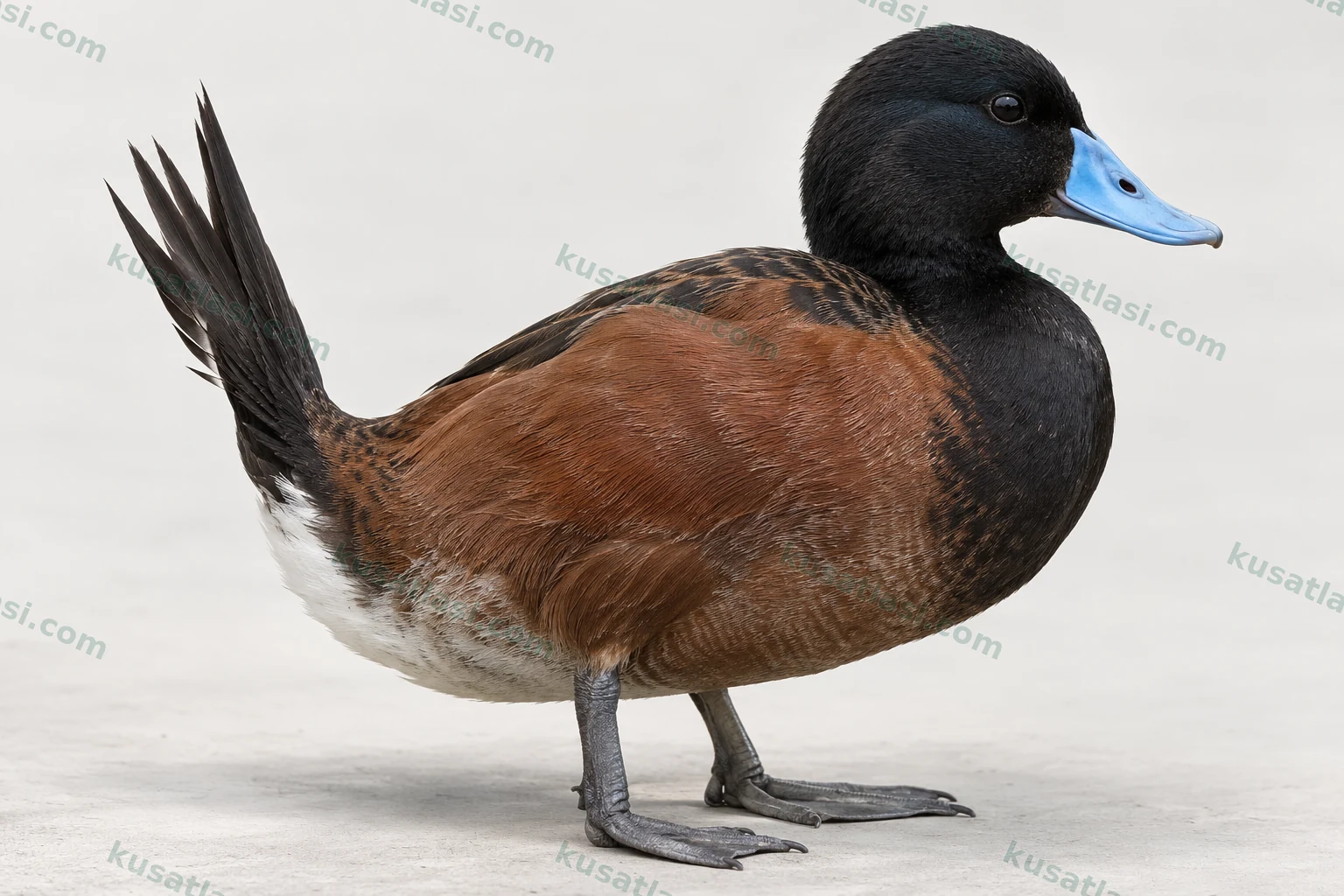
It is a compact diving duck with a stiff tail, riding low in the water. The breeding male’s dark head, chestnut body and blue bill, or the female’s horizontal pale facial line, are assessed together.
Biometrics
Length
Male46–51 cm
Female46–51 cm
Shared species value
Wing length
Male15.64 cm
Female15.64 cm
Shared species value
Weight
Male820 g
Female516–720 g
Maccoa Duck
Suitable wetlands of the Ethiopian highlands, East Africa and southern AfricaObservation guide in its natural range
Look for three features together
Do not rely on a single featureThe tail may be upright or close to the surface; one posture does not exclude the species.
The dark head, chestnut body and blue bill are sought together on the same bird.
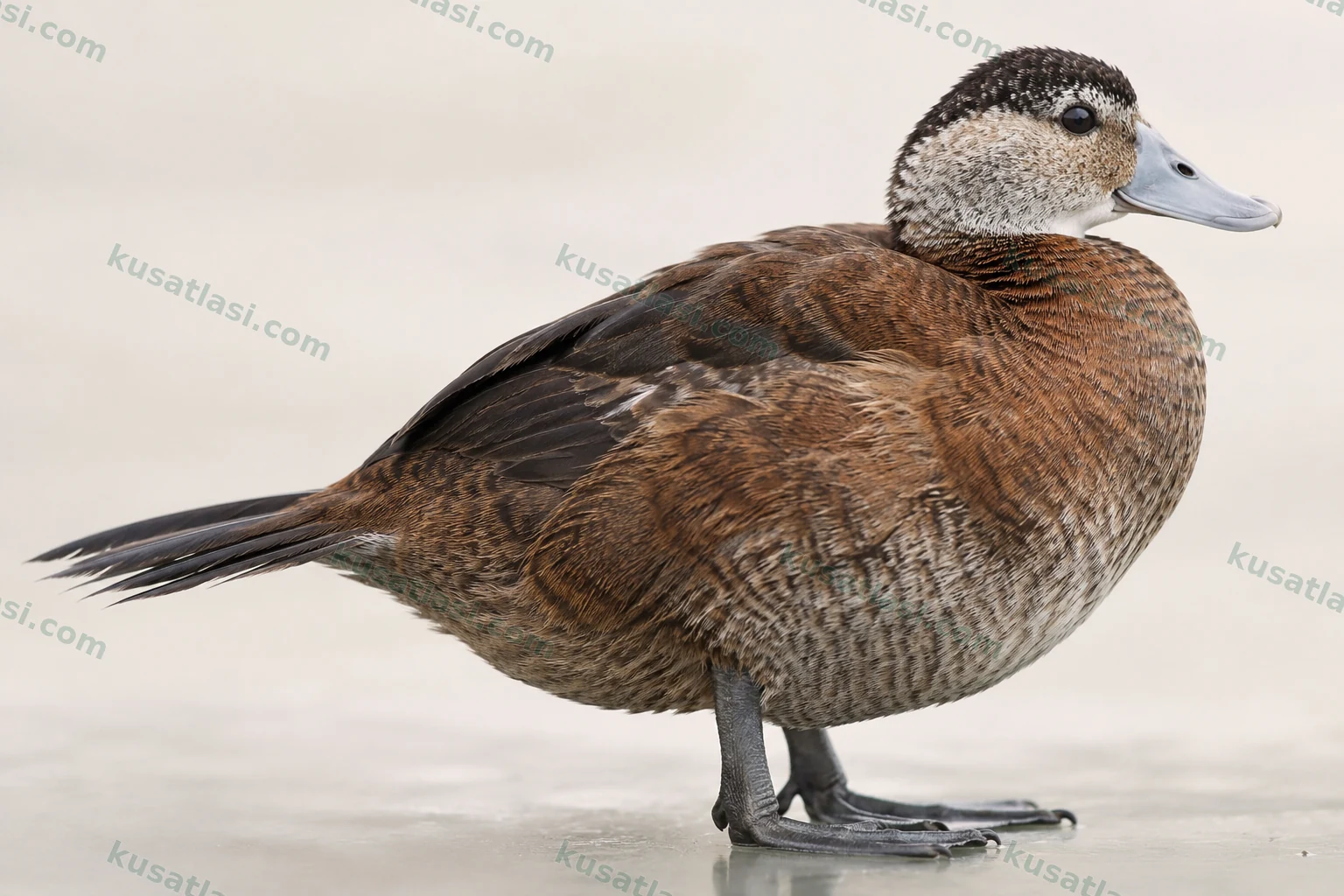
The pale line extending backwards below the eye is assessed with bill and body shape.
Compare male and female
 FemaleMale
The breeding male’s dark head, blue bill and chestnut body are distinctive. Females and males outside breeding plumage may look alike; sex is not determined with certainty in poor light.
Where to look in its natural range?
From existing shore viewpoints watch open water and reed edges. Do not approach mothers with young or nest cover, or try to flush ducks.
Breeding times vary with water conditions and region. The AEWA account gives August–January for Western Cape, concentrated in October–November, and breeding in different months for some northern South African regions and Zimbabwe. This range is not applied throughout the distribution.
January
Local movements among wetlands are possible; presence at the same place each month is not assumed. This month is within the regional August–January breeding interval reported for Western Cape. Some other southern African regions have year-round breeding records.
February
Local movements among wetlands are possible; presence at the same place each month is not assumed. This month is outside the main interval reported for Western Cape; this does not mean absence of the species or of breeding throughout the range. Some other southern African regions have year-round breeding records.
March
Local movements among wetlands are possible; presence at the same place each month is not assumed. This month is outside the main interval reported for Western Cape; this does not mean absence of the species or of breeding throughout the range. Some other southern African regions have year-round breeding records.
April
Local movements among wetlands are possible; presence at the same place each month is not assumed. This month is outside the main interval reported for Western Cape; this does not mean absence of the species or of breeding throughout the range. Some other southern African regions have year-round breeding records.
May
Local movements among wetlands are possible; presence at the same place each month is not assumed. This month is outside the main interval reported for Western Cape; this does not mean absence of the species or of breeding throughout the range. Some other southern African regions have year-round breeding records.
June
Local movements among wetlands are possible; presence at the same place each month is not assumed. This month is outside the main interval reported for Western Cape; this does not mean absence of the species or of breeding throughout the range. Some other southern African regions have year-round breeding records.
July
Local movements among wetlands are possible; presence at the same place each month is not assumed. This month is outside the main interval reported for Western Cape; this does not mean absence of the species or of breeding throughout the range. Some other southern African regions have year-round breeding records.
August
Local movements among wetlands are possible; presence at the same place each month is not assumed. This month is within the regional August–January breeding interval reported for Western Cape. Some other southern African regions have year-round breeding records.
September
Local movements among wetlands are possible; presence at the same place each month is not assumed. This month is within the regional August–January breeding interval reported for Western Cape. Some other southern African regions have year-round breeding records.
October
Local movements among wetlands are possible; presence at the same place each month is not assumed. This month is within the regional August–January breeding interval reported for Western Cape. This regional account reports concentrated breeding in this month. Some other southern African regions have year-round breeding records.
November
Local movements among wetlands are possible; presence at the same place each month is not assumed. This month is within the regional August–January breeding interval reported for Western Cape. This regional account reports concentrated breeding in this month. Some other southern African regions have year-round breeding records.
December
Local movements among wetlands are possible; presence at the same place each month is not assumed. This month is within the regional August–January breeding interval reported for Western Cape. Some other southern African regions have year-round breeding records.
Nest, egg and incubation
The female builds a deep cup of stems among emergent plants. A typical clutch of five–six eggs and 25–27 days of incubation are reported. She incubates and cares for the young; several females may nest in one male’s territory. Young leave the nest and gather food early; the current specialist account describes the precise age at first flight as unknown. Eggs deposited by another female may explain large clusters.
Displays and sound behaviour have been studied, but the sources read for this account did not provide a precise written sound comparison. Voice alone is not used as an identification key; it is assessed together with the bill, head, facial line and tail.
Do not play recordings to attract birds; observe quietly, especially near nests.
Species information
Quick Identification
The Maccoa Duck, Oxyura maccoa, is a compact diving duck riding low in the water, with a long stiff tail. It sometimes raises the tail and sometimes holds it close to the surface. A breeding male combines a near-black head, chestnut body and bright blue bill. These three features on one bird give strong identification. A tail not currently upright does not exclude it; posture changes.
Females and non-breeding males are less striking. Look for a pale facial line extending backwards below the eye on the brown head and body. A brown diving duck alone is insufficient. Check immersion, bill shape and tail carriage before the face. A line invisible on a distant female is not necessarily absent. Waiting for a head turn is better than approaching nests or shoreline shelter.
Maccoa Duck matches the accepted Oxyura maccoa taxon. Separate Ethiopian-highland, East African and southern African populations belong to one species, without subspecies in current specialist accounts. That does not give all populations identical breeding months or routes. Record both appearance and wetland geography.
General Appearance and Posture
A short full body and substantial bill produce a distinctive shape. Head and back may barely clear the water. The raised long tail forms a narrow projection behind the low body. Waves and shoreline plants can hide it, so visible body length in one photo is no measurement. Several postures on open water are more reliable.
The breeding male has a dark head without a pale cheek. The boundary of chestnut body and black head draws attention with the blue bill. The eyes are dark brown, and the legs and feet are greyish. Strong sunlight can make the chestnut colour warmer or redder, while shade can make it appear darker. Distinguish reflected sky on a bill from actual blue. Bright light may blend the female's face line with surrounding feathers; its direction and position matter more than whiteness.
Males, Females and Young Birds
Head, bill and body are assessed together to distinguish the breeding male from the female: the black head, blue bill and chestnut feathers form a distinctive male combination. Females have a dark brown bill, pale chin and throat and a pale line backwards below the eye. Brown plumage requires comparison with other diving ducks. Two birds swimming together need not be a pair; several females may occupy one male's breeding territory.
Outside breeding, males become browner and more female-like. Specialist accounts describe darker crown and breast than females, yet one dark patch in poor light cannot establish sex. Do not force an uncertain bird into either label. Partly changing plumage cannot be judged solely by a bright breeding-male illustration. Record bill colour and face line separately before a sex interpretation.
Hatchlings may leave the nest early, swim, dive and collect food themselves. The attending parent is the female. Being able to swim does not demonstrate flight ability or the end of the need for maternal care. Nest departure, flight-feather growth and independence are separate stages. A young bird unlike a breeding male is not another species; assess face, bill and body for age and sex. Reliable sources do not supply an exact colour key for every juvenile age, so detailed age is not assigned to unclear young.
Appearance in Flight
It is mostly seen swimming or diving. Cornell's specialist account says it prefers diving rather than flying when disturbed and is rarely watched in flight. This does not mean flightlessness. Hiding by swimming and moving to another wetland occur under different conditions. Daytime flights seen from shore cannot alone measure local movement.
In flight, assess large bill, compact body and tail with the water view. A brief or rear view may hide blue bill and face marks, so dark colour alone does not give certainty. Do not chase by boat or flush flocks to study flight.
Voice and Behaviour
Male displays and social behaviour have been specifically studied. Siegfried and van der Merwe's 1975 work reports watching and filming wild birds in southwestern Cape and separately following marked captive birds. These settings are not identical evidence. A brief head movement from shore is not equivalent to seeing every studied display sequence. Written sound likeness without a recording likewise does not identify certainly; clear body and face marks take priority.
Breeding males defend against other males. Females build, incubate and care for young. Chases or male encounters record behaviour, not eggs, chicks or successful lake breeding by themselves. Wait at the existing viewpoint instead of following a female into reeds. Avoid approaches that interrupt the female’s own feeding when she is attending young. Resurfacing elsewhere after diving does not imply disappearance or injury.
Similar Species
Southern Pochard, Netta erythrophthalma, especially the brown female, needs comparison. Its pale crescent behind the eye is more upright; the Maccoa Duck has a horizontal line backwards below the eye. Male Southern Pochard's red eye helps. Low swimming, bill and tail should accompany these face marks; waves and shadows can alter the impression.
White-backed Duck, Thalassornis leuconotus, is another compact low-riding duck. A prominent white patch at the bill base and puffier head help. Its namesake white back often shows in flight; not seeing it while swimming does not exclude it. Maccoa identification combines male plumage or horizontal face line with large bill and a stiff tail sometimes raised.
Global Distribution
The Maccoa Duck naturally inhabits eastern and southern African wetlands. Current accounts treat Ethiopian highlands, Kenya–Tanzania and southern Africa as separate geographical populations. Highland Eritrea and Ethiopia, suitable East African lakes and wetlands from the Namibia–Zimbabwe region to South Africa provide the regional setting. This does not imply every intervening lake or the whole surface of each country is occupied.
South Africa's Highveld, Western Cape and high KwaZulu-Natal are important. It may occur in suitable lowland waters of Lesotho; arid interior distribution is sparse and water-dependent. Isolated national records differ from regular residence. A modelled colour or limited observation sample is not an exact native boundary. Breeding reeds and large lakes gathering birds outside breeding may serve different functions.
Status Within Its Native Range
Global status is Endangered, EN, with the underlying global assessment dated 2021. The 2025 South Africa, Lesotho and Eswatini regional account gives Vulnerable, VU. Different geographic scales are not contradictory. Older claims of expansion through artificial waters and no serious threat do not invalidate current decline. Past spread is not proof of a safe population today.
Drying and conversion of lakes, deteriorating water quality and entanglement in fishing nets are conservation concerns. Their shares across populations are not equally certain. A local count decrease may involve displacement or changed observation as well as death. Repeated waterbird counts need site condition and effort context. One high day's count does not prove species-wide increase.
Migration
It is not described as a regular intercontinental migrant, but makes variable local movements among wetlands. Outside breeding it may gather on larger permanent waters. Tanzanian reports describe shifts from temporary breeding water to deeper permanent sites. Water level and food changes may alter lake use, without a verified common monthly direction for every bird.
Connections between Ethiopian and Kenya–Tanzania populations and detailed inter-wetland movements remain incompletely understood. Possible links in an older action plan are not proven migration routes. Connecting countries or deriving certain distances from a few points misleads. Date and wetland used are more valuable than unverified origin and destination assumptions.
Breeding Habitat
Breeding habitat combines open water with emergent vegetation. A lake, pond or suitable artificial water needs more than surface area: feeding bottom and nesting plants matter. Sheltered reed and similar plant stands are important. Completely choked water differs from open water edged by suitable vegetation. A large bare lake used outside breeding is not a nest site merely because ducks occur.
Nest Site
The female assembles stems and leaves into a deep cup among water plants. It anchors to surrounding vegetation and is concealed; old structures of other waterbirds may also be used. Rapidly rising water can flood it. Cutting plants or passing boats may change the shelter's function. Do not part reeds or enter a gap used by a duck to find nests.
Typically five–six eggs are reported, with broader regional numbers. Large clusters may result from other females laying there. Incubation is 25–27 days, by the female. A nearby male is not an incubating or caring parent. Young leave early after hatching. Current specialist accounts call precise flight age unknown, so nest departure is not substituted for flight date.
Daily Space Use
It dives from open water to the bottom and rests low on the surface. Non-breeding groups may use larger permanent, sometimes saline or alkaline waters. Such use does not mean those lakes satisfy all breeding conditions. Record present water level, shore vegetation and activity together. As disturbed birds may dive, do not enter water or pursue resurfacing locations to improve visibility.
What Does It Eat?
It mainly takes small bottom-dwelling invertebrates. Specialist accounts include aquatic insect larvae, small crustaceans and snails. Plant seeds and roots may also be eaten, so exclusively plant-eating would be incomplete. Bottom productivity and food availability cannot be judged only from visible green vegetation. Feeding presence does not prove a lake's entire food chain healthy.
Food lists do not imply equal proportions every meal. The female’s own feeding during incubation and care of the young may take place under different conditions from feeding in non-breeding groups. Young gather their own food early; accompanying a mother does not mean everything is delivered from her bill. Mud on a resurfacing duck's bill alone does not identify the prey.
How Does It Feed?
It dives and can separate small food items from bottom material. Underwater activity may be unseen from shore; success or item counts cannot be presumed for every dive. Repeated dives can be recorded as a feeding sequence. If timing, watch entry and exit and leave periods hidden by waves or plants uncertain.
Water volume alone does not conserve feeding habitat: bottom animals, quality and shoreline structure also matter. The action plan treats pollutant accumulation through food chains as a possible risk; establishing an actual site's effects needs measurement. Do not lure ducks with bread or other food, especially interrupting mothers' dives and natural feeding.
Several Females in One Male's Territory
Breeding is more complex than one male–female pair. A male defends against other males while several females may nest in his territory. Females build, incubate and remain with young. Counting every adjacent bird as a permanent pair is therefore wrong. Defence alone proves neither success nor the male's offspring number.
Some females may lay eggs in other females’ nests. Seeing many eggs in a nest does not establish that they all belong to one female. Typical clutch size and total eggs counted in a nest are different measures. Determining nest ownership and egg origin requires research, not observers opening nests to solve it.
Breeding Beyond One Season
Cumming and colleagues' 2016 study compared African waterbird timing using long-term nest records, including 372 Maccoa Duck breeding records. These are not 372 birds counted in one year or today's population. The authors found a pattern with several periods, perhaps not closely tied to one season. This does not prove that each female breeds several times annually.
Records for all species together span 1897–2013, with unequal amounts and regions per species. Rainfall, food and nest-safety explanations remain hypotheses to test. Regional months are not fixed for all Africa. Monthly guidance offers context, not a promise of nests at every suitable lake.
Spreading Does Not Remove Danger
Artificial waters helped colonise some southern African sites. Wider recorded distribution does not imply continuously increasing numbers; global status is now Endangered. Earlier expansion and later decline concern different periods and belong together.
A high lake count cannot explain the entire range: drying elsewhere may concentrate birds in fewer places. Regular counts, effort and wetland condition help separate these effects. Underwater feeding bottoms and nest cover matter in conservation as much as surface birds.