

World Birds IUCN statusVU · VulnerableGlobal IUCN category. BirdLife v10 (2025); taxon matching: AviList 2026 / IOC 15.2; checked: 29.10.2026. The list year is not the species assessment date. Source and method · BirdLife OrderProcellariiformesTubenoses FamilyHydrobatidaeHydrobatidae
Ainley’s Storm-Petrel
Hydrobates cheimomnestes
A small seabird breeding in winter on the Guadalupe islets, carefully distinguished from similar relatives through age and feather-renewal cycles.
Biometrics
Length
Male19 cm
Female19 cm
Shared species value
Wingspan
MaleData unavailable
FemaleData unavailable
Weight
Male35.6–43.8 g
Female34–37.5 g
Ainley’s Storm-Petrel
Guadalupe islets and the eastern–central North PacificObservation guide in its natural range
Look for three features together
Do not rely on a single featureDark body, forked tail and variable pale rump; one colour does not give a certain identification.
A winter breeder on the Guadalupe islets; summer-breeding Townsend’s is a separate species.
Four individuals in the 2024 tracking sample went to the high seas north of Hawaii outside breeding.
Compare male and female
 FemaleMale
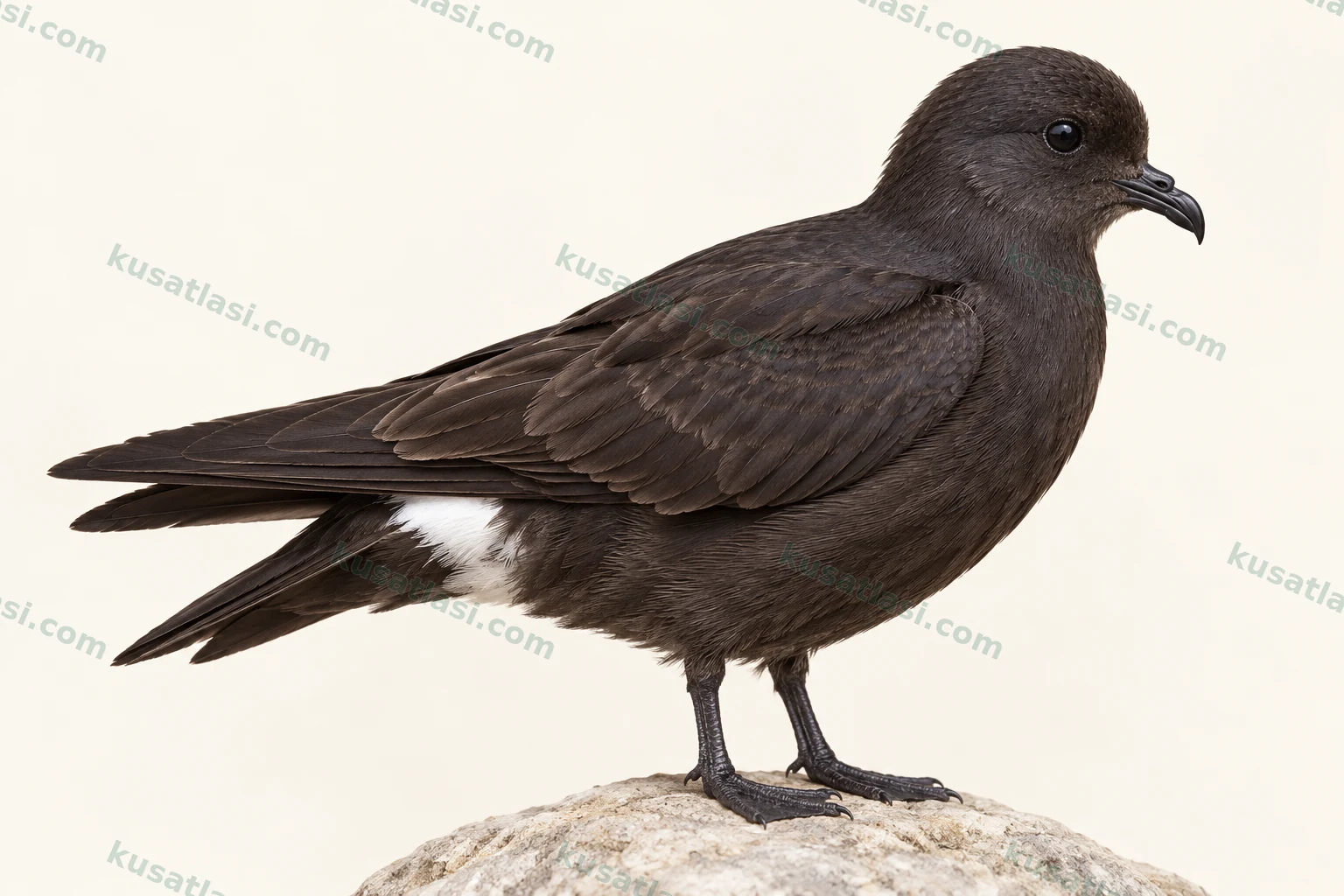
No reliable distant field key for sex was verified. Age and the state of flight-feather replacement matter for species identification; a young bird is not assessed by the adult cycle.
Where to look in its natural range?
Open sea around Guadalupe in winter; carefully verify the species identity of similar birds seen.
Winter breeding around Guadalupe; seasonal movements at sea are known from small tracking samples.
January
Marine use changes with season; a precise location or the same breeding stage cannot be assigned to every individual in this month. Guadalupe islets: within the reported winter breeding period. Morro Prieto research: adults incubating or feeding chicks were tracked by GPS in the 2021–2022 season.
February
Marine use changes with season; a precise location or the same breeding stage cannot be assigned to every individual in this month. Guadalupe islets: within the reported winter breeding period. Morro Prieto research: adults incubating or feeding chicks were tracked by GPS in the 2021–2022 season.
March
Marine use changes with season; a precise location or the same breeding stage cannot be assigned to every individual in this month. Guadalupe islets: within the reported winter breeding period.
April
Marine use changes with season; a precise location or the same breeding stage cannot be assigned to every individual in this month. Guadalupe islets: within the reported winter breeding period.
May
Marine use changes with season; a precise location or the same breeding stage cannot be assigned to every individual in this month. No verified regional date specific to this month was provided; this does not mean local absence.
June
Marine use changes with season; a precise location or the same breeding stage cannot be assigned to every individual in this month. North Pacific research sample: the 2024 study shows four individuals moving west in the non-breeding summer; no monthly boundary is drawn.
July
Marine use changes with season; a precise location or the same breeding stage cannot be assigned to every individual in this month. North Pacific research sample: the 2024 study shows four individuals moving west in the non-breeding summer; no monthly boundary is drawn.
August
Marine use changes with season; a precise location or the same breeding stage cannot be assigned to every individual in this month. North Pacific research sample: the 2024 study shows four individuals moving west in the non-breeding summer; no monthly boundary is drawn.
September
Marine use changes with season; a precise location or the same breeding stage cannot be assigned to every individual in this month. No verified regional date specific to this month was provided; this does not mean local absence.
October
Marine use changes with season; a precise location or the same breeding stage cannot be assigned to every individual in this month. Guadalupe islets: within the reported winter breeding period.
November
Marine use changes with season; a precise location or the same breeding stage cannot be assigned to every individual in this month. Guadalupe islets: within the reported winter breeding period.
December
Marine use changes with season; a precise location or the same breeding stage cannot be assigned to every individual in this month. Guadalupe islets: within the reported winter breeding period. Morro Prieto research: adults incubating or feeding chicks were tracked by GPS in the 2021–2022 season.
Nest, egg and incubation
Cavities and rock crevices on the Guadalupe islets are used; winter breeding and alternating parental incubation are verified. Typical egg number, incubation duration in days and age at first flight specific to the species were not verified in this review.
The initial study found rougher flight calls with different stress patterns. Rapid nest sounds are more like Townsend’s; sound alone does not separate every situation.
Do not play recordings to attract birds; observe quietly, especially near nests.
Species information
Quick identification
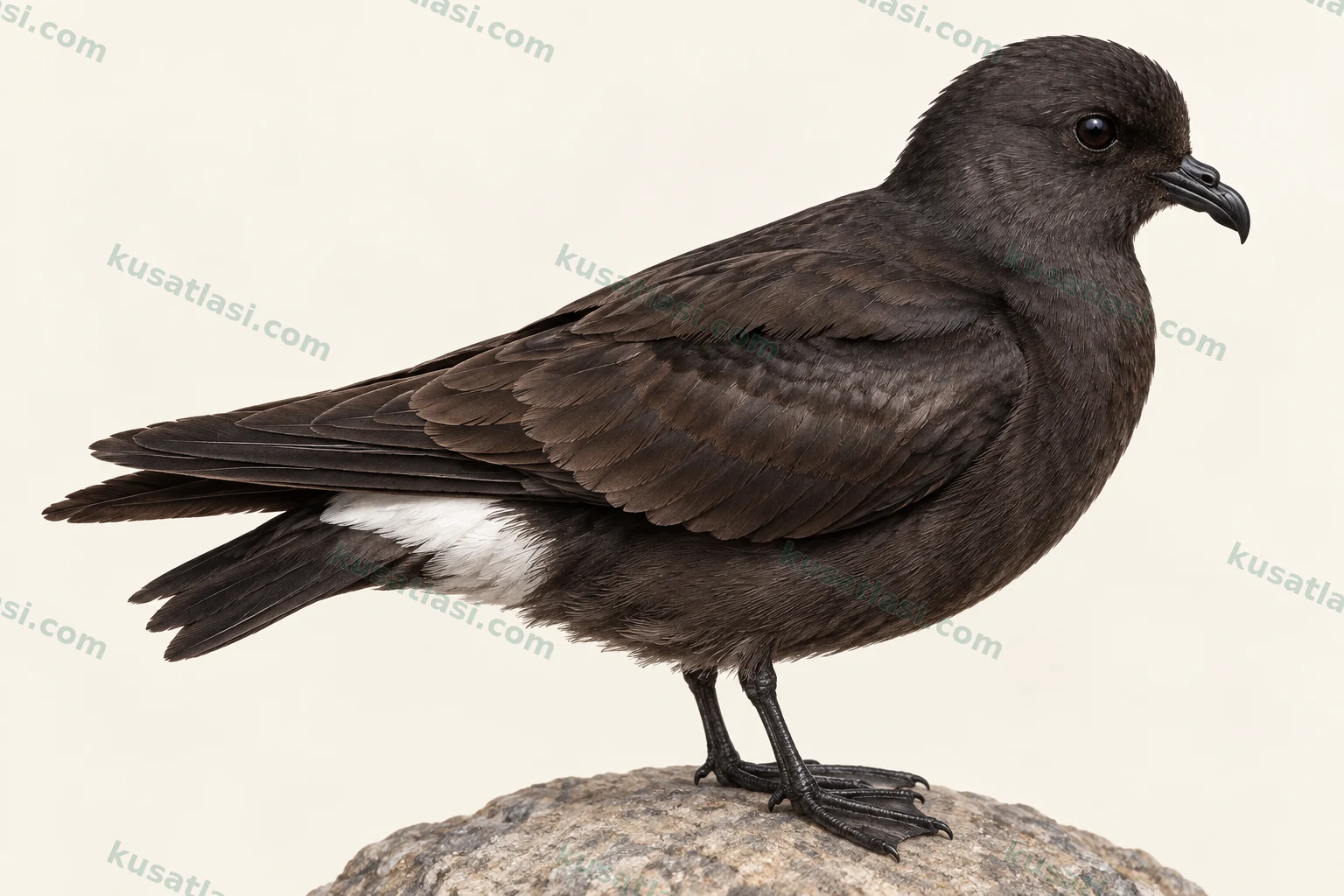
Ainley’s Storm-Petrel Hydrobates cheimomnestes is a small, dark seabird breeding in winter around Guadalupe Island off western Mexico. Its brown-black body, long wings and forked tail closely resemble Leach’s and Townsend’s Storm-Petrels. The pale rump is not a reliable identification mark alone either. Age, the state of flight-feather replacement, observation date and good photographs all matter; a distant dark seabird often cannot be named with certainty.
The English name Ainley’s Storm-Petrel belongs to this taxon. Older scientific sources may use Oceanodroma leucorhoa cheimomnestes or Oceanodroma cheimomnestes. Initially described as a subspecies of the broad Leach’s species, it was later accepted as separate; the current genus is Hydrobates. Summer-breeding Townsend’s Storm-Petrel around Guadalupe is a different species. Breeding on the same islet in different seasons does not make the two birds interchangeable in records throughout the year.
General appearance and posture
Dark brown body tones can look blacker or paler with feather wear and light. Adults examined near Guadalupe by ornithologist Steve Howell were medium-sized, relatively full-bodied birds resembling Leach’s. Broad diffuse dark streaks could occur on the pale rump. Some Leach’s individuals show similar patterns, however. At least some white on the rump sides in specimens of the original description does not show that every living bird has a bright white patch of identical size.
Males, females and young birds
No reliable species-specific colour key separating sexes in distant field views was verified. An older measurement study noted that females in the broad Leach’s group could be slightly larger, but pooled sexes for analysis. That general difference does not prove that every female Ainley’s has longer wings or a paler colour. Feather tone, viewing direction or width of the tail patch is not used for certain sexing.
Correct age assessment is especially important to species identification. A recently fledged bird’s wing feathers may initially be similarly fresh, while adult feathers replaced at different times show regular contrasts in wear. The 2023 study assessed age in specimens and photographs using feather shape, wear and replacement sequence. These details cannot be read in every distant image. A bird with no wing gaps is not therefore an adult winter-breeding Ainley’s: a young summer-breeding species can also carry fresh wings.
Detailed nestling plumage development and a reliable species-specific age at first flight were not verified in this review. Most age information concerns flight feathers of museum specimens and photographs at sea. Importing incubation or chick-development periods from close species would falsely imply the same life cycle. Identity of a breeding-site adult and an uncertain young bird at sea are evaluated using different evidence.
Appearance in flight
Long wings and a forked tail are shared with close relatives. In the 1980 comparison, winter-breeding Guadalupe birds had more pointed wingtips than the summer-breeding Townsend’s series, although measurements overlapped. Bill length cannot be read from a single flight silhouette. Howell’s view of three candidate individuals at sea was also too brief to assess flight style. No distinctive gliding or surface-pattering technique is inferred from that observation.
Adult moult timing is helpful: the cycle of winter-breeding Ainley’s differs from its summer-breeding relatives. The 2023 study nevertheless limits the certainty of this approach. Age groups may moult at different times, individual birds may fall outside the usual calendar, and some candidate identifications need independent confirmation. Date, age-related feather features and stage of replacement are recorded together. One month name or a single wing gap does not give a certain identification.
Voice and behaviour
The first scientific comparison examined rapid nest sound sequences separately from flight calls over the colony. Ainley’s flight calls were rougher and contained more notes than other specimen series, with different stress placement. Rapid sequences at the nest were more like those of Townsend’s. Not every sound type is therefore equally diagnostic. The limited recording series is not used to claim that the bird always gives the same number of notes; disturbing a night colony to obtain recordings is inappropriate.
Four individuals tracked in 2024 showed greater flight activity at night than by day outside breeding, but were active in daylight too. This result derived from wet–dry sensors does not mean the bird can be seen only at night. Activity probability increased on brighter nights; this is an association, not an experiment showing that moonlight alone improves feeding success. Time at the sea surface is not always foraging time either. Life at a land nest and on the open sea must be considered together.
Similar species
1. Leach’s Storm-Petrel Hydrobates leucorhous can look very similar, especially smaller individuals of the eastern Pacific. Pale rump pattern and body size may overlap. Adult moult cycle helps, but young and exceptional schedules prevent an unqualified distinction. Both wing-feather condition and rump are assessed in photographs; with inadequate evidence, leaving the bird as a species group is more appropriate.
2. Townsend’s Storm-Petrel Hydrobates socorroensis breeds in summer on the same Guadalupe islets. In the 1980 series, mean bill, tail and leg measurements were smaller; distant impressions of body size do not reliably separate living individuals. Rump colour varies and some nest sounds resemble Ainley’s. Season and age are used with suitable feather details. Being on the same rock does not make the two species one taxon.
World distribution
Verified breeding distribution consists of small islets around Guadalupe, west of Mexico’s Baja California Peninsula. Scientific accounts mention Morro Prieto or Islote Negro, Islote Afuera and Gargoyle Rock. Morro Prieto is one of two names for the same islet, not two colonies. GPS tracks of breeding adults in winter 2021–2022 extended from open sea south of Guadalupe towards Cedros and San Benito, and in some birds to waters off Southern California. A sea position does not show a nest there.
Status within the natural range
The current global assessment is Vulnerable. Breeding tied to few islets and very wide marine use combine in the same conservation problem. The tracking study published in 2022 shows the area used by winter-breeding adults, not every age and season. Some records at sea proposed using moult in 2023 remain possible identifications. They are not presented with the same certainty as verified GPS birds. The map’s ring marks the geographical position of a confirmed research colony; it is not a coloured range polygon or a new bird observation.
Movements and migration
The 2024 study gives new direct tracking evidence outside breeding. Four tracked Ainley’s moved west to waters north of Hawaii and spent most time on high seas beyond national jurisdiction. Earlier accounts highlighted the southeastern Pacific and Galápagos; this small new sample prevents treating that older assumption as the species’ only route. Conversely, four individuals may not represent every movement pattern. Light-based positioning carries uncertainty of hundreds of kilometres at some points; precise coastal passages or a narrow migration corridor are not drawn.
Breeding habitat
Breeding depends on small rocky islets around Guadalupe. Winter-breeding Ainley’s and summer-breeding Townsend’s use the same general setting at different times. Nest information for another historical storm-petrel on the main island is not transferred to this species’ present islet habitat. Seasonal separation alone does not explain all ecological differences; marine foods and non-breeding movements are also being investigated. The colony’s geographical location is not a visitor guide to individual nest positions.
Nest site
Research on Morro Prieto describes nests in large cavities and rock crevices; both parents alternate incubation duties. Adults on eggs and feeding chicks were tracked in December 2021–February 2022. The examined sources did not verify a reliable total incubation duration, a series establishing typical completed clutch size, or age at first flight for this species. No period from a related species is presented as an exact measurement. Colony access, handling and nest checks form part of permitted research, not recommendations for ordinary observation.
Daily use of space
The nesting islet and feeding sea are different settings. In the 2022 GPS results adults travelled in open waters beyond the continental shelf, rather than appearing restricted to a narrow coastal strip. Breeding-season returns to a nest are not confused with wider summer movements towards Hawaii. GPS alone cannot establish active feeding at every sea position. The 2024 distinction between remaining at the surface and flying rests on wet–dry sensor data; this is not the same behaviour as time spent at a nest.
What does it eat?
A directly studied species-specific prey list, stomach contents or reliable seasonal food proportions were not verified in this review. Studies of fish, small crustaceans or other marine organisms in Leach’s and other storm-petrels cannot be used as this taxon’s confirmed list. The breeding population behind an older result published under broad Leach’s must be identified. Occurrence at sea alone does not reveal prey species or quantity.
How does it forage?
The 2022 research used GPS to establish the extent of foraging trips by adults tied to eggs or chicks. This is not a video record of individual prey capture. No verified species-specific result was found for surface pattering, diving depth, daily intake or specialisation on particular prey. More night flight activity in 2024 does not establish that all food was caught at night either. Movement data help study feeding areas; they do not replace detailed prey-capture behaviour.
Breeding time is part of species identity
Similar birds breed in summer and winter on the same Guadalupe islets. Ainley’s 1980 description considered measurements, voice and timing as well as colour. Acceptance of the winter breeders as a species means that all older broad Leach’s records cannot automatically belong to Ainley’s. Islet name matters, but is considered with season and breeding state.
A winter breeder can travel to distant summer seas
The 2022 winter GPS study showed use between Guadalupe, Baja California and Southern California waters. Annual tracking published in 2024 revealed four Ainley’s travelling west to the high seas north of Hawaii. These are not contradictory pictures but data from different life-cycle stages. The small sample does not exclude other individuals using other directions. Positional uncertainty also requires avoiding a narrow route.
The bird’s calendar can be read in wing feathers
Different breeding times in close relatives also affect feather replacement. A good photograph’s arrangement of old and new feathers can assist age and species identification together. Some candidate identifications in the 2023 study need independent confirmation, however. Confusing young and adult cycles can produce a wrong conclusion from a useful seasonal clue. One colour or one calendar month is therefore insufficient.
A light record is not a collision count
In 2024, tracking devices on both species recorded increases consistent with artificial light on some nights. The authors discuss light pollution as a conservation risk. These records do not directly document every bird colliding with a ship or dying from light. Reliance on birds whose devices were recovered is another important limit. Risk, the need for new measurement and actual harm remain separate.