

World Birds IUCN statusLC · Least ConcernGlobal IUCN category. BirdLife v10 (2025); taxon matching: AviList 2026 / IOC 15.2; checked: 29.10.2026. The list year is not the species assessment date. Source and method · BirdLife OrderCiconiiformesStorks FamilyCiconiidaeCiconiidae
Asian Openbill
Anastomus oscitans
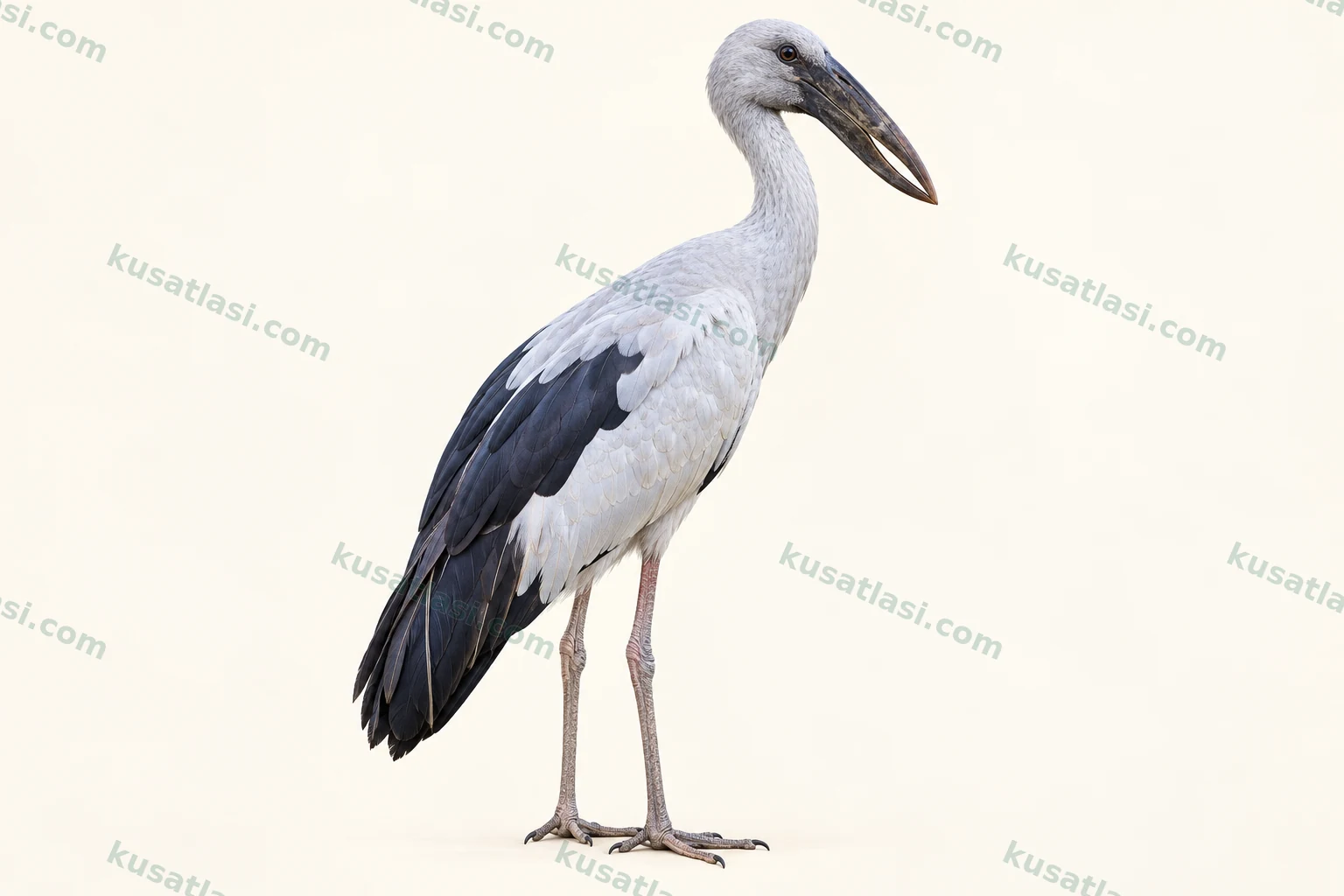
A pale stork of South and Southeast Asian wetlands with a natural gap in the middle of the adult bill.
Biometrics
Length
Male81 cm
Female81 cm
Shared species value
Wingspan
Male147–149 cm
Female147–149 cm
Shared species value
Weight
Male1.59 kg
Female1.59 kg
Shared species value
Asian Openbill
Lowland wetlands of the Indian subcontinent and Southeast AsiaObservation guide in its natural range
Look for three features together
Do not rely on a single featureThe adult’s middle bill section remains open while the tips may meet. Young may lack the gap.
Pale body, black flight feathers and tail.
Lowland wetlands, flooded rice fields and tree colonies.
Compare male and female
 FemaleMale
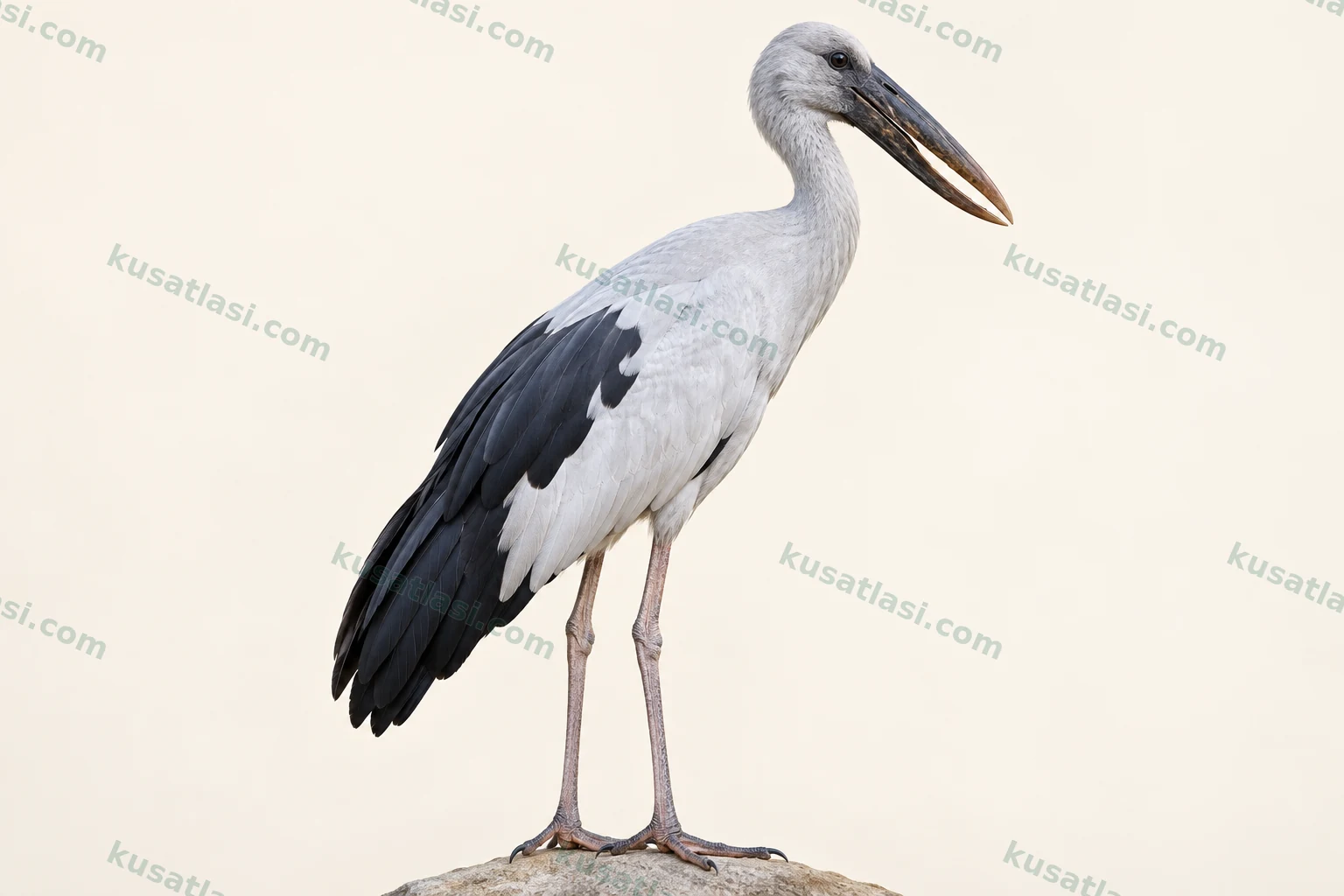
Males and females are similar; young may look browner and dark-billed, without an obvious bill gap yet.
Where to look in its natural range?
Watch feeding flocks in shallow water and at aquatic vegetation edges from a distance.
Many populations are resident; breeding and local-movement calendars differ by region.
January
Resident populations coexist with directly documented regional movements. No verified regional date specific to this month was provided; this does not mean local absence.
February
Resident populations coexist with directly documented regional movements. No verified regional date specific to this month was provided; this does not mean local absence.
March
Resident populations coexist with directly documented regional movements. No verified regional date specific to this month was provided; this does not mean local absence.
April
Resident populations coexist with directly documented regional movements. No verified regional date specific to this month was provided; this does not mean local absence.
May
Resident populations coexist with directly documented regional movements. Eastern Nepal — 2020–2022 monitoring: nest material collection in late May.
June
Resident populations coexist with directly documented regional movements. Eastern Nepal — 2020–2022 monitoring: breeding and young development followed in colonies; not every month represents the same stage. Gaya, India — 2023–2024 monitoring: arrival at the colony with the first rains.
July
Resident populations coexist with directly documented regional movements. Eastern Nepal — 2020–2022 monitoring: breeding and young development followed in colonies; not every month represents the same stage.
August
Resident populations coexist with directly documented regional movements. Eastern Nepal — 2020–2022 monitoring: breeding and young development followed in colonies; not every month represents the same stage. Gaya, India — 2023–2024 monitoring: the study’s month with the highest nest count.
September
Resident populations coexist with directly documented regional movements. Eastern Nepal — 2020–2022 monitoring: breeding and young development followed in colonies; not every month represents the same stage.
October
Resident populations coexist with directly documented regional movements. Eastern Nepal — 2020–2022 monitoring: breeding and young development followed in colonies; not every month represents the same stage.
November
Resident populations coexist with directly documented regional movements. Eastern Nepal — 2020–2022 monitoring: breeding and young development followed in colonies; not every month represents the same stage.
December
Resident populations coexist with directly documented regional movements. No verified regional date specific to this month was provided; this does not mean local absence.
Nest, egg and incubation
A branch platform in a tree; compiled typical figures are 2–4 white eggs, 27–30 days of incubation and first flight at 35–36 days. The direct Nepal study recorded 1–5 eggs in ordinary pair nests and 6–9 in nests with multiple mates. Regional research and compiled development durations are distinguished.
Muffled low sounds may be heard in colonies; an uncertain call alone is not a certain species key.
Do not play recordings to attract birds; observe quietly, especially near nests.
Species information
Quick identification
Asian Openbill Anastomus oscitans is a pale-bodied stork feeding in flocks in the wetlands of South and Southeast Asia. Even when the tips of an adult’s closed bill touch, a conspicuous gap remains in its middle. The species takes its name from this natural shape; the bill is not broken or injured. Black flight feathers and tail contrast strongly with the pale body. A young bird whose bill has not yet acquired the adult shape may lack a visible gap. Looking only for that gap therefore makes young birds harder to recognise.
The English name Asian Openbill belongs to this taxon. African Openbill Anastomus lamelligerus is a separate species and its information is not transferred to this Asian stork. Current taxonomy lists Asian Openbill as a species without subspecies. Lowland wetlands of the Indian subcontinent and Southeast Asia are its principal natural environment. A crowded feeding flock does not by itself establish nests in nearby trees; breeding colonies and daily feeding areas are sought separately.
General appearance and posture
The pale body approaches white in breeding plumage; birds outside breeding may show a greyer tone. The long flight feathers and tail are dark. Neck and legs are long; the head is lowered while walking in shallow water and the neck may be held more upright when not searching for food. The eye is dark brown. The bill may be pale pinkish-grey and the legs pink or reddish. Seasonal and light-related colour appearance is not given precedence over adult bill structure and overall body pattern.
Despite the gap, the adult’s bill tips can be used to grip. Direct feeding observations in Thailand showed the bird inserting the lower bill tip into a snail’s shell opening to extract its soft body. Describing the bill as a nutcracker constantly crushing shells is therefore incorrect. The central opening and the meeting tips are assessed together in an image. Seeing a distant gap does not show what the bird is eating at that moment; the actual feeding action must be seen separately.
Males, females and young birds
Males and females look similar. Feather whiteness, darkness of pink legs or apparent body size in one photograph are not used alone for reliable field sexing. Sex determination and species identification are different tasks. A bird performing a nest duty is not identified certainly as male or female without separate behavioural evidence.
A young bird may look browner and darker; its bill may be darker than the adult’s, straighter along the lower edge and without an obvious central gap. It can occur in the same flock as adults. Grey-brown head, black flight feathers and general stork structure are assessed together. Development of the adult bill over time means the same structure is not expected unchanged in the young. This review did not verify an exact age of gap formation valid for all individuals.
The eastern Nepal study notes that growing young can also use neighbouring nests within the same colony. This is not the same as flying away from the colony or becoming completely independent of parents. A specialist compilation gives 35–36 days for first flight; the direct Nepal study does not present an age series testing this figure for the species as a whole. Compiled development duration and the young’s success actually counted in research are distinguished. A young bird standing outside a nest is not an independent adult on location alone.
Appearance in flight
Long broad wings suit soaring in rising warm air. The pale body and black flight feathers remain conspicuous in flight. The neck may be seen extended forwards and the long legs trailing behind; this general stork silhouette differs from the retracted neck of most herons. A silhouette alone does not distinguish all pale Asian storks, however. Bill structure, head feathering and wing pattern are checked again when a suitable view allows.
A flock soaring over a wide area is not necessarily a long-distance migrant group; it may be travelling to a feeding or roosting site. Conversely, international movements of some individuals have been documented directly by GPS. Flight purpose cannot be read from height or flock size alone.
Voice and behaviour
Although a single bird often seems quiet, muffled low sounds can be heard in large gatherings. A calling colony may help locate birds from afar; other waterbirds may be nearby, so an uncertain sound does not establish a species name. This page’s sound description explains acoustic behaviour. A call not verified as belonging to an adult, young bird, sex or breeding stage is not made an identification key common to all situations.
It forms feeding flocks and gathers in tree colonies for breeding. The eastern Nepal study documented nests involving more adults alongside ordinary pair nests; those nests held more eggs. This does not mean every nest has the same family arrangement. A bird approaching a neighbouring nest is not by itself proof of an additional mate or helper. Researchers’ followed nest records and a short distant visit provide different levels of detail.
Similar species
1. Painted Stork Mycteria leucocephala can occur in colonies in the same region. Adults attract attention through the bare orange head, long yellowish slightly downcurved bill and pink wing areas. Asian Openbill has a feathered head; the adult bill’s central gap and simpler pale–dark body pattern are seen together. Bright adult colours are weaker in young Painted Storks, so lack of pink alone is insufficient.
2. Asian Woolly-necked Stork Ciconia episcopus combines a white neck with a dark body. In Asian Openbill, most of both neck and body are pale; head and bill structure differ too. The woolly-necked group’s African Ciconia microscelis is a separate taxon. This comparison concerns the Asian bird; old broad accounts from different continents are not silently merged.
World distribution
The principal natural range extends from lowland wetlands of the Indian subcontinent to Southeast Asia. India, Sri Lanka, Bangladesh, lowland Nepal, Myanmar and Thailand are important parts of this broad setting. River floodplains, lakes, marshes and rice fields are used; not every place within national borders is suitable. The current taxonomic account describes a lowland distribution. High mountains or continuous open sea are not counted as habitat merely to fill the space between countries.
Status within the natural range
The global category is Least Concern. Regional threat assessments in countries such as Nepal may differ from that global label. The 2021 study examines use of new areas towards China and towards the Malay Peninsula and Singapore. During the years covered, presence in the new areas was not matched by breeding evidence. This does not mean breeding is impossible in every later year. A new sighting, an established breeding population and predicted suitable conditions are assessed separately.
Movements and migration
Many populations are resident, but movements associated with food, water conditions and regional seasons occur. A young bird tracked in Yunnan, China, travelled to Thailand in 2018 and later moved through Laos towards Vietnam. This is one bird’s partial annual track, not a shared route for the whole species. Loss of the signal does not prove death either. Prediction layers and documented observation samples are distinguished on the map; neither shows a particular month’s breeding area or the route of every bird.
Breeding habitat
Lowland landscapes combining suitable colony trees and nearby feeding wetlands are important. Nepal research in 2020–2022 documented colonies around natural forest patches, community forests, farmland and human settlements. Bombax ceiba was selected more than expected from its availability in some study areas; this does not mean the same tree species is required throughout Asia. A separate study in Gaya city recorded nesting in many tree species.
Nest site
The nest is a platform of branches in a tree, lined with softer plant pieces. The specialist compilation reports typically 2–4 white eggs and 27–30 days of incubation shared by both parents. The direct Nepal study recorded 1–5 eggs in ordinary pair nests and 6–9 in nests involving multiple mates. The larger number is not presented as one female’s usual clutch. The compiled age at first flight is 35–36 days; moving from a nest to a neighbouring one is not the same developmental stage.
Daily habitat use
Shallow fresh water, muddy shores, edges of aquatic vegetation and flooded rice fields provide feeding sites. In the Thai research, birds searched for snails beside plant stems and beneath floating cover. Irrigation water can change prey abundance and accessibility. Tree nesting in a city does not show that traffic, pruning or human approach is harmless. Rather than waiting beneath colonies or climbing nest trees, observe daily comings and goings from a distance.
What does it eat?
Freshwater snails make up an important part of the diet. Research at India’s Raiganj colony reports Pila globosa, Bellamya bengalensis and other aquatic invertebrates. One prey studied directly in Thailand is the introduced apple snail Pomacea canaliculata, which can cause problems in rice farming. Heavy consumption in one region does not mean the species eats only that prey. Food of the young and the adult’s year-round diet are not assumed to have the same list or proportions.
How does it forage?
It probes with its bill while walking in shallow water; on finding a snail, it grips it and inserts the lower bill tip into the shell opening. In the Thai observations the soft part of a large snail was removed and swallowed, leaving shell and hard operculum; small snails were also swallowed whole. Preference for larger prey was observed, while an energetic explanation was the researchers’ interpretation. Equally certain experimental evidence is not supplied for the function of the bill gap alone. Snail consumption may benefit agriculture; it is not a guaranteed solution removing every pest.
The bill gap is not a shell crusher
The bird’s name refers to the gap remaining in the middle of an adult’s closed bill. Its tips can nevertheless approach each other and be used to extract a snail’s soft body. Kahl’s early research on both openbill species also rejected the explanation of a nutcracker constantly crushing shells. Later direct Thai observations show the processing sequence with much of the shell left behind. Seeing a shape does not experimentally explain every part of its function.
Reaching a new country is not breeding there
The 2021 research examined conditions and movements behind new records outside the principal natural range. The GPS bird travelling from Yunnan to Thailand gives direct evidence of regional connection. One individual’s journey does not explain the origin of all birds in China, however. An island judged suitable by a climate model does not show actual settlement either. Observation maps, nest records and predictions of future conditions are therefore read differently.
A crowded nest tree is only part of the surroundings
In the eastern Nepal study, used nest trees were structurally larger than comparison trees in the surroundings. The analysis did not conclude that tree height alone determined young’s success; crown cover and colony size mattered too. Urban colonies in Gaya show that breeding near settlements is possible. This does not show natural wetlands or feeding environments are no longer needed.
A larger egg number has a different story
In Nepal, egg ranges in ordinary pair nests differed from nests involving more adults. Treating records of six to nine eggs as typical for each female overlooks the nest arrangement. Likewise, nest totals from several years are not counts of birds present simultaneously. Every breeding-success figure gains meaning from which nests and years were followed.