

World Birds IUCN statusNT · Near ThreatenedGlobal IUCN. BirdLife v10 (2025); taxon matching AviList 2026 / IOC 15.2; checked: 29.10.2026. The list year is not the species’ assessment date. Source and method · BirdLife OrderCiconiiformesLeyleksiler FamilyCiconiidaeCiconiidae
Saddle-billed Stork
Ephippiorhynchus senegalensis
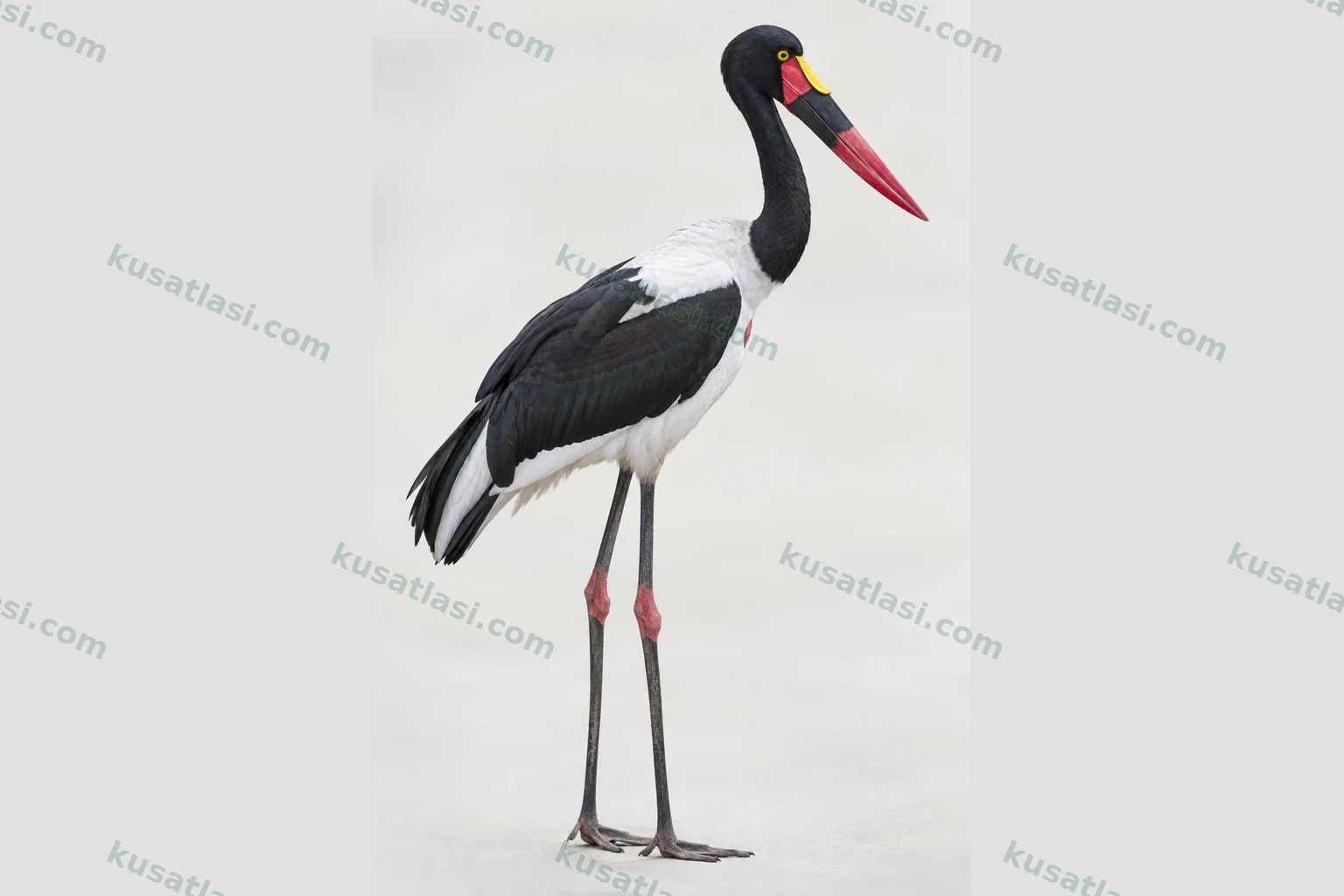
A very large black-and-white stork; the long red bill has a broad black band and yellow saddle. Dark eyes in adult males and yellow eyes in adult females help identification.
Biometrics
Length
Male145–150 cm
Female145–150 cm
Shared species value
Wingspan
Male250 cm
Female250 cm
Shared species value
Weight
Male5.085–7.524 kg
Female5–6.84 kg
Saddle-billed Stork
Suitable wetlands of sub-Saharan AfricaObservation guide in its natural range
Look for three features together
Do not rely on a single featureCheck the red, black and yellow saddle area together with the long, black-feathered neck.
The male has dark brown eyes and the female yellow eyes; this rule must not be forced onto young birds.
Look for shallow edges together with suitable trees; one record does not establish breeding or continuous presence.
Compare male and female
 FemaleMale
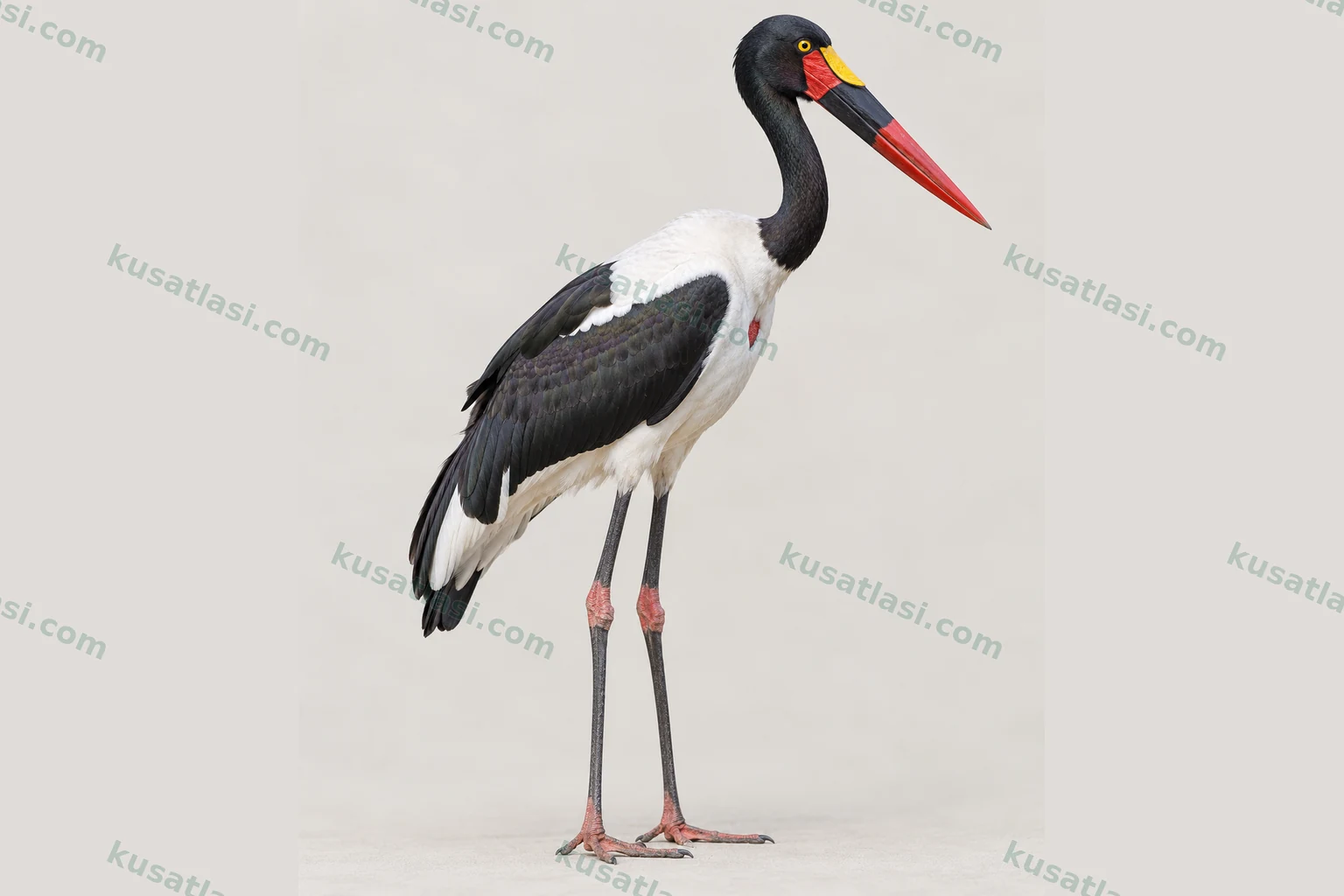
Adults share the same basic plumage pattern; the male has dark brown eyes and the female yellow eyes. Wattles at the bill base alone do not establish sex; young birds must be assessed separately.
Where to look in its natural range?
Watch the shallow margins of rivers and floodplains from afar; compare the bill pattern with the head, neck and wing together.
The egg-laying examples in the SABAP1 atlas are regional: peaks in February–March in Zimbabwe/Botswana and April–June in the former Transvaal. Different seasons and breeding stages from other accounts have not been merged into a single continental calendar.
January
Adults are primarily resident; water-related local movements and dispersal of young may occur. No verified regional date specific to this month was provided; this does not imply local absence.
February
Adults are primarily resident; water-related local movements and dispersal of young may occur. Zimbabwe and Botswana, SABAP1: this is a reported regional peak in egg laying.
March
Adults are primarily resident; water-related local movements and dispersal of young may occur. Zimbabwe and Botswana, SABAP1: this is a reported regional peak in egg laying.
April
Adults are primarily resident; water-related local movements and dispersal of young may occur. South Africa, former Transvaal, SABAP1: this is a reported regional peak in egg laying.
May
Adults are primarily resident; water-related local movements and dispersal of young may occur. South Africa, former Transvaal, SABAP1: this is a reported regional peak in egg laying.
June
Adults are primarily resident; water-related local movements and dispersal of young may occur. South Africa, former Transvaal, SABAP1: this is a reported regional peak in egg laying.
July
Adults are primarily resident; water-related local movements and dispersal of young may occur. No verified regional date specific to this month was provided; this does not imply local absence.
August
Adults are primarily resident; water-related local movements and dispersal of young may occur. No verified regional date specific to this month was provided; this does not imply local absence.
September
Adults are primarily resident; water-related local movements and dispersal of young may occur. No verified regional date specific to this month was provided; this does not imply local absence.
October
Adults are primarily resident; water-related local movements and dispersal of young may occur. No verified regional date specific to this month was provided; this does not imply local absence.
November
Adults are primarily resident; water-related local movements and dispersal of young may occur. No verified regional date specific to this month was provided; this does not imply local absence.
December
Adults are primarily resident; water-related local movements and dispersal of young may occur. No verified regional date specific to this month was provided; this does not imply local absence.
Nest, egg and incubation
Both sexes build a branch platform with a lined cup in a tree. The South African expert synthesis gives two–four eggs, shared incubation of about 30–35 days and a nestling period of about 70–100 days; care of flying young may continue.
Adults are mostly quiet, with bill-clattering near the nest. Young birds’ begging calls must not be confused with adult song.
Do not play recordings to attract birds; observe quietly, especially near nests.
Species information
Quick identification
The Saddle-billed Stork Ephippiorhynchus senegalensis is a very large, long-legged stork. The adult has a black head and neck and a largely white body. Its most striking feature is the combination of red, black and yellow on the long bill: a broad black band crosses the red bill, and a yellow, saddle-shaped area sits at the upper base. Checking this combination together with the long black neck and pale body provides good identification evidence. If only the bill tip is visible, do not assume that you have seen the whole pattern. A bill dipped in muddy water can also look temporarily darker than it really is.
The English name Saddle-billed Stork refers to this same African species. The word jabiru in its Turkish name does not make it the same species as the American Jabiru mycteria. Nor can the Asian and Australian Ephippiorhynchus asiaticus stand in for this record. With a large black-and-white waterbird, first examine whether the head is feathered, the bill's shape and colour pattern, the neck's length and the geographical location. Large size alone does not identify a species; other storks may share the wetland. With distant birds, waiting to see several independent features is more reliable.
General appearance and posture
The long neck and legs give the bird a tall, slender stance. Black head and neck feathers shine in suitable light, whereas shade may make the same areas look dull. The boundary between the adult's white body and dark wing areas appears differently as it turns. Not all flight feathers are visible when the wing is folded. Distinguish the dark parts of the legs from the warm reddish tones around the joints and feet; when the bird stands in water, the entire leg colour has not necessarily been seen. Holding its long bill near the water and waiting motionless is also a normal hunting posture.
Males are generally larger.
Males, females and young birds
Adults of both sexes share the same basic black-and-white plumage. In a good view, the male's eye is dark brown and the female's yellow. You must actually see the eye: a bright reflection can make a dark eye look pale, while shadow can darken a yellow one. Apparent larger size can only support other features; do not compare the sizes of two birds at different distances. Small wattles at the bill base must not be used alone to identify a male. The current regional expert assessment states that these may be present or absent in either sex; examining eye colour together with plumage maturity is more reliable.
Young birds are less contrasting than adults: the head and neck are brownish grey, pale body areas have dirtier tones, and the bill is duller. A bird that has not yet developed the adult's complete red-black-yellow bill pattern should therefore not be rejected as another species. Research in Zambia shows that maturing birds change plumage gradually, and that some age classes can look very similar with closed wings. The researchers' age distinctions are preliminary; they do not justify assigning an exact age in years to every distant bird. The adult eye-colour rule cannot simply be applied to young birds either. Record association with parents alongside feather and bill development.
Appearance in flight
The large body, long neck and broad wings are conspicuous in flight. Dark bands within the adult's pale wing create important contrast. Use this feature only together with the proportions of the whole silhouette and the bill pattern; not every stork showing black-and-white wings during a brief rear view is a Saddle-billed Stork. The bird can soar on rising air, and its wingbeats look broad and powerful. A white area appearing narrower as the flight angle changes does not mean that the feather colour has changed. It is also wrong to assume that one photograph shows both wing surfaces completely.
Young and immature birds may have darker tips or brownish areas compared with the adult's clean white flight feathers. The Zambian study's use of these feathers in assessing age does not mean that a single wingtip reveals an individual's exact age. Even birds approaching adult appearance can be difficult to distinguish with folded wings. In a flight record, note the head, bill, wing pattern and silhouette including the legs together; flushing a bird to establish its age or sex is inappropriate.
Voice and behaviour
Adults are often quiet; rapid bill-clattering near the nest is one audible aspect of their behaviour. Young that had left the nest were also observed giving whistling begging calls in Zambia. On hearing such a sound, first establish which bird is making it by watching. Describing the young birds' voice as a continuous adult song would be misleading. Look for single birds or pairs in open wetlands; their location may change with water levels and food conditions. Several birds together do not demonstrate that they all belong to a nesting colony.
Pairs usually nest separately. Flying young continuing to receive food from their parents show that nest departure and full independence are distinct stages. Observe without approaching the nest tree, from a distance that allows the parents to return naturally.
Similar species
1. The Yellow-billed Stork Mycteria ibis has a paler body, a yellow bill and a red, bare face. Compare these with the Saddle-billed Stork's long, black-feathered neck and red-black-yellow bill together. Do not decide from just the visible part of a bill dipped in muddy water. The Yellow-billed Stork also has black wing areas, making reliance on one dark patch in flight unsafe.
2. The Marabou Stork Leptoptilos crumenifer is very large and has a powerful bill; its bare, pinkish-looking head and neck and white neck surround are important. The adult Saddle-billed Stork has a black-feathered head and long neck, with a conspicuous yellow saddle on the bill. Size alone, or two birds standing in the same water, is not identification; examine the head's surface, bill pattern and body posture together.
World distribution
The Saddle-billed Stork occurs in suitable wetlands in sub-Saharan Africa. Its range does not continuously cover the whole continent; water regimes and suitable feeding places are important. In the south, regional accounts highlight northern Namibia and Caprivi, northern/eastern Botswana, Zimbabwe, Mozambique and northeastern South Africa. The Kruger area, the Limpopo River and some Zululand wetlands are important South African examples. A country appearing in the range does not imply a regular population in every city or along all its coasts. Nor should the West African coasts be filled in as if they were equivalent to suitable inland wetlands.
Status within its natural range
Despite being conspicuous, it is scarce in some areas. The IUCN's published 2025 category-change table moved its global status from Least Concern to Near Threatened. The 2025 regional assessment covering South Africa, Lesotho and Eswatini instead lists it as Endangered. These results concern different geographical scopes and must not be substituted for one another. A regional count is not the world's total population either. Wetland drying, declining water quality and changes in water use may affect local conditions; one sighting or a short-term increase does not prove that the entire species is secure.
The coloured predicted area on the map must not be read as a confirmed breeding boundary. Observation points are evidence of records; a young bird seen at a point must separately be shown to have hatched there. Consider suitable wetland, bird identity and date together. Few records in a dry season may reflect both actual movements and conditions affecting detectability.
Movements
The southern African atlas describes adults as primarily resident, but young birds and some individuals can disperse widely. Other expert accounts report partial, water-related nomadism in parts of the range. Residency does not mean that every individual stays at the same pool throughout life. Temporary ponds forming or drying can change feeding locations. Nevertheless, this information does not establish one regular migration route across the continent. A tracked individual's movements, local distribution and population changes at a breeding site require separate evidence.
Breeding habitat
Rivers, floodplains, marshes, lake margins and temporary waters are among the Saddle-billed Stork's habitats. Feeding water and suitable trees together in open or semi-open surroundings are important. Areas associated with large permanent rivers stand out in northeastern South Africa; Zambia's Liuwa Plain provides a different example, with wet-season flooding and pools remaining in the dry season. These environments should not be expected to provide identical water depths, food densities or breeding success. Measuring only a large wetland's surface area gives insufficient information about the shallow edges the bird can use.
Nest site
The pair builds a platform of large branches and soil, with a central cup lined with materials such as grass and reeds. A tree nest can be reused over the years. Nesting and roosting trees, sometimes far from water, need protection alongside feeding waters. Use of another large bird's old nest has been reported; this does not mean that every pair takes another bird's nest. The South African synthesis gives two–four eggs and approximately 30–35 days of incubation shared by both partners; the young birds' approximately 70–100-day nestling period is distinct from incubation. These values do not mean that every nest in different countries develops on the same timetable. Climbing the tree to inspect a nest or repeatedly flushing the bird is inappropriate.
Daily habitat use
The bird may wait in shallow water, move slowly or search among aquatic plants with its bill. Pools remaining as water recedes offer feeding places; year-round use of the same pool must not be assumed. Small fish and invertebrate prey observed in the Zambian research represent a particular dry-season example. Avoidance responses to people moving along the shore are also local observations; one numerical disturbance threshold cannot be assigned to every wetland. Watching from afar allows observation without altering the bird's posture or hunting behaviour. Consider the nest tree, shallow feeding edge and surrounding water catchment together.
What does it eat?
Fish are important in the Saddle-billed Stork's diet; expert accounts also record frogs, small reptiles, small mammals, birds and various aquatic invertebrates. This list does not mean that every individual eats the same foods daily. Gula and Mungole's 2021 dry-season observations on the Liuwa Plain recorded captures of small fish and invertebrates, while some prey could not be identified at a distance. Unidentified prey must not be filled in as definite snails or insects. Being a long-billed bird capable of catching large fish does not imply a diet consisting solely of large fish.
How does it hunt?
Visual and tactile hunting can be observed as separate methods. The bird may wait with its bill outside the water and strike at prey it sees; in another situation it immerses its bill and probes among plants for food. Distinguish unsuccessful strikes from actual captures. Water depth in the short Zambian study was estimated visually; reported depths were not direct instrumental measurements at every pool. This example cannot establish that the bird hunts only within a particular centimetre limit.
The research involved a total of 255 minutes observing 11 different birds. Repeated observation of one individual does not turn the number of observation periods into a count of additional birds. Numerical differences between male and female foraging rates were not established as a definite sex rule, given the small sample and repeated observations of individuals feeding young. Flying young continuing to receive parental food also require a distinction between attempts to hunt independently and full independence. Fishing activity and changing water levels should be examined together in further research; a short observation does not yield a general percentage of benefit or harm.
The bill pattern may help track individuals
The yellow saddle and broad black band first help identify the species. Researchers have also tried to recognise the same bird again by comparing photographs of individual differences along the black band's edges. Photographing the pattern on both sides was part of this method in the Liuwa study in Zambia. This does not mean that every distant photograph establishes an individual's identity; the angle must be suitable and the image sufficiently clear. Young birds' bill patterns are not yet developed, so the approach used for adults cannot simply be applied to every age.
Flying does not mean being independent
The feeding study on the Liuwa Plain recorded flying young continuing to be fed by their parents. They may try to hunt in the same water while also begging for food. This behaviour cautions against treating nest departure as the day all care ends. Verify a young bird's relationship with a nearby adult through observation; birds sharing a pool do not automatically form one family. The exact age at which care ends is not a question answered by the available short study.
Breeding calendars involve different stages
The southern African atlas explains that nest-building, incubation and sightings of large young may be recorded in different seasons. Eggs or small young in a high, large nest may be invisible from the ground, while larger young are noticed later. Breeding activity in an observation report is therefore not the same datum as the laying month. The atlas gives regional examples of peak laying in February–March in Zimbabwe and Botswana, and April–June in the former Transvaal. These do not form a common calendar for the whole continent.
Read conservation status with its scope
The 2025 IUCN change table lists the Saddle-billed Stork's global category as Near Threatened; the 2025 South African regional book uses Endangered. They describe risks over different areas. A historical population estimate cannot be presented as a current global count; seeing fewer birds in one dry year does not by itself measure the full population loss either. Long-term monitoring of habitat water regimes and local breeding helps explain why short observations can yield different results.