

World Birds IUCN statusLC · Least ConcernGlobal IUCN category. BirdLife v10 (2025); taxon matching: AviList 2026 / IOC 15.2; checked: 29.10.2026. The list year is not the species assessment date. Source and method · BirdLife OrderCiconiiformesStorks FamilyCiconiidaeCiconiidae
African Woolly-necked Stork
Ciconia microscelis
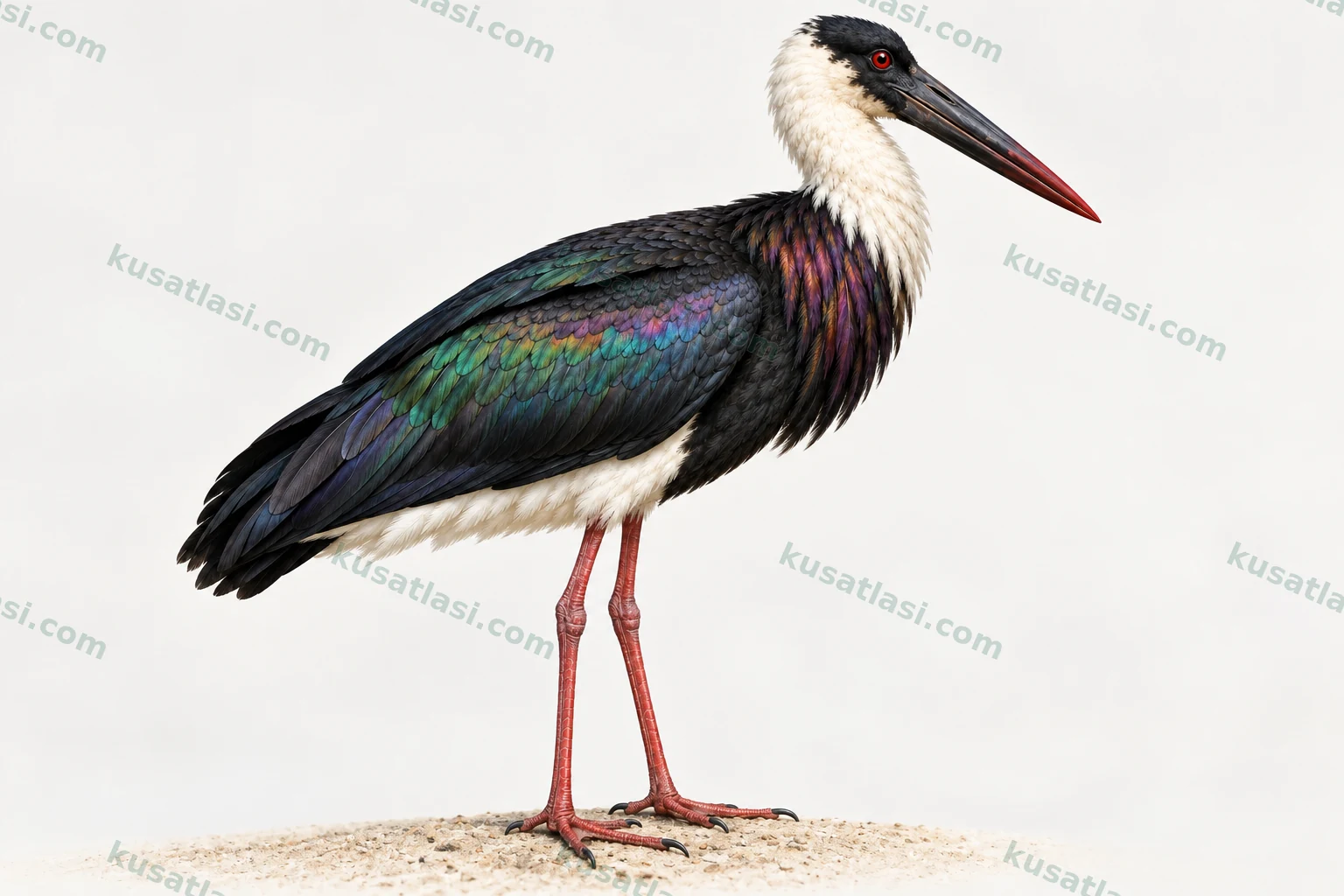
Glossy dark body, fluffy white neck and white lower belly; feathered sides of the head and an irregular dark crown boundary.
Biometrics
Length
Male86–95 cm
Female86–95 cm
Shared species value
Wing length
Male48.05 cm
Female48.05 cm
Shared species value
Weight
Male1.59–2.79 kg
Female1.59–2.79 kg
Shared species value
African Woolly-necked Stork
Sub-Saharan AfricaObservation guide in its natural range
Look for three features together
Do not rely on a single featureDark body, white neck and irregular dark crown are viewed together.
Four eggs were most frequent in KwaZulu-Natal; this is not extended to the whole continent.
Compare male and female
 FemaleMale
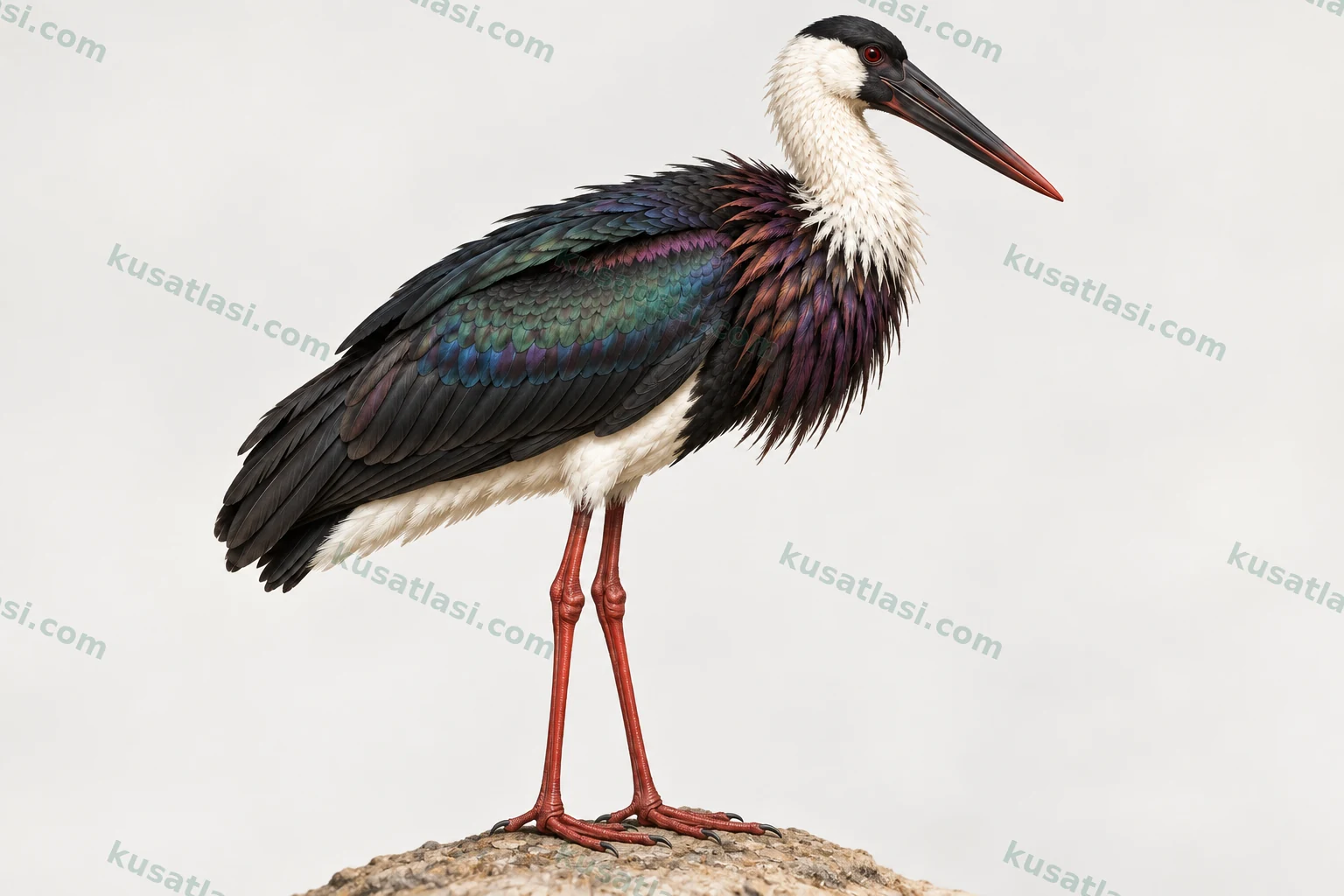
Adult sexes are similar; young may be duller, with less white on the forehead and paler legs. Colour alone does not establish sex.
Where to look in its natural range?
Wetland margins and wooded open country; urban adaptation is documented for KwaZulu-Natal.
KwaZulu-Natal’s August–March period is not the breeding calendar of all Africa.
January
Largely resident; local movements and dispersal of young may occur. KwaZulu-Natal, 2022–2024 study: The monitoring period of the breeding study; it is not generalised to the whole continent.
February
Largely resident; local movements and dispersal of young may occur. KwaZulu-Natal, 2022–2024 study: The monitoring period of the breeding study; it is not generalised to the whole continent.
March
Largely resident; local movements and dispersal of young may occur. KwaZulu-Natal, 2022–2024 study: The monitoring period of the breeding study; it is not generalised to the whole continent.
April
Largely resident; local movements and dispersal of young may occur. No verified regional date specific to this month was provided; this does not mean local absence.
May
Largely resident; local movements and dispersal of young may occur. No verified regional date specific to this month was provided; this does not mean local absence.
June
Largely resident; local movements and dispersal of young may occur. No verified regional date specific to this month was provided; this does not mean local absence.
July
Largely resident; local movements and dispersal of young may occur. No verified regional date specific to this month was provided; this does not mean local absence.
August
Largely resident; local movements and dispersal of young may occur. KwaZulu-Natal, 2022–2024 study: The monitoring period of the breeding study; it is not generalised to the whole continent.
September
Largely resident; local movements and dispersal of young may occur. KwaZulu-Natal, 2022–2024 study: The monitoring period of the breeding study; it is not generalised to the whole continent.
October
Largely resident; local movements and dispersal of young may occur. KwaZulu-Natal, 2022–2024 study: The monitoring period of the breeding study; it is not generalised to the whole continent.
November
Largely resident; local movements and dispersal of young may occur. KwaZulu-Natal, 2022–2024 study: The monitoring period of the breeding study; it is not generalised to the whole continent.
December
Largely resident; local movements and dispersal of young may occur. KwaZulu-Natal, 2022–2024 study: The monitoring period of the breeding study; it is not generalised to the whole continent.
Nest, egg and incubation
In the 2022–2024 KwaZulu-Natal sample, four eggs were most frequent among 102 nests with counts; 30 days of incubation was not directly measured but assumed for dating. The broad stick nest is in a tree; parents feed young, joined by helpers at some regional nests.
The specialist summary reports short whistled sounds and occasional bill-clattering during pair greetings, and a more muffled voice in young birds.
Do not play recordings to attract birds; observe quietly, especially near nests.
Species information
Quick identification
African Woolly-necked Stork Ciconia microscelis is recognised by the strong contrast between its dark body and soft-looking white neck. White on the front of the head, irregular dark colouring on the crown, white neck, glossy near-black back and wings, white lower belly and dark legs are assessed together. Older sources may refer to it as the African subspecies of Asian Woolly-necked Stork Ciconia episcopus. Current classification separates the two species, and Ghimire and colleagues’ 2024 study of museum genomes likewise found two distinct related genetic clusters. Similar names and a white neck alone do not establish taxonomic identity.
In the African species, black on the crown may meet the white head in a more irregular and limited transition; the Asian species has a more sharply delimited black crown and some facial areas look bare. Oiseaux.net details dark grey feathers on the African bird’s face, a white feathered neck, dark breast, white belly and near-black legs. One photograph showing how dark the crown looks cannot establish identity with certainty. Wet feathers, shade, a young bird’s duller colours and different angles can change the apparent boundary. Check geography first, then head feathering together with body pattern. Other similar African storks also have black and white areas; the real colours of neck and breast matter.
General appearance and posture
The neck and legs are long, and the bill straight and strong. Loose white neck feathers create a fluffy appearance, which gives the bird its name. Most of the body is glossy dark and may show blue, green or purple reflections in light. The white lower belly and undertail may not be fully visible while the bird stands. In flight the legs extend backwards and the neck forwards; the broad wings are large relative to the body.
Males, females and young birds
Adult males and females have similar overall colour patterns. A single photograph does not establish sex. Young birds may have duller, browner feathers, and the white head area may not look as clean as in adults. Oiseaux.net notes that a young bird may lack the adult’s conspicuous white forehead and may have paler pink legs. Recent rain, mud or shade can also alter the impression of colour. Assessing age requires several signs, overall structure and, when needed, observations over time.
The 2024 genomic study supports Asian and African woolly-necked storks as separate sister lineages. Genetic separation does not mean that one feather mark is absolutely reliable in every photograph. The Asian species’ different bare facial area and more clearly defined dark crown help; a photograph with an incorrect locality makes these differences harder to interpret. Compare the record’s locality with its scientific name first. Within Africa, regional movements and different feeding conditions may also influence posture or apparent body fullness.
Appearance in flight
Broad-winged flapping and soaring both occur. The neck stretches forward and the legs project backwards, clarifying the silhouette as that of a flying stork. White neck, dark breast and white lower belly contrast at a suitable angle. Oiseaux.net describes largely dark underwings and some bare skin areas that may appear as a narrow bright line. This fine line is not used alone as a certain species mark; light and distance have a strong influence. A general silhouette resembling the Asian stork does not resolve the separation through broad wings alone. The actual boundary of head feathering and observation geography are more useful.
A photograph in which white appears to cover the entire breast may show an unsuitable angle or a different species. Several views and a recorded flight direction make field identification more reliable.
Voice and behaviour
In natural areas it generally walks alone or in pairs, looking for prey. Oiseaux.net describes slow steps beside water, in marshes and flooded grassland, sometimes probing around pieces of wood or in shallow water with the long bill. Recent research in KwaZulu-Natal, South Africa, instead documents a population nesting in human-modified mosaics and using gardens and parks. This regional urban adjustment does not mean the entire species has become urban across Africa. Areas described as holding shy and rare birds in older sources and birds feeding near people in towns present different conditions. Behaviour needs its locality, season and the presence or absence of human feeding as context.
Bill-clattering and various vocal greetings have been recorded around nests, but one written sound does not establish the species. Gula and Downs’ 2026 study reports non-parent helpers at some KwaZulu-Natal nests, observed in 35.2% of nesting attempts. The expectation that helpers increased success was not supported; the study found an association in the opposite direction. This is not experimental proof that helpers directly caused harm either. Association and causation remain distinct; a finding in this regional population is not generalised as routine behaviour for all African storks.
Similar species
1. Asian Woolly-necked Stork Ciconia episcopus may appear with the African bird under one species in older sources. Its more sharply delimited dark crown and bare skin beside the head are compared with the African bird’s more extensive white feathering and irregular black crown boundary. An old species name does not establish a continent without locality information.
2. Abdim’s Stork Ciconia abdimii shares some African areas. Oiseaux.net describes its darker neck and breast, whereas the white neck of African Woolly-necked Stork contrasts strongly with its black breast. Check underwings together with the body in flight.
3. Black Stork Ciconia nigra is another large, dark-bodied stork. Neck and breast pattern, distribution of white and head feathering are checked together; size alone in a distant silhouette is insufficient.
World distribution
African Woolly-necked Stork is widespread in sub-Saharan Africa, but local density varies. Oiseaux.net describes a northern belt from Senegal to Eritrea, fragmented areas in the continent’s centre and southern records through northern Namibia and Botswana to eastern South Africa.
Status within its natural range
It may also reach high ground in eastern Africa. This broad geography does not mean equal use of every river, plain or country’s entire surface. The 2024 genomic study supports the African bird as a lineage separate from Asian Ciconia episcopus; the Asian map is therefore not added to the African species’ natural range. Habitat suitability, reliable breeding observation and an individual bird record are different layers.
Its current global category is Least Concern. Expansion into urban surroundings in KwaZulu-Natal does not show the same increase in all the continent’s natural wetlands. Regional studies describe new nesting and feeding settings, while sparse observations and difficulties in finding natural nests also need consideration. A broad geographic range is not the same as being common everywhere.
Seasonal movements
Oiseaux.net describes the species as broadly resident, with local and season-related movements. Tracking in KwaZulu-Natal found adults using a smaller part of the urban mosaic, while young could range more widely. This regional GPS result is not a fixed movement distance for every African population. Changes in water, prey and breeding sites may produce different behaviour elsewhere. Any route drawn on a map must be supported by the identity and actual tracking dates of the individual.
Breeding habitat
The species may be associated with wetland margins, wooded open land and grassland. Gula and Downs’ 2026 KwaZulu-Natal study documents a new breeding environment interweaving built structures and green areas. Researchers monitored 169 nesting attempts at 96 separate nest sites in 2022–2024. This is not a random sample of natural forest, savanna or marsh nests across Africa. Indeed, the authors explicitly note that concealed natural nests are hard to find and that the sample leans towards human surroundings. Nesting near a town does not mean complete loss of dependence on water or increase in every town.
Nest site
The KwaZulu-Natal study examined nest sites in 84 trees; 81% were in tree species introduced to the region. This percentage belongs to the sampled South African urban mosaic, not a continent-wide nest-tree preference. A stick nest on a broad framework of branches and selection of a sheltered site are important to understanding nesting. Among 102 nesting attempts where eggs could be counted, four eggs was most frequent; the total range was two–six and the sample mean 3.5 eggs. Four is the regional most frequent value here. To calculate nest dates, the paper assumed 30 days of incubation; it did not directly measure and verify that duration for the species. The duration is therefore not presented as a certain value for the African species.
Daily habitat use
Gardens, parks, lawns and stream sections may provide food for adults, while trees provide nesting surfaces. The GPS study found that KwaZulu-Natal adults used a more restricted area than young birds. Dispersing young and breeding adults staying around a nest are distinguished. Gula and Downs’ breeding study reports an association between wooded land near the nest and a higher probability of fledging young; the prediction that a greater proportion of built-up land directly increased success was unsupported. Association is not proof of causation. The nest, surrounding natural foraging land and human feeding should be recorded as distinct things.
What does it eat?
This African stork catches small animals while walking slowly. Oiseaux.net describes prey searching beside water and in open areas. Thabethe’s university research in KwaZulu-Natal followed food delivered to young: although human-provided food was available, natural prey dominated, and frogs, especially local toads, were important. Gula and Downs’ newer paper, reporting findings from the same research line, states that 67% of food items delivered to young were natural prey. This is food for young in that region, not a claim that 67% of adults’ year-round food across Africa is natural prey. Sources mention fish, amphibians, reptiles and insects; equal proportions everywhere have not been shown.
How does it hunt?
On long legs it advances slowly through shallow water, wet grassland and open lawns. It may quickly seize visible prey with its bill; probing water with a partly open bill or searching for small animals around wood also appears in the specialist description. Although use of human food in gardens and waste sites is documented in KwaZulu-Natal, this does not mean the whole species has abandoned natural prey. An association between success of young and the surrounding proportion of wooded land points to a role for natural feeding areas; it does not alone establish which prey improves success. Unseen prey species are not invented; the observation is recorded with water depth and locality.
Two continents, two species
African Ciconia microscelis and Asian C. episcopus were long grouped as one woolly-necked stork. The museum-genome study published in 2024 supported separate sister lineages. Older breeding and conservation data for Africa and Asia are no longer interchangeable without checking source localities. The resemblance of fluffy white necks does not put two separate species in the same data box.
Helpers produced an unexpected result
The study found non-parent helpers in 35.2% of nesting attempts. The initial expectation was that their help would increase the success of young. Data showed an association in the opposite direction: nests with helpers tended to have lower success. This does not experimentally prove that the helping bird directly caused failure. An unusual observation in a regional urban population is not written as a habit of all stork species.