

World Birds IUCN statusLC · Least ConcernGlobal IUCN. BirdLife v10 (2025); taxon matching AviList 2026 / IOC 15.2; checked: 29.10.2026. The list year is not the species’ assessment date. Source and method · BirdLife OrderPelecaniformesPelicans and allies FamilyThreskiornithidaeThreskiornithidae
American White Ibis
Eudocimus albus
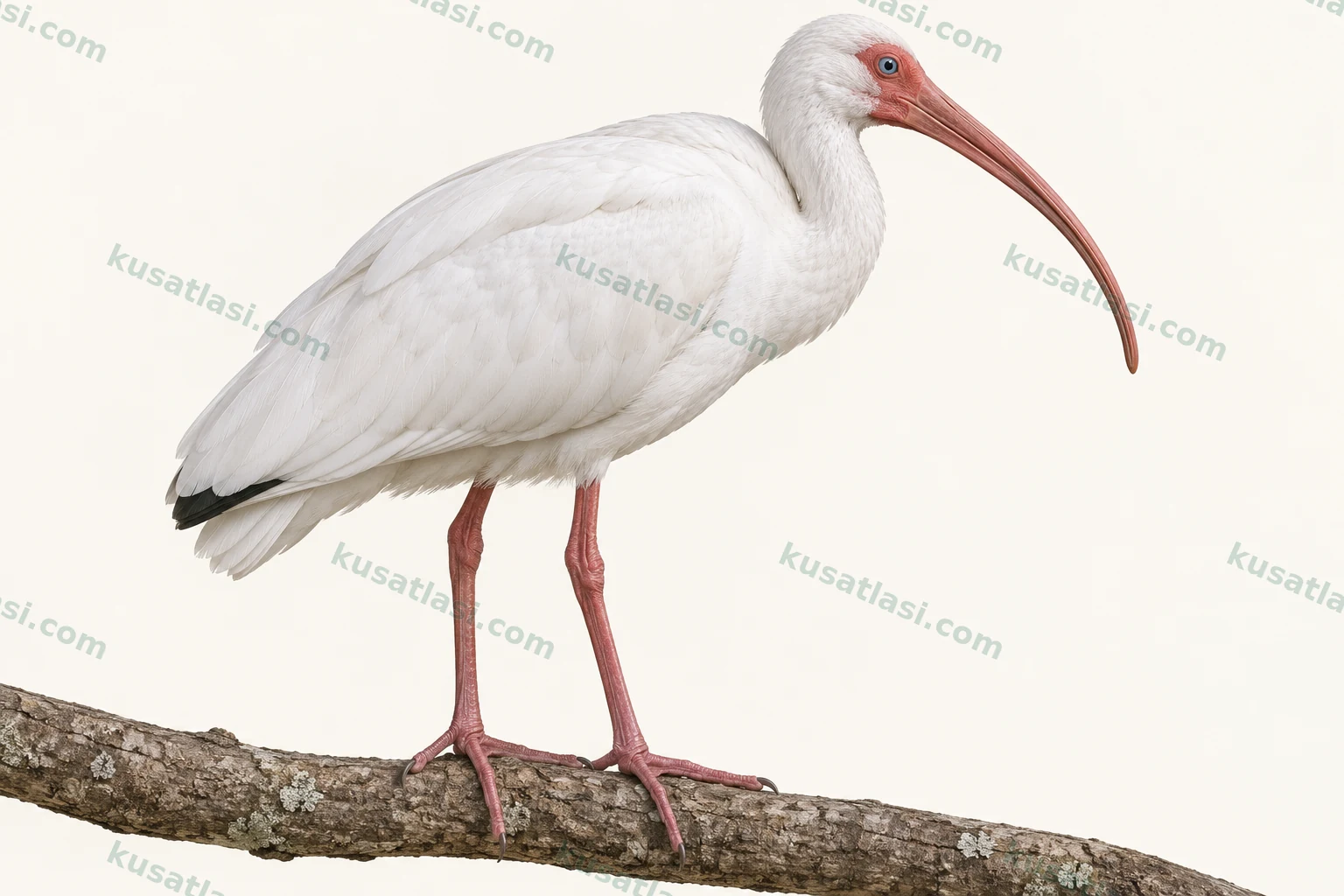
White body, reddish downcurved bill and black wingtips in flight; young birds have brown upperparts and a white belly.
Biometrics
Length
Male56–71 cm
Female56–71 cm
Shared species value
Wingspan
Male97 cm
Female97 cm
Shared species value
Weight
Male810–1261 g
Female593–901 g
American White Ibis
Southeastern USA, Mexico, Central America, the Caribbean and northern South AmericaObservation guide in its natural range
Look for three features together
Do not rely on a single featureWhite feathers; reddish-pink face, bill and legs.
Neck extended straight ahead, legs behind; black wingtips.
Brown upperparts, white belly and orange-pink downcurved bill.
Compare male and female
 FemaleMale
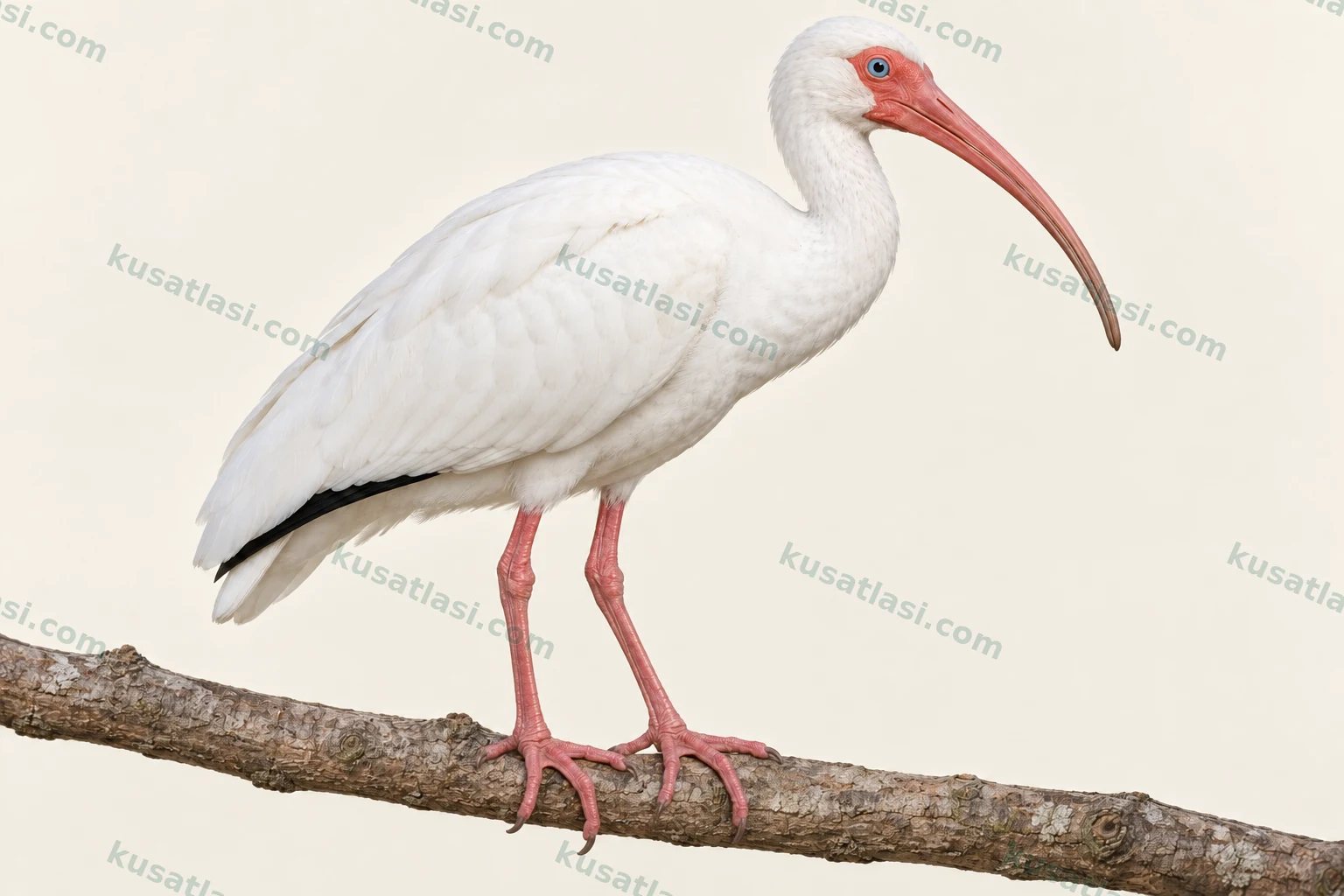
Adults share the same feather pattern. Males are generally larger and longer-billed, but sizes overlap. Young birds’ mixture of brown and white changes with age.
Where to look in its natural range?
Shallow fresh or saltwater wetlands, coastal mud and flooded grassland.
In Everglades research during 1999–2001, new nesting began from February to June. Breeding can also begin at other dates depending on food and water conditions.
January
Present year-round in many parts of the broad range; northern numbers decrease in winter and postbreeding dispersal occurs. No verified regional date specific to this month was given; this does not mean local absence.
February
Present year-round in many parts of the broad range; northern numbers decrease in winter and postbreeding dispersal occurs. USA, Florida Everglades: period when new nesting began in the 1999–2001 study.
March
Present year-round in many parts of the broad range; northern numbers decrease in winter and postbreeding dispersal occurs. USA, Florida Everglades: period when new nesting began in the 1999–2001 study.
April
Present year-round in many parts of the broad range; northern numbers decrease in winter and postbreeding dispersal occurs. USA, Florida Everglades: period when new nesting began in the 1999–2001 study.
May
Present year-round in many parts of the broad range; northern numbers decrease in winter and postbreeding dispersal occurs. USA, Florida Everglades: period when new nesting began in the 1999–2001 study.
June
Present year-round in many parts of the broad range; northern numbers decrease in winter and postbreeding dispersal occurs. USA, Florida Everglades: period when new nesting began in the 1999–2001 study.
July
Present year-round in many parts of the broad range; northern numbers decrease in winter and postbreeding dispersal occurs. No verified regional date specific to this month was given; this does not mean local absence.
August
Present year-round in many parts of the broad range; northern numbers decrease in winter and postbreeding dispersal occurs. No verified regional date specific to this month was given; this does not mean local absence.
September
Present year-round in many parts of the broad range; northern numbers decrease in winter and postbreeding dispersal occurs. No verified regional date specific to this month was given; this does not mean local absence.
October
Present year-round in many parts of the broad range; northern numbers decrease in winter and postbreeding dispersal occurs. No verified regional date specific to this month was given; this does not mean local absence.
November
Present year-round in many parts of the broad range; northern numbers decrease in winter and postbreeding dispersal occurs. No verified regional date specific to this month was given; this does not mean local absence.
December
Present year-round in many parts of the broad range; northern numbers decrease in winter and postbreeding dispersal occurs. No verified regional date specific to this month was given; this does not mean local absence.
Nest, egg and incubation
The nest is a stick platform and nesting is colonial; generally 2–4 eggs are laid. Both sexes incubate for about 21 days. Young make short flights at 4–5 weeks and fly more steadily at about six weeks; nest departure and independence are separate stages.
It makes rough nasal sounds in flight or while feeding.
Do not play recordings to attract birds; observe quietly, especially near nests.
Species information
Quick identification
American White Ibis Eudocimus albus is a long-legged bird with a downcurved bill, found in shallow wetlands in warm parts of the Americas. In adults, white body and reddish face, bill and legs attract attention together. Black wingtips are often hidden on a perched bird, becoming conspicuous at the ends of the white wings on take-off. Small beside the white body, these black tips are a valuable identifying mark.
A young bird is not entirely white like an adult. Its upperparts are brown and belly white; brown and pale neck feathers can form a streaked appearance. The orange-pink downcurved bill and long legs help identify the same bird's changing appearance with age. When a brown ibis is seen, check its underside too; back colour alone should not lead to another species name.
General appearance and posture
It is a round-bodied waterbird with a small head and long neck. The bill is not merely slightly bent at the tip: it curves downward along its length. The face has a bare reddish-pink area. A pale-blue appearance can be visible in the adult eye. Legs share warm tones with bill and face; brightness can vary with breeding condition and light. A mud-covered bill can also look darker than its natural colour.
Walking through shallow water, it lowers its head and probes water or mud with the bill. It can feed on land, particularly short grass, too. Long legs hold the body above water; retracting the neck while standing at the edge does not make it a short-necked species. When it raises its head, bill curvature, bare face and body proportions can be seen again.
Males, females and young birds
Adult male and female have the same white-and-black feather pattern. Males are generally larger and longer-billed, but sizes overlap partly. Scientific research in Florida used several body measurements together to determine sex. That method does not mean every large bird seen from a distance can be labelled male. Apparent differences can mislead unless two birds of the same age at the same distance are compared.
Before breeding, the face, bill and legs of both sexes can change from pink to stronger red. A conspicuous red throat pouch in females was recorded with breeding stage in a scientific study. Otherwise, brightness of red alone is not a reliable male character in everyday observation. No artificial colour split is added to the sexes' shared plumage pattern.
The brown upperparts, white belly and more orange-pink bill of a young bird form a whole different from the adult. Growing birds show brown and white feathers together in a patchwork. White on the back of such a bird does not prove disease or another species. Cornell's account of whitening in the first summer concerns age change in a North American context; it is not a single calendar completed in the same month throughout tropical areas.
Appearance in flight
The neck extends forward in flight and legs trail behind the body. This posture helps distinguish white herons flying with retracted necks. Black areas are visible at the tips of white wings. The entire outer half of the wing is not black; examine the extent of darkness at the spread wing's tip. A brief view at take-off can reveal the mark hidden at rest.
Flocks can combine regular wingbeats with short glides. The direction of a group's flight can describe its immediate journey to feeding or roosting grounds. Not every group flight is annual migration. When identifying a distant white-bodied flock, watch neck position with wingtips; one silhouette or white colour alone is not expected to settle the species name.
Voice and behaviour
It can give a rough nasal sound while flying or foraging. This is not expected to resemble a small bird's melodic song. A feeding group may also be silent for a time; there is no need to wait for continual calling to see it. Voice is considered together with the downcurved bill, white body and black wingtips.
Birds gather while feeding and roosting and may nest in colonies. Sharing an area with other waterbirds does not mean all use the same method or prey. While the ibis probes mud, a nearby heron may mostly capture prey it sees. Spacing and head movements among walking flock members are a useful starting point for watching feeding behaviour.
Similar species
Large white herons can look similar through their white bodies, but have straight bills and fly with retracted necks. In American White Ibis, the downcurved reddish bill, black wingtips and extended neck are checked together. A perched heron shortening its neck or its legs looking different in the light is not enough alone to separate them.
Mycteria americana is another white-bodied waterbird with black wings. Its larger body, thick and differently shaped bill and dark bare head are considered together. Young American White Ibises can be confused with dark Plegadis ibises; white belly and orange-pink bill are sought alongside the generally brown appearance. Adult Scarlet Ibis Eudocimus ruber is red, but young birds and mixed appearances in contact zones require closer examination.
World distribution
The natural range extends from southeastern North America to warm coastal Mexico and Central America, the Caribbean and northern South America. Florida and the Gulf of Mexico are important North American observation areas. The range is not restricted to the seacoast; inland areas with suitable shallow wetlands are also used. This broad geography does not mean all intervening land is continuously occupied.
Status within its natural range
The current taxonomic list accepts Eudocimus albus as a separate species and gives its global status as Least Concern. Local wetland loss and changes in water regimes can nevertheless reduce feeding and nesting opportunities. One colony's size does not equal the population of an entire continent. Results of Florida studies in particular are not applied equally to every Caribbean or South American population.
Scientific discussion of species boundaries and records of hybridisation exist around Venezuela and Colombia, where it meets Scarlet Ibis. Genetic research comparing white specimens from Florida with red ones from Brazil supported two different lineages; it did not sample every white individual in South America. Natural geography and the currently accepted species identity are retained together.
Migration
It can occur year-round across much of its range; northern numbers decrease in winter. Some birds ringed in the USA have been recorded again in Mexico, Cuba and northern South America. After breeding, single birds or small groups can also disperse northward and inland. Therefore no migration line with one shared starting point, endpoint and direction is used for all individuals. Movements responding to food and water are considered with regular seasonal movements.
Breeding habitat
Shallow freshwater marshes, coastal lagoons, mangroves and floodplains are parts of its habitat. Nest colony and feeding grounds need not be in the same place. Coastal breeders may fly inland to bring freshwater-derived food to their young. In the Everglades, receding water concentrating small prey has been associated with feeding conditions suitable for breeding; excessive drying does not continually offer the same benefit.
Nest site
The nest is usually a stick platform in a tree, shrub or mangrove; reed-like plants can also be used in some places. The male carries much of the material and the female arranges most of it. Breeding accounts generally report 2–4 eggs; another specialist account gives two eggs or three as common and up to five as exceptional. Both adults participate in incubation of about 21 days and in chick care.
Young can climb near the nest at about three weeks; short flights are described at 4–5 weeks and more sustained flight at about six weeks. Leaving the colony to forage with adults is a separate developmental step. A chick outside its nest is not immediately considered independent. Watch colonies from afar without making birds leave their nests.
Daily habitat use
Muddy shallow shores, lake edges and flooded grassland are used for daytime foraging. In Florida, birds can also occur in short-grassed human settlements. Encountering them in a park does not show the disappearance of their natural wetland needs. A morning feeding group and an evening communal roost may be in different places; these daily movements are not marked as annual migration.
What does it eat?
Crayfish, crabs and various invertebrates are important foods. Small fish, worms, insects, snails and small frogs may also be taken. Fresh water and coastal mud offer different prey, so one obligatory food is not assigned to every region. Seeing a bird catch a crab does not mean that every chick of that colony is fed exclusively marine-derived food.
An experiment on chicks showed that salty food and drinking water matter together. Chicks given highly salty food lost mass at the start of the experiment and began gaining again when fresh water was supplied. The experiment involved 28 chicks under particular conditions. It illustrates the value of freshwater sources around natural colonies; it is not interpreted as saying every adult is unable to forage in salt water.
How does it forage?
It walks slowly through shallow water, probing bottom mud with its bill and moving it sideways. Hidden prey can be found by touch, while prey visible at the surface is also taken. Feeding in turbid water therefore does not necessarily mean impaired vision or failure. Bill shape and length are assessed with the shallow bottom searched. Similar probing can occur on land over short grass or mud.
The parents feed their chicks by regurgitation. The place where an adult caught prey may not be recognisable from the food a chick receives in the nest. This is why coastal colonies and inland freshwater feeding grounds need protection together. Watch natural prey searching from a distance rather than throwing food to a feeding flock.
The face changes while white feathers remain
Research on breeding physiology in Florida followed changes in face, bill and leg colour alongside breeding stages. In both sexes, pink tones were recorded intensifying to red. Thus bare parts can change appearance while feathers remain white. Reading the colour difference in a photograph only as separate male and female colours misses that natural process.
Leaving the nest is not the same as flying
Young can move on branches close to the nest before their flight strengthens. First short flight, sustained flying ability and journeys to feeding grounds with adults are separate stages. A brown chick standing on a branch does not mean it no longer receives parental food. This distinction helps avoid treating nest departure as one fixed day of independence.
Adults and chicks experience salt limits differently
A coastal ibis colony's need for fresh water may seem surprising at first. In the chick-feeding experiment, salty prey together with salty drinking water harmed growth, which improved after the switch to fresh water. The experiment does not reproduce all natural conditions; it demonstrates a particular physiological limit. The link between coastal birds and inland wetlands is therefore more than a matter of flight on a map.
Relatedness between two colours is investigated
Scarlet Ibis and American White Ibis are close relatives and can hybridise where they meet. Genetic research compared three mitochondrial and four nuclear regions, supporting two separate lineages in Florida and Amapá samples. Some genes also showed traces of shared history. The research explicitly states that it did not sample all South American white ibises; the scientific result is interpreted within its sampling limits.