

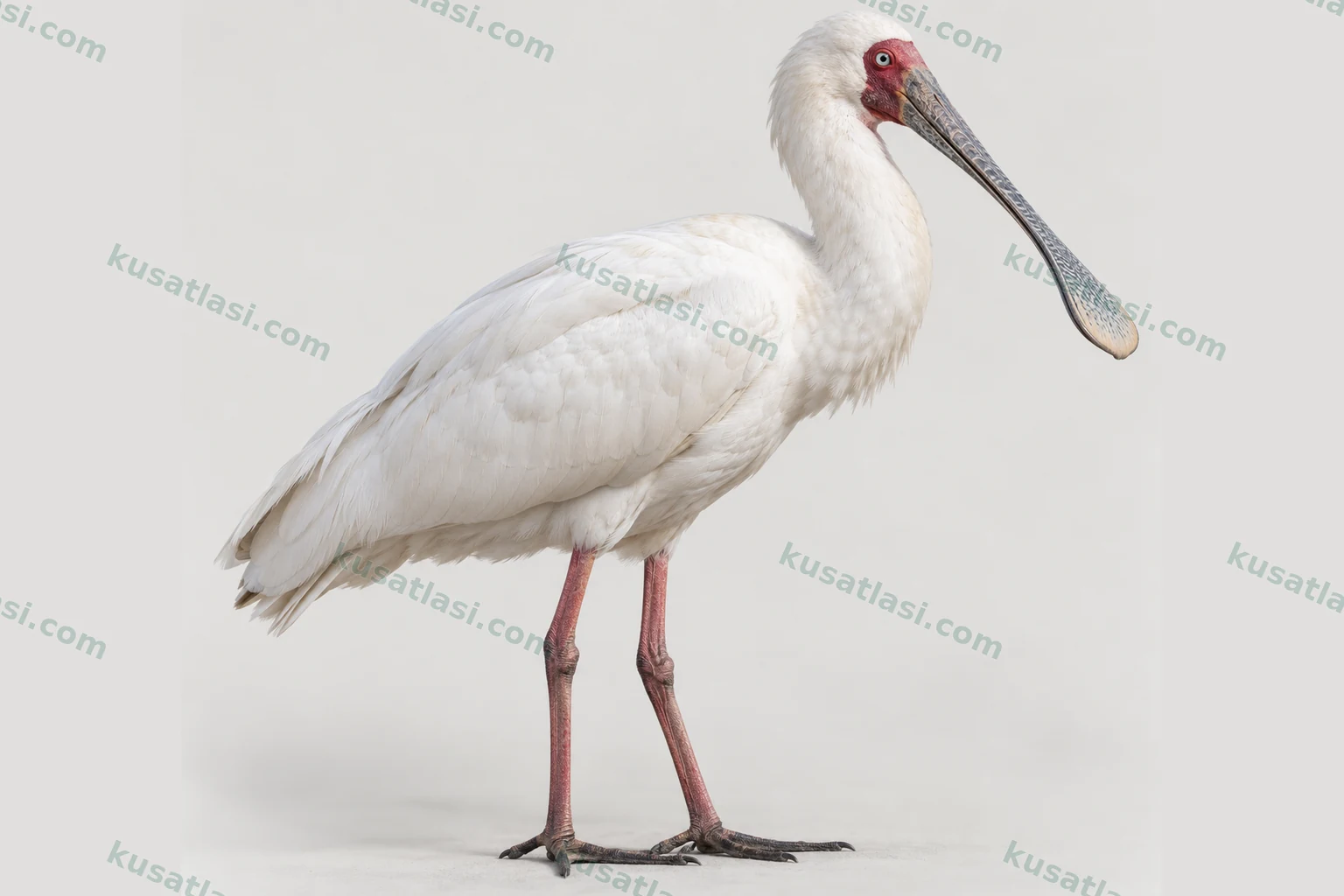
World Birds IUCN statusLC · Least ConcernGlobal IUCN category. BirdLife v10 (2025); taxon matching: AviList 2026 / IOC 15.2; checked: 29.10.2026. The list year is not the species assessment date. Source and method · BirdLife OrderPelecaniformesPelicans and allies FamilyThreskiornithidaeThreskiornithidae
African Spoonbill
Platalea alba
White body, adult bare red face and legs, and a bill with a broad flattened tip; young birds are paler with dark wingtips.
Biometrics
Length
Male90–91 cm
Female90–91 cm
Shared species value
Wing length
Male38.42 cm
Female38.42 cm
Shared species value
Weight
Male1.02–1.9 kg
Female1.02–1.9 kg
Shared species value
African Spoonbill
Wetlands of sub-Saharan Africa and MadagascarObservation guide in its natural range
Look for three features together
Do not rely on a single featureCheck the spoon shape that looks narrow from the side but widens when the bill turns.
Do not require the adult’s red bare face in a young bird.
Assess dark wingtips and a more feathered, pale face together in young birds.
Compare male and female
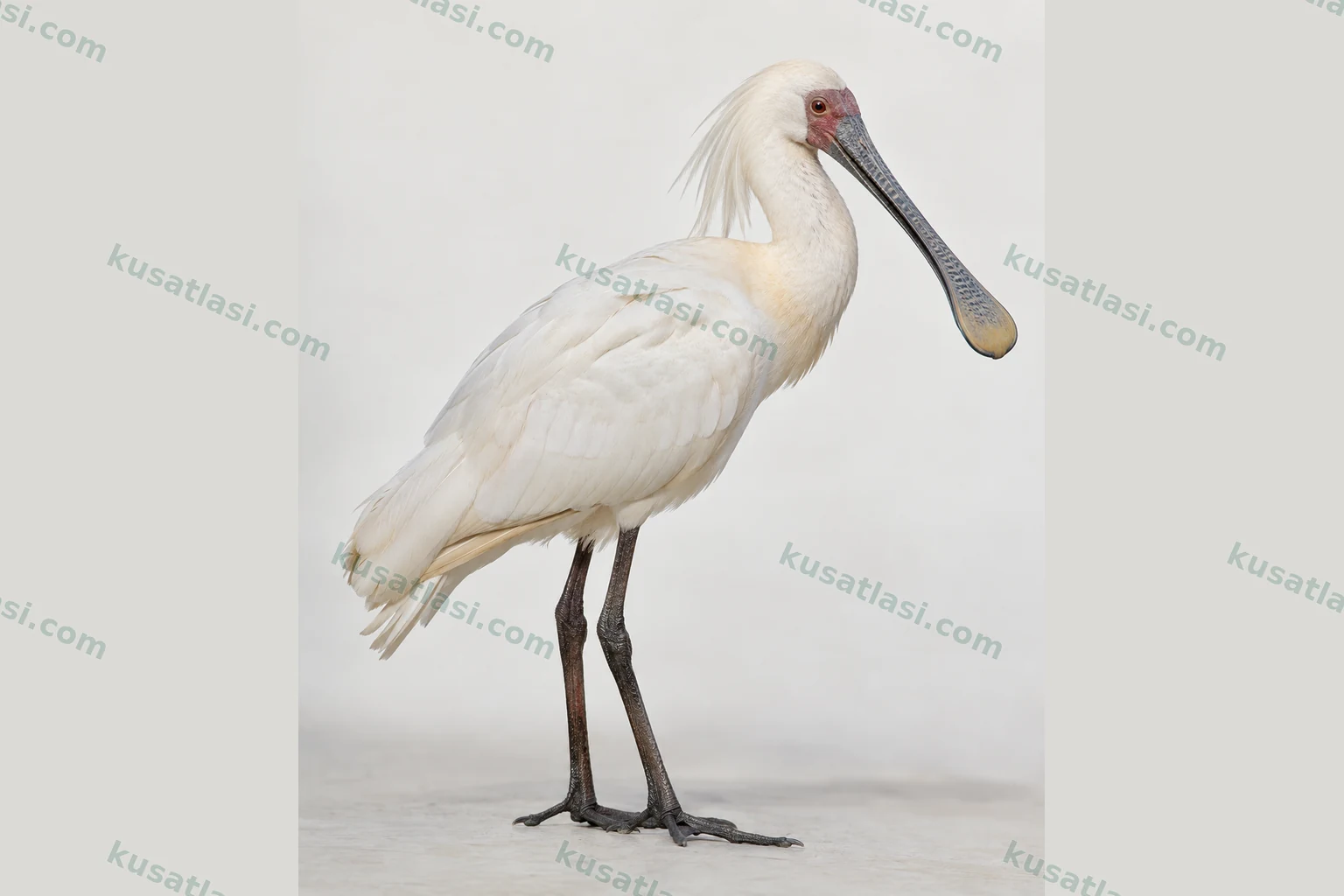 FemaleMale
Adult sexes look similar. Young birds may not yet have developed red on face and legs, and their wingtips may be dark.
Where to look in its natural range?
Watch birds sweeping their heads from side to side along quiet shallow margins.
Regional egg-laying months from the South African expert account are shown; this is not one shared calendar for the whole continent and Madagascar.
January
Wanderings depend on water and rainfall; no verified route is shared by all populations. No verified regional date specific to this month was given; this does not mean local absence.
February
Wanderings depend on water and rainfall; no verified route is shared by all populations. Botswana and Namibia, expert account: regional egg-laying period.
March
Wanderings depend on water and rainfall; no verified route is shared by all populations. Botswana and Namibia, expert account: regional egg-laying period.
April
Wanderings depend on water and rainfall; no verified route is shared by all populations. Botswana and Namibia, expert account: regional egg-laying period.
May
Wanderings depend on water and rainfall; no verified route is shared by all populations. Botswana and Namibia, expert account: regional egg-laying period.
June
Wanderings depend on water and rainfall; no verified route is shared by all populations. Botswana and Namibia, expert account: regional egg-laying period.
July
Wanderings depend on water and rainfall; no verified route is shared by all populations. Southern African region, expert account: main egg-laying period. Botswana and Namibia, expert account: regional egg-laying period.
August
Wanderings depend on water and rainfall; no verified route is shared by all populations. Southern African region, expert account: main egg-laying period. Botswana and Namibia, expert account: regional egg-laying period.
September
Wanderings depend on water and rainfall; no verified route is shared by all populations. Southern African region, expert account: main egg-laying period.
October
Wanderings depend on water and rainfall; no verified route is shared by all populations. Southern African region, expert account: main egg-laying period.
November
Wanderings depend on water and rainfall; no verified route is shared by all populations. Southern African region, expert account: main egg-laying period.
December
Wanderings depend on water and rainfall; no verified route is shared by all populations. No verified regional date specific to this month was given; this does not mean local absence.
Nest, egg and incubation
A flat nest of sticks and reeds; both partners provide care in the colony. The regional expert account gives 2–4 eggs and incubation by both partners for about 25–29 days. Walking around the nest and first flight are separate stages.
Usually quiet; it gives rough throaty sounds and calls during breeding displays.
Do not play recordings to attract birds; observe quietly, especially near nests.
Species information
Quick identification
African Spoonbill Platalea alba is a white waterbird with long legs and a long bill that widens into a flattened tip. In adults, bare facial skin and legs appear pink-red. The bill is not entirely red: bluish-grey areas and pale or pinkish edges may be visible together. When a feeding bird sweeps its head from side to side in the water, seeing the spoon-shaped bill and red face together makes identification much stronger. White feathers alone do not suffice, as several white heron species may share the wetland.
When resting with the head tucked into the shoulders, the entire bill may be hidden. Rather than assigning a definite name from the white body alone, wait for the bird to raise its head naturally. The extent of bare face, whether the bill tip really widens and the colour of the legs must be considered together. Young birds may not yet have developed the adult’s bright red areas; failing to see red is not an exclusion rule valid for every age.
General appearance and posture
Adult body and wing feathers are white. The slender neck may extend forward while walking in shallow water, but shortens at rest, making the body look more compact. Seen from the side, the flattened bill tip can look narrow; its width becomes much clearer when the bill turns. A narrow-looking tip in one side-on photograph therefore does not prove a pointed bill. The bare red face should be read with the feather boundaries of forehead and eye area; water reflections can make white feathers look pink.
The adult’s red legs and face are complementary identification features. Much of the legs is hidden in deep water; do not guess the colour of the submerged portions. During surface sweeping, the neck bends and the head and bill may come close to the water’s plane. Such postural changes can make resting and feeding birds seem like different species. Following the same bird in motion allows bill and facial details hidden in one frame to be compared.
Males, females and young birds
Male and female look similar in their basic white plumage. A red face or apparently long bill must not be used alone as a male feature. Similar appearance does not mean that just one sex performs care either. Regional expert accounts describe both partners incubating and feeding young. Seeing one adult sitting at the nest does not allow its sex to be identified confidently from appearance.
Young birds have a more feathered forehead, and face and legs may lack the adult’s vivid red. Dark feathers can occur at the wingtips. The bill also appears darker and shorter than an adult’s, with proportions changing as it grows. In direct breeding observations on Robben Island, young near the nest were photographed with short, dark bills. However, not every dark bill in a poorly lit photograph indicates youth: the grey portion of an adult bill can also look darker in low light.
A dark wingtip alone does not identify African Spoonbill; young of other spoonbills show similar features. Assess facial feathering, leg and bill colours and the open-wing pattern together when considering age. A youngster walking around the nest may not yet be capable of strong flight. Leaving the nest, first flight and independent feeding are separate developmental stages. Do not reduce them to one day count without a sequence of dated observations.
Appearance in flight
With neck and legs stretched out, the white body forms a distinctive long silhouette. The broad-tipped bill in front of the head may also be visible in flight with a good view. This overall silhouette helps distinguish it from the retracted-neck flight of most herons, but a neck line alone does not identify a distant white bird with certainty. When head and body align, the bill tip may disappear from view; unseen width does not mean a narrow bill.
Dark wingtips in young birds can contrast with the white wing. Do not require this juvenile pattern in adults. Distinguish upperwing from underwing, and wingtip from trailing edge. An adult carrying food across water or a gap in the shore to its nest is not demonstrating seasonal migration. The Robben Island record of a bird arriving from the mainland to feed young directly shows that breeding and feeding sites need not occupy the same small place.
Voice and behaviour
The bird may appear generally quiet; short, rough, throaty sounds and more conspicuous calls during breeding displays are reported. A silent flock does not mean that its members are not communicating or breeding. Other species’ voices also occur in a nearby colony; do not assign a sound to this species without matching it to the spoonbill seen. Approaching a nest or flushing a bird to hear it is not an appropriate observation method.
Small groups may form while feeding, and during breeding the birds may share a colony area with other waterbirds. Co-occurrence does not mean that every individual shares the same pair relationship, nest or feeding task. Each pair has its own nest and care of young. Rainfall and water-level changes in shallow habitats may affect wanderings between wetlands. A fixed annual route and movements related to water availability must not be described as the same kind of movement.
Species that may be confused
1. Eurasian Spoonbill Platalea leucorodia is also white and spoon-billed. Dark legs, a mainly dark bill and a yellowish breast area during breeding help identify adults; adult African Spoonbill’s red face and legs create a different arrangement. Young Eurasian Spoonbills can have pale bills and dark wingtips, so a one-step key based on adult colours is not suitable for young birds. Compare the visible face and bill structure together.
2. Little Egret Egretta garzetta can look similar because of its white body, particularly with the bill hidden in head feathers. Its slender pointed dark bill, blackish legs and typically yellow feet differ from the spoonbill’s broad-tipped bill. If feet are underwater, failing to see yellow is unsurprising; complete the distinction with bill and general posture. Sharing a colony alone does not show that the birds are the same species.
World distribution
African Spoonbill is native to sub-Saharan Africa and Madagascar. Its broad but discontinuous distribution extends from West African wetlands eastwards, then to suitable water networks in East and southern Africa. Not every water body in this large region is used alike; depth, strong currents and a lack of shallow feeding edges affect distribution. Madagascar records are not treated simply as chance appearances outside the continent: the island is part of the species’ natural geography.
Status within its natural range
The southern African atlas highlights high interior wetlands and some Cape water bodies; in arid areas occurrence is sparser and depends on water. The dated expansion in the southwestern Cape has been associated with opportunities provided by artificial wetlands, not an experiment proving that every dam increases the species everywhere. Changes in Free State colonies counted in different years also cannot replace the current population trend of the whole continent. Local counts must be read with the nests and period they cover.
Migration
Wanderings related to rainfall, water and food are important. Ring recoveries show that some individuals reach distant places, but joining two points does not prove that all birds follow the same route each year. Natural geography, record samples and the model layer with its qualifications are assessed separately on the map. The model’s coloured area is not an exact breeding boundary, and one location record is not equivalent to a nest. Regional laying periods can be reported, but no shared monthly route for all Africa and Madagascar is drawn because one has not been verified.
Breeding habitat
Shallow inland waters, lake and river edges, marshes and floodplains are the main habitats; coastal places such as lagoons and estuaries can also be used. Water depth matters for feeding. A colony needs secure nest supports such as trees, bushes or reeds. Nesting and sufficient shallow feeding habitat need not occur at the same point; adults can visit other waters and return to their young. Protecting only the nest tree therefore does not fully protect daily food access.
Nest site
The flat, oval nest of sticks, fine twigs and reeds may be built in a tree standing in water, a bush, reedbed or small rocky island. In the regional expert account, the male brings material and the female incorporates it; both partners incubate and feed. Usually 2–4 eggs and about 25–29 days of incubation are reported (South African expert information for African Spoonbill). Their roles are established through repeated observation, not the appearance of whichever bird is sitting at the nest at one moment.
Daily habitat use
Feeding along shallow edges, resting safely and returning to the colony complement one another. Researchers did not approach the documented Robben Island nest or count its eggs, in order to reduce disturbance; young were later followed from a distance. This example shows that every number need not be collected in every field study. Making a bird leave its nest, going beneath the branch or flying a device over a colony alters natural behaviour. Repeated distant observations better protect both the real developmental stages and the bird’s safety.
What does it eat?
Small fish and aquatic invertebrates are important foods. Frogs delivered to young have also been recorded by direct research. The chick food from one colony study in Free State is not presented as the same year-round food proportions for all adults. Diet composition is assessed with water body, season and developmental stage. Several birds feeding in the same shallow area does not prove that each catches the same prey either.
How does it forage?
Moving slowly through water, the bird submerges the bill partly or entirely and sweeps its head sideways. Catching prey by touch is not the same mechanism as selecting it only by sight underwater. The broad tip suits this search; distinguish bill depth, sweep direction and whether prey is actually swallowed. Prolonged head movements do not mean that every sweep succeeds. An invisible submerged bill is not evidence that the bill is short either.
The expert account reports collecting small animals exposed by crocodile or hippopotamus movements. This opportunistic behaviour does not mean that the species requires those large animals to survive or forms a mutual-help relationship. Very high water can change suitable shallows, while drying reduces available feeding habitat. Observing shallow-water quality and actual captures together is more reliable than inferring food abundance from flock size alone.
First record and first breeding record
The 2012–2013 Robben Island observations show that presence on an island and successful breeding require different evidence. Adults and a sitting bird were seen first; later an adult brought food and fed young, and three young were recorded near the nest. Egg number, incubation start and the hatching date of each youngster were not measured. The calendar interval from the first nest visit to seeing young therefore cannot be converted directly into an incubation period.
Different denominators in colony research
Results from 15 active Free State nests followed over one breeding season show that egg hatching, hatched young reaching flight and a nest producing at least one young are separate success measures. Their denominators differ. A high value for one does not mean equal success for every egg or nest. A small, dated sample also cannot stand for the current success of all African Spoonbill populations.
The published mean of 2.6 eggs does not mean a fraction of an egg occurred in an individual nest. The breeding account therefore uses the actual clutch range; the study mean is understood only as a characteristic of that sample.
Feeding and nesting areas form a whole
An adult feeding away from the colony and returning to young shows that the area needing protection is not just a nesting branch. Feeding shores, safe resting places and access between them and the colony must be considered together. A mixed colony may contain other species, but a neighbouring nest’s success should not be applied to every nest in the tree or every bird species. Each pair’s chick development and adult provisioning require separate observations.
Young birds’ dark wingtips and pale, more feathered faces differ from adult white wings and bare red faces. A change in birds seen months apart does not always mean that a different species has arrived. Record age features and uncertainty about whether the same individual was seen. Walking near the nest does not mean flying as well as an adult or no longer needing care; separating these stages is part of accurate observation.