

World Birds IUCN statusLC · Least ConcernGlobal IUCN category. BirdLife v10 (2025); taxon matching: AviList 2026 / IOC 15.2; checked: 29.10.2026. The list year is not the species assessment date. Source and method · BirdLife OrderPelecaniformesPelicans and allies FamilyArdeidaeArdeidae
White-crested Tiger Heron
Tigriornis leucolopha
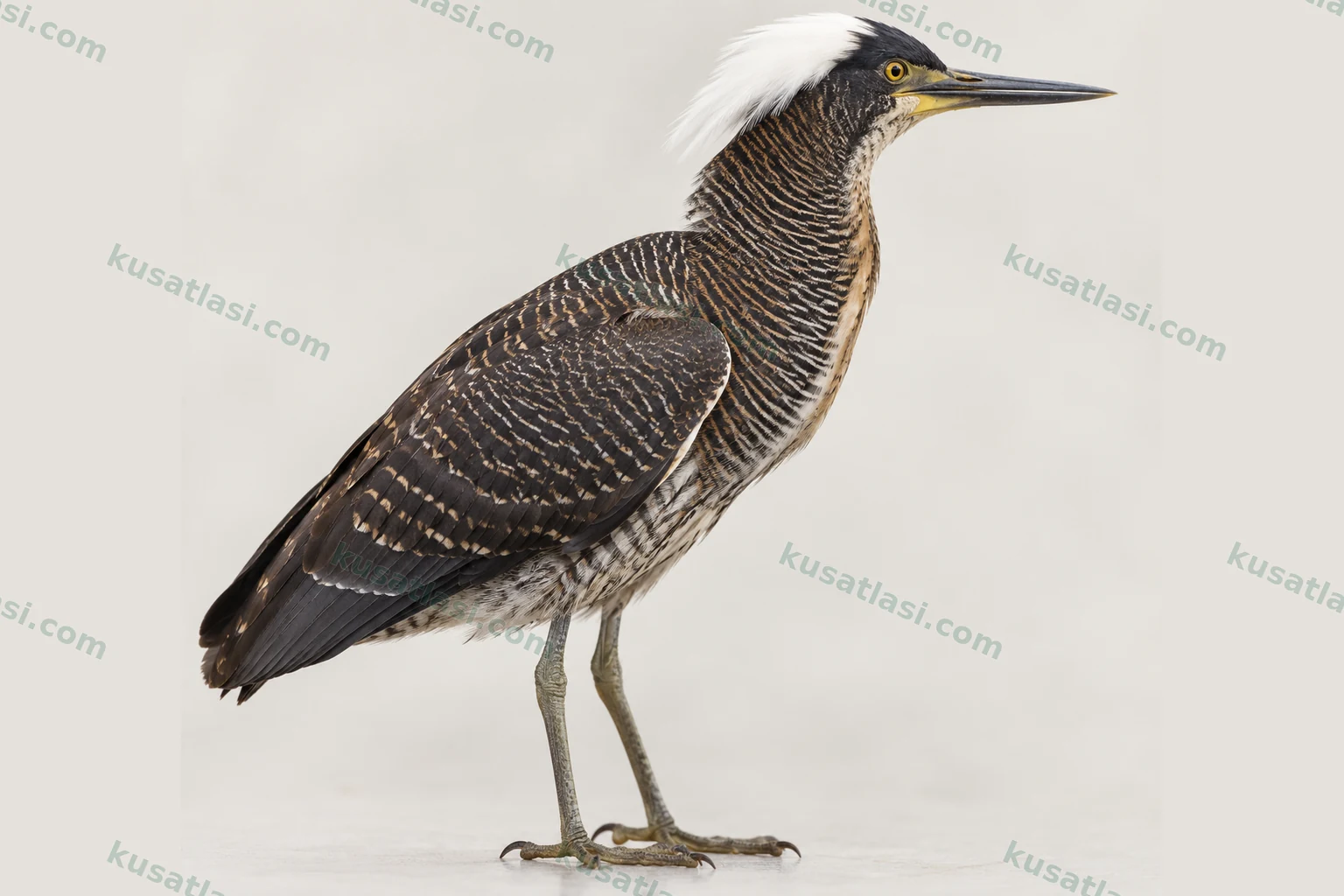
A heron hiding along densely wooded watersides, with a dark crown and fine pale-and-dark transverse bars. Its white crest is often closed.
Biometrics
Length
Male66–80 cm
Female66–80 cm
Shared species value
Wing length
Male26.62 cm
Female26.62 cm
Shared species value
Weight
MaleData unavailable
FemaleData unavailable
White-crested Tiger Heron
Humid forest waterways of West and Central AfricaObservation guide in its natural range
Look for three features together
Do not rely on a single featureLook for the fine pale-and-dark bands of neck, back and upperwing together.
A closed crest may show no white; its apparent absence does not rule out the species.
Consider viewing angle and compare the pale wing spots of young night herons.
Compare male and female
 FemaleMale
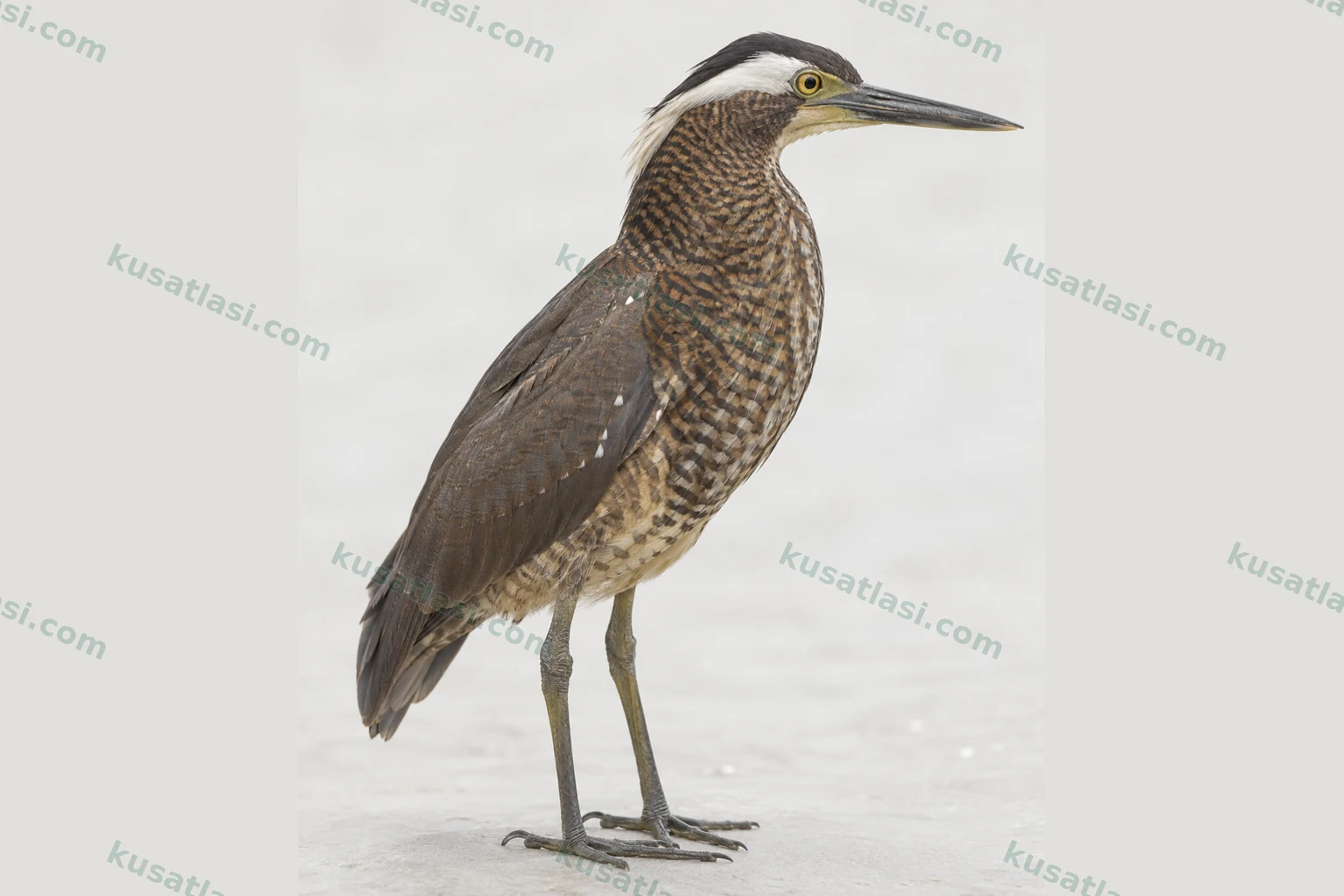
The sexes are generally similar. Tendencies in female size and band width do not allow reliable sexing from one photograph.
Where to look in its natural range?
Quietly watch natural viewing gaps along forest streams and wooded swamps.
Shared laying months across the range have not been verified. The discovery and chick-hatching dates at a single Congolese nest are shown as separate stages.
January
Primarily resident; no annual route is verified for possible local dispersal. No verified regional date specific to this month was supplied; this does not imply local absence.
February
Primarily resident; no annual route is verified for possible local dispersal. No verified regional date specific to this month was supplied; this does not imply local absence.
March
Primarily resident; no annual route is verified for possible local dispersal. No verified regional date specific to this month was supplied; this does not imply local absence.
April
Primarily resident; no annual route is verified for possible local dispersal. No verified regional date specific to this month was supplied; this does not imply local absence.
May
Primarily resident; no annual route is verified for possible local dispersal. No verified regional date specific to this month was supplied; this does not imply local absence.
June
Primarily resident; no annual route is verified for possible local dispersal. No verified regional date specific to this month was supplied; this does not imply local absence.
July
Primarily resident; no annual route is verified for possible local dispersal. No verified regional date specific to this month was supplied; this does not imply local absence.
August
Primarily resident; no annual route is verified for possible local dispersal. No verified regional date specific to this month was supplied; this does not imply local absence.
September
Primarily resident; no annual route is verified for possible local dispersal. No verified regional date specific to this month was supplied; this does not imply local absence.
October
Primarily resident; no annual route is verified for possible local dispersal. Republic of Congo, Louna River, 2006: the nest was seen on 17 October; the laying date is unknown.
November
Primarily resident; no annual route is verified for possible local dispersal. The same nest, 2006: one chick was reported hatching on 19 November.
December
Primarily resident; no annual route is verified for possible local dispersal. No verified regional date specific to this month was supplied; this does not imply local absence.
Nest, egg and incubation
The nest is a loose branch structure on a tree branch above water. Typical egg number and exact incubation and nestling durations could not be verified; one chick record does not establish a typical number.
The calls are deep and muffled, with single or paired notes. Forest echoes make matching the sound to a visible source important.
Do not play recordings to attract birds; observe quietly, especially near nests.
Species information
Quick identification
The White-crested Tiger Heron Tigriornis leucolopha lives in dense forests of West and Central Africa and has fine lines of yellowish light brown and black. Its crown is dark; the white crest in its name is often hidden beneath dark head feathers. A bird without visible white must therefore not immediately be ruled out. The sides of the head and neck, back and upperwing have transverse bars, while the underparts carry a more irregular combination of dark spots and lines. A long pointed bill and yellow eye complete the appearance. Identification depends more on seeing these features together than on a crest photograph.
Cornell's description of a front-heavy body and the slender appearance in the expert heron account can be understood through different postures. With the neck withdrawn, the head lies close to the body and the front looks thick; extending the neck produces a longer, slimmer silhouette. Do not judge body proportions when only the head appears behind branches. Waiting for the bird to enter a natural viewing gap to see its fine, close-set bars is more reliable and less disturbing than trying to flush it.
General appearance and posture
The adult's black crown and nape differ from the light-and-dark barred neck sides. The upper bill is dark brownish and the lower bill yellowish green; bare skin in front of and around the eye may also look greenish. These are small details difficult to see in leaf shade. A bright-looking bill tip does not make the entire bill pale. Head direction also changes how much of the lower bill is visible. Dark markings across the pale underparts must not be described as the same pattern as the regular transverse wing bars.
The tail has light and dark transverse bands, but the wings can cover much of it in a resting bird. Not seeing the tail in a momentary view does not make the bird tailless. Instead of seeking the whole outline of a stationary bird in dense shore cover, compare the parts of head, neck and back within natural gaps. When disturbed it may stretch its neck upwards and freeze like a bittern; this posture alone does not identify the species.
Males, females and young birds
Males and females generally share the same concealing pattern. The expert account states that females may be smaller, with narrower pale bands above and warmer cinnamon tones below. These are not definite rules that reliably sex every wild individual. Light, feather condition and viewing angle particularly affect the apparent width of pale bands. An opened white crest is not a male sign on its own either. Do not assign male or female from one photograph using these slight tendencies.
Young birds may have broader light-and-dark bars; redder or sandier pale areas are considered in relation to age and moult. However, no verified schedule giving exact age sequences and monthly moult for every individual was found. Treating every warm brown bird as young would therefore also be wrong. First establish whether the pattern is transversely barred, spotted or longitudinally streaked, then assess visible head and bill details.
One chick was recorded hatching at a monitored nest in the Republic of Congo in 2006. This is a genuine breeding record concerning a chick, not proof that all nests contain a single egg. Nor can the interval between first seeing the nest and hatching be converted into incubation duration without knowing the laying date. Separate questions such as the adult's sex, egg number and incubation start each require separate observations.
Appearance in flight
In a barred heron briefly flying through forest, look for the dark crown, long bill and light-and-dark body pattern together. Do not expect a white head mark in flight when the crest is closed. Overlapping wing and tail can also obscure which part carries which bands. A flight view does not provide every detail of a perched bird; unseen underwing markings must not be invented.
Herons may look neck-retracted in flight, but neck shape and wingbeats in a distant silhouette do not identify this species alone. Especially when comparing a brown young night heron, seek pale spots versus transverse bands rather than a fleeting impression of dark wings. Recording flight direction and the habitat where it lands again is useful; landing habitat does not replace reliable plumage features. An individual entering an open wetland does not cease to be a forest species.
Voice and behaviour
Deep, hollow-sounding, muffled calls may reveal its presence. Single or paired notes can be repeated at slow intervals. A field study published in 1989 visually confirmed this heron making a sound previously assigned to another bird. Forest echoes and concealment make the heard direction and the bird's actual location difficult to separate. Rather than assigning every muffled sound in one direction to one species, look for simultaneity between sound and the visible bird.
It is usually seen alone and hides readily in dense cover. Twilight and night activity are important, but exclusively nocturnal use throughout its day or identical feeding hours everywhere have not been demonstrated. Knowledge of feeding details, the quantitative division of daytime and nighttime use and the functions of wild displays is limited. Crest-raising and hissing seen in captivity must not be presented as the normal courtship display of every wild bird. Quiet observation is more appropriate for understanding the context.
Similar species
1. Eurasian Bittern Botaurus stellaris: brown concealing plumage and muffled voice create an initial resemblance. The bittern looks stockier; compare its pale yellowish-brown face and neck and streaked body with the tiger heron's darker, narrowly cross-barred appearance. Reedbeds versus wooded stream margins help but are not identification alone. A neck-stretched posture is not sufficient to choose between them.
2. Black-crowned Night Heron Nycticorax nycticorax: the adult's grey wings, black crown and back and red eye differ greatly from the barred tiger heron. The real difficulty is the brown young bird. Compare its conspicuous pale wing-covert spots with the tiger heron's fine transverse bars. A young night heron's eye need not yet be adult red. Eye colour alone is therefore not a shortcut separating all ages.
World distribution
The White-crested Tiger Heron's natural range is associated with humid, wooded waters in West and Central Africa. The basic framework extends from the Senegal region through the Guinean coastal forests, Cameroon and Gabon into the Congo Basin. This broad geography does not imply continuous presence on every intervening tract. Forest structure, water and dense shoreline cover matter locally. Dry open savanna must not be added as though it were a continuation of a suitable stream margin.
Status within its natural range
Concealment and confusion of its muffled calls with other birds mean that observation numbers do not directly reflect actual individual numbers. Research during 2002–2007 in the Lesio-Louna and Lefini reserves, Republic of Congo, provided direct evidence of its local presence and a nest. This dated study is not a present-day census of the whole Congo Basin. Few reports may reflect either scarcity or difficulty of detection; systematic research is needed to distinguish them.
The current expert group's Red List table gives global Least Concern with a decreasing trend. Data Deficient in an older account refers to an older assessment and must not be treated as a simultaneous current category. A broad range also does not make habitat loss in each forest fragment unimportant.
Movements
It is considered primarily resident, with possible local dispersal. No verified intercontinental route, shared monthly direction across the range or measured migration distance was found. An observation from a different tributary does not establish annual migration. Map records show where it was seen; connecting them with lines does not replace actual movement tracking. Particularly in hard-to-access forests, apparently empty areas cannot be regarded as confirmed absence.
Breeding habitat
Wooded surroundings of streams, swamps and flooded areas within humid forest form its basic habitat. Forest strips along large rivers and coastal mangrove waterways may also be used. Closed cover together with water is a different habitat structure from open lake water alone. Limited visibility makes the bird difficult to find; a few records in little-watched areas may not represent all suitable habitat.
Nest site
The few documented nests have loose structures of branches. A monitored nest about three metres high in a branch fork over the Louna River in Congo is an actually observed example. Another expert record describes a tree nest at about six metres. These observations must not be turned into an obligatory nesting-height range or a standard measurement for the species. Typical egg number and exact incubation and nestling durations could not be verified with sufficient data.
Daily habitat use
Brief views of a solitary bird standing or moving within shore cover are normal. Stretching its head upwards and remaining motionless makes it harder to detect among surrounding lines. No species-specific measured daily range was found for distances between daytime refuges, nighttime feeding and resting sites. Opening shoreline cover, moving branches to see the bird or waiting close to a nest is not an appropriate way to resolve this uncertainty; observe from afar through natural gaps.
What does it eat?
The expert heron account lists small fish, various aquatic and shoreline invertebrates, frogs and some other small vertebrates. However, sufficient quantitative research showing their proportions throughout the range was not found. A long pointed bill alone does not prove that a particular prey is its most important food. Nor should the heron name imply an exclusively fish diet. The relationship between local prey availability and daily selection needs separate investigation.
How does it hunt?
Solitary feeding and use of dense waterside cover are known, but detailed hunting behaviour is poorly documented. Other herons' motionless waiting, slow approach or sudden bill strike are therefore not presented as a measured sequence for this species. In an observed feeding event, record separately the standing place, whether prey was actually caught and whether the swallowed organism could be identified. Not every extension of the bill towards water results in a successful capture. Staying concealed away from the shore does not show that all feeding happens in water either. Observe naturally visible behaviour instead of leaving bait or drawing the bird into the open to study hunting.
How was a sound's identity corrected?
A 1989 study demonstrates why visual evidence should support sound identification in secretive birds. A muffled sound previously attributed to the Rufous Fishing Owl was heard near this heron displaying its white crest during fieldwork in Côte d'Ivoire. A later observation directly saw the bird making the sound, correcting the identification. This historical event does not mean that all present-day owl records are wrong. The lesson is to test a familiar sound's assumed name against its simultaneously visible source, rather than merely repeat the assumption.
Similar appearance need not mean close relationship
Its head-stretched freezing posture and brown camouflage recall a bittern. In contrast, a comprehensive heron phylogeny published in 2023 places Tigriornis and the American Tigrisoma species in the same principal tiger-heron group. Bitterns belong to another major group. Similar shapes useful for concealment make relationships difficult to infer from outward appearance alone. This research compares many inherited markers; it does not substitute one photograph or behaviour for the entire evolutionary history.
One nest has two different dates
The Congolese nest was first seen on 17 October 2006, and a chick was reported hatching on 19 November. There are 33 days between these dates, but the laying date is unknown. Therefore 33 days cannot be used as incubation duration. Likewise, one chick does not prove a typical clutch of one. Nest discovery, laying, incubation and hatching are related but distinct stages. Preserving dates accurately in a poorly known species allows new observations to be compared without turning uncertainty into false precision.