

World Birds IUCN statusNT · Near ThreatenedGlobal IUCN. BirdLife v10 (2025); taxon matching AviList 2026 / IOC 15.2; checked: 29.10.2026. The list year is not the species’ assessment date. Source and method · BirdLife OrderPelecaniformesPelicans and allies FamilyArdeidaeArdeidae
Agami Heron
Agamia agami
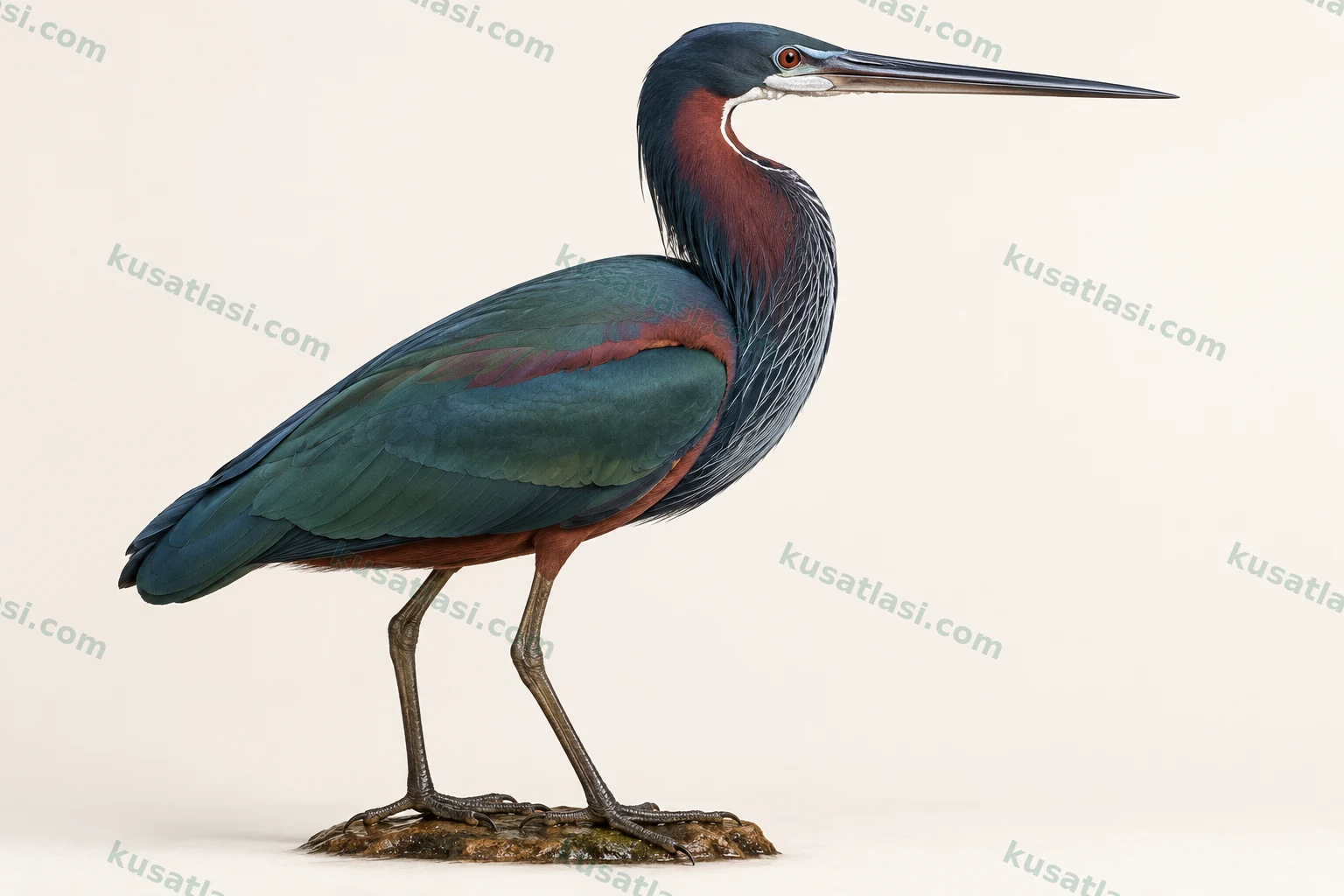
A forest-waterside heron with a very long slender bill; adults have a dark head, chestnut underparts and dark greenish wings.
Biometrics
Length
Male60–76 cm
Female60–76 cm
Shared species value
Wing length
Male27.36 cm
Female27.36 cm
Shared species value
Weight
Male475–580 g
Female475–580 g
Shared species value
Agami Heron
Central America, the Guianas, Orinoco and Amazon basinsObservation guide in its natural range
Look for three features together
Do not rely on a single featureVery long slender bill and neck; relatively short legs.
Chestnut underparts, dark greenish wing; pale silver-blue ornamental feathers in breeding.
Brown upperparts and pale streaked underparts; not all adult colours have developed.
Compare male and female
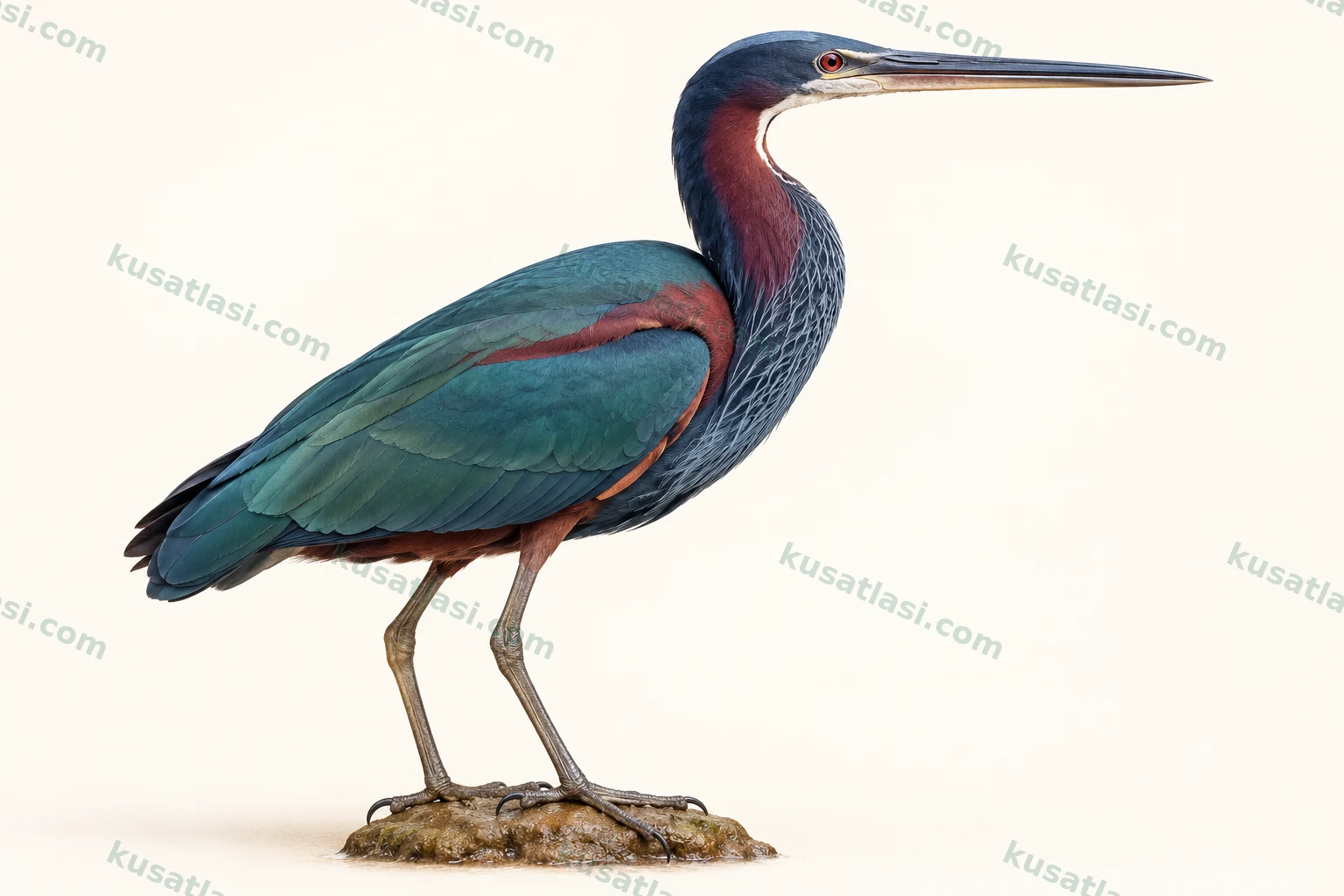 FemaleMale
The plumage pattern is similar; males are generally larger. Changing facial-skin colour alone is not a certain sexing key.
Where to look in its natural range?
At protected forested watersides, watch birds waiting on branches and roots without opening the cover.
Rain-associated breeding dates vary regionally; some individuals move long distances after breeding.
January
Movements differ regionally and individually; not all birds are certainly resident. No verified regional date specific to this month was provided; this does not mean local absence.
February
Movements differ regionally and individually; not all birds are certainly resident. No verified regional date specific to this month was provided; this does not mean local absence.
March
Movements differ regionally and individually; not all birds are certainly resident. Pacuare colony, Costa Rica: The local colony breeding interval in the 2016 publication; not exact dates for every year.
April
Movements differ regionally and individually; not all birds are certainly resident. Pacuare colony, Costa Rica: The local colony breeding interval in the 2016 publication; not exact dates for every year.
May
Movements differ regionally and individually; not all birds are certainly resident. Pacuare colony, Costa Rica: The local colony breeding interval in the 2016 publication; not exact dates for every year.
June
Movements differ regionally and individually; not all birds are certainly resident. Pacuare colony, Costa Rica: The local colony breeding interval in the 2016 publication; not exact dates for every year. Venezuela, specialist compilation: Reported rain-associated breeding; no single date applies to the entire country.
July
Movements differ regionally and individually; not all birds are certainly resident. Pacuare colony, Costa Rica: The local colony breeding interval in the 2016 publication; not exact dates for every year. Venezuela, specialist compilation: Reported rain-associated breeding; no single date applies to the entire country.
August
Movements differ regionally and individually; not all birds are certainly resident. Pacuare colony, Costa Rica: The local colony breeding interval in the 2016 publication; not exact dates for every year. Venezuela, specialist compilation: Reported rain-associated breeding; no single date applies to the entire country.
September
Movements differ regionally and individually; not all birds are certainly resident. Pacuare colony, Costa Rica: The local colony breeding interval in the 2016 publication; not exact dates for every year. Venezuela, specialist compilation: Reported rain-associated breeding; no single date applies to the entire country.
October
Movements differ regionally and individually; not all birds are certainly resident. No verified regional date specific to this month was provided; this does not mean local absence.
November
Movements differ regionally and individually; not all birds are certainly resident. No verified regional date specific to this month was provided; this does not mean local absence.
December
Movements differ regionally and individually; not all birds are certainly resident. No verified regional date specific to this month was provided; this does not mean local absence.
Nest, egg and incubation
The nest is a twig platform in a tree or shrub above water. Two eggs are usual; the compilation gives two–four unspotted pale blue or blue-green eggs. Both sexes take part in nest tasks; incubation duration and age at first flight were not verified.
Usually quiet; short colony calls and bill snaps occur. Rattling and silent retreat may be associated with disturbance.
Do not play recordings to attract birds; observe quietly, especially near nests.
Species information
Quick identification
Agami Heron Agamia agami is a heron with a very long, slender bill, living beside water within Central and South American forests. In adults, the dark head, chestnut neck and belly, dark greenish wings and pale neck plumes are assessed together. The extended neck looks very long relative to the body, whereas the legs are relatively short compared with many other herons. Pale silver-blue ornamental head and back plumes are striking during breeding. These feathers should not be expected to retain the same length in every season.
Although a large bird, it can be easily overlooked while standing with its neck retracted among dense vegetation. The long bill may be noticed first as it waits motionless on a branch, root or low bank above the water. Brown young lack the adult's colourful appearance; seeing only young that do not resemble the adult illustration does not demonstrate absence of the species. The apparent length of the neck changes with posture. Head, bill, body pattern and the surrounding forest wetland should be considered together.
General appearance and posture
The adult's crown and feathered face are dark. The upper neck is chestnut, with fine lines with pale and dark borders along the front. Pale ornamental feathers on the lower neck and back may look grey, silver or slightly blue. Folded wings are dark with a greenish sheen; breast, belly and some areas exposed in breeding display are chestnut-rufous. Gloss depends on the light direction. Forest shade can darken all these colours; one green reflection or brown patch is not enough for identification.
The compilation gives 14–16.3 cm for the very long bill. This bill measurement is not used as the bird's total body length or wing length.
Males, females and young birds
Males are generally considered larger; both sexes share the basic plumage pattern. Accurately assessing a size difference from appearance is difficult when birds are not side by side. During breeding, the bare skin between bill and eye can be yellow, orange or red. During pair formation observed in Costa Rica in 2015, females retained red for longer, while male skin remained more often yellow. This regional behavioural observation is not a key making every red-faced bird always female; both sexes can change colour.
Young have brown upperparts, a darker crown and pale streaked underparts. Legs and facial skin may look greener. Sources differ in details of age-related eye colour, so no single eye colour is used here as a definite age boundary. A dark-feathered nestling and a streaked young bird climbing branches are not at the same developmental stage. Climbing onto a branch beside the nest does not mean that a chick has made its first flight or no longer needs feeding.
Appearance in flight
The adult's chestnut underparts may contrast with its dark greenish wings. The 2016 behavioural study describes this colour becoming conspicuous in display and flight. Head details and ornamental feathers often remain invisible during short forest crossings. Young should not be expected to show the adult's clean colour contrast. A dark heron merely passing between trees cannot be identified certainly without seeing its long bill and basic body pattern.
Hiding in forest or rarely being seen does not mean that it moves only short distances. Some adults satellite-tracked in French Guiana travelled hundreds of kilometres after breeding. It is therefore inappropriate to describe Agami Heron as definitely non-migratory throughout its range. One tracked individual, however, remained around the colony. Movement strategy may vary with individual and region; the same route or seasonal boundary is not drawn for every bird.
Voice and behaviour
It is usually quiet when feeding; sounds accompanying interactions in the colony are easier to hear. Low vibrating or rattling calls, short contact sounds and sharp bill snaps have been reported. In the Costa Rican study, continuous rattling occurred during approach and disturbance, and the bird sometimes subsequently walked silently away into cover. Silence in that situation is not evidence that it is comfortable. The observer should increase distance rather than follow.
Courtship includes side-to-side body rocking, turning the head, emphasizing ornamental plumes and snapping the bill audibly. Male and female participate, and different actions can occur in different orders. Usually a solitary feeder outside breeding, it can join large breeding colonies. Many birds in a colony do not mean that they hunt together all day. A solitary bird feeding by water may also belong to a distant colony.
Similar species
1. Boat-billed Heron Cochlearius cochlearius can occupy the same forest wetlands and sometimes the same colony surroundings. Its bill looks very broad and heavy; Agami Heron's bill is very long and slender, with distinctly chestnut adult belly and neck. A large head or ornamental plumes alone do not separate them. Check bill proportions from both front and side.
2. Young tiger herons such as Tigrisoma lineatum are also brown with pale and dark patterning. Compare that species' broad transverse juvenile bars with the more longitudinally streaked underparts of young Agami, together with bill proportions and leg structure. Adult Tigrisoma lineatum's rufous head and neck may also create superficial similarity; Agami's dark head, very long slender bill and ornamental feathers are important differences. One partially concealed brown neck is not a certain identification.
World distribution
Its natural range extends from southeastern Mexico through Central American forested water systems to northern South America and the Orinoco and Amazon basins. Suitable wet forests in Guyana, Suriname, French Guiana, Colombia, Venezuela, Ecuador, Peru, Bolivia and Brazil are included. The broad mapped region does not mean presence on every land surface. A bird feeding quietly in dense cover is easily unrecorded; few records and certain absence must be distinguished.
Status within its natural range
Its current global category is Near Threatened. The specialist group page listing the 2023 assessment gives a decreasing trend. Vulnerable in the 2015 conservation plan is a historical assessment; the old text does not replace today's label. Many nests at one large colony do not mean a complete continental population count. Beyond protecting colonies, forested banks, feeding waters and non-breeding areas matter too.
Movements
Of five adults successfully tracked in French Guiana in 2012–2013, four moved away after breeding and one stayed around the colony. The conservation plan gives movements of 280–1250 km; these are distances from a small sample, not the species' unchanging migration length. Movements along the Atlantic coast in that study do not prove the same route elsewhere. Satellite locations have error margins, and brief stops may be missed. No fixed migration line for all individuals is therefore added to the general map.
Breeding habitat
It uses lakes, swamps, flooded forests and mangroves surrounded by dense woodland. The basic environment is lowland forest wetland; isolated high-elevation records do not show that the entire species breeds in a mountain belt. Colonies may form in inaccessible places protected by water and cover. Rain-associated breeding occurs at different times according to region and year. March–September has been reported for Costa Rica's Pacuare colony, not for the entire range.
Nest site
The nest is a loose twig platform on tree or shrub branches above water. The general compilation gives two eggs as most frequent and two–four as the reported range; eggs are unspotted pale blue or blue-green. The six nests visible during Pacuare observations in 2015 held one or two eggs; they do not replace the wider compilation as the species' definite complete clutch. Both sexes participate in nest tasks. Reliable incubation duration and age at first flight were not verified in this review. A colony remaining active for months is not the incubation period of one egg.
Daily space use
Branches above water, roots, projecting banks and shallow water are daily feeding surfaces. Colony and feeding area need not be confined to the same small pond; tracking showed wider space use. Some individuals' long post-breeding movements require protection of forests and wetlands outside the colony too. Cover is not opened during nest visits, and silence after an approach call is not treated as permission. Approved observation points and existing hides should be used.
What does it eat?
It feeds mainly on small fish; scientific and specialist compilations mention cichlids and some small schooling fish. Other small animal prey may also be taken. Costa Rican observations in 2015 recorded small fish and unidentified small prey, and an incubating bird was seen catching a passing dragonfly. Unidentified prey are not assigned to a definite insect group. This brief field study does not provide all-season dietary percentages or prey sizes for every country.
How does it hunt?
It waits on a bank or branch above water, walks slowly in shallows and extends the neck towards prey. Its long neck and bill allow access to distant surfaces. In the Costa Rican study, observed captures ended with a slow extension and a small grasp at the tip; the very fast powerful strike assumed by old accounts was not seen in those observations. This difference does not mean one exclusive hunting method in every context. Other actions, including descending feet first into water to reach prey, were recorded in the same study.
Facial colour can change quickly
Bare skin between bill and eye can change from pale to yellow or red quickly in the same individual. The change plays a role in courtship and interactions. One still photograph does not always represent the appearance throughout the day.
Solitary feeding and colonial breeding are compatible
Agami Heron is often seen alone while feeding, but many pairs may gather in one area to breed. Protecting large colonies therefore matters. Some birds followed in the conservation plan moved hundreds of kilometres after breeding. Such a colony may bring together birds from a wide region rather than serve only its immediate neighbours. A colony count is not a complete count of the entire non-breeding distribution.
Quiet retreat may signal disturbance
In the 2016 behavioural study, disturbed birds first rattled, then walked silently into cover and stayed away from their areas. Failure to fly away does not show indifference to the observer. An attending adult leaving a nest may also affect protection of eggs or chicks. When a bird becomes quiet during approach, it should not be followed; remain at the existing observation point and increase distance if needed.
Long ornamental feathers are not identical all year
Silver-blue head and back plumes can become very conspicuous in courtship. The Costa Rican research describes shorter, less full plumes after the young hatched. Shorter head feathers than in another photograph do not automatically make the bird juvenile. Breeding stage, individual variation and light must be considered together. Basic identification uses bill proportions and body pattern alongside changing ornamental plumes.