

World Birds IUCN statusLC · Least ConcernGlobal IUCN category. BirdLife v10 (2025); taxon matching: AviList 2026 / IOC 15.2; checked: 29.10.2026. The list year is not the species assessment date. Source and method · BirdLife OrderPelecaniformesPelicans and allies FamilyArdeidaeArdeidae
White-necked Heron
Ardea pacifica
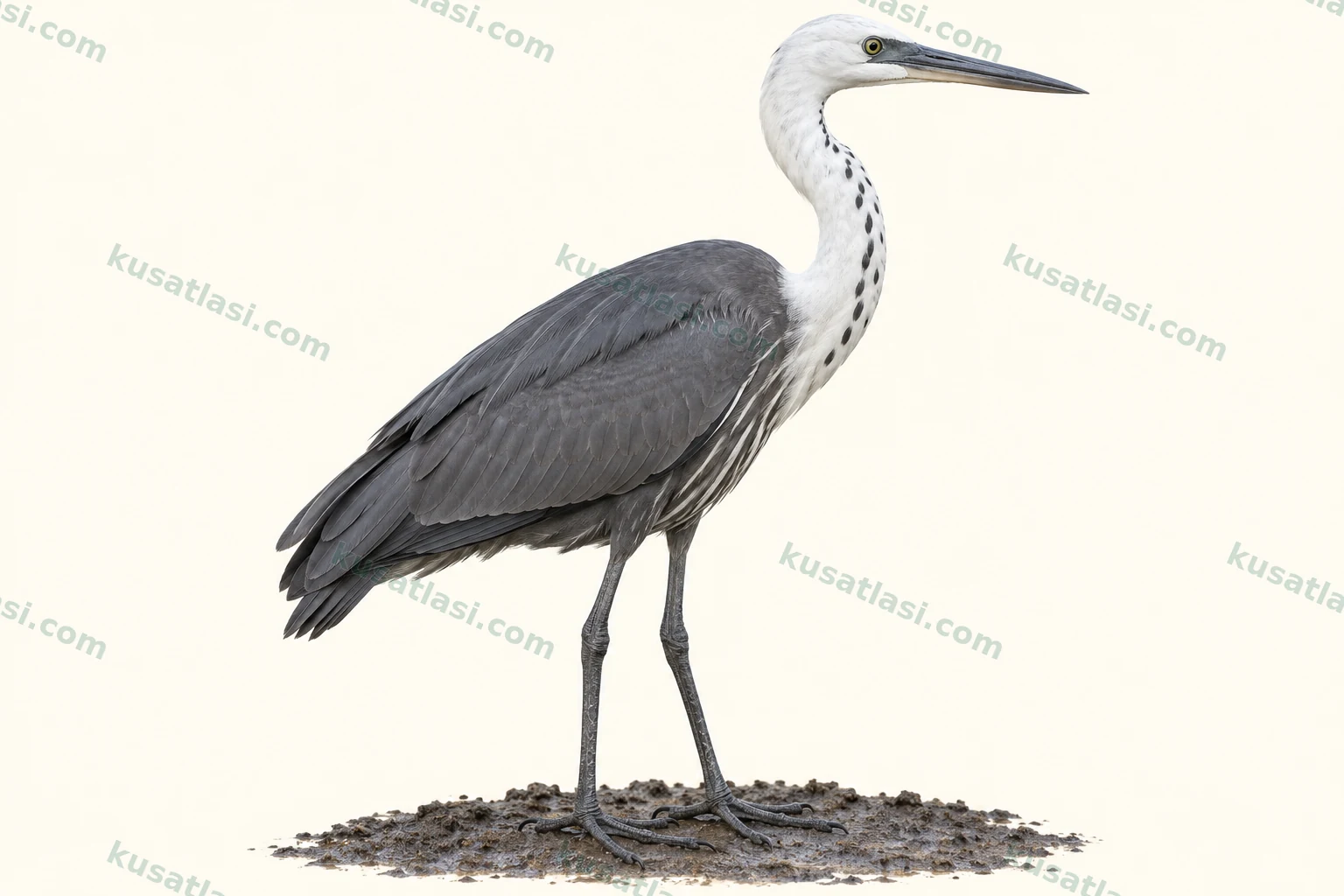
A large heron with a white head and neck and a dark grey body. In flight, pale areas show along the leading edge of the dark wing.
Biometrics
Length
Male76–106 cm
Female76–106 cm
Shared species value
Wingspan
Male147–160 cm
Female147–160 cm
Shared species value
Weight
Male600–1220 g
Female600–1220 g
Shared species value
White-necked Heron
Australia and south-central New GuineaObservation guide in its natural range
Look for three features together
Do not rely on a single featureCheck that the whole head and nape are pale, not just the face.
Check the pale leading edge of the dark wing together with the head and neck.
Compare male and female
 FemaleMale
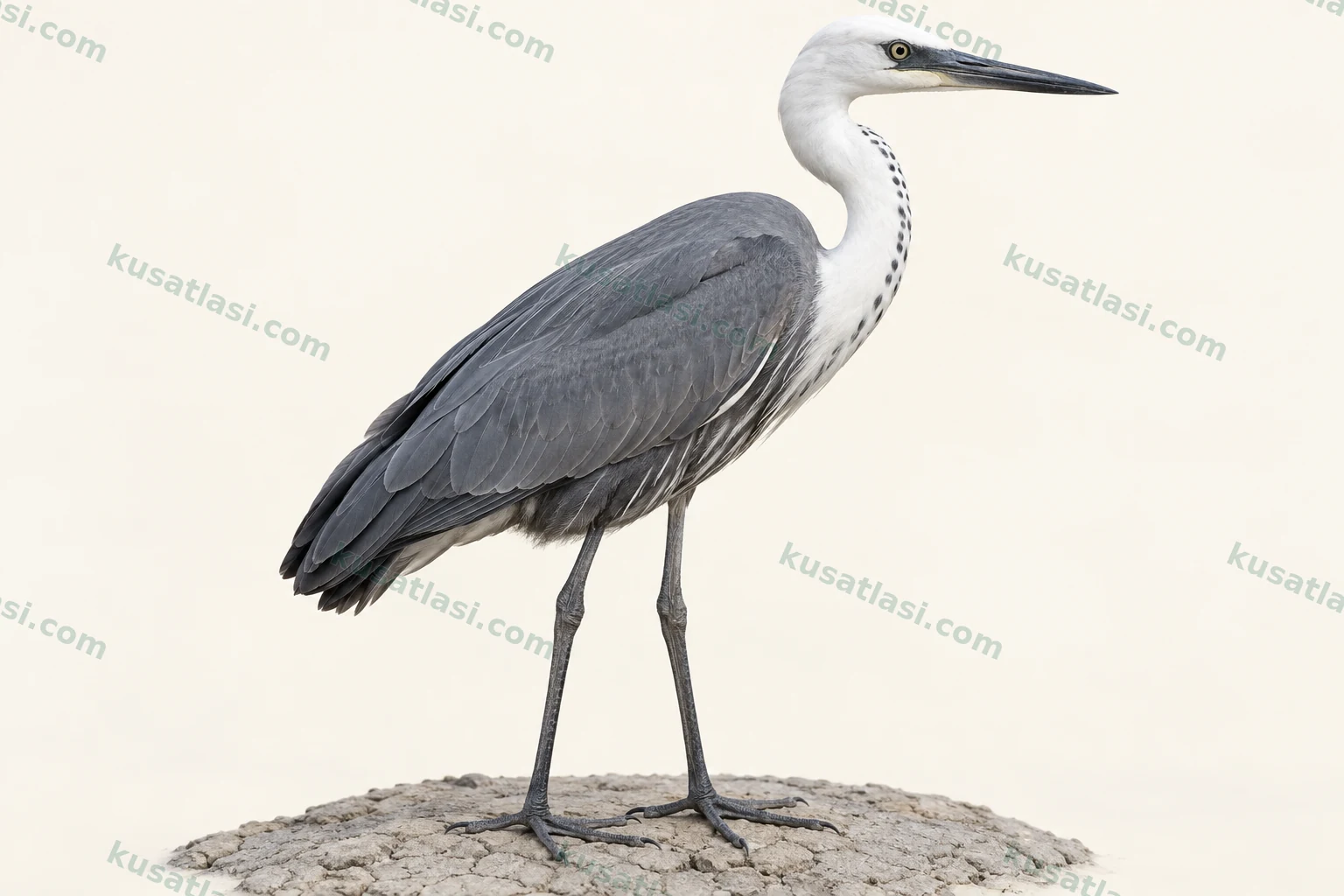
Adults of both sexes look similar. Plumage and a single apparent size difference do not reliably distinguish them.
Where to look in its natural range?
Shallow freshwater, temporary wetlands and damp grassland.
Movements depend on water and rainfall conditions. Breeding seasons vary by region.
January
Nomadic and seasonally mobile. Breeding depends on conditions. Regional breeding period given for southern Australia.
February
Nomadic and seasonally mobile. Breeding depends on conditions. Regional breeding period given for southern Australia.
March
Nomadic and seasonally mobile. Breeding depends on conditions. No verified regional date is given for this month. This does not imply local absence.
April
Nomadic and seasonally mobile. Breeding depends on conditions. No verified regional date is given for this month. This does not imply local absence.
May
Nomadic and seasonally mobile. Breeding depends on conditions. No verified regional date is given for this month. This does not imply local absence.
June
Nomadic and seasonally mobile. Breeding depends on conditions. No verified regional date is given for this month. This does not imply local absence.
July
Nomadic and seasonally mobile. Breeding depends on conditions. No verified regional date is given for this month. This does not imply local absence.
August
Nomadic and seasonally mobile. Breeding depends on conditions. No verified regional date is given for this month. This does not imply local absence.
September
Nomadic and seasonally mobile. Breeding depends on conditions. Regional breeding period given for southern Australia.
October
Nomadic and seasonally mobile. Breeding depends on conditions. Regional breeding period given for southern Australia.
November
Nomadic and seasonally mobile. Breeding depends on conditions. Regional breeding period given for southern Australia.
December
Nomadic and seasonally mobile. Breeding depends on conditions. Regional breeding period given for southern Australia.
Nest, egg and incubation
A platform of sticks in a tree. The typical clutch is four, sometimes two–six eggs. Incubation lasts 28–30 days and the young fly at six–seven weeks. Interpret these within the scope of the sources and local diary.
A harsh, hoarse alarm sound, with deeper short sounds near the nest.
Do not play recordings to attract birds; observe quietly, especially near nests.
Species information
Quick identification
The White-necked Heron Ardea pacifica is a large heron with a striking contrast between its white head and long white neck and its dark grey body. The crown and nape are pale as well as the face. Fine dark spots on the front of the neck and dark legs provide further marks. Pale areas along the leading edge of the dark wing are especially useful in flight. Neither a white head nor a long neck alone identifies the bird. Examine the position of the whole pattern.
A bird in shallow water may extend its neck or draw its head towards the body at rest. The same individual can look very different in size in these postures. Although the white neck stands out against the dark wing, bright reflections from water can wash out detail in pale feathers. A view of the bill, bare facial skin and front of the neck completes the identification. Do not treat the dark body simply as an all-white heron falling into shadow.
General appearance and posture
The body is dark grey and the head and neck pale. The contrast between the blackish bill and white head outlines the face. Dark neck spots can be especially visible in natural light. The entire neck need not be spotless. When the long legs are partly hidden by water, the body can look lower. Leg length cannot be calculated from a photograph with unknown water depth.
Cornell's account describes single birds near water and scattered feeding groups in damp grassland. Being a little way from water therefore does not rule out the species. Temporary shallow pools, wet meadows and water margins may be parts of the same feeding environment. Several birds gathering in one place do not show that they share a nest or a mate. Feeding and breeding groups are considered separately.
Males, females and young birds
Adults of both sexes look similar. The ringing guide provides no reliable distinction between males and females based on feather patterns. Reddish-brown ornamental feathers or blue bare facial skin in the breeding season are not distant identification marks exclusive to one sex either. Do not automatically call the apparently larger bird of a pair male. Posture, distance and individual size differences affect the image. An artificial colour difference should not be expected between male and female plates.
Some feathers may look darker and glossy in breeding appearance. However, the ringing guide notes reddish-brown shoulder feathers in some non-breeding adults too. Seeing them is not certain evidence of a nearby nest. Bare facial skin, bill and eye colours are assessed with age and season. A single eye shade does not establish age or sex unless photographic light is also considered.
Young birds can have grey or brownish shading on the head and neck rather than the clean white of adults. The lower bill may be paler. The bird's whole appearance does not develop the adult pattern at once. Less obvious neck spots in a young heron also matter when comparing species. If only its head is visible, examine the body, bill and legs before deciding. Do not force a definite young or adult label when age cannot be established.
Appearance in flight
In flight it folds its neck back and extends its long legs behind the body. The pale areas on the leading edge of the dark wing, together with the white head and neck, form a useful combination. The Western Australian institutional guide particularly describes these pale wing areas. Long legs or a folded neck alone are shared by many herons and do not identify the species. State which wing surface and edge were actually seen.
As a bird changes angle on approach to land, the pale wing area may disappear from view. That does not mean the real feather pattern is absent. In a very distant flight view, the white head and flashes of pale wing can blend together. A view after landing completes the comparison. The folded neck also helps distinguish long-legged silhouettes from storks, but one short view does not certainly exclude every other species.
Voice and behaviour
A harsh, hoarse sound can be heard in alarm, with deeper sounds near the nest. The Western Australian guide also describes a short guttural sound near the nest. A verbal imitation is only a memory aid. The real duration and tone are compared with a recording. Feeding silently does not mean the bird never calls. Other herons and waterbirds can call in the same colony, so watch the individual producing the sound.
Carrying sticks, standing on the nest and feeding young are separate behaviours. Field observations in Wamboin showed more than one nest being used in the same tree. However, carrying a single stick or displaying does not constitute a completed, successful nest record. A long absence of an adult from its feeding waters does not establish nest abandonment either. Increase the observation distance if approaching makes the bird uneasy.
Similar species
Egretta novaehollandiae has a more restricted pale face and throat, which should not be confused with a wholly white head and nape. Check pacifica's white head and neck combined with its dark body. Body colour or feeding in water alone does not separate the species. If the back of the head is hidden, wait for a better natural angle instead of making the identification certain.
Age-related appearance varies in herons combining dark and pale areas, such as Egretta picata. Compare the head, spots on the front of the neck, bill and leg colours together. Young birds in particular may not have heads as dark as adults, so head colour alone is insufficient. Check overall size and the full pattern rather than using the white head and dark body as one isolated mark. Different herons at a wetland are not automatically the male, female and young of the same species.
Global range
Current taxonomy gives Australia and south-central New Guinea as its natural range. Tasmania forms part of the Australian range. Not every desert surface across the continent is equivalent habitat. Freshwater, temporary pools and wet grasslands are important. A historical account describing the bird as restricted to Australia does not justify ignoring New Guinea records under the current range concept.
Status within its natural range
Local presence can change with water and food conditions. Its appearance in southwestern Western Australia during dry periods is a regional example of nomadic movements. A bird may use a pool for a few days and leave. One record does not establish continuous residence. The 2021–2022 breeding observation in Wamboin concerns a particular site. Applying that calendar across Australia and New Guinea would overlook differences in rainfall.
Movements and migration
Its movements are associated both with season and with the appearance of suitable water and food conditions. It is therefore not described as entirely sedentary. Nor is every bird assumed to pass along the same route on the same dates. The map shows the natural environment and approximate verified records. Points at separate pools are not linked as the route of one individual. Isolated wandering records outside the range do not by themselves establish a new regular breeding area.
Breeding habitat
It uses freshwater surroundings, temporary marshes and wet grassland. Continued availability of feeding water and trees capable of supporting a nest are important together. Using artificial pools does not show that all natural wetland loss can be offset by equally sized pools. Local water level and food access can change breeding conditions.
Nest site
The nest is a platform of sticks, usually on a tree branch near water or extending over it. The specialist account gives a typical clutch of four, sometimes two–six eggs, incubation of 28–30 days and six–seven weeks until young can fly. The Wamboin field diary's dates are broadly consistent with these durations. A more precise day count is not inferred from a nest whose exact laying time is unknown.
Daily habitat use
The feeding area and nest tree can be in different places. A bird commuting among pools may be using parts of the same breeding environment. A new pair is not assumed at every pool. Approaching the nest tree or waiting beneath it for a long time disturbs adults and young. Preserve shallow water margins and natural tree structure, and do not expose the nest platform for a better photograph.
What does it eat?
The Western Australian institutional guide lists insects, crustaceans, tadpoles, frogs and fish among its foods. This broad menu shows that different small prey can be used depending on wetland conditions. Being a heron does not mean it eats only fish. Catching a frog does not describe the proportions of a whole day's food either. Food given to young and prey an adult catches for itself are recorded as separate observations.
How does it hunt?
It searches for small prey while standing or walking slowly in shallow water and damp grassland. Cornell also describes scattered feeding groups, but each bird in the same area need not take the same prey or have the same success rate. A bill entering the water is not necessarily a successful capture. When captured food is visible, its identity and the surface where it was found can be recorded. Attracting birds with food thrown into the water or trampling grass to expose prey prevents an assessment of natural feeding behaviour.
Similar-looking sexes
The ringing guide provides no reliable way to distinguish adult males and females by feathers. Nest behaviour must be followed separately. Do not label a bird male merely because it looks larger or has a yellower head in one photograph. Breeding ornaments and sex are separate matters.
Different nests in one tree
An account from Wamboin reported three adults associated with two groups of young during 2021–2022. The authors describe it as an interesting field event differing from the usual pair arrangement. One observation does not establish the same breeding social structure everywhere in the species. Recording nest, adult and young numbers separately helps explain such an event.
Water changes the map
Because of nomadic movements, a pool used one year may not be suitable the next. Absence from a particular place does not mean disappearance from the wider natural region. Equally, many birds gathering elsewhere do not by themselves show a rise in global population. Comparing years should account for the site's water conditions and observation time.
Pale wing areas in flight
The pale leading edge of the dark wing helps when looking for this species at a distance. However, turning the wing can hide the mark. An unseen area is not automatically absent. Assess it together with the white head and neck, dark body and legs. This combination helps distinguish other dark herons at a wetland or the shadowed appearance of a white bird.