

World Birds IUCN statusLC · Least ConcernGlobal IUCN category. BirdLife v10 (2025); taxon matching: AviList 2026 / IOC 15.2; checked: 29.10.2026. The list year is not the species assessment date. Source and method · BirdLife OrderAccipitriformesHawks, eagles and allies FamilyAccipitridaeAccipitridae
African Harrier-Hawk
Polyboroides typus
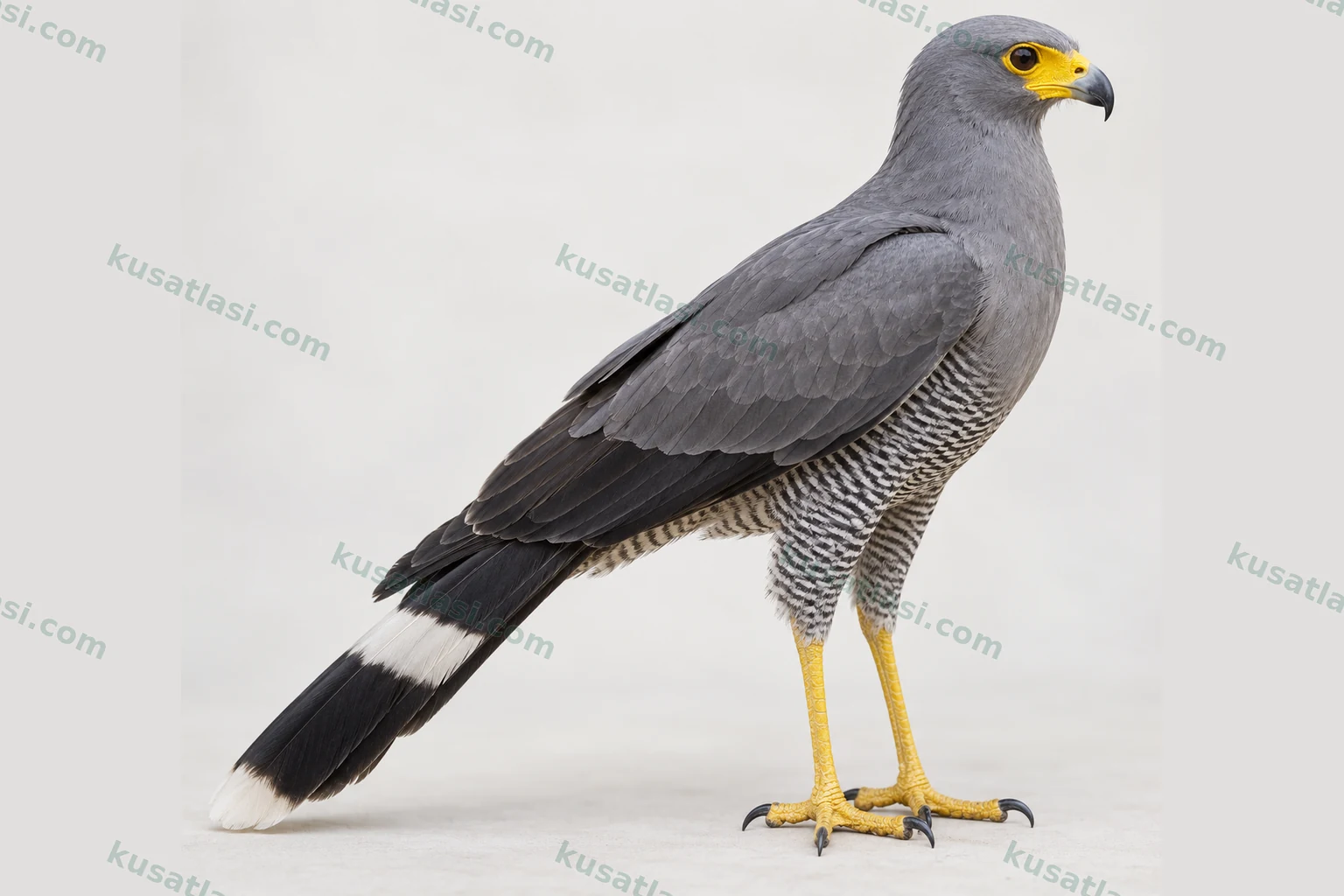
It is a broad-winged raptor that searches tree cavities for prey, recognised by its grey body, finely barred belly, white-banded black tail and bare face.
Biometrics
Length
Male65 cm
Female65 cm
Shared species value
Wingspan
Male118–152 cm
Female118–152 cm
Shared species value
Weight
Male500–710 g
Female580–820 g
African Harrier-Hawk
Suitable wooded areas of sub-Saharan AfricaObservation guide in its natural range
Look for three features together
Do not rely on a single featureUsually yellow; may turn pink or red during behaviour.
Assessed with the adult’s grey body and fine belly bars.
May spread wings for balance while searching narrow cavities.
Compare male and female
 FemaleMale
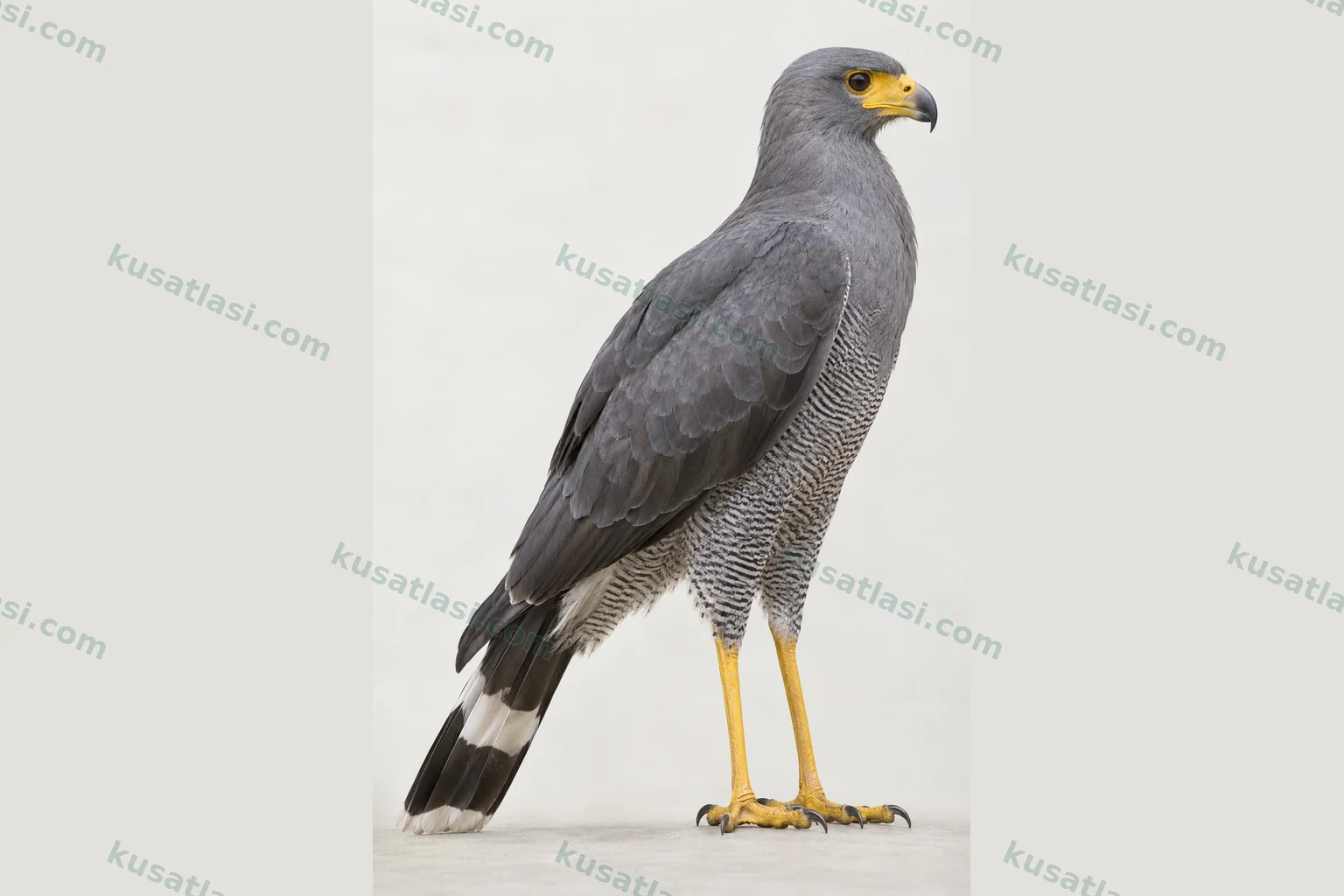
Adult sexes share basic colours; females are generally larger. A flushing face does not indicate sex. Brown, spotted young must not be forced into the grey-adult colour key.
Where to look in its natural range?
From an existing road or lookout watch tree perches, forest edges and wooded stream strips; do not approach nests or colonies.
The calendar shows a southern African regional laying example: August–December, peaking September–November. Do not assume the same season elsewhere in Africa.
January
The species is generally resident. In the South African regional breeding example, this month is outside the stated main egg-laying period; this does not mean local absence or absence of breeding.
February
The species is generally resident. In the South African regional breeding example, this month is outside the stated main egg-laying period; this does not mean local absence or absence of breeding.
March
The species is generally resident. In the South African regional breeding example, this month is outside the stated main egg-laying period; this does not mean local absence or absence of breeding.
April
The species is generally resident. In the South African regional breeding example, this month is outside the stated main egg-laying period; this does not mean local absence or absence of breeding.
May
The species is generally resident. In the South African regional breeding example, this month is outside the stated main egg-laying period; this does not mean local absence or absence of breeding.
June
The species is generally resident. In the South African regional breeding example, this month is outside the stated main egg-laying period; this does not mean local absence or absence of breeding.
July
The species is generally resident. In the South African regional breeding example, this month is outside the stated main egg-laying period; this does not mean local absence or absence of breeding.
August
The species is generally resident. In the South African regional breeding example, this month is within the egg-laying period.
September
The species is generally resident. In the South African regional breeding example, this is a reported peak egg-laying month.
October
The species is generally resident. In the South African regional breeding example, this is a reported peak egg-laying month.
November
The species is generally resident. In the South African regional breeding example, this is a reported peak egg-laying month.
December
The species is generally resident. In the South African regional breeding example, this month is within the egg-laying period.
Nest, egg and incubation
The nest is a stick platform lined with green leaves, in a tree or suitable rocky site. The southern African account gives 1–3 eggs, 35–36 days of incubation, nest departure at 45–55 days and at least ten further days of partial parental support. Peregrine Fund’s two eggs, about 36 days of incubation and 52 days of development belong to another source context. Lethal attacks between sibling chicks are reported, but are not presented as inevitable at every nest.
It is often silent. Prolonged thin plaintive whistles in breeding interactions and shorter repeated nest-area calls are reported; one call does not determine sex.
Do not play recordings to attract birds; observe quietly, especially near nests.
Species information
Quick Identification
The African Harrier-Hawk, Polyboroides typus, is a broad-winged daytime raptor with long legs and a small head. Adults combine grey head and breast, finely black-and-white-barred belly, a broad white band across a black tail and bare yellow facial skin. A face temporarily turning pink or red does not indicate another species; its colour can change during behaviour. A distant grey body or yellow spot alone is insufficient: tail band, head proportions and wing shape must also be seen.
Watching it explore trunks and cavities is particularly instructive. It may spread its wings for balance, turn its body at unusual angles and reach a foot into a narrow gap. This need not indicate distress; it is part of foraging. Not every tree-climbing raptor is this species, however. Behaviour becomes useful when matched with visible anatomical marks. The slender-looking head and legs conspicuously long relative to the body help when the face is unclear.
General Appearance and Posture
Adult upperparts are mostly grey, with dark marks on wing coverts. Beneath the grey breast, belly and feathered upper legs show denser cross-barring. The spread tail contrasts its broad white band against black. Eyes are dark brown, bare legs yellow. Bare facial skin is distinct from eye colour: yellow or flushed skin surrounds, rather than constitutes, the dark eye. Hooked bill and a head small relative to the body alter the impression of an ordinary grey goshawk.
A 2023 visual-field study found binocular coverage extending above the head. Researchers link this with an upside-down bird seeing its feet and the opening it investigates. The measured field is a finding; its foraging advantage is a functional interpretation. It would be wrong to explain every movement through it or declare better vision than all other raptors. Head shape and eye placement may fit a different hunting problem.
Males, Females and Young Birds
Adult sexes share the basic colour pattern. Females are generally larger, but an isolated, distant or unscaled bird cannot be sexed from size impression alone. Wing-spot count, shadowed breast or flushed face likewise are not reliable single sexing keys.
Young lack the adult's clean grey appearance. Upperparts are brown, underparts variably pale with spots or streaks, and wings and tail show several dark bars. Facial skin may look yellow-green. A brown juvenile should not be assigned another species merely for differing from an adult image. Assess face, wing pattern, complete tail and leg proportions together. Not every brown tone denotes a particular month or exact age; intermediate plumages occur during maturation.
Appearance in Flight
Broad wings with fingered tips and a long tail make a distinctive silhouette. In soaring birds, dark wing tips and rear portions can contrast with a pale body. The broad white tail band helps in clear views but is harder in a closed tail or backlighting. Flapping, soaring and low searching birds do not give identical images. Waiting for posture to change is better than forcing a blurred frame.
Size alone cannot determine a flying bird. Two apparently equally high birds may be at different distances, while temporary wing flexion changes proportions. Record small head, broad wings, tail band and underpart bars only if actually seen. Do not complete an unseen white band through photo editing. A short flight between hunting trees is not evidence of long-distance migration either.
Voice and Behaviour
It may be silent during many encounters. Breeding and pair interactions include reported long, thin plaintive whistles, with shorter repeated calls near the nest. Turkish written sound comparisons cannot fully convey pitch, duration or distance. Link a call with the bird seen in that direction; a sound of unknown origin establishes neither sex nor breeding outcome.
Rapid flushing of facial skin has been observed when mates meet or exchange nest duties. It differs from permanent plumage colour. Pairs may build together; incubation task-sharing need not match prey delivery after hatching. Do not assume every prey carrier enters the nest or that one visit describes the whole care system. During longer watches, note time, behaviour and individuals separately.
Similar Species
1. Melierax metabates may look similar at a distance through grey body and long legs. Adult pink-orange legs and bill base, different wing pattern and head area help. In the African Harrier-Hawk, combine broad bare skin around a small head, the broad white band on black tail and finely barred underparts. One grey shade is not decisive.
2. African Goshawk, Aerospiza tachiro, may appear grey or brown with age, sex and region. Yellow-eyed appearance, white throat and variable rufous or brown underparts help. Check the harrier-hawk's broad bare area around a dark eye and differing head, wing and tail proportions. Forcing adult colour keys onto brown young is especially misleading.
Global Distribution
The African Harrier-Hawk is native to sub-Saharan Africa, from western and central Africa eastwards and south along suitable wooded areas to South Africa. Broad distribution does not mean complete occupancy of every country. Open deserts and very dry treeless land differ from forest edges offering hunting and nesting sites. The southern African account particularly describes Zimbabwe, Mozambique, northern and eastern Botswana, northern Namibia, and eastern and southern South Africa.
Current specialist taxonomy recognises two subspecies; their boundaries are not redrawn from darkness in one photograph. Madagascar's Polyboroides radiatus is a separate species: measurements and breeding data of the African bird are not transferred there. Mapping by genus alone would lose that distinction. This page separates range modelling and identity-verified observation records into layers. Model colour is not an exact breeding boundary, proof of all present populations or real absence in every blank area.
Status in Türkiye
This source review found no natural regular range or breeding population in Türkiye. A Turkish name on the site is not proof of inclusion in the Turkish bird list. A claimed Turkish record requires separate identity and origin assessment before entering the native-range map. A dated African observation is not a starting point for a presumed journey to Türkiye.
Migration
Generally regarded as resident, it may wander locally in drier regions. Increased occurrence in some months in western parts of the southern African account was interpreted as a possible movement clue, not a transmitter-verified west–east route. No arrows connecting countries, total distance or line towards Türkiye were created. Changing hunting trees and seasonal migration are distinct. Calendar months explicitly describe a southern African laying example, not continent-wide migration.
Breeding Habitat
Wooded savanna, forest edges, riverine tree strips, wooded cliffs and large garden trees may be used. Occurrence in modified habitats and planted trees does not make native-tree loss unimportant. Cavities for prey searching, sheltered perches and nesting supports all matter. Record treeless dry ground separately from an adjacent wooded streambed.
Nest Site
The pair builds a platform of sticks lined with green leaves. It may be in trees or suitable rocky sites; old nests of other raptors are also reported. The southern African account gives one–three eggs, incubation mainly by the female for 35–36 days and nest departure at 45–55 days. The abstract of a 1978 study of two pairs also reports 35–36 days and both sexes incubating. The Peregrine Fund gives two eggs, about 36 days incubation and 52 days development. These are different source scopes, not figures combined into a new mean.
Nest departure and complete food independence need not coincide. The regional account reports that the young may receive partial parental support for at least ten further days. Lethal sibling attacks are recorded, but two chicks do not prove this inevitable or caused solely by food shortage. Do not climb nest trees, open branches or use playback to expose birds. Avoid repeated close visits that disrupt care.
Daily Space Use
It may watch from a concealed perch, then investigate a trunk or bird colony. Wing balancing and reaching a foot into a cavity differ from simply chasing prey fast over open land. Presence in a garden does not confine its entire range to that garden. Note the foraging tree, surrounding vegetation and arrival and departure directions; do not calculate territory size or permanent residence from one encounter.
What Does It Eat?
Food includes small birds' eggs and young, small mammals, reptiles, frogs and insects; fish, carrion and oil-palm fruit are also reported in some circumstances. Not every individual eats them equally often. Striking colony visits may be easier to record, so the most frequently seen prey should not be declared the year's staple. Capturing a live animal and taking one found dead are different behaviours.
The abstract reporting 1978 breeding observations lists bird, reptile and amphibian, small-mammal and insect groups among 85 identified prey. This does not support an exclusively nestling-bird diet. As particular pairs and a breeding period were covered, proportions were not extended across Africa, all months or non-parental periods. No continental diet percentage is created here.
How Does It Hunt?
It may use bill and feet to explore trunks, branches, rock gaps or weaver nests, sometimes hanging upside down and flapping for balance. Extracting hidden prey from a gap presents different visual and mechanical demands from pursuit. A highly mobile ankle helps reach narrow spaces, and a small head approaches the opening. Seeing it near a nest does not establish that it is taking eggs at that moment.
The 2023 study measured a binocular field above the head. Researchers propose that keeping the feet in this field during unusual postures may ease reaching into openings. The measured eye property and proposed hunting function remain distinct. Record wing and tail posture only if actually visible; if the cavity is hidden, do not guess its prey.
Ankle Mobility
The familiar “double knee” description does not mean a second knee joint. The 1978 anatomical abstract describes unusually extensive forward, backward and sideways ankle movement, examining its relation to joint structure. Long legs alone do not explain reaching into narrow cavities; changing joint direction also matters. Do not manipulate a bird's leg or alter nest entrances to see it: watch natural behaviour from afar.
Seeing Together Above the Head
Portugal and colleagues in 2023 compared its visual field with data for 18 other accipitrid species. The striking feature was extension above the head, rather than exceptional maximum binocular width. Measurements used captive birds and previously published comparative data, not separate field measurements of every wild individual. Seeing feet while upside down is an interpretation of that finding, not a ranking above all raptors.
A Rapidly Changing Face
Bare skin changing from yellow to pink or red explains differences between photographs of one bird. Changes have been reported during mates' encounters near nests. A red face is not a permanent subspecies colour or certain female mark. If the before and after are seen, record the behaviour too. Do not assume identical expression everywhere; confirm identification with body and tail marks.
Similar Hunting, Different Species
America's Geranospiza caerulescens also has mobile legs suited to extracting prey from confined spaces. The earlier anatomical study concluded that this similarity alone does not establish close relationship between the genera. Madagascar's Polyboroides radiatus is a separate species in the same genus. Similar action, shared genus and species identity are three different information levels. Verify scientific names before transferring another raptor's measurements, breeding duration or range.