

World Birds IUCN statusEN · EndangeredGlobal IUCN. BirdLife v10 (2025); taxon matching AviList 2026 / IOC 15.2; checked: 29.10.2026. The list year is not the species’ assessment date. Source and method · BirdLife OrderAccipitriformesDiurnal raptors FamilyAccipitridaeAccipitridae
White-collared Kite
Leptodon forbesi
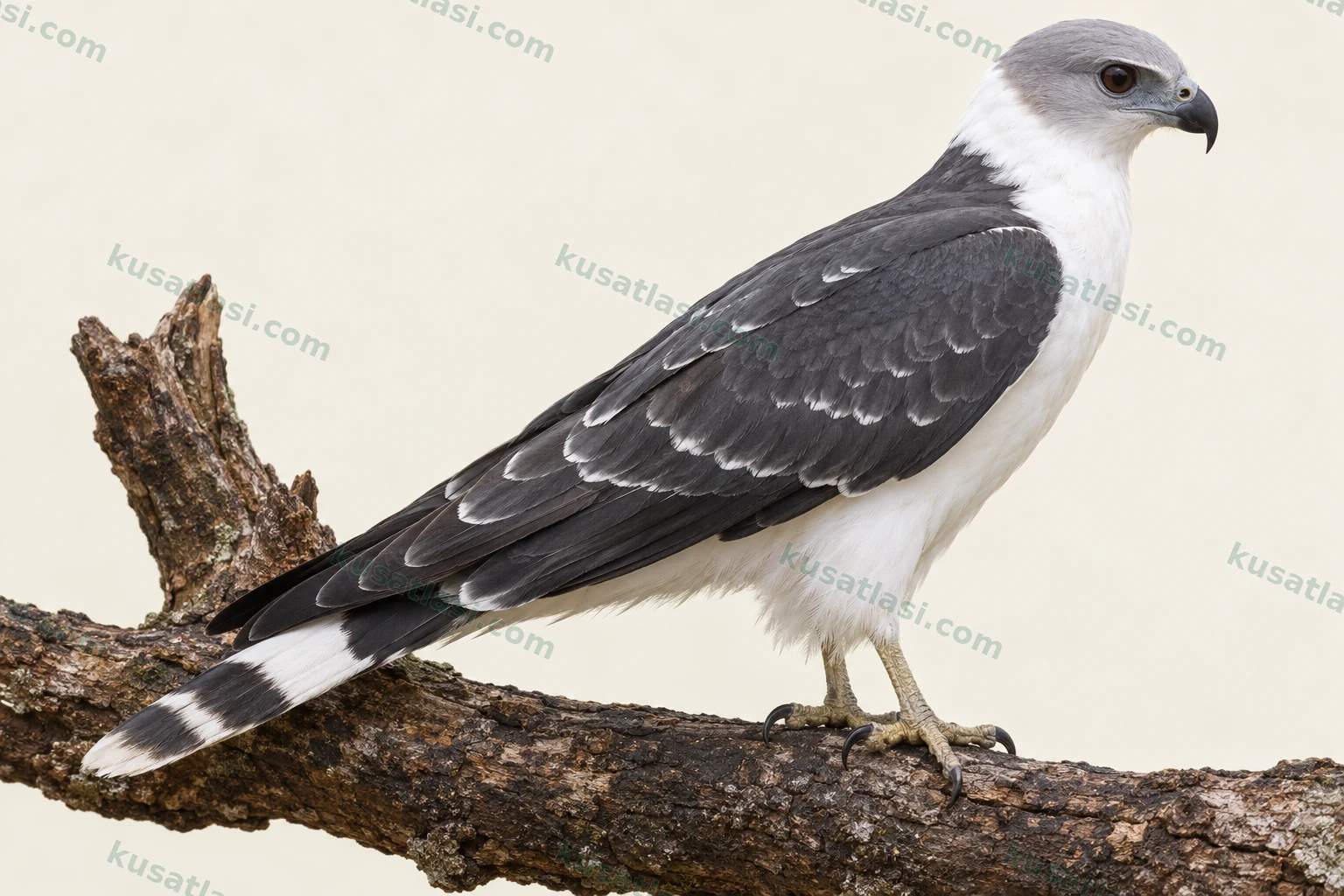
Dark upperparts and white lower body, with a white nape and largely white underwing coverts in adults. A raptor of northeastern Brazil’s Atlantic Forest.
Biometrics
Length
Male49–50 cm
Female49–50 cm
Shared species value
Wing length
Male31.62 cm
Female31.62 cm
Shared species value
Weight
Male580 g
Female550 g
White-collared Kite
Northeastern Brazil, Atlantic Forest fragments from Rio Grande do Norte to SergipeObservation guide in its natural range
Look for three features together
Do not rely on a single featureWhite nape, dark upper-back feathers with white tips and a dark eye.
The coverts near the body are largely white. Assess the flight feathers separately.
Young birds and those approaching adult plumage can be confused with a close relative.
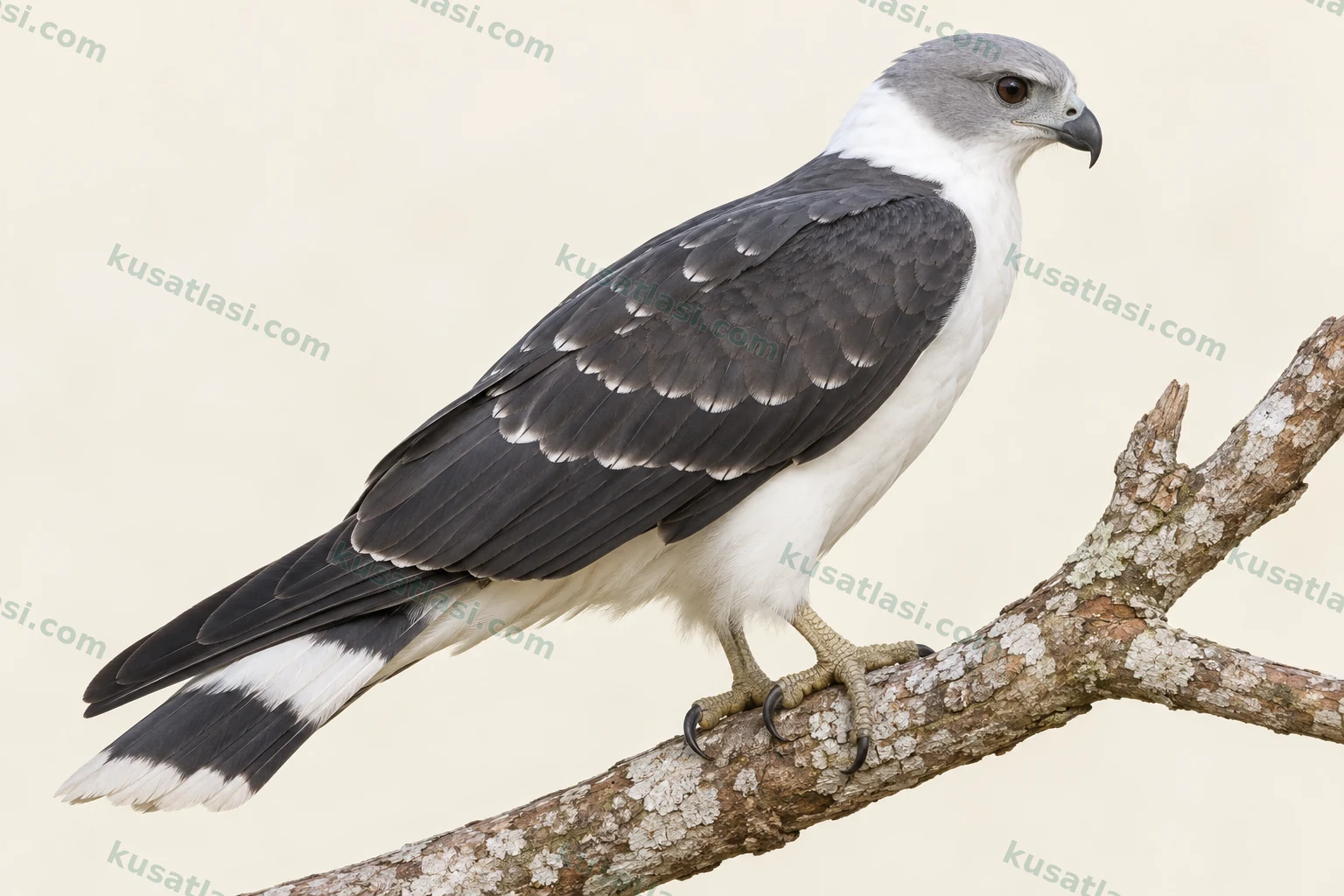
Compare male and female
 FemaleMale
The link between tail bands and sex is a hypothesis and is not used as a reliable sexing key. Young birds and those approaching adult plumage can look very similar to a close relative.
Where to look in its natural range?
Look inside humid forest and along its edges, on exposed branches and for morning display flights above the forest.
The original Alagoas and Pernambuco study recorded display flights in October 2007 and November 2008. These do not establish a laying calendar for the entire range.
January
Birds move between forest fragments. No regular long-distance migration route was verified. No verified regional date specific to this month was given; this does not mean local absence.
February
Birds move between forest fragments. No regular long-distance migration route was verified. No verified regional date specific to this month was given; this does not mean local absence.
March
Birds move between forest fragments. No regular long-distance migration route was verified. No verified regional date specific to this month was given; this does not mean local absence.
April
Birds move between forest fragments. No regular long-distance migration route was verified. No verified regional date specific to this month was given; this does not mean local absence.
May
Birds move between forest fragments. No regular long-distance migration route was verified. No verified regional date specific to this month was given; this does not mean local absence.
June
Birds move between forest fragments. No regular long-distance migration route was verified. No verified regional date specific to this month was given; this does not mean local absence.
July
Birds move between forest fragments. No regular long-distance migration route was verified. No verified regional date specific to this month was given; this does not mean local absence.
August
Birds move between forest fragments. No regular long-distance migration route was verified. No verified regional date specific to this month was given; this does not mean local absence.
September
Birds move between forest fragments. No regular long-distance migration route was verified. No verified regional date specific to this month was given; this does not mean local absence.
October
Birds move between forest fragments. No regular long-distance migration route was verified. Alagoas and Pernambuco, 2007–2008 field study. Courtship or territorial display flights, not records of laying months or a complete breeding calendar.
November
Birds move between forest fragments. No regular long-distance migration route was verified. Alagoas and Pernambuco, 2007–2008 field study. Courtship or territorial display flights, not records of laying months or a complete breeding calendar.
December
Birds move between forest fragments. No regular long-distance migration route was verified. No verified regional date specific to this month was given; this does not mean local absence.
Nest, egg and incubation
Regional courtship or display flights are confirmed. Reliable species data were not found for usual nest structure, egg count, incubation duration or time to nest departure.
In flight it gives short, repeated harsh kua-like notes. During display it gives a longer, catlike call. Voice alone does not reliably separate it from the close relative.
Do not play recordings to attract birds; observe quietly, especially near nests.
Species information
Quick identification
The White-collared Kite Leptodon forbesi is a restricted-range raptor associated with the Atlantic Forest of northeastern Brazil. Adults are dark above, with a white breast and belly. The hindneck is white, and the dark feathers of the upper back have small white tips. In flight, the largely white underwing coverts near the body are an important feature. Distinguish this white area from the dark, barred flight feathers at the wingtip.
It can be confused with the Grey-headed Kite Leptodon cayanensis, especially in juvenile and transitional plumages. A white underwing or a single dark tail band is not conclusive by itself. Assess the apparent age first, then the combined pattern of the nape, upper back and underwing coverts. Distinctive back markings may not be visible in a distant image taken only from below.
General appearance and posture
The head can look pale grey or very pale and almost white. The white hindneck borders the dark back. The underparts are white and the bill and eye dark. In adults, the bare area at the base of the bill is greyish. Feather condition and distance affect how clearly the small white tips on the dark back appear in an image. A very pale-looking head does not mean every individual always has an entirely white head.
The bird may perch on exposed branches within a forest fragment or along its edge. A view of the hindneck and back from that position offers a different identification opportunity from a view of the underwing alone. A perched bird may reveal the white nape when it turns its head. If only a white breast is visible, consider other raptors with pale underparts found in the area.
Males, females and young birds
A reliable plumage key for separating adult males and females has not been verified. One identification study discussed whether differences in tail pattern within pairs might be linked to sex, but the researchers explicitly said this was uncertain. One or two dark tail bands are therefore not used to assign male and female labels. General plumage appearance and the sex of an individual are separate questions.
A comparative study published in 2020 showed that the pale and streaked juvenile forms of the two Leptodon species can look very similar. Juvenile colour cannot be reduced to the adult pattern of white underparts and a dark back. An accompanying adult, a single pale marking or the state in which a juvenile is seen is not sufficient for reliable species identification.
In birds approaching adult plumage, the underwing can be pale, with dark areas remaining on some coverts. Grey-headed Kites can also have pale underwings at this stage, making separation difficult. A combined view of the nape and upper back becomes important. Do not fill in details of moult that are too fine to resolve in a photograph. Leave the record at genus Leptodon when necessary.
Appearance in flight
Broad wings, a small head and a relatively long tail are conspicuous in flight. Watch the separated flight feathers at the wingtip together with the white coverts near the body. The white coverts and dark flight feathers are distinct parts of the same wing. Describing the underwing as entirely white or entirely black loses the distinctive pattern.
The number of pale and dark bands on the tail varies. The strength of barring on the inner flight feathers also fails to distinguish every individual of the two Leptodon species. More recent research has shown these limitations of earlier identification suggestions. A useful flight record shows the age-appropriate wing coverts and, if possible, the nape as well as the tail bands. A dark silhouette against the sun should not be mistaken for a genuinely dark feather area.
Butterfly-like flight with short, rapid wingbeats has been reported in courtship or territorial display. The wings can be held raised and partly folded. A display flight does not indicate distant migration. Circling above forest and flying in a definite direction between two forest fragments are also described separately in observation records.
Voice and behaviour
Short, repeated, harsh kua-like notes may be noticeable in flight. A more drawn-out, catlike call has also been recorded during display. The original research notes that comparisons of voice with Grey-headed Kite are limited. Hearing a similar call does not remove the need to check the age and plumage pattern visible on the bird.
During fieldwork, birds seen above the forest early in the morning later remained inside it. This context helps when choosing when to watch. It does not mean that every individual performs the same display at the same minute every day. An exposed branch at the forest edge and the sky above it can be watched from a distance. Entering the forest and approaching a rare bird’s perch for a close view may disturb its natural behaviour.
Similar species
Adult Leptodon cayanensis has a grey nape, dark upper back and largely black underwing coverts. Adult White-collared Kite combines a white nape, white-tipped dark back feathers and largely white underwing coverts. This adult comparison does not apply directly to juveniles or birds approaching adult plumage.
Amadonastur lacernulatus can also combine a pale head and body with dark wing areas. Compare its flight feathers and dark pattern along the trailing edge with the kite’s barred outer flight feathers. When Amadonastur lacernulatus is perched, its wingtip extends much nearer to the tail tip. Identifying a pale raptor in the region as a White-collared Kite just from its white head overlooks this distinction.
World distribution
The species is endemic to the Atlantic Forest of northeastern Brazil. Pernambuco and Alagoas form the core of the known records. There are also confirmed records in Paraíba and Rio Grande do Norte. More recent identification research found birds with the appropriate adult markings in Sergipe. The São Francisco River is therefore not treated as an absolute boundary for all records.
Status within its natural range
The current global category is Endangered. Forest loss and the isolation of remaining fragments are major conservation concerns. A sighting in a small urban forest does not prove that the fragmented habitat supports a secure population in the long term. The higher threat category given in older publications is distinguished from the current category by date.
The 2020 study explains that an earlier identification from Ceará was corrected and that a bird in transitional plumage photographed only from below in Bahia should not be accepted as a confirmed White-collared Kite. The map does not include such doubtful extensions as established natural range. Confirmed adult records from Sergipe are distinguished from misidentifications in the same state. A climate model predicts suitable conditions. It does not prove that birds occur or breed in every cell.
Movements
Sources report flights between forest fragments, but no regular long-distance seasonal route has been verified for all individuals. A bird flying over sugarcane fields is not treated as living or breeding in those fields. Daily movements, distribution and migration are distinct. The map does not show monthly routes without verified tracking data.
Breeding habitat
Humid Atlantic Forest and its remaining fragments are the species’ main habitat. Original research covered lowland forests near the coast and forested hills farther inland. Rainfall, forest structure and stream surroundings are relevant to distribution research. An association in a climate model is not a direct measurement of nest-site conditions. Presence in forest is distinguished from evidence of breeding.
Nest site
The open scientific and specialist sources examined did not reliably confirm typical nest structure, egg count, incubation duration or how long the young stay in the nest. Regional display flights may indicate breeding activity, but they are not used to calculate dates of laying or durations. Nest information for Grey-headed Kite and a report of another bird nesting in an arboreal termite nest are not transferred to this species.
Daily use of space
Exposed branches within the forest and along its edge serve as resting points or lookouts. Birds sometimes cross open agricultural land to reach another forest fragment. That crossing does not show that tree cover is dispensable. Observers can record where a flight begins and the direction it takes. They should not enter private protected areas without permission to follow a bird or play calls near a possible nest.
What it eats
The kinds of food and usual proportions of prey are poorly known. In original research published in 2011, one bird was seen taking prey and returning to its perch, but the prey could not be identified. The observation does not provide a definite list of insects, reptiles or frogs. Known foods of a close relative do not substitute for verified meals of this species.
How it hunts
In a direct observation, a bird flew down from a perch and soon returned to the same spot to eat its prey. That one event does not show that it takes all prey from the ground or by the same method. A 2024 camera study recorded a White-collared Kite inspecting another bird’s nest after monkeys had emptied it. The record does not show the kite eating an egg or a chick.
Inspecting a nest is relevant to understanding possible foraging behaviour. It is not recorded as proven nest predation or as a percentage of the diet. Record the return to a branch, the identity of prey carried in the bill and actual eating as separate details. Using a relative’s food list to fill in an unclear prey image would create false certainty about this poorly known species.
Museum specimens and field observations complement each other
For a long time, there was debate over whether the bird was a separate species or a juvenile form of another kite. Comparisons of museum plumage and the discovery of adults in their natural habitat supported recognition as a separate species. The existence of that older debate is no reason to use both names for one species today. Equally, the current species name does not mean that every photograph of a juvenile can be identified conclusively.
New identification evidence can change the map
Misreading the head and underwing pattern can affect more than a photograph’s label. It can also alter the apparent range boundary. A more recent comparison did not accept certain southern records as definitive while recognising suitable adult records in Sergipe. The map therefore requires more detailed evidence than the appearance of a state name on an old list. The presence of two relatives in the same region does not make identification easier.
Suitable climate does not mean a forest is occupied
The 2019 distribution study combined records and environmental conditions to estimate suitable areas. Such a model can help select areas to search during conservation work. It does not indicate that a pair occurs in every suitable cell. The forest fragments that remain and the connections between them are also important. A large potential range does not show that places where tree cover has been lost can still be used to the same extent.
Inspecting an empty nest is not a prey record
In the camera study, the bird’s inspection of an emptied nest was a notable behaviour. No eggs or chicks were eaten on that occasion. This distinction separates what the camera directly recorded from the researchers’ interpretation of its possible function. Further observations may improve knowledge of the diet. The existing record does not support the conclusion that the kite regularly preys on all birds’ nests.