

World Birds IUCN statusCR · Critically EndangeredGlobal IUCN. BirdLife v10 (2025); taxon matching AviList 2026 / IOC 15.2; checked: 29.10.2026. The list year is not the species’ assessment date. Source and method · BirdLife OrderAccipitriformesBirds of prey FamilyAccipitridaeAccipitridae
White-headed Vulture
Trigonoceps occipitalis
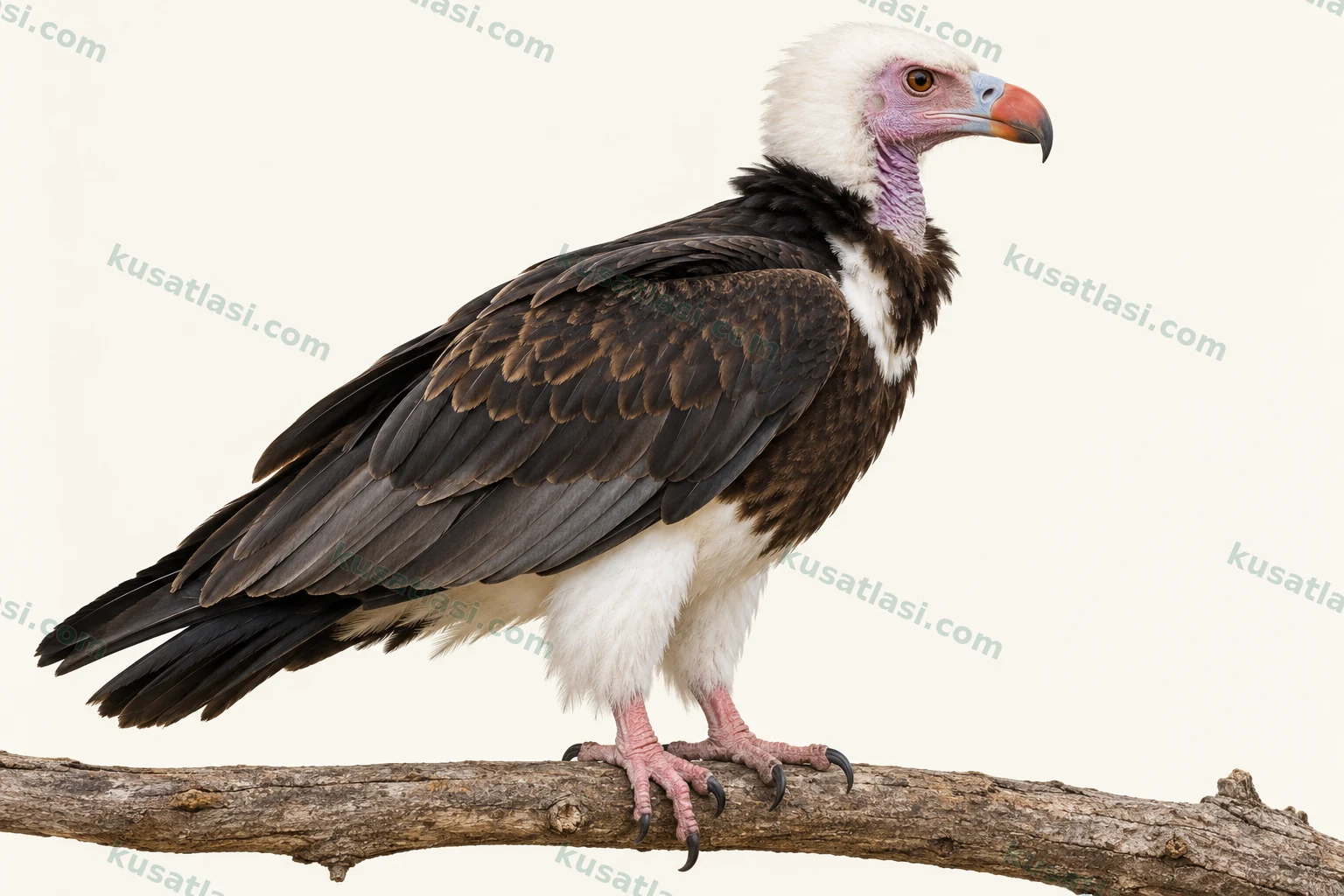
Angular pale pink head, powerful coral-coloured bill, dark breast band and white lower belly; the female has white inner flight feathers.
Biometrics
Length
Male72–85 cm
Female72–85 cm
Shared species value
Wingspan
Male207–223 cm
Female207–223 cm
Shared species value
Weight
Male2.12–5.3 kg
Female2.12–5.3 kg
Shared species value
White-headed Vulture
Fragmented wooded savannas of sub-Saharan AfricaObservation guide in its natural range
Look for three features together
Do not rely on a single featureFine white feathers on the crown and nape; the bare face is pink and the bill base pale blue.
White belly and upper-leg feathers below the dark breast band.
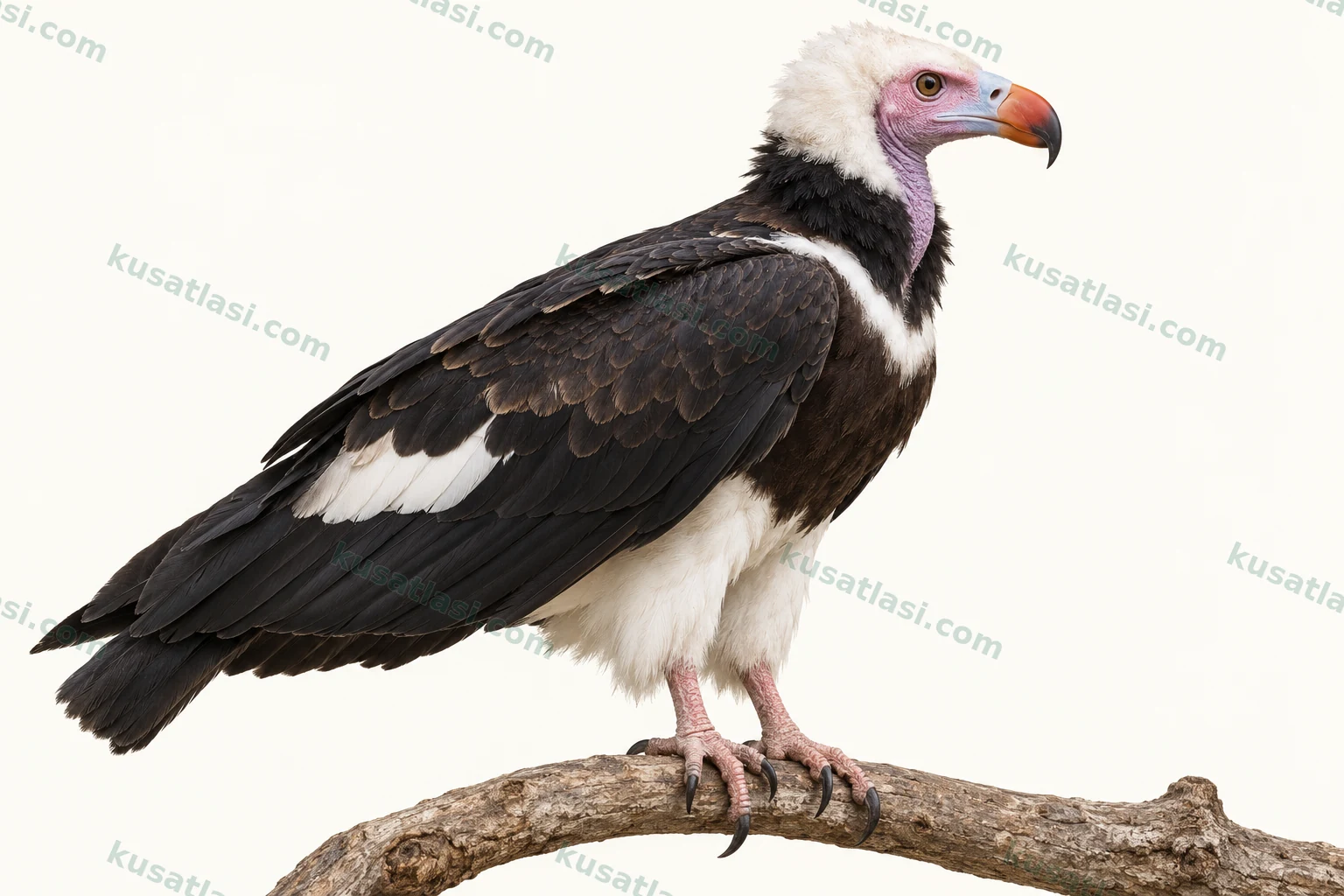
Both sexes have a pale underwing band; the female has additional white on flight feathers near the body.
Compare male and female
 FemaleMale
The female’s inner flight feathers are white and the male’s dark or grey; the shared white underwing band is not confused with this difference.
Where to look in its natural range?
Tall trees for nesting and open feeding areas nearby; the broad framework does not prove breeding at every point.
In the Kruger 2008–2012 study, laying starts that could be dated fell in June–August; dates were back-calculated from chick age and an assumed 55-day incubation.
January
Generally resident; wandering in search of food is not regular long-distance migration. No verified regional date specific to this month was given; this does not mean local absence.
February
Generally resident; wandering in search of food is not regular long-distance migration. No verified regional date specific to this month was given; this does not mean local absence.
March
Generally resident; wandering in search of food is not regular long-distance migration. No verified regional date specific to this month was given; this does not mean local absence.
April
Generally resident; wandering in search of food is not regular long-distance migration. No verified regional date specific to this month was given; this does not mean local absence.
May
Generally resident; wandering in search of food is not regular long-distance migration. No verified regional date specific to this month was given; this does not mean local absence.
June
Generally resident; wandering in search of food is not regular long-distance migration. South Africa, Kruger National Park, 2008–2012: laying starts estimated in the study, not dates directly measured at every nest.
July
Generally resident; wandering in search of food is not regular long-distance migration. South Africa, Kruger National Park, 2008–2012: laying starts estimated in the study, not dates directly measured at every nest.
August
Generally resident; wandering in search of food is not regular long-distance migration. South Africa, Kruger National Park, 2008–2012: laying starts estimated in the study, not dates directly measured at every nest.
September
Generally resident; wandering in search of food is not regular long-distance migration. No verified regional date specific to this month was given; this does not mean local absence.
October
Generally resident; wandering in search of food is not regular long-distance migration. No verified regional date specific to this month was given; this does not mean local absence.
November
Generally resident; wandering in search of food is not regular long-distance migration. No verified regional date specific to this month was given; this does not mean local absence.
December
Generally resident; wandering in search of food is not regular long-distance migration. No verified regional date specific to this month was given; this does not mean local absence.
Nest, egg and incubation
The nest is a stick platform high in a tree crown; the typical clutch is one egg. The specialist account gives 51–56 days of incubation and first flight at approximately 110–120 days. Both adults provide care; the study’s 60-day success threshold is not first flight.
Usually sparingly vocal; during matings observed in Kruger, a deep, rather prolonged creaking sound was recorded.
Do not play recordings to attract birds; observe quietly, especially near nests.
Species information
Quick identification
The White-headed Vulture Trigonoceps occipitalis lives in wooded savannas south of the Sahara and shows a strong contrast between its dark body and pale head. Assess the angular head, thick hooked bill, white lower belly and dark breast together. The pale head is not made up entirely of white feathers: the face also has bare pale pink skin. Fine white feathers can form a small projection around the crown and nape.
The adult female has an extensive white area in the flight feathers close to the body; the same feathers are darker in the adult male. Do not confuse this difference with the pale underwing band found in both sexes. The female does not have an entirely white wing. If the wing is folded or its inner part is hidden, do not determine sex from the incomplete view alone.
General appearance and posture
The body is largely dark brown, and the flight feathers and tail are dark. Pale areas on the throat and upper breast are followed by a dark breast band, with a white belly and white upper-leg feathers below it. The feathered and bare parts of the head have different textures. A head that looks white at a distance should not be imagined as a face entirely covered with feathers. Turning the head makes the bare area at the bill base and cheek easier to see.
The bill is orange-red or coral-coloured, with a dark tip and a strong hook; the soft skin at its base is pale blue. This blue area does not mean that the whole bill is blue. The orange-bronze tone of the small eye may change with the light. Rather than relying on a single head colour at a distance, watch the angular shape, powerful bill and body pattern together. The order of the white and dark breast areas is also an identification feature belonging to that same bird.
It may stand in a tree alone or with its mate, and is also seen on the ground around carrion. Stretching its neck to check the surroundings makes the pale head area stand out. Other vultures at a carcass do not mean that every individual is the same species. In a crowd, follow the head, breast and wing pattern of the bird itself. Do not accidentally assign the white feathers of a nearby bird to this individual’s wing.
Males, females and young birds
Adults have a similar basic head and body pattern. The female is generally larger, but size comparisons made at a distance in the field are not reliable on their own. A more useful difference is the white flight feathers in the inner part of her wing. The corresponding area in the male appears dark or grey. Check the position of this area in good light; the shared white underwing band alone does not establish that a bird is female.
Young birds have not yet acquired the adult’s full white pattern on the underparts and may look darker brown. The colour of the fine head feathers also changes during development. A newly flying bird and an individual several years old should not be forced into a single juvenile appearance. The Kruger study described the head of an approximately three-month-old nestling as brown; that record does not mean that young birds of every age necessarily have the same head colour.
Age assessment considers head feathers, pale and dark body areas, and wing pattern together. The white wing area conspicuous in the adult female may not yet be fully developed in a young bird. An incomplete pattern is no reason to call the bird male immediately. If a photograph shows only the head, uncertainty about sex is retained; a hidden wing marking is not assumed to have developed fully.
Appearance in flight
When it soars on long wings, the dark flight feathers, white band across the middle of the underwing and pale lower belly attract attention. The white band can occur in both sexes; the female’s additional white on the inner flight feathers is a separate area. A photograph showing the upperwing and one showing the underwing may not display the same marking. Establishing the surface and its position relative to the body allows the identification description to be used correctly.
Scanning a wide area while soaring is part of its food search. The point where a descending bird is seen may not be the location of its nest. A single high-flying record is not treated as a breeding area or migration route. Identification is stronger when the white head, inner and lower wing areas and dark breast band are seen together on the same individual.
Voice and behaviour
It is not a bird that frequently gives long songs, yet it should not be regarded as completely silent. During directly observed matings in Kruger, researchers described a deep, rather prolonged creaking sound. A sound heard in this particular context is not presented as a general call used in every situation. The meaning of harsh sounds at a carcass is also assessed alongside the birds’ interactions at that moment.
It mostly uses carrion, but may also take prey from other predators and catch small live animals. Directly observed hunting corrects the idea that this species can only eat carrion. However, a few prey records do not establish that live prey makes up most of its diet. Pairs appearing to corner prey together also require the observation to be kept separate from the explanation about cooperation.
Similar species
The Lappet-faced Vulture Torgos tracheliotos is another large African vulture with a powerful bill and bare head. Compare its conspicuous head skin folds with the angular head and fine white feathers of the White-headed Vulture. A pale underwing area alone is insufficient; the head and breast pattern must also be seen.
The Hooded Vulture Necrosyrtes monachus has a more slender bill and different head-to-neck proportions. The White-backed Vulture Gyps africanus has a long neck and a different body and wing pattern. Because pale areas in young birds may be less conspicuous than in adults, assess the whole bird’s structure and the markings that are clearly visible together.
World distribution
Its natural range lies in sub-Saharan Africa. It occupies a fragmented area extending from Senegal and neighbouring savannas in the west to the surroundings of Ethiopia, Kenya and Somalia in the east, and south to northern Namibia, Botswana, Zimbabwe and northeastern South Africa. It does not use every part of the continent at the same density. Wooded savannas, open surroundings with available food and safe nesting trees are important together; a broad country name does not mean that it inhabits the entire country.
Status within its natural range
It is classified as Critically Endangered in the global assessment underlying the current taxonomic list. Specialist accounts emphasise a marked decline outside protected areas. Poison added to carcasses or baits intended to kill mammalian predators can also reach vultures. Loss of suitable wooded areas is another pressure. An old population estimate with a stated date is not used as if it were a newly completed current census.
The breeding study in Kruger describes particular years in a particular park; it does not give the number of pairs across Africa. Continued presence of nests in one region does not cancel losses elsewhere. The broad geographical framework retained on the map does not claim that a bird or nest has been seen in every modelled cell. An individual observation and a permanent breeding population are assessed separately.
Migration and movements
It is generally classified as resident and is not a regular intercontinental migrant. It may wander widely when looking for food. Neither such wandering nor the movements of a young bird that has left the nest are converted, without evidence, into migration along the same route every year. Being resident also does not mean remaining only around the nesting tree; soaring in search of food connects different parts of its living area.
Breeding habitat
Savannas where trees occur alongside open areas, and sparsely wooded surroundings, are important. Nests may belong to separate pairs; the image of a dense cliff-nesting vulture colony is not automatically transferred to this species. Most nests studied in Kruger during 2008–2012 were in thorny savanna trees. This regional finding does not mean that only the same tree species is used throughout Africa.
Nest site
The nest is a stick platform built in the upper crown of a tall tree and may be lined with fine grasses. The typical clutch is one egg. The institutional specialist account gives 51–56 days of incubation and approximately 110–120 days to first flight; both adults participate in care. The Kruger study assumed a 55-day incubation period when assigning dates. That assumption is not presented as if the time from laying to hatching had been measured directly at every nest.
For a breeding attempt to count as successful in that study, the chick only had to reach approximately 60 days of age; this is not the age at first flight. The breeding card keeps chick development separate from the study’s success criterion. Approaching the nest tree and flushing a bird can harm this sensitive species; watch the adults’ arrivals and departures from a distance.
Daily use of space
The nesting or roosting tree does not serve the same function as open areas searched for food by day. A soaring bird may look for carrion, the feeding activity of other predators or small animals it can catch. Feeding in a treeless area does not show that it nests there. The surroundings requiring protection are not limited to a single platform; safe connections to feeding areas around the tree also matter.
What does it eat?
Carrion is among its main food sources. It may also use animals killed by other birds of prey. In addition, it is reported to catch small mammals, reptiles and birds. Directly observed hunting events in Kruger involved a small mongoose, a monitor lizard and a tree squirrel. These records show dietary variety; a few observations do not allow annual food percentages to be calculated.
How does it hunt?
It scans its surroundings while soaring, descends to food or watches other birds’ activity. Running after live prey on the ground has also been recorded. In one event a pair tried to corner a squirrel around a tree, but the squirrel escaped. This failed attempt is not the same as a capture record.
An animal part found at a nest does not, on its own, prove that the bird caught the animal alive: it could have come from carrion or another predator. Events in which the researcher directly watched the hunt are therefore distinguished from explanations based only on food remains. A few pairs appearing to act together suggest the possibility of cooperation; they do not show that every pair uses the same method on every hunt.
Not all four hunting attempts succeeded
The 2014 paper describing direct observations in Kruger includes four events. Small vertebrates were caught in three, while a tree squirrel escaped in one. This small distinction matters: observing four events does not mean four successful kills. The observations show that live hunting genuinely occurs; they do not measure its share of the species’ entire diet.
Visual field and visual acuity are different
A study comparing three vulture species measured the visual fields of two individuals of each species. The widest angle jointly seen by the eyes of the White-headed Vulture was approximately 30 degrees, compared with approximately 20 degrees in the two Gyps species examined. Researchers related the difference to the way prey is sought and caught on the ground. This small-sample measurement does not prove that its vision is a particular number of times sharper or that it can see at night. A small number of birds in human care do not represent all the variation of a wild population.
Breeding success depends on its definition
The Kruger study used a chick of approximately 60 days as its success criterion. Reaching that age is not the same event as hatching and does not give the date of first flight. Comparisons of success figures from different studies must consider which developmental stage was followed. The figure in a results heading alone may not reveal that detail.
Northern and southern parts of the same park differed
In the study, laying starts that could be dated fell between early June and early August. The small northern sample showed a later start than the southern one. The dates are uncertain because they were calculated backwards from chick ages and the assumed incubation duration. This local difference shows why selecting a single breeding month for all of sub-Saharan Africa is inappropriate.