

World Birds IUCN statusLC · Least ConcernGlobal IUCN category. BirdLife v10 (2025); taxon matching: AviList 2026 / IOC 15.2; checked: 29.10.2026. The list year is not the species assessment date. Source and method · BirdLife OrderAccipitriformesHawks, eagles and allies FamilyAccipitridaeAccipitridae
African Hawk-Eagle
Aquila spilogaster
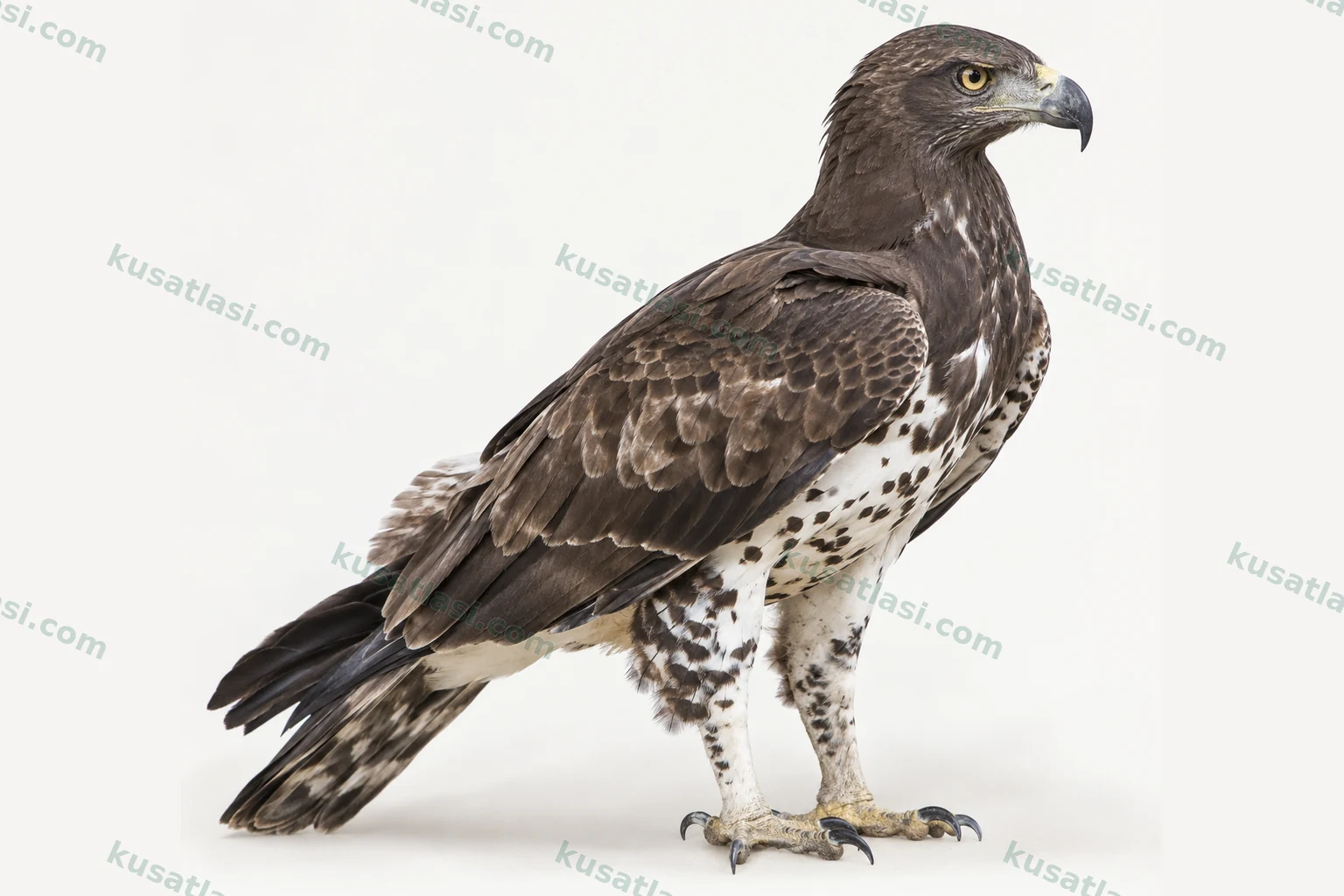
Adult dark upperparts, streaked pale underparts, broad dark wing trailing edge and tail-end band. Young birds have different rufous underparts.
Biometrics
Length
Male60–70 cm
Female60–70 cm
Shared species value
Wingspan
Male130–160 cm
Female130–160 cm
Shared species value
Weight
Male1.15–1.45 kg
Female1.4–1.8 kg
African Hawk-Eagle
Wooded savanna and open woodland of sub-Saharan AfricaObservation guide in its natural range
Look for three features together
Do not rely on a single featureBroad dark wing trailing edge and tail-end band together.
Rufous underparts differ from the adult black-and-white pattern.
Wooded hunting area; do not decide from silhouette alone.
Compare male and female
 FemaleMale
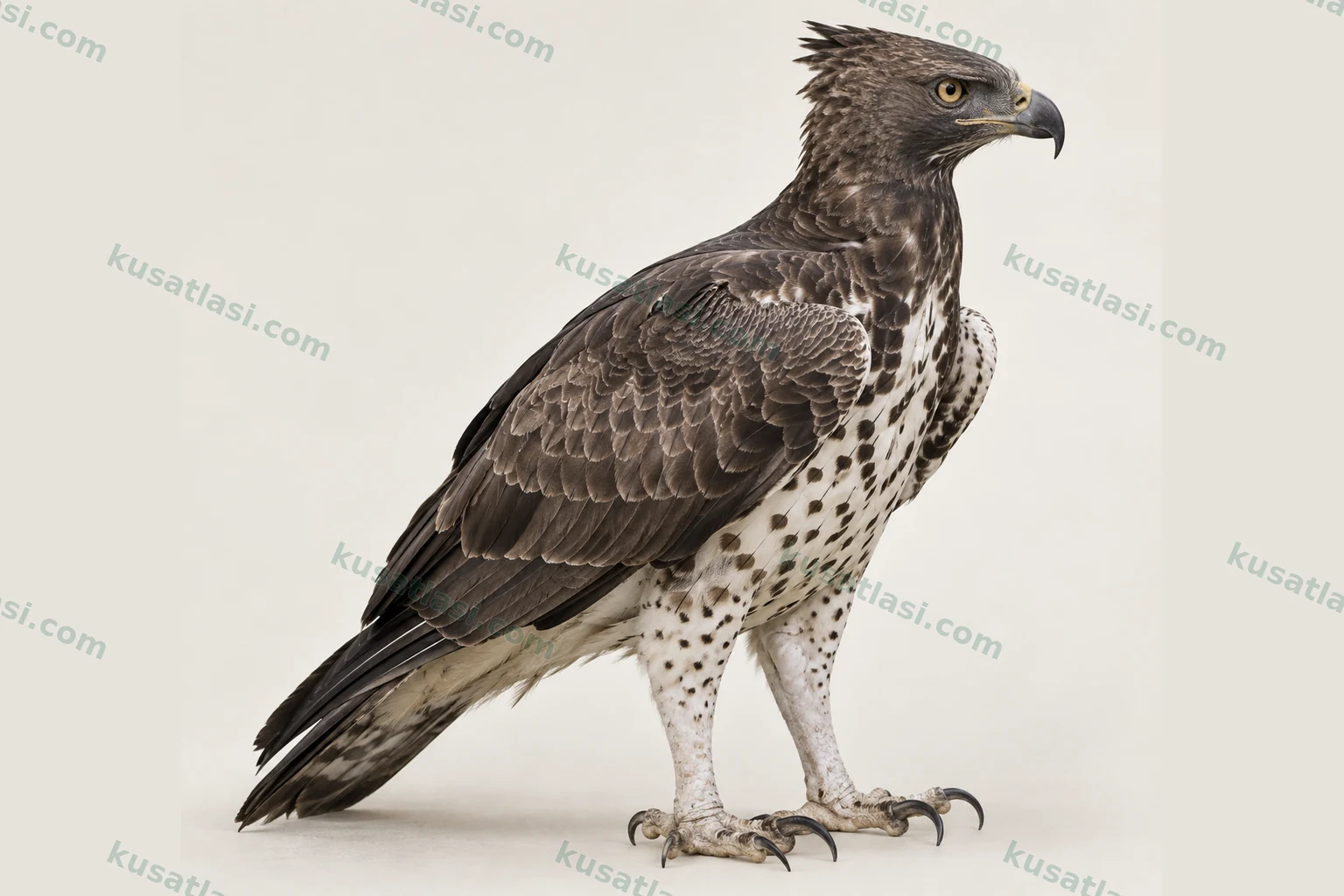
Adult plumage is similar; the female is larger. Young birds have rufous-brown underparts and are not forced into the adult pattern.
Where to look in its natural range?
At high perches and savanna openings, observe the entire wing, tail and age-related appearance together.
The species is usually resident, but may move to distant areas to avoid drought. The months below are examples only from the named regional study or expert account.
January
The species is usually resident, but may move to distant areas to avoid drought. No verified regional date specific to this month was given; this does not mean local absence.
February
The species is usually resident, but may move to distant areas to avoid drought. No verified regional date specific to this month was given; this does not mean local absence.
March
The species is usually resident, but may move to distant areas to avoid drought. No verified regional date specific to this month was given; this does not mean local absence.
April
The species is usually resident, but may move to distant areas to avoid drought. South African regional account: Laying period; June–July peak.
May
The species is usually resident, but may move to distant areas to avoid drought. South African regional account: Laying period; June–July peak.
June
The species is usually resident, but may move to distant areas to avoid drought. South African regional account: Laying period; June–July peak.
July
The species is usually resident, but may move to distant areas to avoid drought. South African regional account: Laying period; June–July peak.
August
The species is usually resident, but may move to distant areas to avoid drought. South African regional account: Laying period; June–July peak.
September
The species is usually resident, but may move to distant areas to avoid drought. No verified regional date specific to this month was given; this does not mean local absence.
October
The species is usually resident, but may move to distant areas to avoid drought. No verified regional date specific to this month was given; this does not mean local absence.
November
The species is usually resident, but may move to distant areas to avoid drought. No verified regional date specific to this month was given; this does not mean local absence.
December
The species is usually resident, but may move to distant areas to avoid drought. No verified regional date specific to this month was given; this does not mean local absence.
Nest, egg and incubation
The nest is a branch platform in a tall tree, with one–two eggs. The South African account gives incubation mainly by the female for 42–44 days, while the male supplies food. First flight and independence are separate stages.
It gives whistling calls, and partners call to each other while soaring. Silence does not exclude the species.
Do not play recordings to attract birds; observe quietly, especially near nests.
Species information
Quick identification
African Hawk-Eagle Aquila spilogaster is an eagle of sub-Saharan wooded savannas, with strongly contrasting dark upperparts and pale underparts as an adult. When identifying an adult, assess together its blackish head and back, dark breast streaks on a white background, broad dark trailing edge to the wing and dark band near the tail tip. One black-and-white patch does not distinguish it from all other raptors. Wing shape, tail, body proportions and the head seen when perched are all parts of the same identification.
The juvenile does not match the adult’s black-and-white pattern: its upperparts are browner, and underparts and underwings may be warm rufous-brown. This distinction is especially important; rejecting a rufous-underparted bird simply because it does not resemble the adult illustration would be wrong. The English African Hawk-Eagle is matched to the accepted Aquila spilogaster. Hieraaetus spilogaster in old sources is an earlier generic placement of the same species. Head, wing and tail pattern must be examined together without requiring the same colour boundaries in juveniles and adults.
General appearance and posture
The adult head and upperparts are very dark, approaching black. Throat and fore-neck are pale, with conspicuous dark streaks on breast, flanks and underwing coverts. White areas occur towards the lower belly and undertail. Beneath the tail, fine dark bars and a broad dark terminal band may be visible. Upper and lower tail views must not be read as the same colour pattern; lighting direction and the surface seen change the result. The dark–pale contrast of head and body provides broader information than one wing fragment.
The bill is hooked and dark, with a yellowish bare area at its base. The adult eye is described as yellow. Upper legs are feathered, while the bare part of the feet is assessed separately. Eye colour, bill base and feathered legs cannot be distinguished in many distant flight views. Do not record them as present on a bird where they were not seen. A bird perched on an exposed branch or dry tree offers a better comparison of head and lower body; this posture does not mean that the species lives only on dry branches.
Males, females and young birds
Adult male and female have similar basic plumage, with the female larger. The expert description also notes that the female’s underpart streaking can be denser. Yet counting streaks on a distant lone bird or deciding from apparent large size alone is unreliable. Viewing angle, distance and overlapping feathers alter the pattern. Seeing a pair at equal distance under the same conditions may help a size comparison, but sex must still not be assigned from an uncertain silhouette alone.
Juveniles show browner upperparts, paler rufous and whitish wing details, and rufous underparts and underwings. The eye may appear browner rather than the adult’s strong yellow. Wing and tail patterns are less sharply defined than in adults; looking for the adult’s broad dark trailing edge with the same clarity on a juvenile is misleading. Intermediate-age birds must not be forced into one adult colour template either. Assess underparts, wing edge, head and tail together, without assigning an exact calendar age from colour change alone.
Appearance in flight
From below, the adult’s dark marks on a pale background, broad dark wing trailing edge and terminal tail band are useful. The whole underwing pattern needs to be seen; a single dark part near the tip occurs in many eagles. A turn revealing the upperwing shows the dark head and back. Features of these two angles must not be combined as colours on one surface. Strong light can make pale wing areas shine, while white parts look subdued in shade.
The expert guide describes fast, powerful wingbeats, high soaring and lower flight while searching for prey. A high-circling bird is not identified with certainty by flight behaviour alone; shape and pattern must complete it. The juvenile’s rufous underwing provides a different starting point from the adult, but similar young eagles exist, so head and tail need checking too. Two birds soaring together may be associated with courtship; that alone is not proof of a nest site or successful breeding.
Voice and behaviour
Although silent in many observations, it gives whistling and sometimes melodious calls. The regional expert account reports pairs calling to each other while soaring together. Silence does not exclude the species, and one whistle does not distinguish it from every other raptor. If the calling bird is visible, match the voice with wing, tail and age appearance. This describes natural vocal behaviour; playing sounds to attract the bird or provoke alarm at a nest is not recommended.
It can occur alone or in pairs. It may wait on a high perch, watch prey movement and then make a rapid attack on a bird or another small vertebrate. Some accounts describe cooperative hunting by partners; this does not mean that every pair divides identical roles in every hunt. Strong feet and predatory behaviour are striking, but a momentary attack does not establish the captured animal’s species or mass. Regular nest provisioning and an ordinary landing after hunting are also different events.
Species that may be confused
1. Hieraaetus ayresii, Ayres’s Hawk-Eagle: pale and dark underpart patterns may create similarities. Assess the complete wing shape, head-to-body proportions, tail pattern and age together. A distant black-and-white eagle cannot be named from one band alone.
2. Polemaetus bellicosus, Martial Eagle: apparently larger birds with dark markings on pale underparts may enter the comparison. Size alone is unreliable without knowing distance; check head, wing and tail proportions together with whether the pattern consists of streaks or spots.
3. Young eagles with rufous underparts: juvenile African Hawk-Eagle does not resemble the adult illustration. Compare regional possibilities, including Aquila species, using age, wing trailing edge, tail and head; warm underpart colour alone does not give a definite identification.
World distribution
African Hawk-Eagle occurs widely across sub-Saharan Africa and is associated with wooded savanna and open woodland. It should not be described as a forest eagle making equal use of dense lowland forests in West Africa and the Democratic Republic of the Congo. In southern Africa, the expert account highlights northern and central Namibia, suitable parts of Botswana, Zimbabwe, Mozambique and northeastern South Africa. Extremely arid treeless areas must be distinguished from savannas with suitable prey and nesting trees.
Status within its natural range
Local density varies within the broad range. The southern African expert account notes woodland degradation and persecution because the bird takes domestic fowl. Its historical regional threat category is not identical to the current global conservation label. Local scarcity is not a measurement of continental numbers, while a wide range does not imply safe, abundant populations everywhere. An estimated coloured area on a map is not evidence of breeding or regular presence in every part of it.
Migration
Usually resident, it has nevertheless been reported moving to distant areas to avoid drought. This should not be confused with regular long-distance migration in the same direction and months every year. Space use by adults near a nest and movements of dispersing young are different events too. No particular sequence of countries, monthly route or distance calculation is given here; that would require verified information at species and individual level. A daily hunting flight, a change of feeding site or a brief observation does not by itself prove such a route.
Breeding habitat
Wooded savanna, open woodland and strips of trees along watercourses provide suitable habitat. Large trees capable of supporting a nest need to occur together with openings for hunting. The species should not be sought in the same way in dense lowland forests and extremely arid treeless regions. A bird on one dry branch does not live only on that branch; the surrounding hunting area and nesting cover must be considered together.
Nest site
The pair builds a large platform of branches and sticks and may line it with green leaves. The nest is usually below the crown of a tall tree or in a fork; other supports and reuse of old nests have also been reported. The typical clutch is one–two eggs. The southern African regional account gives incubation of about 42–44 days, mainly by the female, while the male brings food. Steyn’s study of two Zimbabwe pairs also reports 43 ± 1 days. No new average absent from the sources is calculated from these agreeing results.
Daily habitat use
Waiting on a high perch, low hunting flights and high soaring may occur within the same wooded area. The South African account gives laying in April–August, concentrated in June–July; this calendar is not shared by the whole continent. Source context is retained for young development: Steyn recorded four first flights between 61–71 days, whereas the regional expert account gives nest departure at about 73 days. First flight, nest departure and independence are different stages. Do not climb to the nest or wait for long beneath its tree; watch perched or food-carrying adults from a distance.
What does it eat?
It feeds mainly on birds; expert accounts include francolins, guineafowl, pigeons and other appropriately sized birds. Small mammals and reptiles are also taken. Steyn’s Essexvale study in Zimbabwe found birds predominant among 104 prey remains. The food proportions of this particular sample are not an unchanging menu for every African pair. Available local prey, observation methods and the year matter when assessing the results.
How does it hunt?
It may wait on a high perch, watch prey pass and capture it in a rapid attack. Watching birds at water, attacking ground prey and pursuit in flight have been reported. The large feet grasp prey. Some observations describe two birds hunting together, one attacking prey flushed by the other; this is not a compulsory sequence in every hunt. If prey carried in the bill or feet cannot be recognised from a distance, its species is not invented. Prey delivered to a nest represents breeding-season food, whereas general feeding observations may cover other periods. The two datasets must not be merged as though their scope were identical.
A long study is still a limited sample
Peter Steyn’s 1975 paper presents observations of two pairs over 12 years in the Essexvale area of Zimbabwe. Long-term monitoring offers valuable detail on breeding and hunting, but two pairs do not provide a continental sample of the whole species. Their differing breeding histories also show the danger of describing the whole species from one nest’s outcome. Without more data from other areas collected by the same method, no certain continent-wide success rate can be derived.
Using branches before first flight
Steyn reports that a young bird may climb onto branches around the nest before its first flight. This is not the same as full flight ability or living independently of parents. A juvenile that appears to have left the nest may still be using the nest tree. Bringing such a bird to the ground, approaching the tree to flush it, or testing whether it can fly is inappropriate.
What male and female measurements mean
The figures are attributed to earlier sources such as Dunning and Bennett. The natural size difference is not enough to sex a lone distant bird with certainty in every situation.
An old genus name is not another eagle
Scientific sources may use Hieraaetus spilogaster. Matching it to the current placement Aquila spilogaster shows that it is the former genus name of the same species. This match does not permit transferring measurements among all similar eagles by name alone. Other taxa, such as Ayres’s Hawk-Eagle, are checked separately under their own scientific names. In particular, the lack of an adult black-and-white pattern in juveniles requires species identity and age appearance to be assessed together.