

World Birds IUCN statusLC · Least ConcernGlobal IUCN category. BirdLife v10 (2025); taxon matching: AviList 2026 / IOC 15.2; checked: 29.10.2026. The list year is not the species assessment date. Source and method · BirdLife OrderAccipitriformesBirds of prey FamilyAccipitridaeAccipitridae
African Marsh Harrier
Circus ranivorus
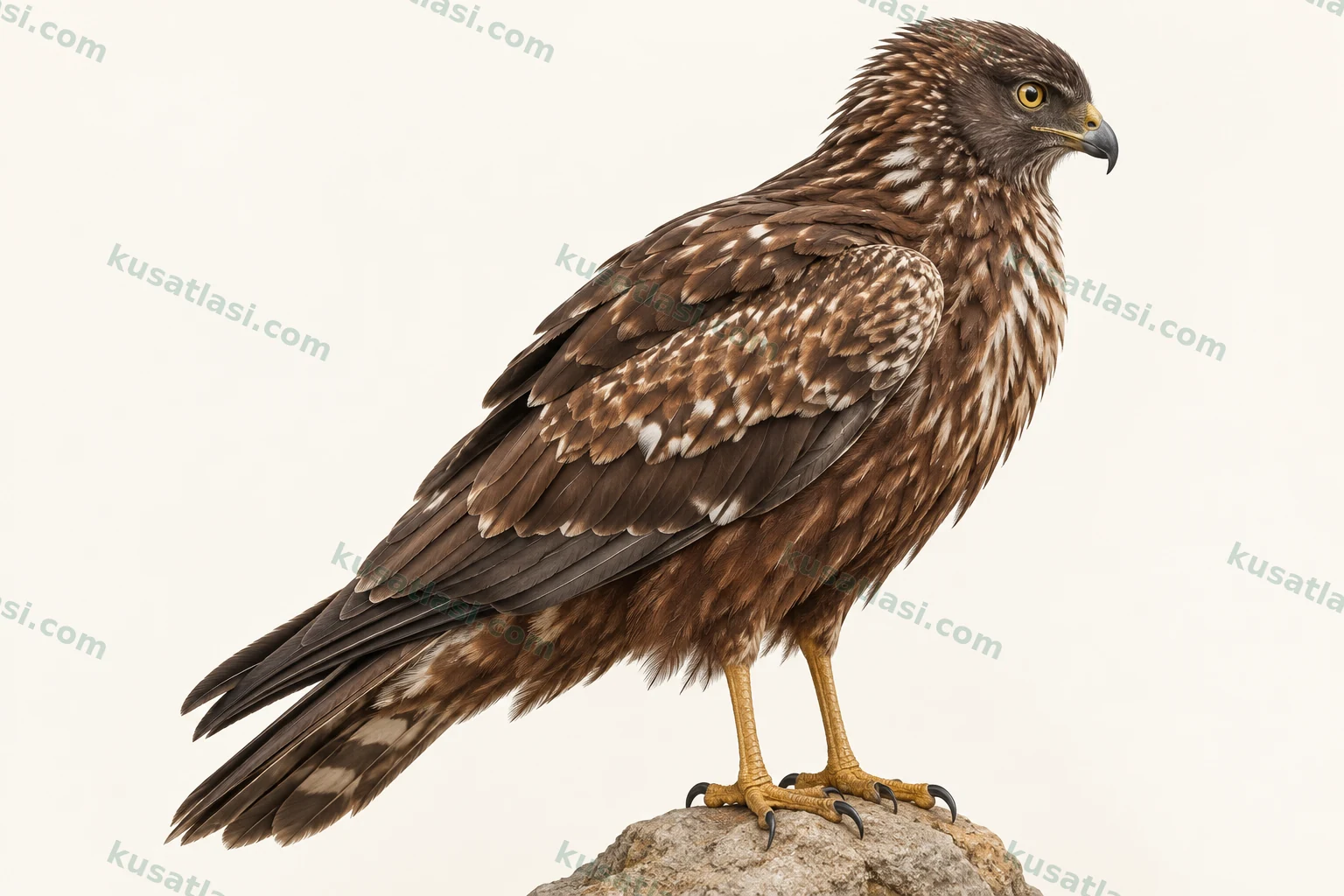
A brown harrier with banded underwings and tail on pale ground colour, and grey inner flight feathers in the adult male. It is associated with East and southern African reedbeds.
Biometrics
Length
Male44–49 cm
Female44–49 cm
Shared species value
Wingspan
Male105–125 cm
Female105–125 cm
Shared species value
Weight
Male350–470 g
Female490–690 g
African Marsh Harrier
Wetlands of East and southern AfricaObservation guide in its natural range
Look for three features together
Do not rely on a single featureCheck the cross-bands on both in the same bird.
The male’s grey wing area is not a one-step key for brown young.
Not every harrier hunting over reeds is this species.
Compare male and female
 FemaleMale
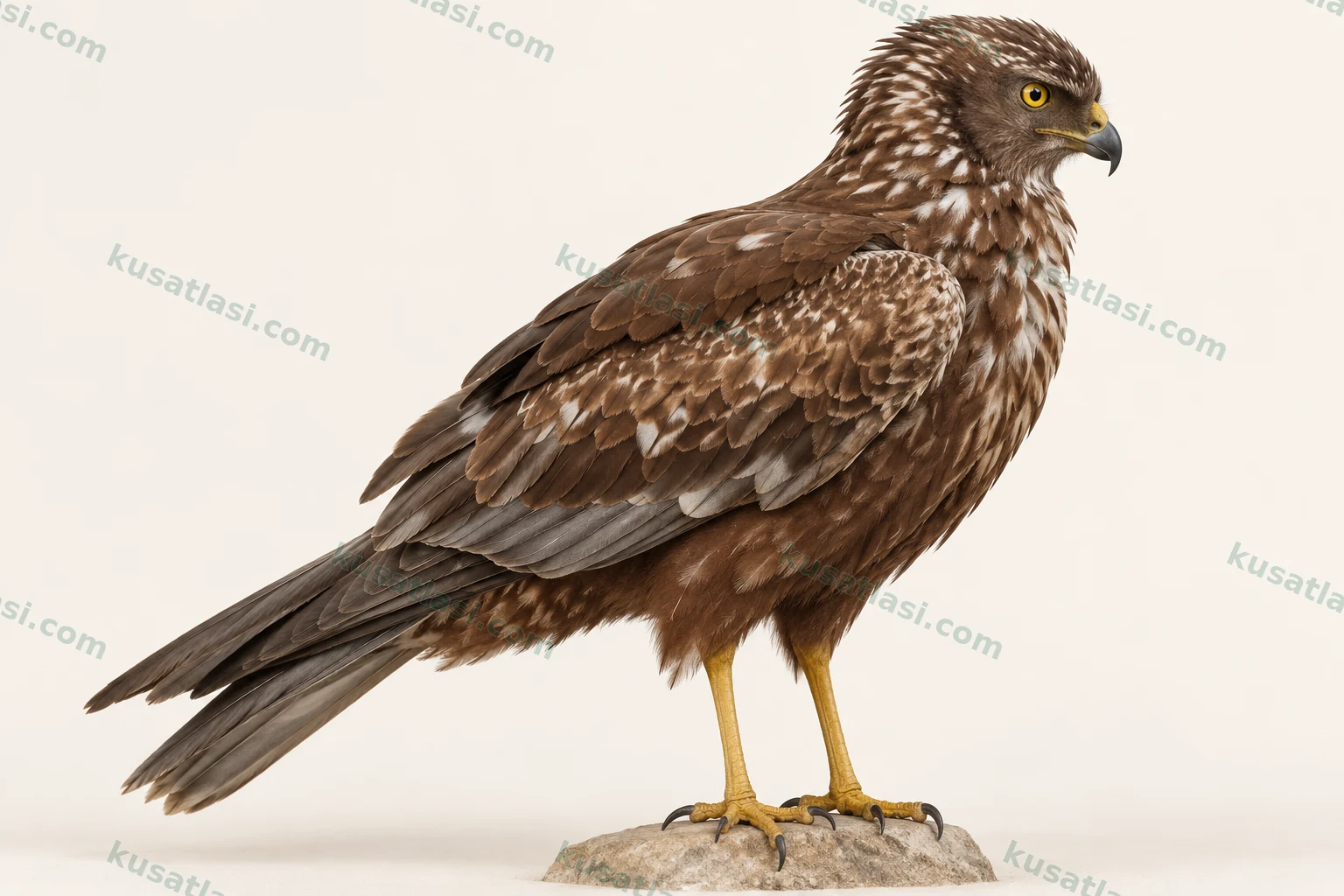
The adult male has broader grey areas on the inner flight feathers; the female is mainly brown and larger on average. Age and posture are considered.
Where to look in its natural range?
Watch low hunting flights over reeds from a safe distance.
The South African egg-laying example and Zimbabwe’s dated regional breeding period are separate; they are not a shared calendar for the whole range.
January
Breeding adults are mostly resident; young may wander. Zimbabwe, dated regional SABAP1 account: this month is in the reported breeding period, not simply an egg-laying date.
February
Breeding adults are mostly resident; young may wander. Zimbabwe, dated regional SABAP1 account: this month is in the reported breeding period, not simply an egg-laying date.
March
Breeding adults are mostly resident; young may wander. Zimbabwe, dated regional SABAP1 account: this month is in the reported breeding period, not simply an egg-laying date.
April
Breeding adults are mostly resident; young may wander. Zimbabwe, dated regional SABAP1 account: this month is in the reported breeding period, not simply an egg-laying date.
May
Breeding adults are mostly resident; young may wander. Zimbabwe, dated regional SABAP1 account: this month is in the reported breeding period, not simply an egg-laying date.
June
Breeding adults are mostly resident; young may wander. Zimbabwe, dated regional SABAP1 account: this month is in the reported breeding period, not simply an egg-laying date.
July
Breeding adults are mostly resident; young may wander. Zimbabwe, dated regional SABAP1 account: this month is in the reported breeding period, not simply an egg-laying date.
August
Breeding adults are mostly resident; young may wander. South African specialist account: this month is in the main egg-laying period.
September
Breeding adults are mostly resident; young may wander. South African specialist account: this month is in the main egg-laying period.
October
Breeding adults are mostly resident; young may wander. South African specialist account: this month is in the main egg-laying period.
November
Breeding adults are mostly resident; young may wander. South African specialist account: this month is in the main egg-laying period.
December
Breeding adults are mostly resident; young may wander. No verified regional date specific to this month was provided; this does not mean local absence.
Nest, egg and incubation
The nest is in wetland vegetation. The specialist account gives 3–4 eggs, 30–34 days of incubation by the female and first flight at 38–41 days. The male supplies prey to the female during incubation and then to the family.
Calling is reported especially during breeding and mate communication; silent hunting flight does not exclude the species.
Do not play recordings to attract birds; observe quietly, especially near nests.
Species information
Quick identification
African Marsh Harrier Circus ranivorus is a long-winged, long-tailed raptor hunting in East and southern African wetlands. Its overall appearance is brown, with light and dark streaking below and conspicuous dark cross-bands beneath the flight feathers. Grey areas on the inner flight feathers may become conspicuous in adult males; females look browner. Identification depends on considering underwing, tail, head and rump together, not just the brown body.
Low quartering over reedbeds is striking, but several harriers may hunt in the same way. First try to see wing and tail pattern, then consider age and the region's seasonal visitors. A brown harrier cannot be assigned to this species solely because it is in Africa. Particularly with female and young raptors, a sequence showing the same bird turning different ways is more useful than one frame.
General appearance and posture
The upperparts are dark brown, possibly with reddish feather edges. The underparts are lighter brown, with light-and-dark streaking on throat, breast and flanks. The relatively long tail has grey and brown bands. In a perched bird the wingtips do not reach the tail tip. The bill is grey and the bare area at its base pale yellowish; adult eyes, legs and feet are yellow. If these bare-part colours are not securely visible in shade, details absent from the photograph are not supplied.
Reed heads may partly conceal the body. The visible long tail and brown back then do not reveal the diagnostic pattern below. Wait for the bird's open posture and voluntary flight. The grey wing area is more or less conspicuous depending on the surface visible; do not confuse grey above the wing with cross-bands that should be seen below. An older male can be paler grey; not every adult is expected to match one colour example.
Males, females and young birds
Adult males and females are reported to differ in size and plumage. Broad grey areas in the male's inner flight feathers help separate him from the browner female. Females average larger, but comparing two birds seen separately at a distance cannot establish sex reliably. Supporting appearance with wing pattern is better than a size-only rule.
Young brown harriers cannot be identified with an adult-male colour key. Absence of grey wing areas alone does not prove a bird female; age can also affect that appearance. Record age and sex as separate uncertainties. A mark used to call a bird an adult male must actually suit that age and sex. If head colour, underwing and tail pattern are insufficiently visible, recording only the species or harrier level is more accurate.
A female sitting in the nest agrees with this species' verified care system, but there is no need to elicit that behaviour or approach a distant nest to determine sex. The male supplies the female during incubation and also brings prey during the chick period. Prey carried by one adult does not alone show its partner's appearance or every chick's age. Prey-carrying, presence at the nest and sighting flying young are separate observations when watching a family.
Appearance in flight
Long wings and tail make a balanced silhouette while quartering low over reeds. On detecting prey the bird can make a short, fast descent into vegetation. Pale ground colour and dark cross-bands beneath the flight feathers are evaluated with tail bands. A mark seen below normally disappears when a turn exposes the upper surface; do not assign the same pattern to both surfaces.
Rather than identify a brown harrier solely from low hunting flight, see the open-wing pattern and rump. The white rump area matters particularly in comparisons with some age and sex appearances of Pallid and Montagu's Harriers. Poor light can hide a mark; failure to see it is not evidence of its absence. Repeated passes in the same direction over reeds are searches of a feeding area and do not by themselves establish seasonal migration.
Voice and behaviour
Specialist accounts report vocal activity particularly during breeding and communication between mates. There is no rule that a silently hunting bird cannot belong to this species. A call from the reeds and a raptor flying above may occur in the same record; do not attribute the voice without linking it directly to the visible bird. Voice behaviour is described on this page; calling the bird or approaching a nest is unnecessary for identification.
Breeding adults are mostly resident and defend the area around the nest. Several birds in a reedbed do not always mean a dense nesting colony; the species may nest alone or in loose neighbourhoods. Wetland vegetation, surrounding hunting areas and water level all matter. Young dispersal and adults' attachment to a nesting area are assessed separately. Gaps in movement knowledge are not filled as though a regular verified route existed.
Similar species
1. Female and young Western Marsh Harriers Circus aeruginosus can be confused with this bird through their brown appearance. African Marsh Harrier's typically conspicuous bands on underwing and tail are compared together with the general head-and-body pattern. Age and light affect both species; one distant banded view is not a definitive identification. The possibility of a regional seasonal visitor is also considered.
2. Brown plumages of Pallid Harrier Circus macrourus and Montagu's Harrier Circus pygargus can give a similar first impression. White rump, wing shape and age-appropriate underpart pattern help together; African Marsh Harrier's typical reddish-brown rump differs. If the upper surface was not seen, do not guess this area's colour.
3. Young Black Harriers Circus maurus are also compared. The regional specialist account describes their relatively shorter-winged, longer-tailed appearance. As photographic angle can alter proportions, this difference is not used alone; recheck tail and wing pattern in the same bird. Do not wrongly exclude all young by the adult's black appearance.
World distribution
Its natural geography extends across suitable East and southern African wetlands. Populations from South Sudan, Ethiopia and Somalia through eastern Democratic Republic of the Congo, Uganda and Kenya southwards do not form a continuous range over the whole continent. Dry sectors without reeds, marshes and surrounding feeding areas may leave major gaps. A country list does not guarantee occurrence throughout each country.
Status within its natural range
The Okavango wetlands and the wet coastal and inland water networks of southern Africa are important regional examples. Large dry areas of Northern Cape are not assessed in the same way as wetland-rich regions. However, a record at one suitable water body does not make all surrounding dry ground breeding habitat. Breeding and visitor status may also differ among Eswatini's elevation belts.
The 2025 regional Red Data Book account classifies the species as Vulnerable within the assessment scope of South Africa, Lesotho and Eswatini; the global category is Least Concern. These two scales are not interchangeable. Uncertainty in regional population and area estimates is also stated. The model colour on the map is not presented as that report's exact breeding census or the current occupied area of every individual.
Seasonal movements
Breeding adults are mostly resident; no clear shared pattern supporting large-scale regular seasonal migration has been found. Long-distance wandering has been recorded in a small number of marked young. These records show capacity for movement, not the same distance or route for all young. Drying or alteration of reedbeds can change local use. Dated record examples and potential distribution models are read separately; without a verified tracking sequence, no country-by-country migration itinerary is drawn.
Breeding habitat
Coastal and inland reedbeds, marshes and dense wetland vegetation are the main breeding environments. It may hunt in adjoining grasslands or farmland, but that does not make farmland its sole nesting habitat. Vegetation support over water and surroundings with accessible small prey are considered together. Open-water extent alone does not indicate the amount of suitable nest cover. Reed cutting, burning or excessive grazing can alter nest support.
Nest site
The nest is built in wetland vegetation, usually 0.5–2.5 m above water in the regional specialist account. Usually 3–4 eggs and 30–34 days of incubation by the female are reported, with first flight at a developmental age of 38–41 days, according to the 2025 South African specialist assessment for African Marsh Harrier. Another regional Roberts-based account may give broader egg and developmental ranges; source limits are not converted into one calculated value. The male provides prey to the female during incubation and to the family afterwards.
Daily habitat use
Low hunting flights may extend beyond the nest cover. An adult carrying prey into reeds indicates continued use of the nesting area, but an exact nest location is not recorded if the drop-off point cannot be seen from afar. Entering the reeds to find a nest may disrupt normal food delivery. Watching from a safe viewpoint preserves the behaviour's meaning and avoids unnecessary disturbance to young.
Use of artificial wetlands, such as dams or treatment areas, may also be reported. This does not mean every artificial water body replaces natural reedbeds equally successfully. Water level, continuity of cover and nearby prey are separate conditions. Conservation planning should consider maintaining both breeding and feeding surroundings, rather than relying on a single visible raptor.
What does it eat?
Small mammals are among the main prey; songbirds, waterbirds, frogs and some fish are also listed. Taking eggs or chicks at bird colonies and occasionally feeding on large fish carrion are reported. The species name indicates a reedbed connection, not a diet restricted to aquatic animals. Use of wetland-adjacent grassland should be understood together with access to small land mammals.
A dietary study's percentages depend on the samples and method. Not all prey groups are equally recognisable in pellets and prey remains. A regional study's mammal–bird shares therefore do not become a fixed year-round menu for every African Marsh Harrier. Prey-carrying while feeding young is not an equivalent measurement of the adult's total daily consumption either.
How does it hunt?
It quarters low over reeds and neighbouring open areas and turns quickly into vegetation when prey is detected. Repeated returns to a spot may show searching but do not prove a capture at each descent. Direct signs such as prey in talons, swallowing or transport to the nest are recorded separately. Do not fill an unseen capture in reeds with invented prey details.
While hunting it can move between open ground and dense cover. Use of an adjacent field or grassland does not make wetland protection unnecessary; nest and feeding areas serve different functions. Much circling over the same reedbed is not a direct count of prey abundance either. Assessing success requires seeing both attempts and actual captures; one brief observation cannot stand for those two counts.
Global and regional risks are different
African Marsh Harrier's global Least Concern and 2025 southern African regional Vulnerable categories are both valid. They assess different geographic scopes. A broad continental range does not establish that reedbed loss is absent in a particular country. Equally, a regional decline does not prove that all populations outside that report are declining at the same rate.
A category change does not always mean recovery
The 2025 regional assessment explains the change from the previous Endangered category to Vulnerable as correction of an assessment error. A lower-risk category name therefore does not directly indicate population recovery. The report's reasons, trend information and data uncertainty must be evaluated together. This distinction prevents treating conservation labels only as colours or ranks.
What young-bird movements can establish
Wandering in a few marked young does not mean that all movements of the species are understood. A bird reaching a distant place is a real and valuable observation, but insufficient to assign a shared annual route or distance to the whole age group. Resident adult breeding behaviour and young dispersal are not merged into one migration arrow on the same map.
The nest and surrounding hunting grounds
Nesting in reeds and using small prey outside them complement each other. Leaving a small vegetation island around the nest alone does not prove enough hunting area remains for the family. Conversely, a hunting bird in a field does not establish the field as safe nesting habitat. Wetland cover, water regime and neighbouring open-ground quality are considered together; record the function of the observed use.