

World Birds IUCN statusLC · Least ConcernGlobal IUCN category. BirdLife v10 (2025); taxon matching: AviList 2026 / IOC 15.2; checked: 29.10.2026. The list year is not the species assessment date. Source and method · BirdLife OrderAccipitriformesHawks, eagles and allies FamilyAccipitridaeAccipitridae
Bald Eagle
Haliaeetus leucocephalus
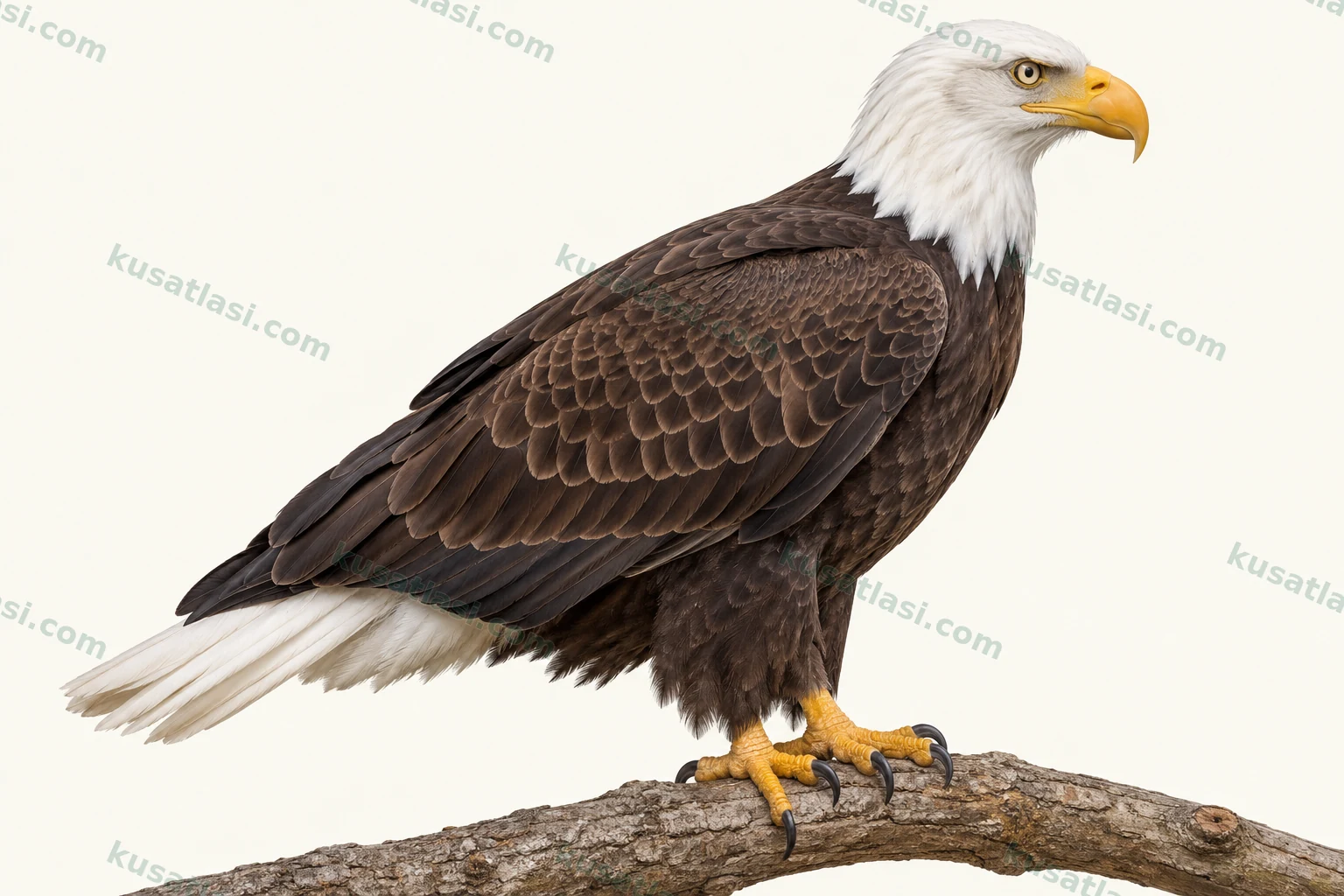
A large North American eagle of waterside habitats; adults have a white head and tail with a dark body, while young birds have dark plumage with variable white mottling.
Biometrics
Length
Male70–96 cm
Female70–96 cm
Shared species value
Wingspan
Male178–229 cm
Female178–229 cm
Shared species value
Weight
Male3.2–5.2 kg
Female4–6.41 kg
Bald Eagle
Suitable waterside areas of Canada, the United States and MexicoObservation guide in its natural range
Look for three features together
Do not rely on a single featureWhite head and tail; a yellow, thick hooked bill.
Dark head; irregular white and brown on the body and underwings.
Broad wings usually held flat, and a large head.
Compare male and female
 FemaleMale
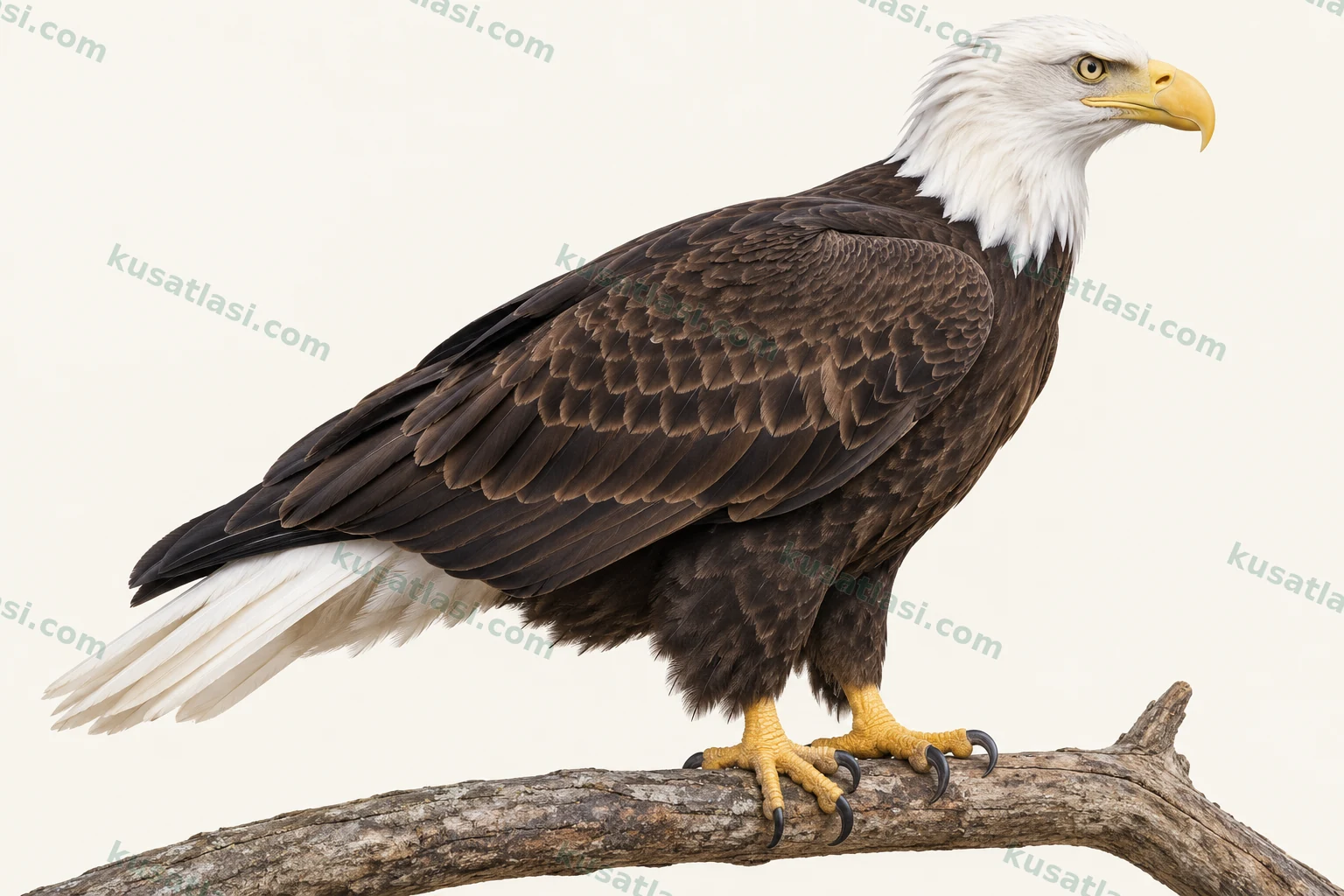
Adults of both sexes share the same colour pattern; the female is generally larger. Differences between young and adult plumage are not sex differences.
Where to look in its natural range?
Large lakes, rivers, estuaries and sea coasts, with large trees nearby.
Regional examples of incubation from the sources; northern and southern populations are not forced into one calendar.
January
A partial migrant: northern birds move south and towards open water; some southern populations are resident. Florida: the broad regional period in which incubation may occur according to the source; it is not the duration of one nest.
February
A partial migrant: northern birds move south and towards open water; some southern populations are resident. Florida: the broad regional period in which incubation may occur according to the source; it is not the duration of one nest.
March
A partial migrant: northern birds move south and towards open water; some southern populations are resident. Florida: the broad regional period in which incubation may occur according to the source; it is not the duration of one nest. Yellowstone area: the regional incubation period reported in the source.
April
A partial migrant: northern birds move south and towards open water; some southern populations are resident. Florida: the broad regional period in which incubation may occur according to the source; it is not the duration of one nest. Yellowstone area: the regional incubation period reported in the source.
May
A partial migrant: northern birds move south and towards open water; some southern populations are resident. No verified regional date specific to this month was given; this does not mean local absence.
June
A partial migrant: northern birds move south and towards open water; some southern populations are resident. No verified regional date specific to this month was given; this does not mean local absence.
July
A partial migrant: northern birds move south and towards open water; some southern populations are resident. No verified regional date specific to this month was given; this does not mean local absence.
August
A partial migrant: northern birds move south and towards open water; some southern populations are resident. No verified regional date specific to this month was given; this does not mean local absence.
September
A partial migrant: northern birds move south and towards open water; some southern populations are resident. No verified regional date specific to this month was given; this does not mean local absence.
October
A partial migrant: northern birds move south and towards open water; some southern populations are resident. Florida: the broad regional period in which incubation may occur according to the source; it is not the duration of one nest.
November
A partial migrant: northern birds move south and towards open water; some southern populations are resident. Florida: the broad regional period in which incubation may occur according to the source; it is not the duration of one nest.
December
A partial migrant: northern birds move south and towards open water; some southern populations are resident. Florida: the broad regional period in which incubation may occur according to the source; it is not the duration of one nest.
Nest, egg and incubation
The nest is large and built of branches, usually with 1–3 eggs. Both sexes provide care; incubation takes about 35 days (Cornell: 34–36), and nest departure 56–98 days. Parental feeding may continue after departure.
The calls are thin, high whistles and chattering sounds; a voice as deep as its imposing appearance might suggest is not expected.
Do not play recordings to attract birds; observe quietly, especially near nests.
Species information
Quick identification
The Bald Eagle Haliaeetus leucocephalus is a large raptor living around large bodies of water in North America. The adult has a white head and tail, a dark brown body and wings, and a thick, hooked yellow bill. Its broad wings may be held like a flat plank when soaring. Seeing the white head and tail on the same bird, together with the large head and powerful bill, helps identify an adult.
A young bird does not fit this short adult description: its head and tail are dark, and its body and underwings show varying amounts of white mottling. Rejecting such a bird because it lacks a white head would be a mistake. Changes in appearance with age are much stronger than the differences between adult males and females. Identification considers the age class, head-to-bill proportions, tail and underwings together.
General appearance and posture
The head and neck are powerful in proportion to the body; even at a distance, the heavy bill may stand out. On a perched adult, the white head contrasts with the dark shoulder and breast below. The tail is white, although dark marks may remain in birds only just approaching mature appearance. The eyes and legs are yellow. The body's genuinely brown feathers may look almost black in shade; this lighting effect is not a separate colour form.
It may watch its surroundings from the same high branch for a long time. This quiet posture does not show poor hunting ability: a high perch helps it see prey in the water. Its walk on the ground may look heavy and swaying. A bird is not declared ill from its ground posture alone; flight, balance and general behaviour are assessed in the same individual.
Males, females and young birds
Adult males and females share the same basic colour pattern: white head and tail, dark brown body, and yellow bill and legs. The female is generally larger. Using head whiteness or body darkness as a sex character is incorrect. Comparing photographic sizes of two birds not seen side by side and at similar distances does not measure a real size difference either.
In its first year, the bird has a dark head, eye and bill; white on the underwings is irregular and variable. In subsequent years, the eye and bill become paler, and the distribution of white and brown on the body changes. In the second year, some birds may show a distinct pale belly, dark breast and dark face mask. As third- and fourth-year birds approach adult appearance, dark feathers may still remain on the head and tail.
Adult plumage is usually attained in about five years. This is not a precise calendar in which all the feathers of every bird change at once on its birthday. Some individuals may retain dark marks over the white areas even later. Age is not assigned from a single white spot: the complete pattern of the head, tail, body and underwings is viewed together.
A young bird leaving the nest for the first time need not look like a miniature adult. Nest departure is one stage in flight development; the bird may continue receiving food from its parents. Nor are a downy nestling and a young bird with fully developed flight feathers reduced to one illustration under the same age class.
Appearance in flight
The long, broad wings show separated tips of the flight feathers. They are usually held flat when soaring, with the head projecting strongly ahead of the body. The bird combines heavy wingbeats with soaring. A young bird's irregular white underwings and body mottling are assessed together with its dark head; the flight pattern of a white-headed adult is not imposed on a young bird.
It may descend over water and take a fish near the surface with its talons. This does not mean it hunts by diving with its body underwater. During a breeding display, two birds with talons interlocked in the air may spiral downwards, separating before reaching the ground. Not every chase between two eagles is a courtship display: territorial defence or competition for food may produce similar movements.
Voice and behaviour
Despite its imposing appearance, its voice may be relatively thin, high-pitched and whistling or chattering. The bird's actual voice is not replaced by any eagle scream thought suitable for a powerful image. Mates may call to one another around the nest; territorial defence may involve both calls and chasing. The meaning of a sound is assessed in its behavioural context.
Pairs defend their surroundings during the breeding season. Where food is abundant and outside breeding, many birds may gather at one place and use communal roosts. Such a gathering is not a colony jointly raising young in one shared nest. Concentrations of fish, carrion or other prey may change where groups are seen; a single flock photograph is not a census of the regional population.
Similar species
The Golden Eagle Aquila chrysaetos may be confused especially with a dark-headed young Bald Eagle. In a young Bald Eagle, irregular white scattered over the underwing coverts and body, a larger, more projecting head and a relatively short tail are useful. Dark plumage alone is insufficient: the position and distribution of underwing white are checked in the same view. Identification may be deferred for a very distant or backlit bird.
The white head and white tail of an adult Bald Eagle are a strong combination. However, a distant large raptor whose head is hidden is not identified conclusively from its pale tail alone. Being beside water is not an identification either. Different raptors may use the same waterside surroundings; size, head-and-bill shape and plumage pattern must be used together.
World distribution
Its natural range is in North America: it occurs in suitable parts of Canada, the United States and Mexico. Large rivers, lakes and coasts are important. Alaska, the northwestern coasts and southeastern waterside areas do not share one climate; colouring every part of country maps as permanent breeding habitat would be incorrect.
Rare wandering birds reported outside the natural range do not represent a new, regularly breeding population. Individual records in Europe or other distant regions do not replace the North American centre of the natural range. The accepted scientific name is Haliaeetus leucocephalus, and the English name is Bald Eagle; white feathers on the head do not mean actual baldness.
Status within its natural range
A marked population recovery following conservation measures and regulations on harmful chemicals has been documented. The estimate in the US report announced in 2021 concerns the contiguous 48 states, excluding Alaska and Canada; it is not presented as the current entire world population. General recovery does not mean every nest site is safe or all threats have disappeared. Risks such as waterside habitat loss and lead exposure are monitored separately.
Migration
Movement patterns are regional. Some northern breeders move in winter to more southerly areas with open water and accessible food; some southern populations are resident. Young birds' movements may be more variable than the regular returns of adult pairs. Although unfrozen water and abundant food matter, not all individuals follow one route. No shared migration line assumed to have been used by every bird is drawn on the map.
Breeding habitat
Woodland near large lakes, rivers, estuaries and sea coasts is the principal setting. Tall, strong trees with an unobstructed flight approach may support the nest. Depending on the region, coniferous or deciduous trees are used, and mangroves in the south. Some treeless areas also have nesting on rocks or on the ground; this exception does not mean all pairs nest on the ground.
Nest site
Softer material is added to the large nest built of sticks and branches. Both sexes may carry material; an old nest may be repaired and enlarged in later years. Usually 1–3 eggs are laid. Specialist sources give incubation as about 35 days or 34–36 days, and report 56–98 days to nest departure. These are species data varying by region, not an unchanging duration for one pair. Both parents provide care.
Daily use of the habitat
High perches provide views of the feeding area, and sheltered trees serve as roosts. Groups may form around food in winter. A bird feeding beside a human structure does not mean approaching its nest is harmless. Active nests are watched from a distance; waiting beneath the tree, flushing birds for photographs or attracting them with food is inappropriate.
What does it eat?
Fish form the basis of the diet in many places, but the species does not eat fish alone. Waterbirds and other birds, small mammals and carrion are also used. Dietary proportions vary with season, region and available prey. An abundance of fish in Alaska does not allow annual dietary proportions to be calculated for the whole continent; an individual turning to carrion in winter is not a separate species either.
How does it hunt?
It watches its surroundings from a high place and descends, or catches a fish near the surface with its talons while flying over water. It may try to take food from an Osprey or another bird; direct hunting, food stealing and scavenging are different methods. Chasing another bird does not mean obtaining food every time.
Using carrion may expose the bird to lead fragments from hunting. Swallowed fragments are not always visible to the eye; looking healthy in a photograph does not rule out exposure measured in a laboratory. Gathering around human refuse is not proof that safe food is available either. Interfering with natural feeding and hand-feeding the bird are inappropriate.
The white head develops with age
A newly flying Bald Eagle does not have the adult's white head. Its plumage changes over several years; the adult appearance of the white head and tail usually develops in about five years. This change is not uniform in all birds of the same age. Giving a young bird the wrong species name because of its dark head shows how important age information is in identification.
Recovery figures must be read with their scope
The statement published by the US agency in 2021 reported estimates of about 316,700 individuals and more than 71,400 nesting pairs for the contiguous 48 states. The research combined aerial counts with other data for areas of lower density. This result is not a world census repeated in 2026; it cannot be used as a total including Alaska, Canada and Mexico. The date and geography of the estimate are as important as the figure.
A toxin may reflect different times in different tissues
Research published in Science in 2022 examined Bald Eagle and Golden Eagle samples together from 38 US states. Lead in bone provided information about long-term accumulation, while blood and other tissues gave different information about more recent exposure. The study's 1210 birds are the total of both species, not the entire Bald Eagle population or the sample size of this species alone.
Model results and direct counts are different
The same research modelled how lead-related effects could limit population growth. This does not mean researchers counted every dead bird across the continent or established that all deaths had the same cause. Laboratory measurement, frequency within the sample and population modelling are separate stages. Conservation success does not make these risks invisible; even a large, conspicuous bird needs continued monitoring.