

World Birds IUCN statusLC · Least ConcernGlobal IUCN category. BirdLife v10 (2025); taxon matching: AviList 2026 / IOC 15.2; checked: 29.10.2026. The list year is not the species assessment date. Source and method · BirdLife OrderAccipitriformesDiurnal raptors FamilyAccipitridaeAccipitridae
African Fish Eagle
Icthyophaga vocifer
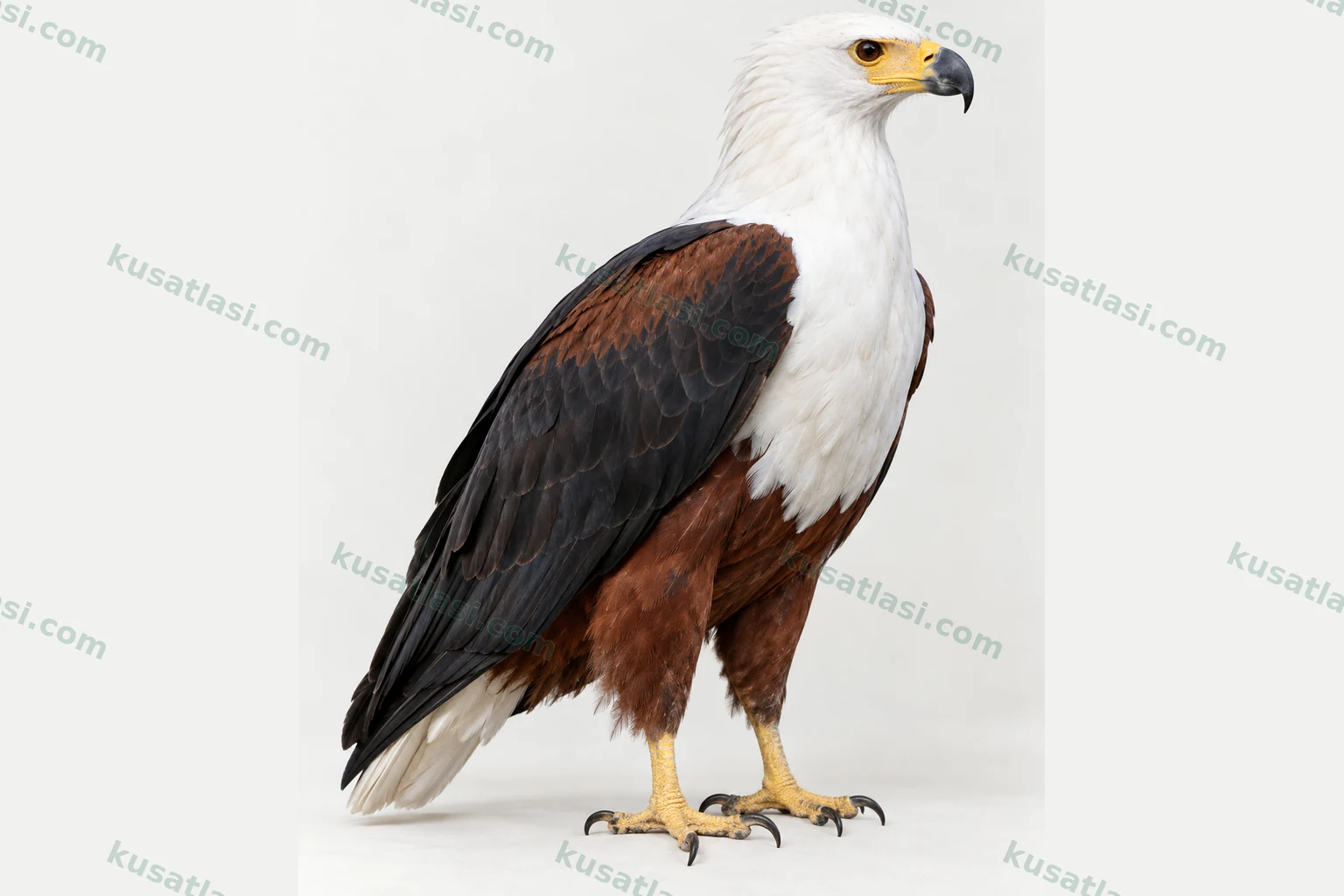
Adults are recognised by the combination of a white head and tail, chestnut body and broad dark wings. It inhabits suitable rivers, lakes and other watersides in sub-Saharan Africa; fish are its main food.
Biometrics
Length
Male63–73 cm
Female63–73 cm
Shared species value
Wingspan
Male170–200 cm
Female170–200 cm
Shared species value
Weight
Male1.928–3 kg
Female2.3–3.9 kg
African Fish Eagle
Watersides of sub-Saharan AfricaObservation guide in its natural range
Look for three features together
Do not rely on a single featureCheck the chestnut body and dark wings together; young birds have less conspicuous white areas.
Spread wingtips and a short tail show when gliding. Yellow bill base and dark tip complete the adult head.
It may scan water from tall waterside trees or rocks; proximity to water is not diagnostic alone.
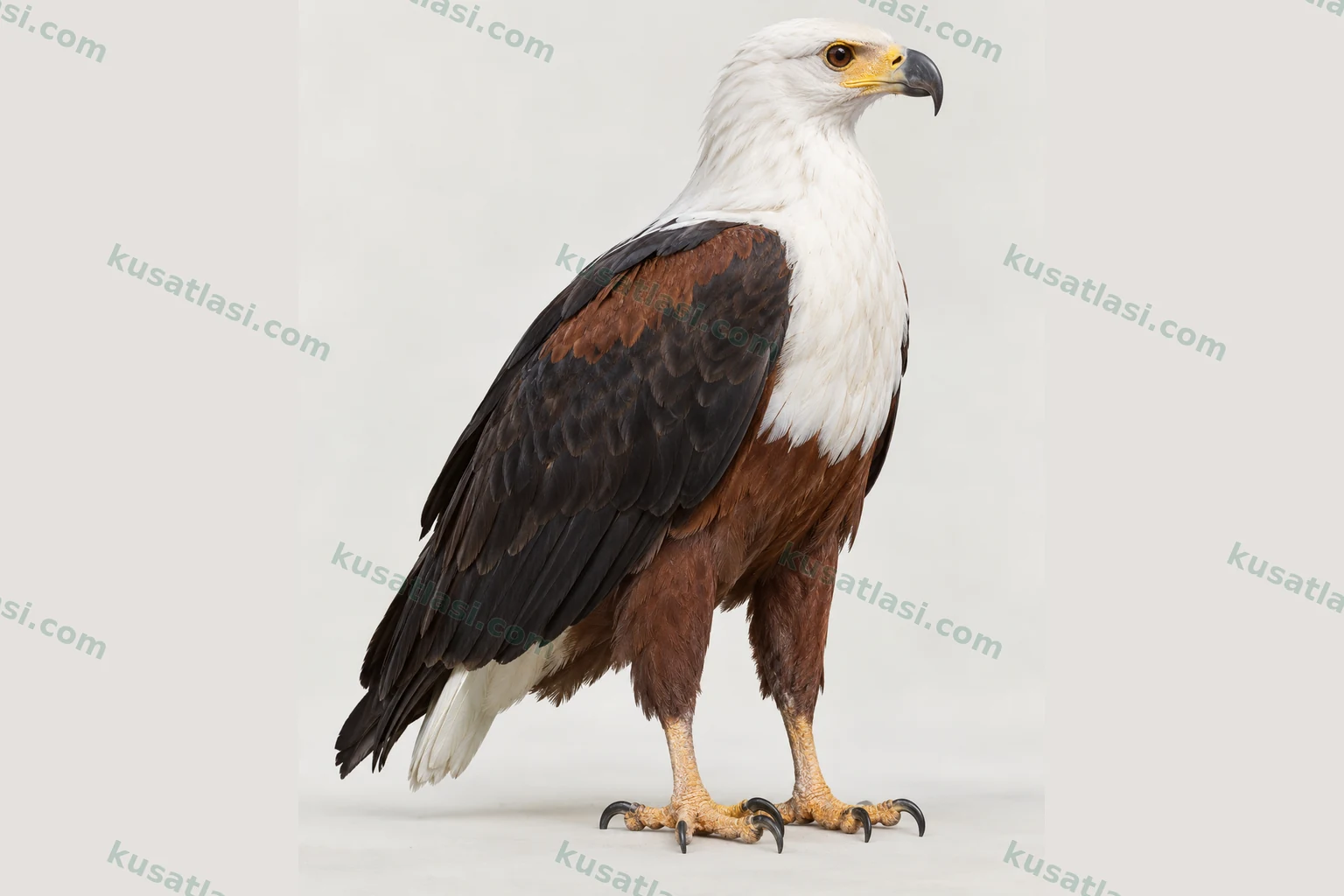
Compare male and female
 FemaleMale
The female is generally larger; adult males and females share the same basic white, chestnut and dark pattern. An unscaled impression of size in one photograph does not reliably determine sex.
Where to look in its natural range?
Scan tall trees beside lakes, rivers, deltas and suitable reservoirs. Watch exposed perched birds from afar. Do not approach large stick nests; map records alone are not breeding evidence.
Mainly resident. South African egg laying is reported April–August, peaking May–June. Breeding timing elsewhere, such as Uganda, is not assumed identical. A monthly presence indicator does not mean birds or nests at every shore each month.
January
Generally resident. South African regional breeding example: outside the stated main laying period; this does not mean local absence or absence of breeding.
February
Generally resident. South African regional breeding example: outside the stated main laying period; this does not mean local absence or absence of breeding.
March
Generally resident. South African regional breeding example: outside the stated main laying period; this does not mean local absence or absence of breeding.
April
Generally resident. South African regional breeding example: within the laying period.
May
Generally resident. South African regional breeding example: a reported peak laying month.
June
Generally resident. South African regional breeding example: a reported peak laying month.
July
Generally resident. South African regional breeding example: within the laying period.
August
Generally resident. South African regional breeding example: within the laying period.
September
Generally resident. South African regional breeding example: outside the stated main laying period; this does not mean local absence or absence of breeding.
October
Generally resident. South African regional breeding example: outside the stated main laying period; this does not mean local absence or absence of breeding.
November
Generally resident. South African regional breeding example: outside the stated main laying period; this does not mean local absence or absence of breeding.
December
Generally resident. South African regional breeding example: outside the stated main laying period; this does not mean local absence or absence of breeding.
Nest, egg and incubation
A large stick platform stands in a tall tree or on a suitable rocky ledge and may be reused. The specialist South African account gives 1–4 eggs, usually 2, and incubation of 42–45 days. Ugandan field research recorded 1–3 eggs, usually 2, and about 41 days. The female does more incubation, but the male may also participate. The South African account gives first flight around 70–75 days; parental dependence can continue afterwards. Chick competition is not generalised to only one survivor in every nest. Do not disturb the nest tree or surroundings.
Gives powerful high calls carrying far, sometimes with its head thrown back. Partners may answer each other. Rhythm and repetition are assessed alongside visual features. A written description does not represent every sound in every context.
Do not play recordings to attract birds; observe quietly, especially near nests.
Species information
Quick Identification
African Fish Eagle is a large waterside raptor whose adult plumage combines a white head and tail, chestnut body and dark wings. The white extends from the head down the neck to the upper breast; the warm brown belly begins below it. A distant white head alone is insufficient. Check the short white tail, broad wings, dark back and body colour pattern together. The bill has a yellow base and dark tip. Adult eyes appear dark. The bird is often noticed on an exposed branch of a tall riverside or lakeside tree.
Folded wings projecting conspicuously beyond the tail, an upright posture and powerful feet complete its appearance. Young birds without the adult white head may not resemble the adult plate; examine tail and wing structure before calling a dark young raptor another species on colour alone.
General Appearance and Posture
The adult head, neck and upper breast are clean white. Shoulders and belly range in appearance from chestnut to reddish brown, while the wings and much of the back are far darker. The short white tail is conspicuous in flight too. This arrangement of white, chestnut and nearly black colours is among its most useful visual features. Lighting direction can make a dark wing look brown and a shaded breast darker than expected. Compare boundaries between light and dark areas rather than one colour's shade.
The strong bill has a downcurved tip. Its yellow base and dark tip stand out within the adult's white head. Large toes and curved claws on yellow feet suit grasping prey. Perched, it holds its body fairly upright, with broad shoulders, a distinct head and a short-looking tail. Even at rest it may turn its head to scan water and neighbouring shore. Watching an exposed eagle from afar rather than trying to flush it increases the chance of seeing natural hunting behaviour.
Proximity to water matters but is not diagnostic alone. Herons, cormorants, Ospreys and other raptors may share the shore. First check whether the bird truly has an eagle's structure, then whether head, breast, tail and wing colours fit together. White-headed adults are generally easy to recognise; young birds require more detail and preferably several views.
Males, Females and Young Birds
Adult sexes share the same basic colour pattern. Females are generally larger, but judging the size of a single distant bird does not establish sex. Perspective, wing posture and different distances can mislead comparison. Size differences may support assessment when partners sit side by side at the same distance, but plumage colour is not a separate definitive sexing key.
Young birds have not yet developed the adult's clean white head and chestnut body in the same form. The body may be dark brown with pale spots or streaks. The crown can be dark and cheeks paler; pale areas on breast and tail vary with age. The bill base and feet may look paler or greyer than in adults. This variability makes a single fixed colour scheme unsuitable for all young birds.
Adult appearance develops gradually. Intermediate stages show an increasingly pale head and tail. Two differently looking youngsters need not be different species. Assess age from the whole wing and body pattern, not head whiteness alone. The adult male and female plates illustrate adult appearance; young birds are not expected to match their colours exactly.
Appearance in Flight
Broad long wings, conspicuously spread wingtips and a short tail stand out in flight. The adult's white head and tail appear as two pale ends among dark wings. The chestnut body is visible in suitable light. Gliding along water or moving between perches may reveal this arrangement better than a perched view. Young birds have different amounts of pale colouring, so an exact adult colour match is inappropriate.
When hunting, it may descend to water and extend its feet forwards to seize a fish at the surface. This supports fishing, but a raptor descending to water alone does not establish identity. When comparing it with an Osprey hunting over water, assess wing shape, tail, head pattern and the way the entire body enters the water together. African Fish Eagle generally takes prey from the surface; full-body diving is not its expected principal method of grasping fish.
Voice and Behaviour
Its far-carrying, high, powerful calls can be heard along many African watersides. It sometimes raises its head backwards when calling; partners may answer each other. Written imitations do not fully represent every individual's call. Assess rhythm, repetition, waterside setting and the visible bird's structure together. Constant playback or flushing the bird is unnecessary to hear it.
Adult pairs may defend waterside territories. However, several birds can gather around suitable food; not every gathering is a regular migrating flock. Birds occur alone, in pairs or with their young. Attempts to take another bird's fish are also recorded. This does not mean it obtains every meal by stealing: ordinary hunting and opportunistic feeding can coexist in one species.
Similar Species
1. Osprey (Pandion haliaetus) may cause confusion in a shared fishing scene. Adults have much paler underparts and a distinct dark eye stripe; their wings and flight appearance differ from the African Fish Eagle's broad-winged, white-headed, chestnut-bodied structure. Compare head, breast and tail as well as hunting behaviour.
2. Madagascar Fish Eagle (Icthyophaga vociferoides) matters as a close fish-eating relative. Its natural range is confined to Madagascar; its head and neck colour pattern differs from the African Fish Eagle's extensive white head-neck area. Do not match a record solely by country name or white tail: check appearance and verified geography together.
Natural Range
African Fish Eagle has a wide sub-Saharan African range tied to suitable wetlands. It occurs around rivers, lakes, deltas, reservoirs and some coastal waters. Wide distribution does not imply equal frequency in every country. Much of arid regions such as the Namib and Kalahari is unsuitable without permanent water and appropriate waterside trees. Its occurrence from South Africa to East African lakes and suitable waters farther north relates to the continuity of this water network.
Regional Status
An eagle common at one lake may be scarcer at another in the same region. Studies at Kenya's Lakes Naivasha and Baringo with different local findings illustrate this distinction. Changing water levels and drought impacts on breeding pairs at Naivasha do not prove identical changes throughout Africa in the same year. Retain the study lake and period when discussing regional population or breeding results. Loss of waterside woodland, water use and fish resources can affect local status.
Movements and Reading the Map
The species is mainly resident; adults and young may disperse locally from breeding areas. These movements do not form a regular intercontinental route for every individual. Moving to other suitable waters when water retreats or food changes does not mean the whole population travels to the same place in fixed months. The calendar therefore distinguishes presence from breeding timing.
The map's modelled area shows estimated distribution; observation cells show records in selected sources. A shore with missing records is not treated as proven absence, nor is one observation a permanent breeding site. Map coverage, recording dates and licence details are explained in the information section; record density is not directly called population density.
Breeding Habitat
Breeding habitat combines fish-bearing water and a safe nest site along the shore. Suitable reservoirs and estuaries can be used as well as large rivers and lakes. Open water offers hunting, while nearby tall sturdy trees provide rest, surveillance and nest support. A large water surface alone is insufficient; shoreline structure, food access and disturbance around nests also matter.
Nest Site
The nest is a large platform of branches. It usually stands in a tall tree, sometimes on a rocky ledge, and may be lined with grass and other plants. A nest can be used across several breeding seasons and enlarged with new material. Alternative nests belonging to one pair do not all necessarily contain eggs in the same year. Approaching the nest tree, waiting beneath it in a boat or getting close enough to make the bird leave is unsuitable observation practice.
Daily Space Use
The eagle can watch for prey from an exposed perch overlooking water. Waterside trees support more than nests: they provide waiting and eating sites. Removing all shoreline trees can therefore reduce usable habitat even without a change in water quality. Presence alone does not measure or prove unpolluted water. Water-health assessment also requires fish, shoreline structure and direct environmental measurements.
What Does It Eat?
Fish underpin the diet. Different species are caught in suitable waters; dominant prey at one lake may not dominate another. Waterbirds and other small animals are also recorded. Scavenging and attempts to take another fishing bird's catch show opportunism. Rare prey records do not replace the staple diet; animals on a prey list are not assumed equally consumed.
How Does It Hunt?
It often watches water from a shoreline perch, descending when an opportunity arises to take fish from the surface with its feet. It usually carries the fish to a perch to eat. Feet and talons grasp prey while the powerful bill tears it apart. Unlike Osprey, putting its entire body into water is not the principal hunting method. Splashing in a brief image may not prove complete submersion.
Access to fish varies with water level, visibility and prey proximity to the surface. A long wait on shore need not mean scarce prey; the eagle may be waiting for an opportunity. Conserving food resources goes beyond protecting the bird. Excessive water withdrawal, habitat loss and disrupted fish communities require joint consideration. Feeding fish to the bird or placing bait in its hunting grounds is unnecessary for observing natural behaviour.
Following the Same Lake over Time
A one-day count and a long-term population study do not provide the same information. Lake Naivasha monitoring considered water conditions alongside breeding pairs. Fewer breeding pairs during drought and recovery as conditions improved are a local pattern. Different results at nearby Lake Baringo show why one lake's findings should not automatically be extended to the whole species. Record numbers alone likewise cannot establish that a heavily recorded area has a healthier population.
Reusing the Nest
A large stick nest need not be rebuilt from scratch every year. A pair can add material or choose between alternative nests. An old shoreline nest may therefore indicate past use and remain reusable. Seeing a nest, however, does not prove eggs are currently present. Distant observation without climbing or flushing the bird is preferable.
Competition between Chicks
Different hatching times can produce age and size differences. Food competition and aggression are recorded, yet not every nest necessarily produces just one youngster. Ugandan field research found nests where more than one young could be raised. Egg counts, hatched-chick counts and fledged-young counts are distinct measures and are not reduced to one success figure.
Why Durations Are Not Reduced to One Number
The South African specialist account's 42–45-day incubation and about 41 days in the Ugandan study have different localities and research contexts. The 70–75 days given for leaving the nest do not include post-flight dependence. These values are not combined into a new African average. The breeding card names the event and regional context with each duration: first flight and independence are not the same stage.