

World Birds IUCN statusNT · Near ThreatenedGlobal IUCN. BirdLife v10 (2025); taxon matching AviList 2026 / IOC 15.2; checked: 29.10.2026. The list year is not the species’ assessment date. Source and method · BirdLife OrderAccipitriformesDiurnal raptors FamilyAccipitridaeAccipitridae
White-necked Hawk
Buteogallus lacernulatus
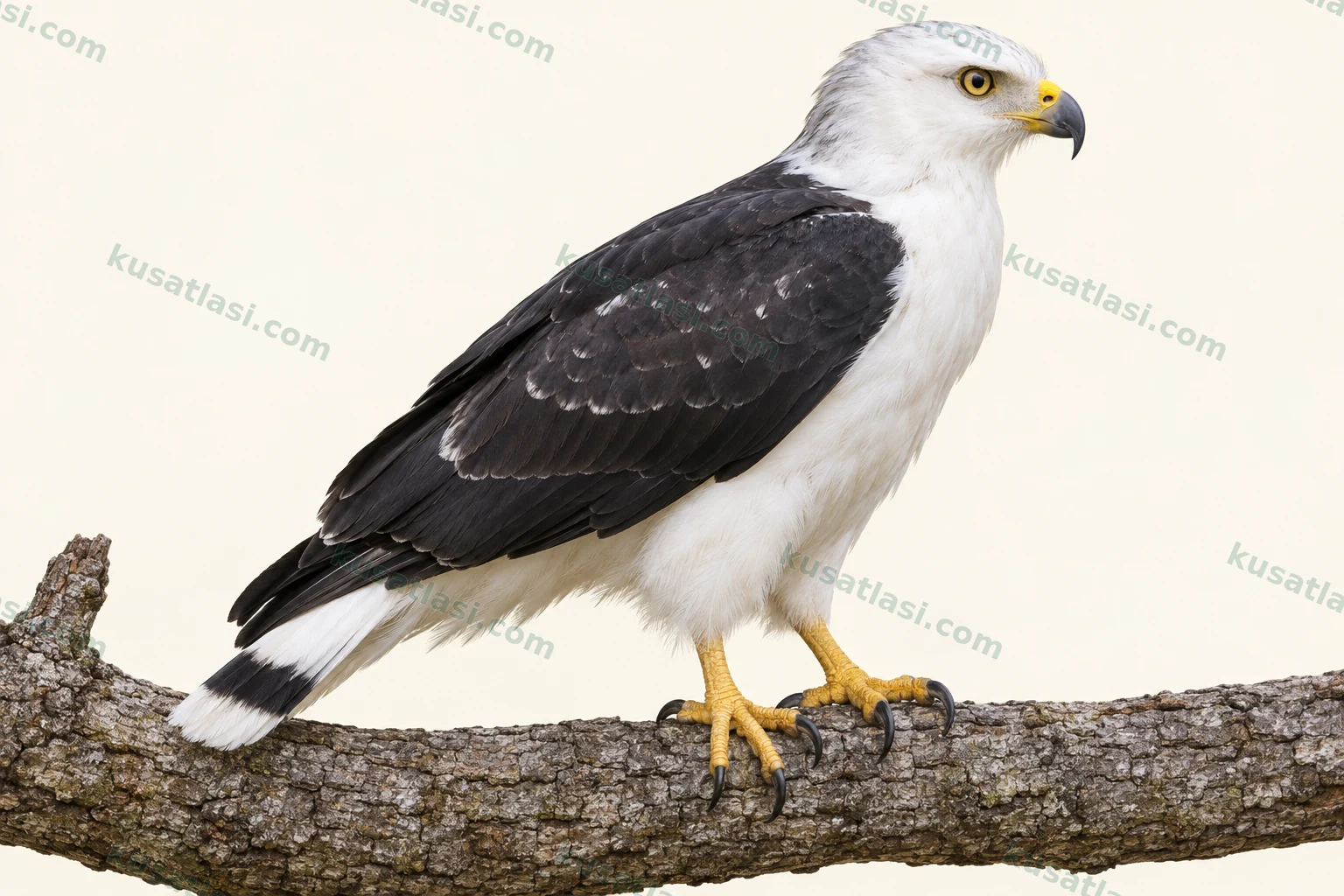
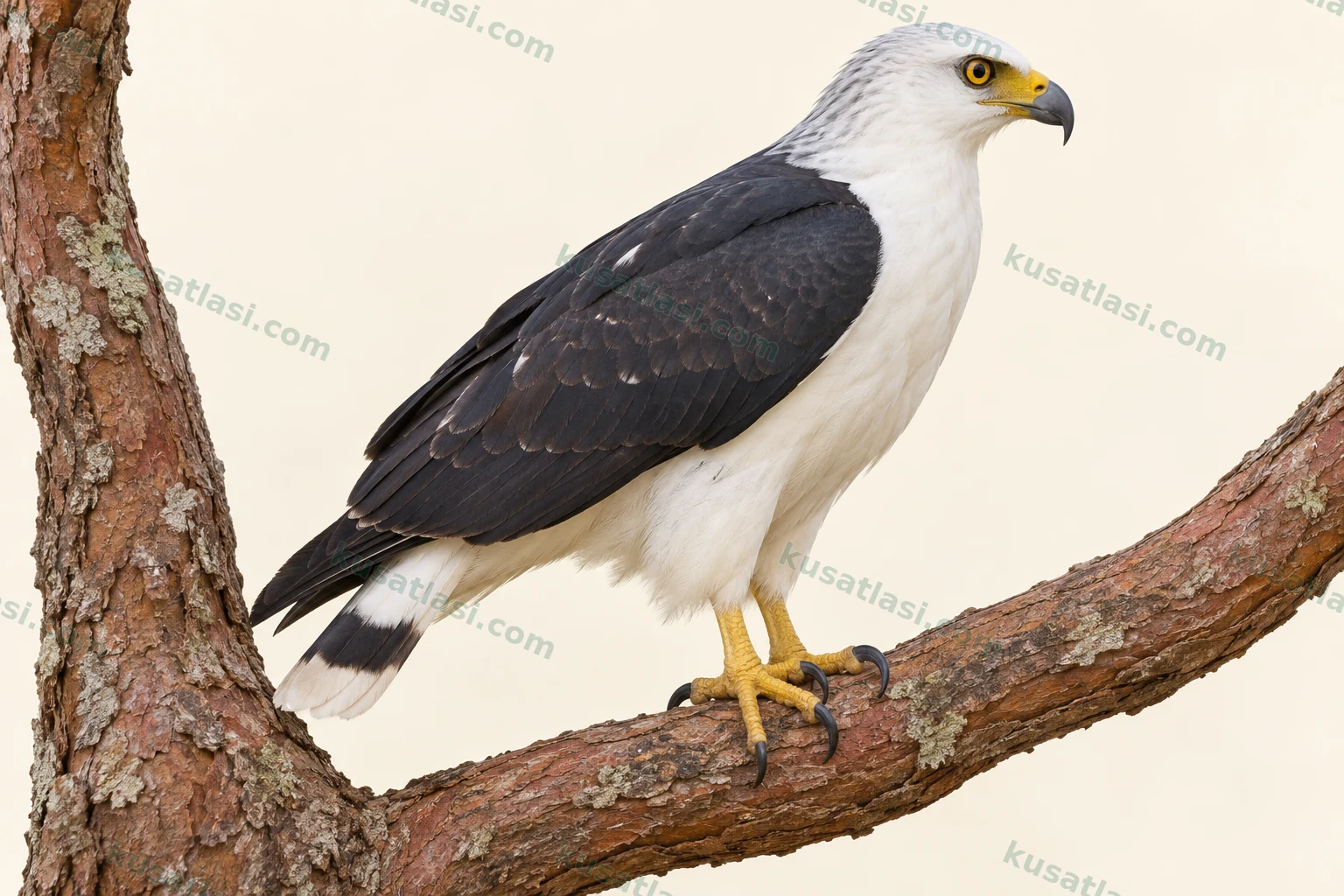
White head and underparts, dark back; yellow bill base and a dark band near the tail tip.
Biometrics
Length
Male43–48 cm
Female43–48 cm
Shared species value
Wingspan
Male91–101 cm
Female91–101 cm
Shared species value
Weight
Male520 g
Female520 g
Shared species value
White-necked Hawk
Atlantic Forest of eastern BrazilObservation guide in its natural range
Look for three features together
Do not rely on a single featureSee the pale area and dark band near the tip together.
Compare the yellow base with the similar species’ bluish bill base.
Compare male and female
 FemaleMale
A certain field sexing key was not verified. Crown streaks in young birds help assess age.
Where to look in its natural range?
Dense forest, wooded slopes and tree cover near the coast.
Generally resident. Species-specific breeding months were not verified.
All months: Resident. Monthly breeding status could not be verified. No verified regional date is given for this month. This does not imply local absence.
January
February
March
April
May
June
July
August
September
October
November
December
Nest, egg and incubation
Usual nest structure, egg number, incubation and young development duration were not verified.
The comparative study examined does not alone provide a certain voice key for this species.
Do not play recordings to attract birds; observe quietly, especially near nests.
Species information
Quick identification
The White-necked Hawk Buteogallus lacernulatus is a black-and-white raptor of Brazil's Atlantic Forest. The pale head and neck, white underparts and dark back are assessed together. A black band near the tail tip helps distinguish it from similar pale forest hawks. The yellow area at the bill base is part of the same comparison. One colour mark alone does not decide identification.
A bird soaring over forest may look white below, but several raptors share this. Without the tail pattern, certainty is difficult. Closing the tail or flying directly towards the observer may hide the band. Record it as unseen rather than absent. Follow head, bill base and tail together through different natural angles.
General appearance and posture
The pale head and neck against dark shoulder and back also help on a perched bird. A field paper describes a dark grey impression on the back and a broad pale tail band with a dark end. These descriptions do not make the entire tail plain white. Recording which tail surface and part appeared pale makes comparison easier.
When the bird looks small over forest, photographic magnification does not give its true size. Resemblance to another larger raptor does not alone establish identity. Even a known bird on a nearby branch or at equal distance is only a supporting comparison, not a precise measurement. Posture and raised feathers alter head–body proportions. Record visible colour fields instead of classifying a single instant's silhouette.
Males, females and young birds
Young birds can have dark crown streaks. These help against the pale-headed adult appearance, but a shadow line in one image is not a real feather streak. Check whether it continues across feathers in other natural views. Do not transfer another raptor's whole brown pattern to a young bird simply because of age.
The sources examined did not provide a certain field sexing key usable for every individual. Calling the larger-looking member of a pair female may overlook distance and posture. Even with breeding context, sex inferred from a photograph remains distinct from genuinely confirmed sex.
Age is not decided by crown streaks alone either. Note them if the head is clear; otherwise adult or young may remain uncertain. The Ubatuba hunting study followed a young individual. Its behaviour does not show that all ages use the same prey at the same place. Separating identification marks from a single behavioural record improves interpretation.
Appearance in flight
Observed displays in eastern Brazil included undulating rises and falls, downward glides and revolving movements. These may have a different context from ordinary transit. Circling once does not prove courtship. Observe how the sequence begins and relates to other birds.
Assess the dark band near the tail tip with the pale underparts. The dark back dominates from above and white areas from below. Different colour distribution between these angles does not create two species. Without knowing a photograph's angle, an upperwing area is not transferred to the underwing. Do not turn one shadow into several real bands.
Voice and behaviour
The field research discusses flight movements in territorial and courtship contexts. A display need not have exactly the same function every time. A relative's or similar species' whistle sequence cannot become this bird's sole voice key: the comparative work also describes another raptor's calls. A detailed species-specific voice account was not established here.
Despite being a forest bird, it was directly recorded hunting on a sandy beach at Ubatuba. This does not mean it lives entirely on open beaches. One bird may exploit a temporary feeding opportunity. Hunting near people does not establish tolerance of all human activity or a wish to be approached. Watch natural hunting at a suitable distance.
Similar species
Pseudastur polionotus is a similar forest raptor with a larger appearance, bluish bill base and wholly pale undertail. In the White-necked Hawk, yellow bill base and dark subterminal tail band matter together. Size alone is unreliable between different distances. Use marks actually visible at bill and tail.
Other black-and-white forest raptors can also have pale heads and underparts. Compare possible species with the actual locality. Similar birds from a worldwide photo list do not all share one Brazilian forest. Do not imagine a crest beside the pale head or an unseen tail band. Identification proceeds from the real view and verified geography.
Global range
It is endemic to Brazil's Atlantic Forest belt. Its natural range concerns eastern coastal forests, not all Brazil or the entire Amazon basin as one suitable habitat. Different dated northern and southern boundary records do not establish continuous occurrence at every intervening point. Forest fragments and actual record localities are assessed together.
Status within its natural range
The current taxonomic list gives Near Threatened status. Vulnerable in older scientific papers belongs to their assessment date. Forest loss and fragmentation remain important. A category change alone does not prove population growth. A new local record is not presented as a global number or breeding population.
Movements and migration
It is generally resident. Seasonal dispersal was discussed for a record in the upper Serra do Japi, but the authors called for more data. Increased observation effort is another possible explanation. A single highland record is therefore not regular altitudinal migration. Coastal and inland points do not trace one tracked bird; observation dates stay with the map localities. Flying south on one day does not prove annual migration in that direction.
Breeding habitat
Dense Atlantic Forest, wooded slopes and coastal tree cover form its habitat. It has a strong lowland association, but documented highland records do not support an absolute elevation limit. Not every feeding forest fragment is a confirmed nest site. Territorial display and a direct nest-with-eggs record are different levels of evidence.
Nest site
The breeding review specifically notes a knowledge gap in its nesting biology. The examined sources did not verify usual nest structure, egg number, incubation or young development durations. Timings for other raptors in that review are not transferred here. A pair on a branch does not prove that a structure there is its nest.
Daily habitat use
It occurs inside and above forest and, when relevant, at edges. One coastal hunting record is not confused with forest dependence. Do not approach a resting or hunting perch to flush the bird. Watch its chosen place and subsequent movement from a distance. Seeing it at a food opportunity does not show that open ground meets all its life requirements.
What does it eat?
Feeding records include invertebrates and small vertebrates. Hunting the shore crab Ocypode quadrata was directly documented at Ubatuba. A separate study recorded interactions with subterranean Amphisbaenidae reptiles. These are verified prey examples, not evidence that all food consists of crabs or these reptiles.
How does it hunt?
The crab study observed the bird reaching into a sand burrow and descending from a perch to ground prey. Removal of hard parts was also recorded. Of three interactions with subterranean reptiles, consumption was directly seen in only one. Holding prey and actually eating are recorded separately. Annual diet proportions are not calculated from such limited observations. Do not expose prey or leave bait. Record which movement was actually seen as the bird uses its own chosen opportunity.
Rain is a possible explanation
A possible link between subterranean reptiles emerging and hunting opportunity has been discussed. Heavy rain is one possible factor. Limited records do not show that rain controls all hunting. The observed interaction and the suggested explanation remain separate.
One record is not three consumptions
Images of the bird carrying or catching prey in the Amphisbaenidae study are not equivalent to an image of consumption. An object in the talons does not prove that all of it was eaten. This small distinction is essential to interpreting successful hunting and consumption rates.
A highland sighting is not annual migration
The Serra do Japi record limits the idea that it occurs only in low coastal forest. The authors discussed seasonal dispersal and increased observation effort as separate possibilities. Without regular tracking, the record does not become a monthly route or elevational calendar. It can guide research without explaining everything alone.
The pale tail has a dark detail
Similar forest raptors have pale heads and underparts. Here a dark subterminal tail band and yellow bill base matter together. The angle can hide the band, so a mark unseen in one image is not absent. Waiting for a natural turn gives a stronger comparison than greatly enlarging an image and inventing marks from unclear areas. Crown streaks in young birds also remind us that not every pale-headed bird is adult. Species and age are therefore assessed separately.