

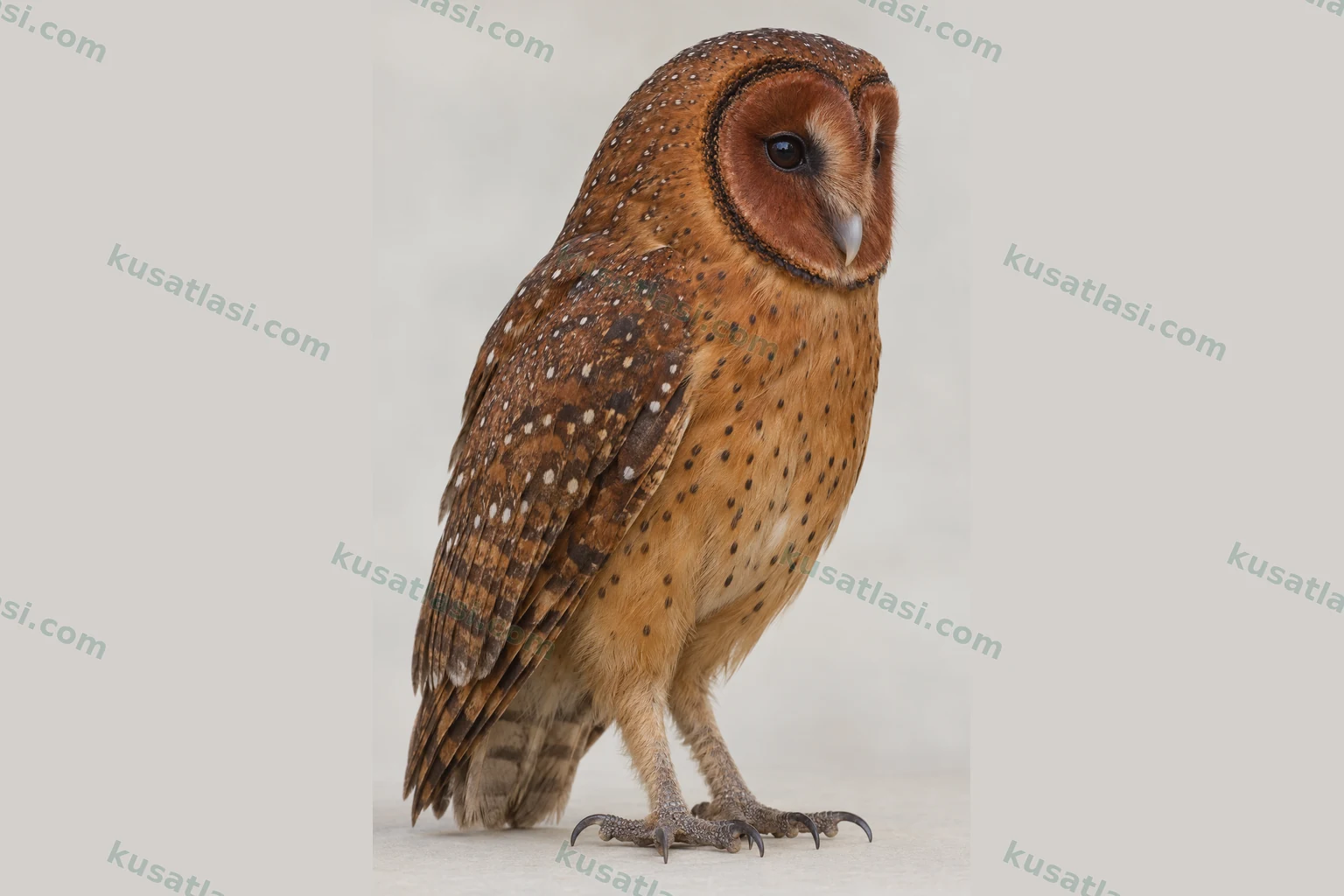
World Birds IUCN statusDD · Data DeficientGlobal IUCN. BirdLife v10 (2025); taxon matching AviList 2026 / IOC 15.2; checked: 29.10.2026. The list year is not the species’ assessment date. Source and method · BirdLife OrderStrigiformesOwls FamilyTytonidaeTytonidae
Itombwe Owl
Tyto prigoginei
A poorly known, chestnut-rufous brown, spotted owl with a heart-shaped face, confirmed in the Itombwe Mountains; its voice and nest have not been verified.
Biometrics
Length
Male23–29 cm
Female23–29 cm
Shared species value
Wingspan
MaleData unavailable
FemaleData unavailable
Weight
MaleData unavailable
Female195 g
Itombwe Owl
Eastern Democratic Republic of the Congo, Itombwe mountain forest–grassland mosaicObservation guide in its natural range
Look for three features together
Do not rely on a single featureA nearly heart-shaped face, dark eyes and yellowish bill.
Chestnut-rufous brown appearance with dark and pale spots.
The rare species is not identified without excluding Barn Owl and African Grass-Owl.
Compare male and female
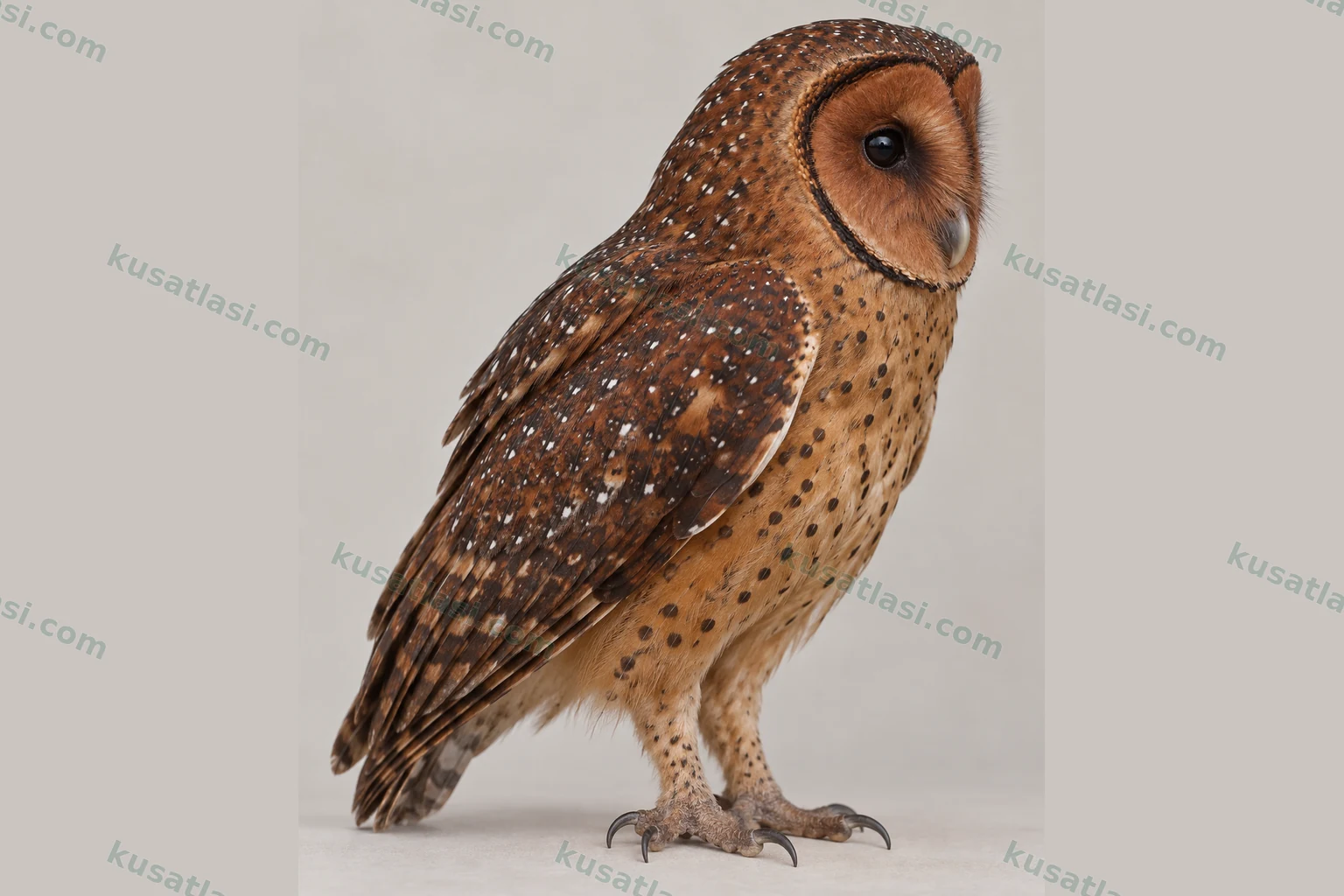 FemaleMale
Reliable distinctions for male and young appearance were not verified. The 1996 bird was described as a possible female because of its brood patch.
Where to look in its natural range?
Forest, grassland and bamboo boundaries; candidate sounds are not presented as confirmed records.
A monthly breeding calendar was not verified. The May 1996 bird’s brood patch does not provide an egg-laying date or incubation duration.
All months: Regular migration or monthly movements were not verified. No verified regional date specific to this month was provided; this does not mean local absence.
January
February
March
April
May
June
July
August
September
October
November
December
Nest, egg and incubation
Nest location and structure, egg number, incubation duration and time to first flight were not verified. A suggested tree cavity is not an observed nest.
A call securely assigned to the species is unknown; old candidate sounds from Rwanda do not count as verified species recordings.
Do not play recordings to attract birds; observe quietly, especially near nests.
Species information
Quick identification
The Itombwe Owl Tyto prigoginei is a very poorly known owl with confirmed records in the Itombwe Mountains of the eastern Democratic Republic of the Congo. Assess its chestnut-rufous brown appearance, dark and pale spots, nearly heart-shaped face and yellowish bill together. Merely resembling a dark barn owl does not establish its identity. Barn Owl and African Grass-Owl, which may occur in the same surroundings, must first be excluded; a brief or poorly lit view should not be forced into identification as this rare species.
Its current English name is Itombwe Owl. Older publications use Congo Bay Owl and Phodilus prigoginei. These are earlier names for this taxon, not a different bird. The IOC's 2023 update placed it in Tyto on characters including facial shape and the structure of the eyes, feet and bill. This classification decision does not mean its entire life history has been resolved. The breeding durations and prey lists of other Tyto species cannot automatically be applied to it.
General appearance and posture
The current Cornell account emphasises predominantly rusty chestnut-brown plumage with black and white spots and a yellowish bill. Facial outline, dark eyes and overall body proportions should be read together. A torch may emphasise white spots while altering warm colours. Do not infer the unseen half of a face divided by leaf shadows. Different angles during the same observation help distinguish changes in the bird's pattern from changes in lighting.
Certain identification cannot rest on resemblance to a plate alone. Photographs and descriptions of scientifically documented individuals are especially valuable for so little-known a bird. Drawing its body in, stretching its neck or moving briefly can make the same bird appear different in size. If the actual size of a nearby branch is unknown, calculating centimetres from a photograph is inappropriate. Record time, elevation zone, cover and visible marks together, leaving missing details unresolved at the end of the record.
Researchers considered it female because of its brood patch; this was not a definitive sex determination.
Males, females and young birds
The 1996 study describes male appearance as unknown. The current accounts used likewise provide no reliable plumage distinction between males and females. There is consequently no rule that the female is darker and the male paler. Differences between two drawings do not establish a scientific sex distinction. If the real bird's sex is unknown, leave it uncertain in the record; add age and sex only where reliable evidence exists.
The developed brood patch of the 1996 bird is a sign associated with breeding, but does not show that a nest was found. Its capture does not reveal egg number, how long an adult incubates or the day on which a chick first flies. Capture in May also does not mean egg laying throughout Itombwe occurs only in May. Capture date, possible sex and the breeding sign are kept as separate information.
Young plumage development and reliable age criteria have not been verified. A pale or fluffy-looking owl is therefore not automatically a young Itombwe Owl. The young of other owls may differ from their adults. A small-looking bird is insufficient to prove the presence of this known rarity. Without detailed images, leaving the identification at a broader owl group produces a more useful record than false certainty.
Appearance in flight
The original rediscovery paper reports that the bird entered a net while flying low and crossed grassland to forest after release. These are two concrete movements, not evidence that it hunts at the same height every night or lives only in grassland. A short flight observation and regular hunting behaviour are different things. If the upperwing and underwing patterns of a silhouette crossing a dark clearing were not seen, those details must not be added afterwards.
Barn Owl flight over open ground and the African Grass-Owl's long wings may help comparisons; equivalent detailed flight research is lacking for the Itombwe Owl. One wingbeat therefore does not justify a definite identification.
Voice and behaviour
A natural call securely assigned to the species has not yet been verified. Some older sounds from Rwanda's Nyungwe Forest have been discussed as candidates, not confirmed examples. Describing a candidate sound does not allow any similar-sounding owl to be assigned to this species. The 1996 researchers listened to night birds nearby but heard no sound they could link to the Itombwe Owl. This does not prove that the bird never vocalises.
Daytime resting in grass and association with a forest–grassland mosaic are assessed from a few historical records and researchers' interpretations. No study determines the entire daily activity pattern or exact hunting times. Capture at a forest edge does not demonstrate tolerance of every human land change. Particularly when the nest site is unknown, clearing vegetation to search may alter habitat before the behaviour being sought has even been understood.
Similar species
Barn Owl Tyto alba is a basic comparison because of its heart-shaped face and dark eyes. Its face and underparts may range from white to rufous-orange, so rufous colour alone does not distinguish the rarity. Cornell compares Barn Owl as a larger bird hunting in open habitats. Head-to-body proportions, the entire upperpart pattern, habitat and a detailed record should be examined together. A high or harsh sound does not identify an Itombwe Owl.
African Grass-Owl Tyto capensis is larger and long-winged, with a contrast between its dark back and pale face and underparts. Its use of marshes, grassland and heath is better known. Finding Itombwe Owl at a forest–grassland boundary does not mean habitat names alone securely separate them. A dark back and heart-shaped face occur in more than one species; do not decide on the rare species without seeing enough of the whole pattern and structure.
Global distribution
Confirmed documented records come from the Itombwe Mountains in the eastern Democratic Republic of the Congo. This mountainous part of the Albertine Rift is the species' known geographical focus. An old observation in Burundi and candidate sounds in Rwanda's Nyungwe Forest have been discussed, but cannot replace confirmed records. There is insufficient evidence to colour those entire countries as verified breeding range or add a continuous area extending into northwestern Tanzania.
Status within its natural range
After the specimen obtained in 1951, a second individual photographed and measured in 1996 confirmed the species again after a long interval. That gap does not mean the bird must have been absent during the intervening years; access and research effort also affect detection. Equally, two documented individuals do not mean that only two birds exist worldwide. The number of known records and actual population size are different.
The 2025 global assessment places it in Data Deficient. The change from the former Endangered category should not be read as improved forest or increasing bird numbers; it concerns uncertain knowledge. Itombwe studies demonstrate the value of a landscape combining forest openings, grassland, bamboo and valley forest. Overall forest area does not establish occurrence at every point or a particular number of resident pairs.
Migration
No regular migration route or monthly movement boundaries have been verified. The distance between two confirmed records is not a journey travelled by the same individual. The captured bird's passage across grassland to forest after release is a local flight record. Maps should not combine candidate records and confirmed documentation at the same evidence level; a few observations do not establish a migration line, wintering area or continent-wide seasonal movement.
Breeding habitat
There is no verified account of a nest or breeding habitat. Known individuals came from landscapes where mountain forest adjoins grassland and bamboo. The 1996 record was obtained in slightly disturbed valley forest; this does not show that natural forest is unnecessary or that clearing benefits the bird. Describing the surroundings where specimens were found is different from determining its complete habitat requirements.
Nest site
Nest location and structure, egg number, incubation duration and age at first flight have not been verified. Tree-cavity nesting has been suggested by analogy with relatives; it is a possibility, not an observed nest of this species. The 1996 bird's brood patch is a breeding sign, not a nest location. Forcing birds out while searching grass or tree hollows may affect unknown breeding behaviour.
Daily habitat use
Forest–grassland boundaries, valley forest and bamboo connections provide possible searching environments. Local observations and research should be undertaken with authorised field teams without damaging habitat. Driving possible daytime-resting birds out of grass is inappropriate. Regional studies describe loss of connections between these covers through land conversion as a conservation concern; the bird's precise daily ranging area remains unknown.
What does it eat?
A species-specific prey list for the Itombwe Owl has not been reliably verified. There is no stomach, faecal, pellet or nest-feeding study establishing proportions of insects, small mammals or other prey. Giving it Barn Owl's well-known rodent diet would substitute relatedness for observation. A pellet found in forest is not its menu unless the bird responsible is established.
How does it hunt?
Long legs and the known habitat have suggested possible hunting on or near the ground. This interpretation is not a directly observed prey-capture sequence. The 1996 individual's low flight likewise does not prove it was hunting before entering the net; it only gives its movement height at that moment. The presence of prey is kept separate from evidence that the bird consumes it.
If a new observation reveals prey carrying, capture or food remains, the connection with the bird's identity must be clearly documented. Prey identity may remain uncertain when cover interrupts the view. Offering food or placing live prey does not produce a record of natural behaviour. An honest account of its feeding distinguishes verified information from possible interpretation, rather than filling gaps with another owl's details.
Rediscovery and the actual date
Seeing a bird long known only from a museum specimen encourages reconsideration of the places research has reached. The second confirmed Itombwe individual was measured and released on 1 May 1996. The old record and new bird were at different elevations, broadening the known conditions. This does not imply every intervening slope is occupied. Greater opportunity to search and verified distribution are different kinds of information.
A new genus, the same bird
The move from Phodilus to Tyto represents a reassessment of this taxon's anatomical relationships. Name matching must be maintained when reading older publications; a name change does not turn the 1996 measurement into another species' measurement. Conversely, the behaviour of Asia's Oriental Bay Owl is not thereby observed in this African bird, even if they were once placed in the same genus. Taxonomy organises life-history information; it does not generate new observations in its place.
Data Deficient does not mean safe
A conservation category describes how available evidence is assessed. Data Deficient does not establish that no losses have occurred or that conservation is unnecessary. Regional documentation of forest and grassland conversion in Itombwe does not mean that every threat to the bird has been individually measured either. Preserving uncertainty, protecting habitat and obtaining verifiable observations all have value.