

World Birds IUCN statusLC · Least ConcernGlobal IUCN category. BirdLife v10 (2025); taxon matching: AviList 2026 / IOC 15.2; checked: 29.10.2026. The list year is not the species assessment date. Source and method · BirdLife OrderStrigiformesOwls FamilyStrigidaeStrigidae
Abyssinian Owl
Asio abyssinicus
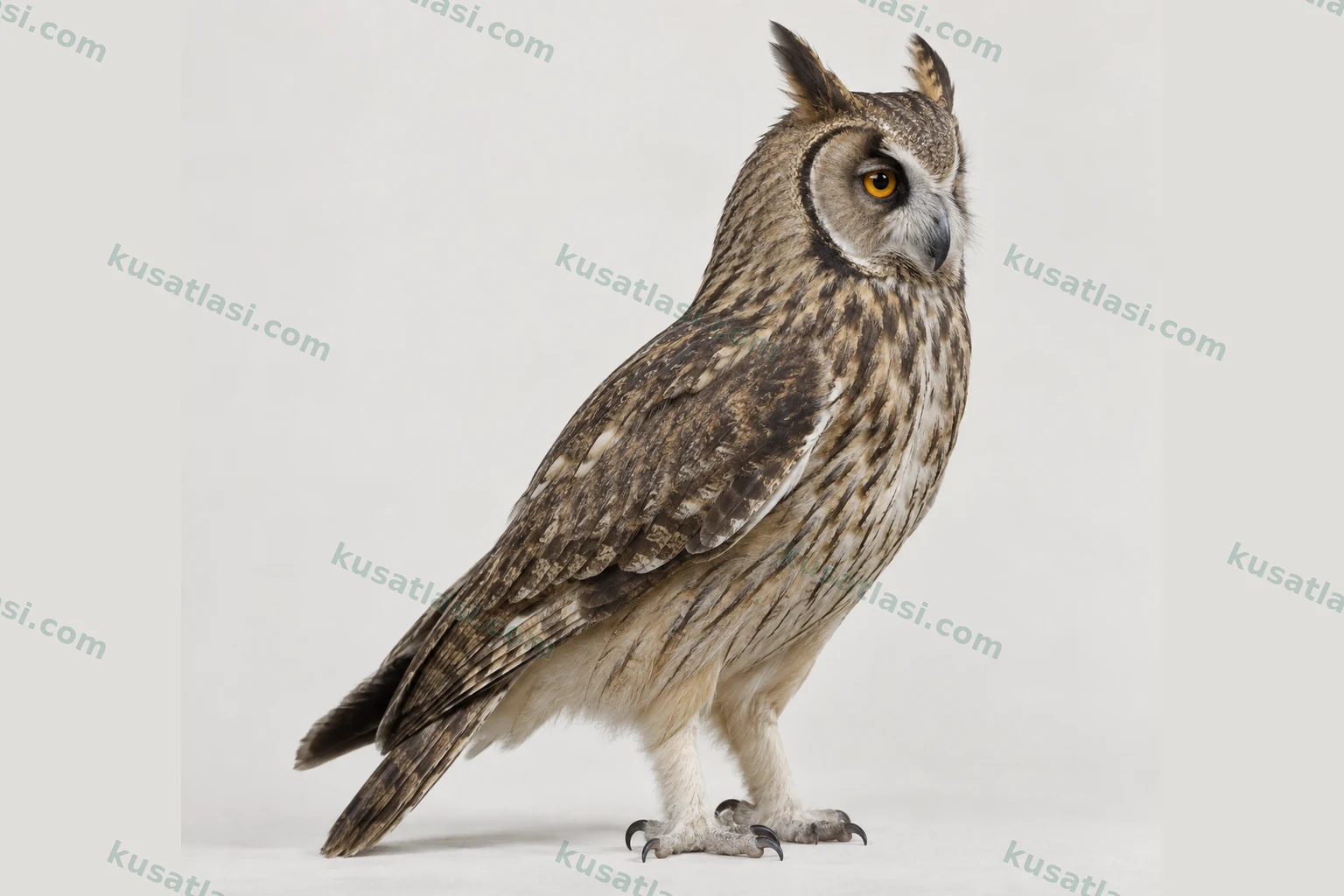
A dark brown owl with prominent head tufts in the eastern African highlands; assess the face and the combined streak-and-bar pattern of the underparts together.
Biometrics
Length
Male42–44 cm
Female42–44 cm
Shared species value
Wing length
Male33.45 cm
Female33.45 cm
Shared species value
Weight
Male245–400 g
Female245–400 g
Shared species value
Abyssinian Owl
High mountain surroundings of eastern AfricaObservation guide in its natural range
Look for three features together
Do not rely on a single featureLong tufts near the centre and a dark-bordered facial disc.
Longitudinal streaks and crosswise markings together give a compartmented appearance.
An uncertain mountain silhouette or remains are not a definite species record.
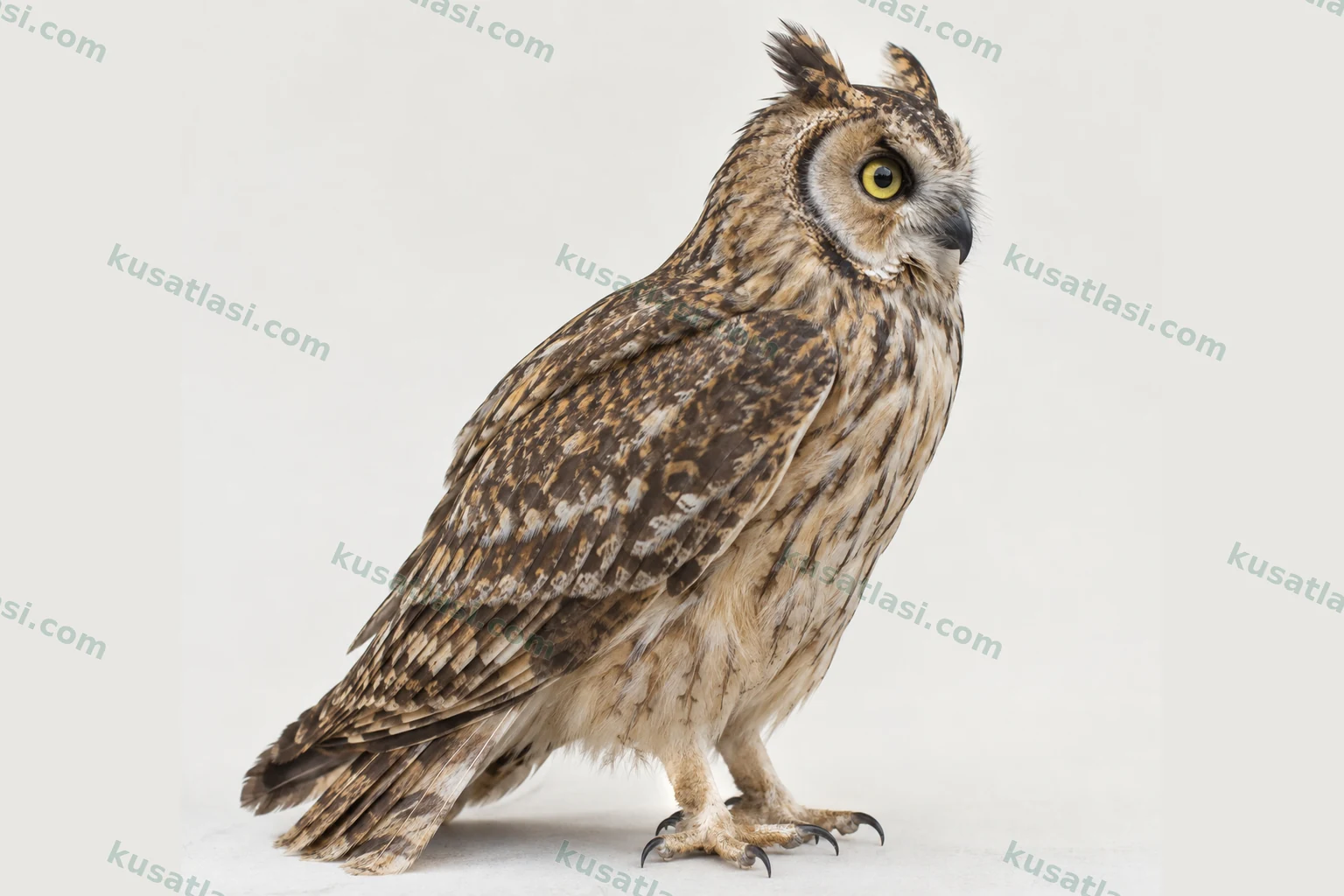
Compare male and female
 FemaleMale
Adults are similar; females may be slightly larger, but there is no reliable visual threshold for determining sex. Details of juvenile ages are limited.
Where to look in its natural range?
Watch tall shrub and woodland edges without causing disturbance; do not approach sensitive resting sites.
A reliable species-specific monthly breeding sequence has not been verified; the months of the year remain visible.
All months: Essentially resident; a regular migration route and monthly movement sequence have not been verified. No verified regional date specific to this month was provided; this does not imply local absence.
January
February
March
April
May
June
July
August
September
October
November
December
Nest, egg and incubation
It may use stick nests abandoned by other birds. A species-specific clutch size, incubation duration and nestling period have not been verified; figures from a related species are not transferred.
The specialist account describes spaced, deep, two-part hooting and harsh alarm notes; the sound’s identity must be verified separately.
Do not play recordings to attract birds; observe quietly, especially near nests.
Species information
Quick identification
The Abyssinian Owl Asio abyssinicus is an owl of the high mountains of eastern Africa, with prominent head tufts. Assess the dark brown body, yellow-orange eyes, pale brown facial disc with a dark border, and both lengthwise and crosswise markings on the underparts together. The head tufts sit close to the middle of the forehead. Flattening them can make the head look rounder; the species should not immediately be excluded because the tufts are invisible. Conversely, not every brown, tufted owl seen in the mountains belongs to this species.
The English names Abyssinian Owl and African Long-eared Owl refer to the same taxon. The Long-eared Owl Asio otus is a separate species; older publications emphasizing their relationship do not imply that all their biology is identical. Details such as clutch size and incubation duration must especially not be borrowed from the better-known relative. The taxon name, record locality and observed head and body pattern must agree. An old, uncertain owl record from Kenya must not be presented as definite presence merely because its name is similar.
General appearance and posture
The feathered area around the face is brownish, with a darker border. Warm, pale markings mingle with a dark brown ground colour on the upperparts; paler feather edges may show on the shoulders. Strong dark streaks on the breast join crosswise markings lower down, creating a compartmented pattern. The underparts do not simply carry a few large round spots. Part of the pattern can be missed when the pale section of a feather, its dark central streak and its crosswise marking are not visible together.
The bill is dark, and the visible upper parts of the feet are feathered. The orange eye can look different under artificial light at night; when the pupil expands, only a small part of the iris remains visible. Do not interpret the reflection created by a torch or camera flash as the natural eye colour. A turned head can conceal one half of the face. In that view, recording what was actually seen is more reliable than filling in the eye region or tuft positions using feathers on the opposite side.
When resting by day, it may hide close to a tree, around its trunk or among dense tall shrubs. A bird with fluffed feathers looks broader, whereas one stretching its body looks slimmer. Do not treat this as a species or sex difference. Opening the resting cover or approaching to make the bird turn its head is inappropriate. Especially for a poorly known species, a record of undisturbed behaviour is more valuable than a new posture obtained through disturbance.
Males, females and young birds
Adult males and females share their colours and patterns; the specialist account notes that females can be slightly larger. However, seeing a bird from a distance does not measure this small difference in size. The female of two birds sitting in different postures on the same branch cannot be identified from apparent width alone.
Reliable information for detailed age classification of young birds is limited. Another owl’s juvenile plumage must not be assigned to this species. A fluffier, short-tailed or begging bird near a nest may provide an age clue, but these features alone do not give an exact age in days. Being in the same surroundings as an adult is not proof of kinship either. Reliable identification requires documentation of the young bird itself, the parents’ appearance and the whole event.
The poorly known breeding biology also makes it difficult to assign care tasks confidently to males and females. One individual calling while another waits silently does not establish their sexes. Even if specialist descriptions mention differences in pitch, a call heard on one night must not be accepted as a sex threshold for every individual. An observer can report care by a bird of unknown sex; adding female or male without enough evidence creates unwarranted certainty.
Appearance in flight
This is a long-winged owl; pale and dark crosswise markings may show on the flight feathers, and broad dark bands on the tail. Colour and head tufts may disappear during a brief view of a bird flying at night. Silent flight or a brown body alone does not identify the species. The habitat from which a bird emerges provides context, but a silhouette emerging from mountain scrub remains only a silhouette. A record may be left uncertain if the head details and body pattern are not seen again.
The specialist account describes hunting in flight and setting off from a perch. This does not mean that the species takes every prey item by one method or flies at the same height every evening. Nor is crossing an opening long-distance migration. As no regular migration route has been verified, local flights must not be turned into a line of intercontinental movement.
Voice and behaviour
The specialist owl account describes spaced, deep, two-part hooting and shorter harsh alarm notes. This description is useful, but the species’ natural history remains poorly known. A recording of a similar Asio species must not be used as this bird’s voice. The exact sound, intervals between repetitions and bird seen at the same time should be recorded separately. Disturbing the bird to obtain more sound, or playing another species’ call, can change the natural observation.
Being active at night and resting in cover by day makes the species hard to find during short visits. Several owls at a resting site do not mean that it is always a communal nest. Resting sites, hunting areas and nests serve different functions. The Kenyan study’s inability to assign remains at a resting site confidently to this species shows why this distinction matters. Knowing that remains came from an owl does not automatically establish which owl species left them.
Similar species
The Cape Eagle-Owl Bubo capensis is large, powerful-bodied and more heavily built; both species may show orange eyes and a warm brown pattern. They may also share rocky mountain surroundings. Eye colour or mountainous habitat alone therefore does not distinguish them. Assess the Abyssinian Owl’s slimmer build, centrally placed head tufts and combination of streaks and bars on the underparts as a whole. A size comparison may be unreliable when only a distant head is visible.
The Marsh Owl Asio capensis has very small head tufts, giving it a rounder head and a different, more uniform brown appearance. Use of damp grassland and open flight at dusk provide helpful context. However, the Abyssinian Owl can also occur in openings. Check the face, breast and wing pattern while remembering that the tufts may be flattened. Seeing a bird before sunset must not by itself become a criterion for definitely excluding either of these species.
Global distribution
It is associated with separate high mountain areas of eastern Africa. Specialist accounts include the Ethiopian highlands, Mount Kenya and mountain areas in Uganda and the eastern Democratic Republic of the Congo. The entire lowlands of these countries must not be filled in as natural range. Large gaps may separate suitable mountain woodland and tall shrub cover. Treating two local forms as one species does not mean that all the intervening geography is occupied continuously.
Status within its natural range
Observations are sparse, and the current continuity of some historical records is uncertain. The 2017 Mount Kenya report explicitly states that it could not definitely reconfirm presence despite prolonged searches. That dated result is not a verdict that the species is definitely absent today; it is the evidence limit of that study. The report distinguishes an older specimen from possible sightings. Few records may relate to a small population, but nocturnal activity, difficult terrain and search methods also affect detectability.
Migration and movements
It is considered essentially resident; no regular migration route has been verified. Hunting movements or shifts between cover within the mountains do not imply an immobile life at one point. Without current individual tracking, the season and extent of movements between elevations cannot be established either. When years separate older and newer records, continuous presence by the same individual or population must not be assumed. A map point supports an observation; it is not month-by-month evidence of breeding or movement.
Breeding habitat
Species accounts mention high mountain woodland, giant heather, openings with groups of trees and suitable forest surroundings. Kenyan researchers particularly discussed the importance of tall shrub cover; however, as the owl’s identity there was not fully verified, that study alone does not define the mandatory habitat limits of the entire species. Finding prey animals in a habitat does not prove that the owl breeds there. The continuity of cover, safety of resting sites and access to prey are separate factors to assess.
Nest site
The Peregrine Fund and the specialist owl account state that stick nests abandoned by other birds are used. Beyond that, a reliable species-specific clutch size, incubation duration and nestling period have not been verified. Figures for the Long-eared Owl must not be transferred to fill this gap. If a nest is found, its structure, supporting tree and care events should be recorded from a distance. Climbing the tree or flushing the adult to see the contents is inappropriate.
Daily use of space
A covered daytime resting site may differ from the opening used for hunting at night. Protecting the shrub or tree requires a wider surrounding area than simply retaining that plant. High mountain fires can change the structure of cover; the actual effect of a fire on this species must be assessed using observations before and after it. Cover loss is a possible threat, not a basis for claiming that the same number of owls is lost everywhere.
What does it eat?
Small mammals feature prominently in descriptions of the diet; the specialist institutional account also mentions small birds and invertebrates. However, the proportion of different prey groups throughout all regions has not been verified. Mice, shrews or other small mammals merely occurring in the same habitat are not direct proof that they are eaten. Observations of prey or remains confidently assigned to the species are needed. The words fish and carrion in a general data category must not be read as separate records of this bird regularly eating fish or carrion.
How does it hunt?
At night it locates prey by sight and hearing; the orderly arrangement of feathers around the face helps it detect sound. The specialist account describes searching for prey both from a perch and in flight. Flying over an opening does not necessarily mean a successful hunt; capture itself must also be seen. It is inappropriate to assign every attack to the same prey species or calculate daily consumption from one success.
Examining remains can be important, but the bird that left them must first be identified. Small mammal bones were found during the Mount Kenya study, but the remains could not be assigned definitely to the Abyssinian Owl. Prey names from that site are therefore not listed as this species’ verified menu. Maintaining this limit does not make the finding worthless; it shows at which stage a new study must verify the bird’s identity. Frequent visits to the resting site are not permission for unlimited disturbance to obtain that verification.
A result the research left unresolved
Ogada and Muriithi’s 2017 report explicitly states that the Mount Kenya study could not definitely verify the species’ current presence despite its objectives. Finding a resting site and remains did not automatically close that gap. The researchers also presented possible sightings and habitat interpretations cautiously. These must not be turned into other events such as a verified nest, complete prey list or population census. What a study could not establish is scientific information as much as its results.
Head tufts are not ears
The ear-like head feathers give the bird its name, but the actual ear openings that receive sound are not these visible tufts. Flattening a tuft does not remove the hearing organ. This explains why a photograph with a rounded head should not change the identification on its own. Separating the posture of head feathers from the face’s fixed anatomical regions is especially useful when identifying owls.
Conservation category and the amount of knowledge
Being classified as Least Concern does not mean that breeding or every local population is fully understood. A global assessment and a question about habitat condition on one mountain operate at different scales. The Peregrine Fund emphasizes gaps in the species’ natural history. A new nest or definite record can be important, especially where knowledge is sparse; the evidence should therefore be documented carefully rather than an uncertain observation being treated as definite.
Small mountain patches on a large-scale map
Mountain birds may occupy only a country’s suitable high areas. Drawing a straight line between points does not prove that a habitat corridor exists. Nor does a marked elevation on a map demonstrate breeding there in every season. The distinction between a country name and mountain habitat must be retained for this species. A single visit to an apparently suitable mountain with no records does not establish definite absence.
During observations at night, avoid keeping the bird under a light for long periods and opening its resting site to visitor traffic. The research report chose not to publish the exact coordinates of the sensitive location. Retaining evidence of the species’ identity and the event is different from enabling everyone to approach the same resting tree. A protected record does not always mean a publicly accessible detailed location.