

World Birds IUCN statusLC · Least ConcernGlobal IUCN category. BirdLife v10 (2025); taxon matching: AviList 2026 / IOC 15.2; checked: 29.10.2026. The list year is not the species assessment date. Source and method · BirdLife OrderStrigiformesOwls FamilyStrigidaeStrigidae
Pel's Fishing Owl
Scotopelia peli
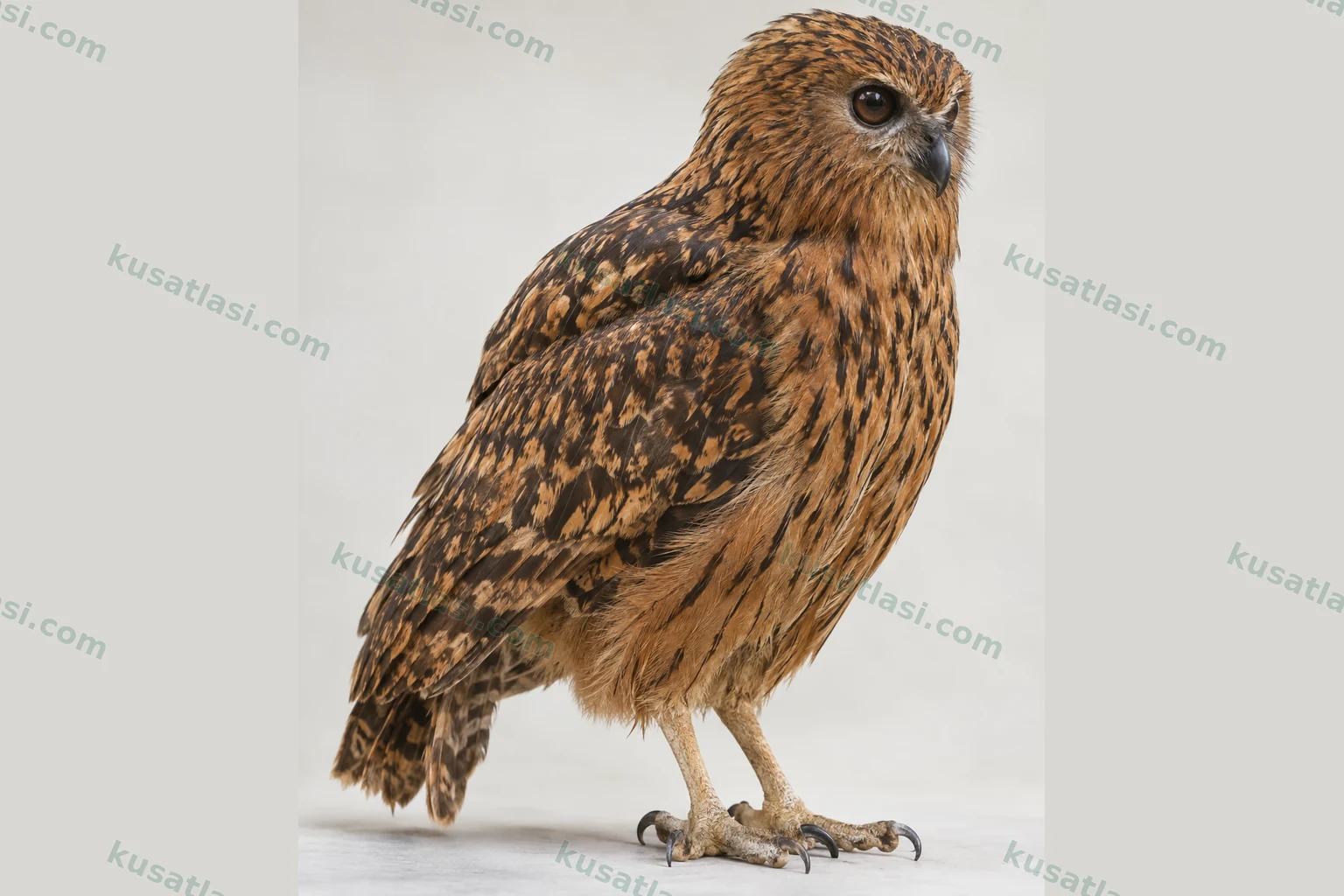
Recognised by rufous-brown plumage, dark eyes and a rounded head without ear tufts. It lives along rivers, lakes and swamps where large trees remain, and chiefly hunts fish.
Biometrics
Length
Male51–63 cm
Female51–63 cm
Shared species value
Wingspan
Male150 cm
Female150 cm
Shared species value
Weight
Male1.725 kg
Female2.055–2.325 kg
Pel's Fishing Owl
Wooded watersides of sub-Saharan AfricaObservation guide in its natural range
Look for three features together
Do not rely on a single featureCompare streaks and spots on the pale rufous underparts together with the dark bill.
No ear tufts; the facial border is weak. Adult sexes share the same basic feather pattern.
Look in shady riverside trees by day and around low branches overlooking water in the evening.
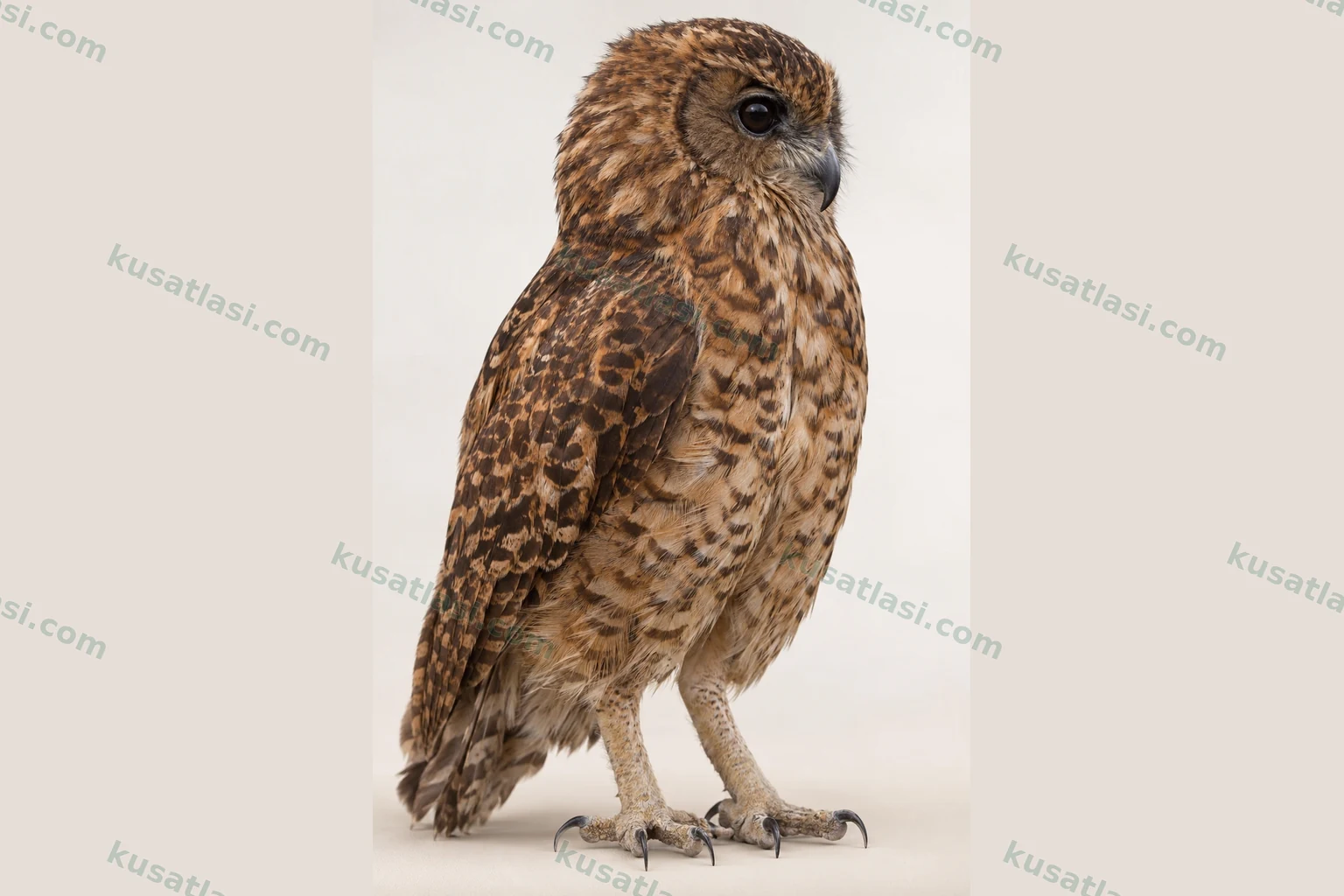
Compare male and female
 FemaleMale
Male and female share the same basic feather pattern. Size and rufous tone in a single photograph do not allow reliable sexing.
Where to look in its natural range?
Look in large shady trees along rivers with permanent water. Suitable waterways in the Okavango and Zambezi systems are important examples. Observe from permitted routes; do not disturb daytime roosts or nest hollows.
A resident species; breeding timing depends on river level and region. Southern African sources give egg laying mainly January–June, peaking February–April. This local pattern is not a fixed calendar for all Africa.
January
Generally resident. Southern African regional breeding example: within the laying period.
February
Generally resident. Southern African regional breeding example: a reported peak laying month.
March
Generally resident. Southern African regional breeding example: a reported peak laying month.
April
Generally resident. Southern African regional breeding example: a reported peak laying month.
May
Generally resident. Southern African regional breeding example: within the laying period.
June
Generally resident. Southern African regional breeding example: within the laying period.
July
Generally resident. Southern African regional breeding example: outside the stated main laying period; this does not mean local absence or absence of breeding.
August
Generally resident. Southern African regional breeding example: outside the stated main laying period; this does not mean local absence or absence of breeding.
September
Generally resident. Southern African regional breeding example: outside the stated main laying period; this does not mean local absence or absence of breeding.
October
Generally resident. Southern African regional breeding example: outside the stated main laying period; this does not mean local absence or absence of breeding.
November
Generally resident. Southern African regional breeding example: outside the stated main laying period; this does not mean local absence or absence of breeding.
December
Generally resident. Southern African regional breeding example: outside the stated main laying period; this does not mean local absence or absence of breeding.
Nest, egg and incubation
Usually lays 1–2 eggs in a natural hollow of an old waterside tree. The specialist South African account gives incubation of 33–38 days and nest departure at about 68–70 days. A French specialist account gives about 32 days of incubation, not presented as the same sample; these values are not combined into a new average. The female incubates and the male feeds her. Young may remain dependent for a time after leaving. Do not approach the nest, shine inside or climb to see chicks.
Deep, resonant hoots and short grunting series may be heard. A high, prolonged call is not assumed exclusive to young: an adult giving it was directly seen in South Africa. Assess context, rhythm and, if possible, appearance together. Do not repeatedly play sounds to dislodge the bird.
Do not play recordings to attract birds; observe quietly, especially near nests.
Species information
Quick Identification
Pel's Fishing Owl is a riverside bird recognised by its large rounded head, reddish-brown plumage and dark eyes. It has no feather tufts rising like ears. Unlike some owls, its face has no distinct black border; the surrounding feathers blend into the rest of the head. Dark streaks and spots on the back are assessed together with dark drop-shaped marks on the pale rufous underparts. Seeing it beside permanent water shaded by large trees supports identification.
Large size or reddish colour alone is insufficient. Also examine the bill, eyes, head shape and arrangement of the underpart pattern. These details may disappear on a bird in a dim tree hollow; do not approach a nest or daytime roost to obtain a clearer view. Shade, distance and fluffed feathers can alter apparent size.
General Appearance and Posture
The body is bulky, the head broad and the tail short relative to the body. Loose head and nape feathers produce a slightly untidy appearance. Narrow dark streaks, spots and occasional paler areas occur on the reddish-brown back. The wing and tail feathers have pale and dark crossbars. The underparts are paler rufous or buff; some dark longitudinal marks widen at their ends into spots. The eyes are dark brown and the bill mostly black; its paler base may not be apparent at a distance.
The lower parts of the feet are unfeathered, helping separate it from many large owls with densely feathered legs. However, overhanging belly feathers may conceal the bare area. Small pointed projections on the soles form part of the structure that holds slippery prey. These are not distant field marks: identification should not require handling the bird or disturbing it to inspect its feet.
By day it usually stays in large shady trees in riverside woodland. It may appear upright and calm; partners may occupy the same tree area or nearby branches. When hunting in the evening, it watches from a low branch or stump extending over water. These perches have different functions: a daytime roost provides cover, whereas a hunting perch affords a view of the surface. Both illustrate the importance of the riverside tree structure.
Males, Females and Young Birds
Adult males and females share the same basic colours and pattern. Specialist accounts describe the female as larger and, in some individuals, less rufous. Nevertheless, the intensity of reddish colour in one photograph does not establish sex. Lighting, individual variation and feather condition can produce the same effect. The apparent sizes of two birds not seen side by side are also an unreliable comparison. Male and female plates preserve this similarity and should not be read as two distinctly different colour forms.
Nestlings have pale whitish down. As they grow, feathers approaching the adult pattern develop on the wings, back and tail; fledged young may look paler and less rufous than adults. The change is gradual. Rather than calling every pale bird a chick, assess feather development, overall pattern and observed behaviour together. An adult beside a young bird does not show that the youngster can feed itself; dependence may continue after flight begins.
Appearance in Flight
On a short riverside flight, the large head, broad wings and relatively short tail are seen together. From above, the reddish-brown back and bars on the wing feathers may be visible. From below, the pale rufous body and paler underwing areas stand out. Always account for the wing surface shown: do not look for an upperwing pattern in an image taken from below. When night or tree shade obscures details, firm identification from silhouette alone becomes difficult.
A hunting strike towards water differs from a long transit flight. The owl may leave its perch, approach the surface with feet stretched forwards and perch again to eat its catch. This supports a fishing interpretation, but another owl is not identified as this species simply because it flies over water. A descent without visible prey is not a confirmed successful fishing record either.
Voice and Behaviour
It gives deep, resonant, prolonged hoots and shorter grunting sounds. Pale feathers around the throat may puff out while it calls. Activity is pronounced in the evening and at night; a resting bird seen by day does not show that it hunts all day. Food conditions and local circumstances can affect activity hours. Written sound imitations cannot convey rhythm fully, so identification also draws on habitat and, where possible, appearance alongside the series heard.
Branfield's South African field observations show that high, drawn-out calls cannot be attributed exclusively to young birds: a calling adult was directly seen. This does not mean that every high call has the same significance. The age or sex of an unseen bird is not established from voice alone. Shining lights at night or repeatedly using playback to follow birds to their hunting grounds is inappropriate, particularly during breeding.
Similar Species
Rufous Fishing Owl (Scotopelia ussheri) may look smaller and more intensely rufous; its underpart streaks and spots differ from Pel's Fishing Owl's conspicuous dark markings. Compare more than redness: check the underpart pattern, bill and head proportions and natural geography together.
Vermiculated Fishing Owl (Scotopelia bouvieri) is compared particularly through its prominent longitudinal upperbreast streaks and paler yellowish bill. Pel's Fishing Owl's dark bill and combination of streaks and spots on a rufous body matter. A bill appearing black in shade is not diagnostic alone. Establish identity by combining several features visible from the same angle.
Global Range
Pel's Fishing Owl is native to sub-Saharan Africa. Rather than occupying most of the continent continuously, it occurs patchily in river, lake and wetland systems with suitable waterside trees. Its distribution extends from West and Central African drainage basins to the eastern great lakes and farther south to the Zambezi and Okavango systems. Specialist accounts also mention isolated populations in Senegambia and Guinea. Presence within a country does not mean that it inhabits all that country's forests.
Status within Its Native Range
In southern Africa, important areas include suitable riverbanks in northern Botswana, Namibia's Zambezi region, Zimbabwe, Mozambique and eastern South Africa. Wooded Okavango waterways are well-known habitat. Local abundance varies with water permanence and riverside woodland condition. The global conservation category and the regional assessment covering South Africa, Lesotho and Eswatini operate at different scales: high risk in one region does not give the whole continental population that category.
Local Movements
The species is generally resident. No particular seasonal intercontinental migration route has been verified, so the map shows none. Concentrations around residual pools during drought and isolated records outside the usual range have been reported; these are not equivalent to a regular migration by all individuals in the same direction. An absence of records along a bank does not prove absence there. Detecting a bird concealed in riverside woodland and active mainly at night depends on observation conditions.
The map's modelled area estimates the general distribution; it does not prove presence or breeding at every point. Openly licensed observation samples are shown separately. Recorded grid cells are not joined into a boundary of natural habitat; an outlying record is not interpreted as establishment in that region.
Breeding Habitat
River and lake shores retaining large trees are important for breeding. Waterside woodland can provide daytime cover, branches overlooking prey and nest cavities in the same place. Water alone is insufficient: a bare, continually disturbed shore or one that has lost suitable trees does not offer equivalent conditions. Wooded islets and wetland edges can also form part of suitable surroundings. Habitat is assessed as an integrated combination of water and waterside trees.
Nest Site
It usually nests in a natural cavity in an old tree near water. A deep hollow where a large broken branch joins the trunk may be used. The specialist South African account also mentions use of old Hamerkop nests; this does not mean every pair chooses one. Do not approach the entrance, shine lights inside or climb the tree to see chicks. Protecting the quiet shoreline around the nest tree matters as well as preserving the tree itself.
Daily Space Use
It rests on large shady branches by day and may move to low perches overlooking water in the evening. Slower river stretches, residual pools and surfaces where prey can be seen provide feeding areas. Roost and hunting perch are not always the same place. Observe from permitted shore paths or normal boat routes, without waiting in front of a bird in a way that blocks its access to water. Fish remains or droppings alone do not confirm the species.
What Does It Eat?
Fish form the basis of the diet. The specialist South African account records different groups, including catfish and cichlids. Frogs, crabs and other aquatic animals have also been taken. Unusual examples such as a captured young crocodile do not imply that such prey forms most of the normal diet. A prey list and prey proportions are separate information; no percentages are given without a verified proportion. Sharing a river does not show that it hunts every creature on its banks.
How Does It Hunt?
It watches the surface from a low branch or stump over water. During a strike it extends its feet to grasp fish; the foot structure supporting its grip suits its fishing way of life. It may return to a perch to eat. Some strikes involve low flight; complete submersion is not assumed. A reliable feeding record notes more than the attack movement: contact with prey and, if possible, the animal taken are also observed.
Changing water levels can influence where prey concentrates. During dry conditions, fish collecting in residual pools may explain birds gathering nearby; this relationship does not guarantee equal feeding success in every river and season. Pollution, damaged banks and reduced water are pressures affecting access to fish. Putting artificial bait or prey in the water to feed the owl disrupts observation of natural behaviour and is not recommended.
What Water Means to an Owl
For this species a large tree is more than a perch and a river more than scenery. A tree supplies a branch overlooking prey, daytime concealment and sometimes a nest hollow. Water provides the fish. Removing riverside trees and degrading water are different pressures, but both affect the same bird's daily life. Protecting one nest tree may therefore be insufficient if its surrounding water and shoreline structure are extensively damaged.
A High Call Does Not Always Mean a Chick
In 2013 Andy Branfield published accounts of calls from birds he had watched near Mkuze in 1992. He reported that grunting sounds from birds concealed by day changed to high, prolonged calls at the feeding grounds. One caller was directly seen to be an adult. This illustrates the danger of assuming the call is exclusive to young birds. Its nature as a local observation is retained; no single definite function is claimed for high calls in every individual.
Two Chicks May Have Different Outcomes
One or two eggs may be laid. The specialist South African account describes the smaller of two chicks sometimes failing to obtain enough food and dying. This is not turned into an absolute rule that every nest raises only one chick. Egg numbers observed in a nest and numbers of successfully fledged young measure different aspects of breeding. Frequent nest visits can also disrupt the natural process, so birds are not disturbed to obtain these counts.
Flight and Independence
Specialist sources give about 68–70 days for leaving the nest; this value remains within its breeding-account context, rather than an exact development date for every individual. A flying youngster may still receive food from its parents. Accounts give differing subsequent dependence periods expressed in months. The distinction matters when avoiding an immediate assumption that a young bird alone on a branch is abandoned or needs help.