

World Birds IUCN statusLC · Least ConcernGlobal IUCN category. BirdLife v10 (2025); taxon matching: AviList 2026 / IOC 15.2; checked: 29.10.2026. The list year is not the species assessment date. Source and method · BirdLife OrderStrigiformesOwls FamilyStrigidaeStrigidae
African Wood Owl
Strix woodfordii
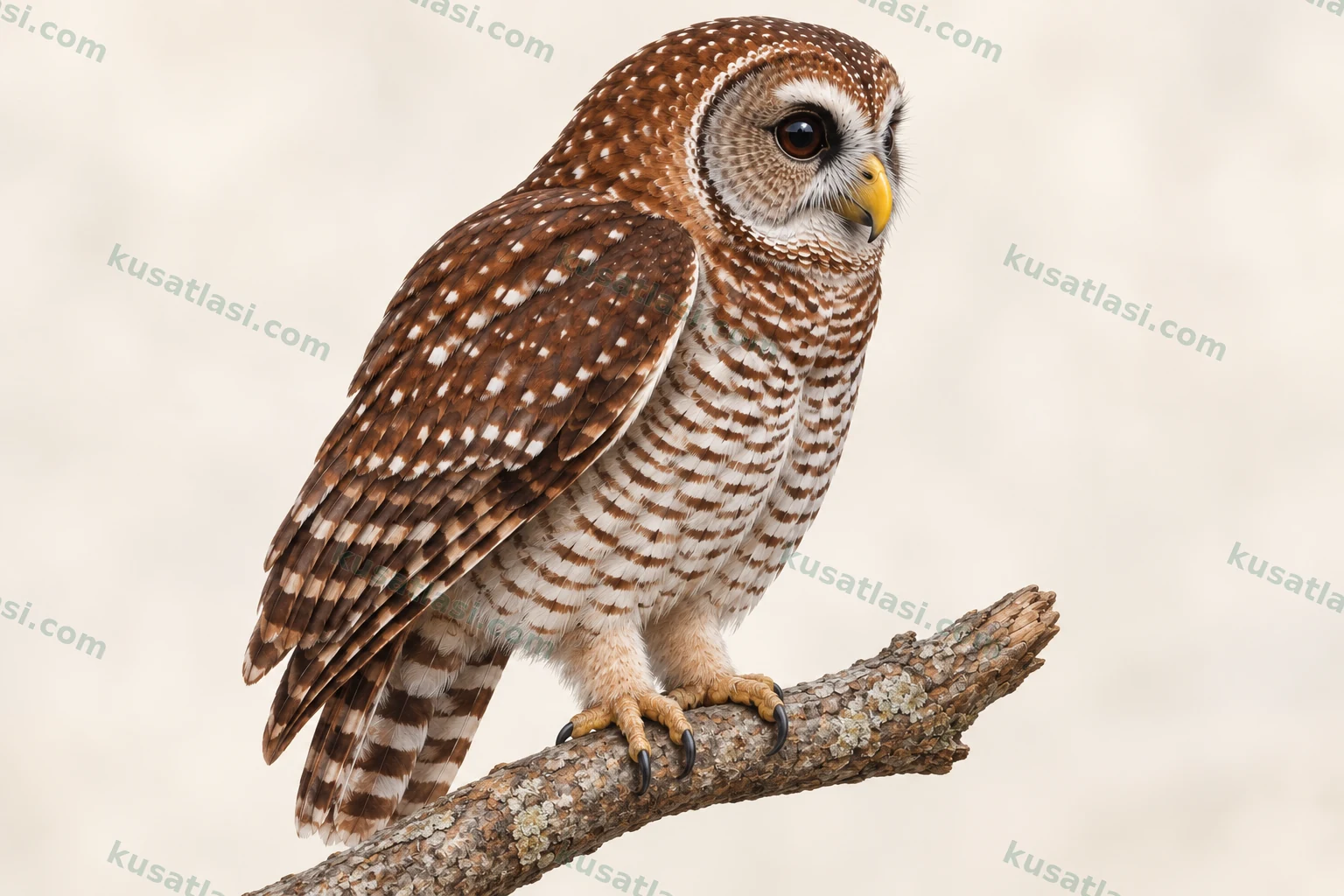
Look at the dark eyes, round untufted head and barred underparts together.
Biometrics
Length
Male30–36 cm
Female30–36 cm
Shared species value
Wingspan
Male80 cm
Female80 cm
Shared species value
Weight
Male240–270 g
Female285–350 g
African Wood Owl
Sub-Saharan AfricaObservation guide in its natural range
Look for three features together
Do not rely on a single featureLook at the dark eyes, round untufted head and barred underparts together.
Colour varies geographically from dark brown to rufous tones.
Compare male and female
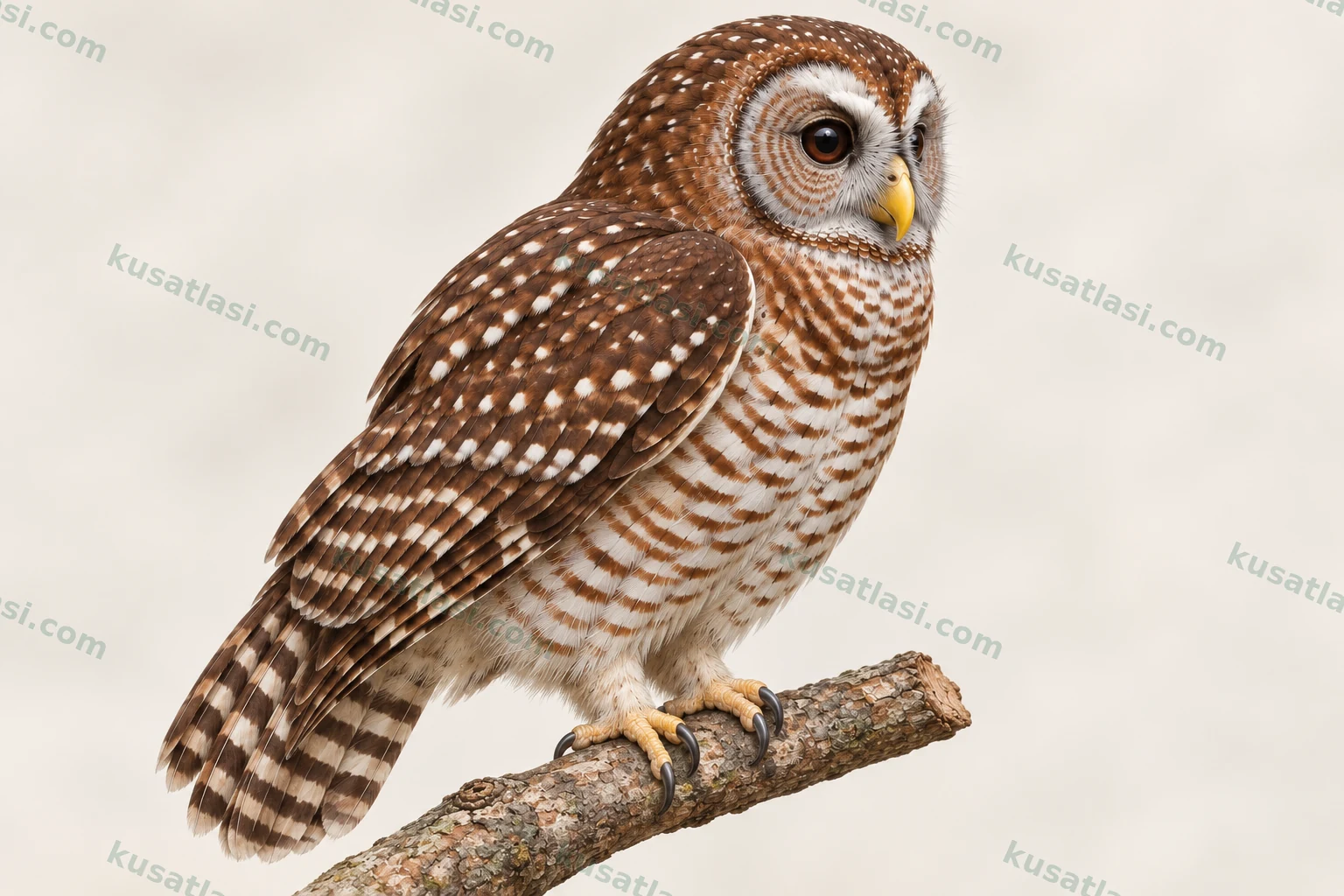 FemaleMale
Colour varies geographically from dark brown to rufous tones.
Where to look in its natural range?
Look in patchy forests and woodland extending from the west to the east and south; the map geometry will be examined separately.
South Africa’s July–October egg-laying period is not applied to the whole of Africa.
All months: Monthly data unverified.
January
February
March
April
May
June
July
August
September
October
November
December
Nest, egg and incubation
SANBI’s regional summary reports nesting in cavities, one or two eggs and an incubation period of about 31 days.
Do not play recordings to attract birds; observe quietly, especially near nests.
Species information
Quick Identification
African Wood Owl Strix woodfordii is a medium-sized, round-headed owl living in wooded areas of sub-Saharan Africa. It has no raised, ear-like feather tufts. Whitish arcs above the dark eyes, a pale brown face with a dark border, dark white-spotted upperparts and pale-and-dark barred underparts are considered together. Cornell eBird explicitly states that colour can vary geographically from dark brown to pale rufous-brown. A single photograph's warm or cool tone therefore does not establish subspecies or sex. The white facial arcs may become less distinct in shade, while a torch at night also changes the appearance of brown. Good identification combines the actual presence or absence of ear tufts with facial and body pattern.
The current scientific name Strix woodfordii and the English name African Wood-Owl match the IOC-based ITIS record. Older sources may use Ciccaba woodfordii; this is not a different owl but an earlier generic placement. The Turkish translation of the heading does not prove occurrence in Turkey. Dark eyes and an untufted head help distinguish this species from tufted, pink-lidded species such as the large Verreaux's Eagle-Owl. Africa nevertheless has several forest owls: if only a head outline is visible in poor light, it is more accurate to record the observed features than to claim a certain identity. A feather found on the ground or a call heard at a distance does not, by itself, replace whole-body identification.
Overall Appearance and Posture
By day it may hide alone or with its mate on a high branch with dense foliage. The head is broad, the bill short and the face round. Small white spots mark the upperparts, while the tail and flight feathers have more prominent pale and dark bands. The underparts show a dense mixture of rufous-brown and whitish bars. SANBI's institutional South African summary describes the pale rufous face and white eyebrow-like arcs. Cornell, in turn, emphasizes regional colour variation. These sources describe different geographical appearances of the same basic structure. Dense tree shade can make the bird look blacker than it is; a pale individual should not automatically be treated as another species either.
Males, Females and Young Birds
The partners have similar overall colour patterns. That some local females look larger is not enough to determine sex confidently from a photograph. Young birds leaving the nest may retain soft, pale rufous feathers for a time; SANBI's summary states that some juvenile feathers can remain visible for months. Dark and pale bars become clearer with age. A single pale facial patch cannot establish a young bird's age or sex.
White arcs on both sides of the face are not exclusive to one sex. Rain, moult and flash change the contrast of the spots. The relationship between an adult seen near a nest and another individual cannot be confirmed without prolonged observation. The title of Steyn and Scott's 1973 peer-reviewed study directly addresses the species' breeding biology. Rather than invent details and attribute them to an unread full text, the explicitly stated numbers in SANBI's sourced summary should be used. Approaching a breeding nest, especially shining light at the cavity entrance, may affect parental behaviour. If age or sex information remains incomplete, the record should retain that uncertainty.
Appearance in Flight
At night it may make short, agile passages between trees. Pale and dark wing and tail bars show during turns, while bars on the underbody receive light from a different direction. White facial arcs are often indistinguishable in flight. The round, untufted head can be recognized only in a good silhouette. Woodland provides context for the bird's movements, but other similar-sized owls may occur. A single underwing mark is not enough for certain identification. Front and side views of a perched bird support the flight frame.
Apparent size in a photograph is not used as a ruler either. Several viewing angles and the correct geographical context strengthen a reliable identification.
Voice and Behaviour
The species hunts mainly at night and rests by day in dense tree cover. Cornell's account describes duetting and differences between male and female voices. A call written as one word does not convey the full vocal repertoire, and an unrecorded sound does not establish an individual's identity.
SANBI's summary describes watching prey from a low branch and descending to the ground, and sometimes catching a flying insect. Partners may defend the nesting tree, but this does not mean that every calling bird has a nest immediately nearby. Place and date can be recorded when observing calls at dusk; rain and breeding seasons in different regions should not be reduced to identical months. If a recording is considered later, checking the taxon and that recording's licence is a separate task.
Confusable Species
1. Verreaux's Eagle-Owl Ketupa lactea is much larger and has short ear tufts and pink eyelids. African Wood Owl's round untufted head, white facial arcs and smaller body are compared together.
2. Spotted Eagle-Owl Bubo africanus also has ear tufts; although age and light change appearance, this structure should be sought in a clear head view. A single breast tone is insufficient.
3. Smaller African owlets in the genus Glaucidium have different body proportions. If the record is only a night silhouette, identification should remain open rather than be confirmed as a medium-sized Strix.
World Distribution
African Wood Owl inhabits broad but patchy wooded areas extending from western to eastern and southern sub-Saharan Africa. Cornell eBird lists forest, dense woodland, gardens and plantations; BirdForum's country list covers western, eastern and southern Africa. This does not mean that every area in all those countries is occupied.
Status in Its Natural Range
The places used vary with tree cover and local connectivity. SANBI reports use of some well-treed suburbs in South Africa; this local adaptation is not equivalent to adaptation to urbanization across the continent. Records published under the current Strix woodfordii and older Ciccaba woodfordii should be combined after identity checks. Without separately examining detailed map geometry, a few example points do not justify colouring the entire continent.
Migration Journey
SANBI's sourced summary considers the species mainly resident and notes that young may disperse as they mature. An individual moving into another wooded area is not regular intercontinental migration. Individual vocal tracking by Delport and colleagues in Kruger Park enabled some birds to be detected in the same area in different years; this park result does not establish one home-range size for the whole of Africa. An observation point, resident area and possible dispersal event carry different meanings on the map.
Breeding Habitat
Natural forest edge, dense woodland, riverine forest and well-treed gardens are among the suitable environments. Cornell and SANBI describe the importance of tree cover for daytime concealment and night hunting. Use of plantations or non-native trees does not prove that they provide every function of native forest. Large cavity trees and connected cover matter for nesting opportunities. South African field information is not automatically transferred to every forest type in western and central Africa. A garden sighting does not establish successful breeding there; observations of the nest and young are needed.
Nest Site
SANBI reports that the species mostly nests in a natural tree cavity, whose entrance may be at the side or top. For South Africa it gives one or two eggs and an incubation period of about 31 days. These figures come from regional literature, including Steyn and Scott's breeding study, rather than a newly measured average for the entire continent. The birds may use a suitable old hollow, but a visible hole alone is not proof of an active nest. Young remaining near their parents for a time after leaving the nest does not mean they are fully independent on the day the active nesting phase ends. Lighting the cavity entrance or climbing the tree disturbs the birds; observations should be made from a safe distance.
Daily Habitat Use
Dense leaves may provide daytime concealment, while surrounding openings and low branches can serve night hunting. SANBI describes watching prey from a low perch and taking it towards the ground; some flying insects may also be caught. Kruger Park's individual-call study shows that sound analysis can be used to track resident individuals in woodland; each call point on a map is not a separate bird or nest. Transitions between forest, garden and plantation differ locally. The nest hollow, daytime resting branch and night hunting site should be recorded separately.
What Does It Eat?
Sources identify insects as an important prey group, with grasshoppers, crickets, moths, caterpillars and beetles as examples. The Owl Pages account also mentions small rodents, shrews, small birds, frogs and reptiles. SANBI's institutional summary supports these groups. An external assessment of Steyn and Scott's peer-reviewed research, published in 1973 on southern African nest observations, particularly emphasizes insects in the food of young. This does not mean that insects dominate by the same percentage in every region and season. Detailed prey counts from that study are not invented here without the full text. Nor does a single captured small vertebrate establish a fixed preference for the entire species.
How Does It Hunt?
It often waits on a low branch and moves towards prey heard or seen on the ground. SANBI also reports taking some insects and bats in the air, or insects from leaves. Foraging in dense forest is not the same as giant eagle-owls hunting in open savanna. Because of its nocturnal activity, an observer more often hears calls; this does not prove that it never moves by day. If prey species cannot be established in an observation or photograph, a guessed name is not recorded. The height, vegetation and time of capture provide a more useful record. A food list beside one nest in a study should not be treated as the dietary table for all of Africa.
A New Name, the Same Nest
Older research may use Ciccaba woodfordii, while the current list uses Strix woodfordii. Both names represent one taxon. Studies of measurements, breeding and voice published under the older and newer names are not mixed without checking identity and region. ITIS explicitly links the current English name African Wood-Owl.
Listening Helped Track Individuals
In 2002, Delport, Kemp and Ferguson compared calls recorded between 1986 and 1998 in South Africa's Kruger National Park using 13 variables. Some adults could be statistically distinguished, and their use of space was followed over time. This particular research does not mean that anyone can safely identify a species or individual from any random recording. Individual vocal differences are considered together with recording quality and comparison method.
Young Growing in a Tree Hollow
A young bird seen near the hollow receiving food from adults shows that nest departure and independence are separate stages. An adult briefly disappearing from view does not prove that the young bird has been abandoned; the family is watched from a distance and without disturbance.