

World Birds IUCN statusLC · Least ConcernGlobal IUCN category. BirdLife v10 (2025); taxon matching: AviList 2026 / IOC 15.2; checked: 29.10.2026. The list year is not the species assessment date. Source and method · BirdLife OrderBucerotiformesHornbills, hoopoes and allies FamilyPhoeniculidaePhoeniculidae
White-headed Woodhoopoe
Phoeniculus bollei
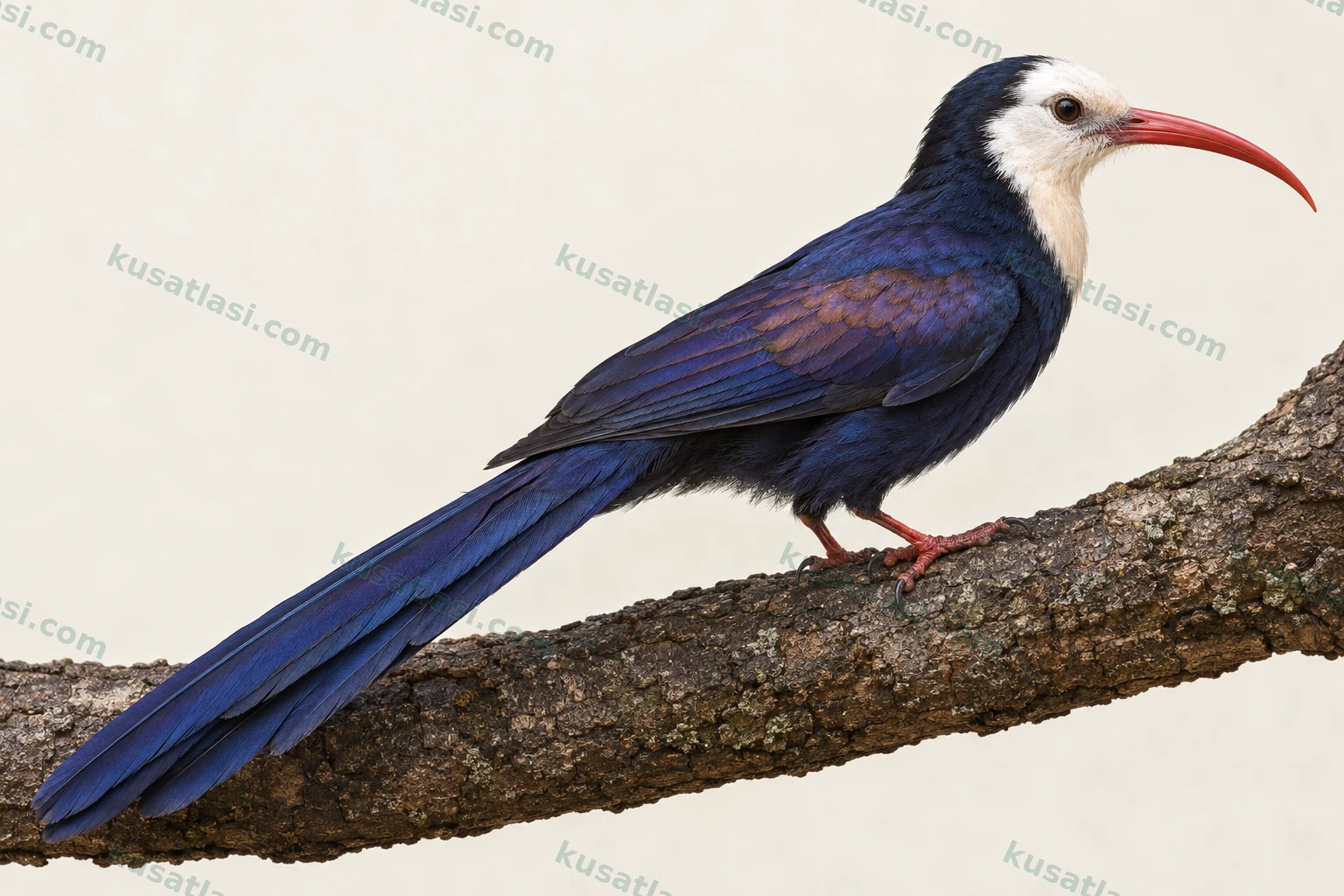
A long-tailed, dark glossy bird living in groups in humid African forests; in adults, the white face, red bill and red feet are identifying features together.
Biometrics
Length
Male30–36 cm
Female30–36 cm
Shared species value
Wing length
Male12.92 cm
Female12.92 cm
Shared species value
Weight
Male45–68 g
Female45–68 g
Shared species value
White-headed Woodhoopoe
Patchy humid forests of West, Central and East AfricaObservation guide in its natural range
Look for three features together
Do not rely on a single featurePartly white in adults; the extent varies regionally.
Red in adults; young birds have dark bills.
Long tail and dark body; no white spots on wings or tail.
Compare male and female
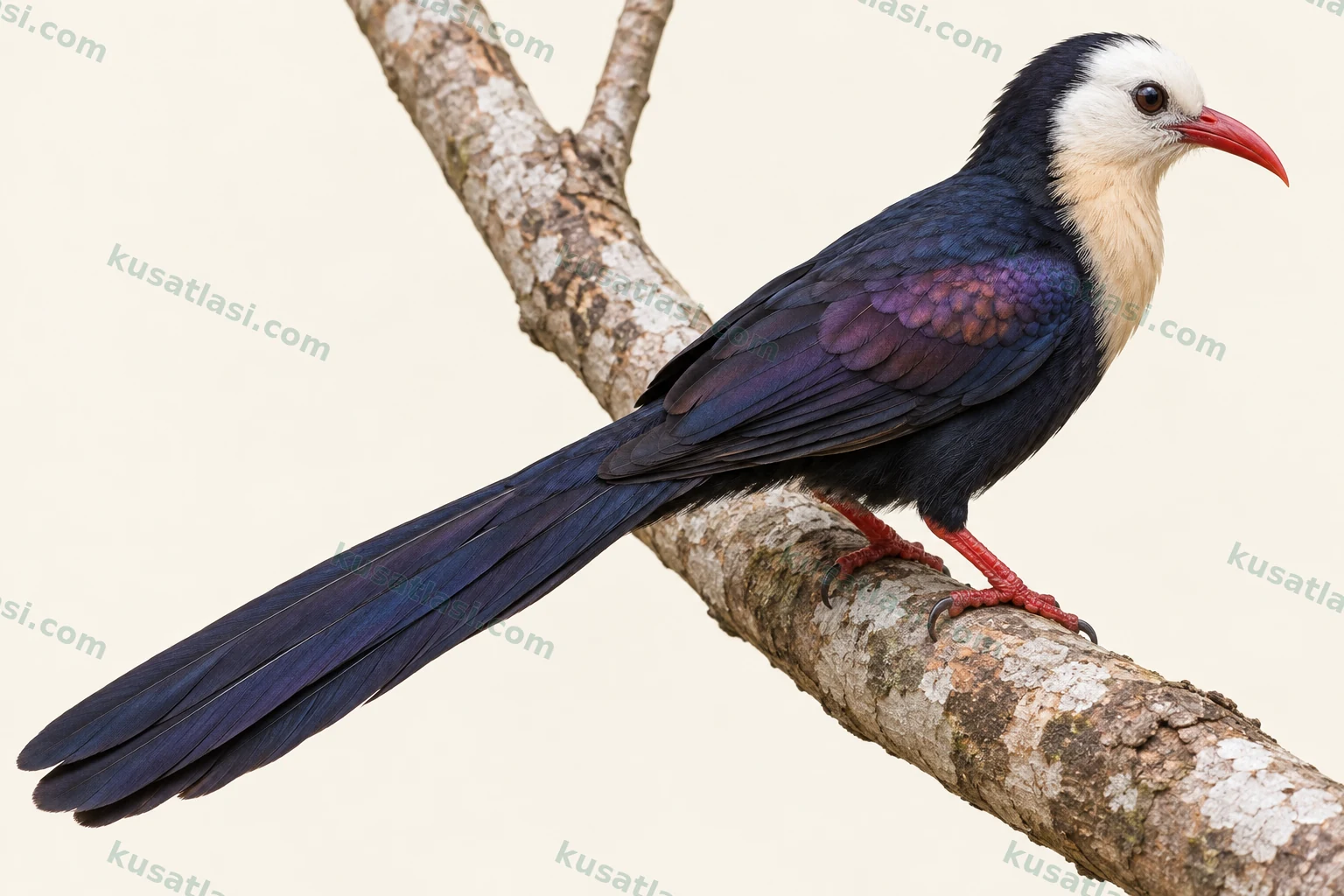 FemaleMale
The female is generally smaller and shorter-billed, with similar basic plumage. Young birds may have a dark bill and less white on the head.
Where to look in its natural range?
Humid lowland and montane forest, developed secondary woodland and large trees with cavities.
Regional breeding records from Daniel Le-Dantec’s specialist account; not an unchanging annual programme for every pair.
January
It is generally resident; no regular long-distance migration route was verified. Nigeria: regional breeding records in the specialist review.
February
It is generally resident; no regular long-distance migration route was verified. No verified regional date specific to this month was given; this does not mean local absence.
March
It is generally resident; no regular long-distance migration route was verified. Nigeria: regional breeding records in the specialist review. Uganda: the period when nests are more frequently reported.
April
It is generally resident; no regular long-distance migration route was verified. Uganda: the period when nests are more frequently reported.
May
It is generally resident; no regular long-distance migration route was verified. Ghana: the egg-laying period reported in the specialist review. Uganda: the period when nests are more frequently reported.
June
It is generally resident; no regular long-distance migration route was verified. Ghana: the egg-laying period reported in the specialist review.
July
It is generally resident; no regular long-distance migration route was verified. No verified regional date specific to this month was given; this does not mean local absence.
August
It is generally resident; no regular long-distance migration route was verified. No verified regional date specific to this month was given; this does not mean local absence.
September
It is generally resident; no regular long-distance migration route was verified. No verified regional date specific to this month was given; this does not mean local absence.
October
It is generally resident; no regular long-distance migration route was verified. Nigeria: regional breeding records in the specialist review.
November
It is generally resident; no regular long-distance migration route was verified. Nigeria: regional breeding records in the specialist review.
December
It is generally resident; no regular long-distance migration route was verified. No verified regional date specific to this month was given; this does not mean local absence.
Nest, egg and incubation
The nest is in a natural tree cavity or an old woodpecker hole; cooperative care in a small group is reported. There are usually two eggs; directly verified incubation duration and time to nest departure were not found.
The group gives rapid, dry, rattling calls together; these help reveal birds that cannot be seen.
Do not play recordings to attract birds; observe quietly, especially near nests.
Species information
Quick identification
White-headed Woodhoopoe Phoeniculus bollei is a long-tailed bird of humid African forests with a slender, slightly curved bill. At least part of the adult’s face is white, and the bill and feet are red. The body is dark, with blue, purple and coppery reflections depending on the light. The extent of head white varies geographically. One bird may have a pale forehead and face, while a bird from another region has more extensive white on its head and throat.
Several birds generally move together. A long tail, red bill and white face glimpsed in the forest are useful in combination. It is wrong to make the particular shade of gloss on the dark body an identification feature by itself: the same feathers can look almost black in shade. Age also matters, since the adult’s white face and bright bill colour may not yet be fully developed in young birds.
General appearance and posture
The tail, long in relation to the slender body, stands out during movements on branches and trunks. The bill curves slightly downwards; it is not a short, thick seed-cracking bill. The white face on the dark body, together with red bill and feet, forms the species’ basic colour pattern. The eye is dark brown; the red structures are the bill and feet, not the eye.
In the western nominate form, the forehead and face are white and the chin and throat can be pale yellowish. In the eastern form jacksoni, the whole head, chin and throat are extensively white. In Cameroon’s okuensis, white is more restricted, concentrated on the forehead, chin, upper throat and sometimes the front of the face. These are geographic differences within the same species; the extent of head white alone does not distinguish males from females.
There are no broad white spots on the wings and tail. This matters when distinguishing it from some other woodhoopoes; expecting the face white to occur on the wing too would be wrong. Purple or blue feather reflections can change with sun, shade and viewing angle. A dark photograph is insufficient for definite identification if face markings and bill cannot be made out.
The long tail forms an important part of the bird’s silhouette.
Males, females and young birds
The female is generally smaller and shorter-billed, with a basic plumage pattern similar to the male’s. Assigning sex with certainty from a distant view of one bird’s bill is unreliable when age and viewing angle are unknown. Comparing proportions among well-seen adults in the same group is more useful.
Young birds have dark bills. In some immature birds the crown remains dark and white is less extensive than in the adult. Absence of a white face therefore does not automatically turn a bird, especially a young one, into another species. Bill, head, tail and group behaviour are considered together. Age must be stated when comparing a dark-billed young bird with a dark-billed adult of another species.
No exact number of months or days to adult plumage was verified for this page. Different ages may occur in the same group; it is wrong to regard every member as a breeding adult. A bird’s position in the group is not a sex character either. An individual moving first along a branch is not identified as male from that behaviour alone.
Appearance in flight
Long tail and dark wings are visible as it flies between trees. Face and bill can be made out in flight only at a suitable angle and distance. A bird passing rapidly through forest shade is not identified with certainty from a dark silhouette alone. The bill colour, white face and tail pattern must be seen again on the same individual where it lands.
It may use wings and tail for balance while working around a branch or climbing a trunk. These movements should not be confused with true flight between trees. Support from the tail does not show that it excavates nest holes by the same method as a woodpecker. Striking wood while feeding and excavating a new nest cavity from scratch are different behaviours.
Voice and behaviour
Rapid, dry, rattling calls sometimes come from several group members together. This combined sound helps reveal a group hidden in the forest. Continued calling is not proof of a nest at that place by itself; birds may also call while feeding or at territorial boundaries. Voices of different nearby birds should not be combined into the same call sequence.
While feeding, it moves over trunks, large branches and twigs, examining bark crevices, lichens and plants growing on trees. Sometimes it reaches the underside of a branch. Bill and long tail are conspicuous during these movements. Not every group member is necessarily on the visible side of the same tree at once; birds behind branches can be missed during a count.
Species that may be confused
Rhinopomastus castaneiceps can look similar with its dark body and long tail; in an adult White-headed Woodhoopoe, the combination of red bill and feet with a white face is important. Since young have dark bills, that brief adult distinction is not applied unchanged to them. The complete head pattern, age and geography are checked together.
Phoeniculus purpureus can give a similar impression of a dark, glossy body and long tail. The White-headed Woodhoopoe’s adult white face and absence of white spots on wings and tail are more useful. To distinguish it from slender scimitarbills with much more strongly curved bills, look for the white face and less curved bill together; do not rely on a single flash of colour.
World distribution
It has a patchy distribution in the forest belt around equatorial Africa. Separate populations extend from western forests to Cameroon, suitable wooded areas of Central Africa and, in the east, the Great Lakes and Kenya region. It is wrong to treat all intervening land as continuously occupied; local forest cover and elevation matter.
The accepted scientific name is Phoeniculus bollei. Since the extent of head white differs among western, Cameroonian and eastern forms, a single adult example from another region does not represent the whole range. Zaire in older sources is matched to the present-day geography of the Democratic Republic of the Congo; the older term Sudan does not automatically create a map covering current national borders.
Status within its natural range
It is strongly associated with humid forest, occurring in montane forest in some regions and at lower elevations in the west. A record within a protected area does not prove occupation of all surrounding open savannas. Felling large trees can reduce both feeding surfaces and nest cavities. The species’ overall conservation category and the condition of a small, fragmented local population are not at the same scale.
Movements
It is generally considered resident. Group movements between trees do not mean long-distance seasonal migration. The sources examined did not verify a regular migration route across the entire range. Suitable geography on the map is not shown as a definite seasonal breeding area or a tracked individual route.
Breeding habitat
Humid lowland and montane forest, developed secondary forest, riverside tree strips and surroundings with sufficient tree cover are used. Western areas near sea level and high eastern forests should not be squeezed into the same narrow elevational band. The presence of large trees with cavities is especially more meaningful than tree numbers alone.
Nest site
It uses a natural tree cavity or an old woodpecker hole; the nest may be in a living or dead tree. The specialist review describing cooperative breeding care in small groups gives a typical two eggs. The same source explicitly states that incubation duration and the time young remain in the nest are unknown; days from another woodhoopoe are not transferred to this species. It is reported that the cavity floor is not given a distinct plant lining.
Daily use of space
While moving over trunks and branches it particularly searches bark cracks. Being seen at a forest edge does not mean it uses treeless open surroundings in the same way. The group can be heard from a distance; approaching a cavity to flush birds or look inside is inappropriate. Removing large trees solely because they are dead or hollow can reduce nesting opportunities.
What it eats
Its principal foods are small invertebrates. The specialist species account lists adult insects and larvae, ants, termites, caterpillars and spiders. The list does not mean that every group eats all these foods at the same frequency in every season. Supplementary use of small fruit and seeds does not make it a mainly fruit-eating species either.
How it obtains food
It parts pieces of bark with its bill and probes cracks; it may reach below branches and into lichens and plants growing on trees. Striking dead wood to extract hidden prey has also been reported. This behaviour is not the same as excavating a new nest cavity like a woodpecker. Wings and tail help balance in difficult positions.
Feeding is mostly observed on tree surfaces. Moving its bill in a crack does not always reveal the prey’s identity to the observer; an unseen prey item is not assigned a definite insect name. Group searching may allow use of different surfaces of the same tree. No species-specific experimental figure for how much this increases feeding success is given here.
Sharing a group does not mean every member breeds
The birds live in small groups, and specialist accounts report cooperative breeding care. Nevertheless, the number of calling group members is not the egg count or the number of breeding pairs that day. The roles of helper, parent and young bird are not assigned to one another without direct monitoring. Hearing a group in the forest is also insufficient evidence to regard a nearby cavity as an active nest.
A tree is more than a perch
Cracks in trunks and branches can be feeding surfaces, while cavities can be nest sites. The value of forest structure is therefore not measured by green leaf cover alone. Old trees, dead branch sections and natural cavities together provide different resources used by the bird. When trees must be managed for safety, these structures and active nests should be assessed by specialists.
The calendar retains regional records
The foreign specialist review reports breeding records in May–June in Ghana, January, March and October–November in Nigeria, and especially March–May in Uganda. Kenya has records spread across different months. These do not mean that every pair breeds continuously throughout the year. Incubation duration and days of young development were not independently verified, so they are not calculated from this calendar; nest dates and developmental durations are different kinds of information.