

World Birds IUCN statusLC · Least ConcernGlobal IUCN category. BirdLife v10 (2025); taxon matching: AviList 2026 / IOC 15.2; checked: 29.10.2026. The list year is not the species assessment date. Source and method · BirdLife OrderBucerotiformesHornbills and hoopoes FamilyPhoeniculidaePhoeniculidae
Violet Wood Hoopoe
Phoeniculus damarensis
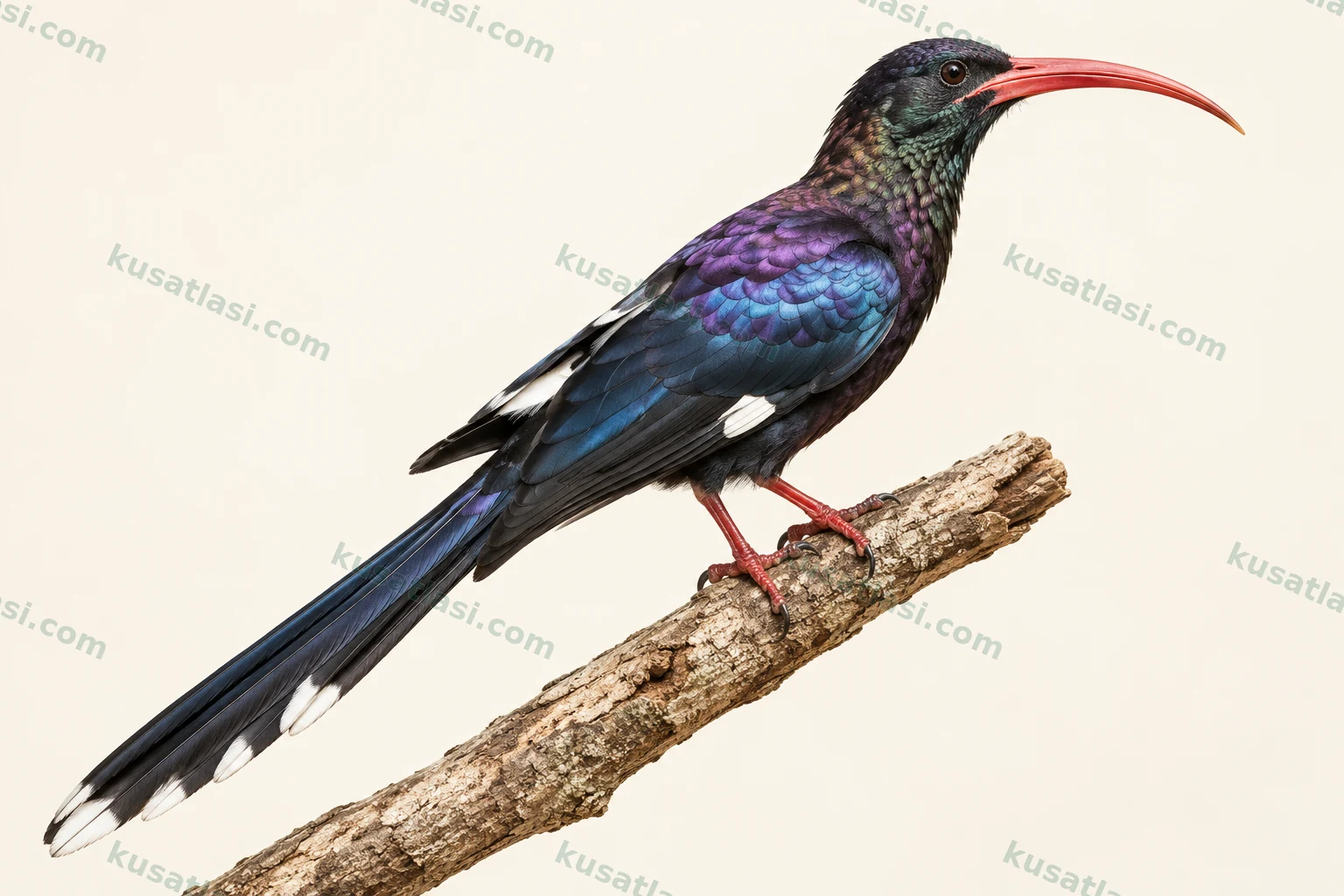
Long curved bill, graduated tail, dark violet-coppery iridescence and white wing/tail markings; helper care in Namibia has been researched directly.
Biometrics
Length
Male34–38 cm
Female34–38 cm
Shared species value
Wing length
Male14.81 cm
Female14.81 cm
Shared species value
Weight
Male78–90 g
Female72–82 g
Violet Wood Hoopoe
Namibia–Angola and the eastern African granti populationObservation guide in its natural range
Look for three features together
Do not rely on a single featureSlender long curved bill and long graduated tail.
Dark iridescent feathers; white markings on wings and outer tail.
Namibia–Angola and Ethiopia–Kenya granti are distant natural fragments.
Compare male and female
 FemaleMale
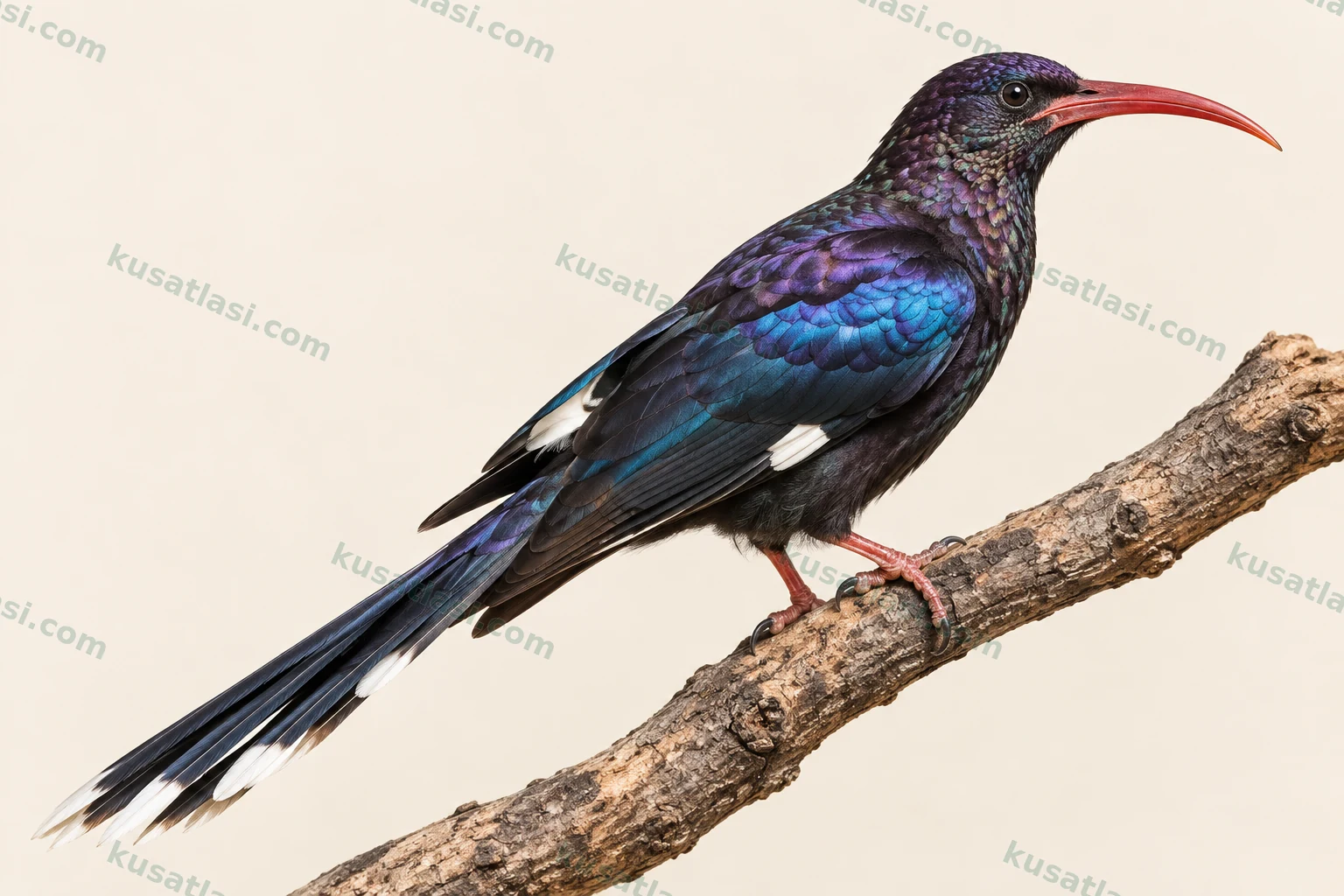
Adult sexes are similar; females may be smaller on average. In young, duller feathers and a short dark bill are assessed together; a related species’ sexing key is not transferred as certain.
Where to look in its natural range?
Watch groups around large cavity-bearing trees and surrounding arid woodland.
Resident. Breeding examples differ by population; Namibian data are not Kenya’s calendar.
January
Resident, with daily core-area use and feeding excursions. Namibia: A regional breeding period; an older atlas also reports records extending into May.
February
Resident, with daily core-area use and feeding excursions. Namibia: A regional breeding period; an older atlas also reports records extending into May. Kenyan granti: Regional breeding months in the specialist compilation; they are not combined with Namibia.
March
Resident, with daily core-area use and feeding excursions. Namibia: A regional breeding period; an older atlas also reports records extending into May. Kenyan granti: Regional breeding months in the specialist compilation; they are not combined with Namibia.
April
Resident, with daily core-area use and feeding excursions. Namibia: A regional breeding period; an older atlas also reports records extending into May.
May
Resident, with daily core-area use and feeding excursions. No verified regional date specific to this month was provided; this does not mean local absence.
June
Resident, with daily core-area use and feeding excursions. No verified regional date specific to this month was provided; this does not mean local absence.
July
Resident, with daily core-area use and feeding excursions. No verified regional date specific to this month was provided; this does not mean local absence.
August
Resident, with daily core-area use and feeding excursions. Kenyan granti: Regional breeding months in the specialist compilation; they are not combined with Namibia.
September
Resident, with daily core-area use and feeding excursions. Kenyan granti: Regional breeding months in the specialist compilation; they are not combined with Namibia.
October
Resident, with daily core-area use and feeding excursions. No verified regional date specific to this month was provided; this does not mean local absence.
November
Resident, with daily core-area use and feeding excursions. No verified regional date specific to this month was provided; this does not mean local absence.
December
Resident, with daily core-area use and feeding excursions. Namibia: A regional breeding period; an older atlas also reports records extending into May.
Nest, egg and incubation
The nest is in a tree cavity; the Namibian compilation gives 3–5 eggs. The female incubates, while the male and helpers deliver food. Independently verified incubation duration and age at first flight were not found.
Sharp calls and resonant group vocalisations; rocking forward and back accompanies some group displays.
Do not play recordings to attract birds; observe quietly, especially near nests.
Species information
Quick identification
Phoeniculus damarensis, recorded under the Turkish name Afrika Yeşil Sırtlı İbibik, is recognised by its long graduated tail, long slender downcurved bill, dark iridescent feathers and white wing and tail markings. Its current English name is Violet Wood Hoopoe. The word green in the Turkish heading does not mean its back should look bright green in every light; coppery and violet reflections matter especially in the southwestern African population. Appearance, locality and similar species are assessed together.
The current AviList treats southwestern African damarensis and eastern African granti within the same species. Older publications may treat granti as a separate species. Care, calendar and space-use details from one place are not combined indiscriminately for these distant populations. In particular, the detailed helper observations described here belong to a field study in Namibia; the same behaviour is not claimed to have been measured at the same frequency in every eastern African group.
General appearance and posture
Long bill and tail contribute strongly to the apparent length of the slender body. Dark feathers carry violet and coppery reflections; head, back and body can appear different as the light changes. Blue-green reflections may show on chin and throat. A single angle on iridescent feathers can make green-versus-violet distinctions appear more definite than they are; wait for several views during natural movement.
There is a white line on the folded wing and white markings on the outer tail feathers. Unequal feather lengths create the tail’s graduated outline. Leaves obscuring white areas or a closed tail can hide these details. Rather than assume an invisible white patch from an illustration of a dark silhouette, confirm it in another posture.
The adult bill is red, sometimes with a dark base, and the short strong legs also have reddish tones. The slender bill appears suited to reaching into bark crevices; it is not a woodpecker’s thick straight bill. Movement on a branch or trunk supports identification alongside wing and tail pattern. A curved red bill alone cannot reliably separate nearby Phoeniculus species.
Males, females and young birds
Adult sexes have similar plumage colours; females may generally be smaller. The examined Namibian study assumed that bill-length and voice differences used in the related Green Wood Hoopoe could likewise help sex this species. This is not an independently verified, certain field key covering the entire species. A photograph with an apparently shorter bill is therefore not simply labelled female.
Young look duller, with a shorter dark bill; brownish tones may occur on chin and throat. A dark bill helps assess youth, but age must also be considered when comparing separate black-billed species. A distant red bill in shade may look dark too. Bill colour, plumage appearance and juvenile behaviour are evaluated together.
The specialist account describes eastern African granti as more violet, with less obvious coppery tones. This geographic difference is not equated with female or juvenile colouring. A Namibian bird’s appearance does not show that all Kenyan birds follow the same colour chart. When age or sex remains uncertain in an image, species identity can be assessed separately.
Appearance in flight
The long tail, dark body and white wing markings may become conspicuous during movements between trees. White on the outer feathers may be clearer in a spread tail than when perched. Sun angle can change iridescence in flight; one dark or greenish instant alone does not select a related species. Examine back and head when the bird perches again.
Travelling to and from tree cavities is not only a flight-identification feature; it may relate to everyday resting, feeding or breeding. Carrying food to a nest is distinguished from arriving merely to roost in a cavity. Natural tree-to-tree movements without flushing the bird can be enough to see long-tail proportions and white pattern. No unverified underwing mark is added as a certain key.
Voice and behaviour
It may occur in noisy groups; sharp calls and resonant communal, laugh-like vocalisations are described. The Namibian field study observed groups calling together and rocking forward and back when another group approached their defended core. Several birds calling together is not one male’s song. Behavioural similarity with Green Wood Hoopoe calls for voice, appearance and geography to be used together.
Non-breeding group members may bring food to the incubating female and young. Both male and female helpers occurred in field observations; a bird feeding the incubating female is not thereby incubating itself. Food sometimes reached small chicks via the female, whereas other birds fed older chicks directly. Cooperative care alone does not make every helper a biological parent.
Similar species
Green Wood Hoopoe Phoeniculus purpureus has a similar long bill and tail, white markings and group behaviour. The Namibian study used its greener back sheen against damarensis’ duller coppery appearance. Light-dependent colours and mixed groups complicate identification, however; one difference in sheen is not a certain identity or hybrid diagnosis.
When comparing black-billed Phoeniculus species, age, the whole plumage and locality matter as much as bill colour. Young damarensis can have dark bills. Listing every black-billed species as a routine possibility at the same place without checking range is misleading. A suitable comparison combines several appearance details with natural distribution.
World distribution
Two distant natural populations remain within the current species: arid woodland of Namibia and Angola in southwestern Africa, and granti around Ethiopia and Kenya in eastern Africa. The entire African space between them is not filled in as continuous distribution. Namibia’s riverside tree belts and surrounding savannas are important parts of the regional habitat. An older account covering Namibia and Angola alone is not used to ignore current inclusion of granti.
Status within its natural range
Its current global category is Least Concern. A dated Namibian conservation account used a higher threat category for the local population; this regional assessment is not on the same scale as the global category. Loss of cavity-bearing trees, wood collection and habitat change are important local concerns. Older population estimates are not presented as a current census. Contact with Phoeniculus purpureus and possible hybridisation have been investigated; presence in a mixed group alone does not prove that every bird is a hybrid.
Seasonal movements
It is described as resident, using space in groups. Daily feeding excursions in Namibia may extend beyond a small defended core into broader surrounding woodland. This is not seasonal intercontinental migration. Separate eastern and southwestern populations do not establish a regular migration route between the two areas either. The map shows only supported geographic scope and licensed observation samples; no artificial line joins the two fragments.
Breeding habitat
Arid and semi-arid woodland and belts of large trees in seasonal watercourses are important. Namibian research found birds defending core areas containing large cavity-bearing trees and feeding in more sparsely wooded surroundings. A dry riverbed on the observation day does not remove the role of its large trees. Assess tree structure suitable for roosting and nesting as well as the extent of open savanna.
Nest site
It nests in natural tree holes and old woodpecker or barbet cavities; nest-box use was also observed in the field study. Direct observations in Namibia report nests with four and five eggs; a dated regional compilation gives 3–5. The female incubates, while the male and non-breeding helpers bring her food. Independently verified incubation duration and age at first flight for the current species were not found in this research. Days borrowed from a related species are not used as certain values.
Daily habitat use
A core containing cavity trees and a wider feeding area are different things. Field tracking of four Namibian groups found defended cores of about 12 hectares and wider daily-use areas of 60–150 hectares. These are area measurements for that sample, not fixed requirements of every group of the species. Communal roosting in a cavity at the end of the day is assessed separately from a nest’s presence. Keeping old cavity-bearing trees matters to both uses.
What does it eat?
It feeds mainly on insects and other small animal foods. Regional specialist accounts report insect larvae, caterpillars, grasshoppers and termites, as well as small geckos. Communal feeding at termite emergences was observed directly in the Namibian field study. These records describe food types, not identical prey percentages throughout the range. An individual prey record from eastern Africa is not added to Namibia’s entire annual diet.
How does it find food?
It reaches its long curved bill into cracks in trunks and branches for small prey. It may also feed on the ground; the Namibian study saw other group members descend after one bird successfully obtained food there. After a short capture, food may be carried to a branch; with abundant termites birds may stay on the ground longer. The study’s proportion of time spent on the ground is not the proportion of the whole diet obtained there; time in trees also includes resting and social behaviour. This distinction prevents describing the bird as entirely ground-feeding.
Helpers perform different nest duties
The Namibian field study directly observed non-breeding males and females bringing food to the incubating female and participating in chick care. Helping does not mean that each bird sits on eggs. Small chicks may receive food via the mother, while other birds feed growing chicks directly. The stage of care and individual providing it are described separately; not every group member is assumed to do the same task.
Defended space and used space differ
A group may strongly defend a narrow core of large cavity-bearing trees while feeding over a broader surrounding area. Seeing only the boundaries disputed by a group does not measure its whole habitat. The area differences found in four groups make this distinction concrete. The same number is not generalised to the entire species without measurements in wetter areas or another geographic population.
A dry riverbed may still matter
Large watercourse trees provide cavities and roosting sites even without running water. Surrounding sparse woodland may supply food, but not every tree has an equally large cavity. Treating dead or old trees as useless firewood overlooks daily resting and breeding places. Conservation needs consider tree structure as well as tree numbers.
Sheen alone does not establish species identity
Classification of Phoeniculus damarensis and the related Green Wood Hoopoe has been scientifically debated. Genetic samples, contact zones and appearance differences have been assessed together; the current checklist retains two species. Two appearances in a mixed group do not alone prove hybrid ancestry for every bird. Violet or green light in a photograph is not a direct measurement of genetic identity either.