

World Birds IUCN statusLC · Least ConcernGlobal IUCN category. BirdLife v10 (2025); taxon matching: AviList 2026 / IOC 15.2; checked: 29.10.2026. The list year is not the species assessment date. Source and method · BirdLife OrderBucerotiformesHornbills FamilyBucerotidaeBucerotidae
African Grey Hornbill
Lophoceros nasutus
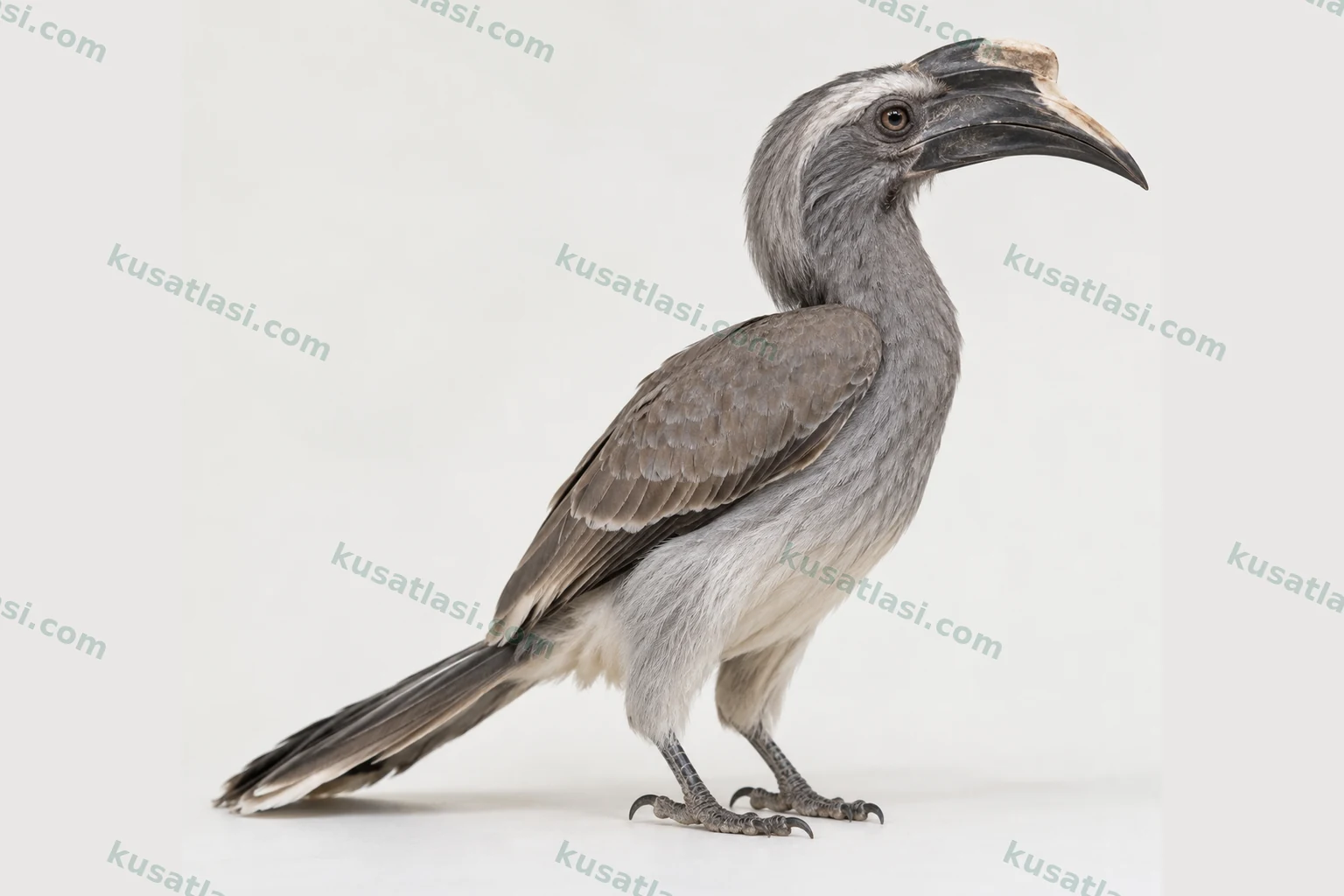
The grey-brown body, pale eyebrow, large curved bill and long tail are recognized together. The adult male’s bill is darker; the female’s upper bill is paler with a reddish tip.
Biometrics
Length
Male45–51 cm
Female45–51 cm
Shared species value
Wing length
Male22.07 cm
Female22.07 cm
Shared species value
Weight
Male172–258 g
Female163–215 g
African Grey Hornbill
Suitable wooded savannas of sub-Saharan Africa and southwestern ArabiaObservation guide in its natural range
Look for three features together
Do not rely on a single featureThe eyebrow extends backwards from above the eye; pale feather edges give the wings a patterned appearance.
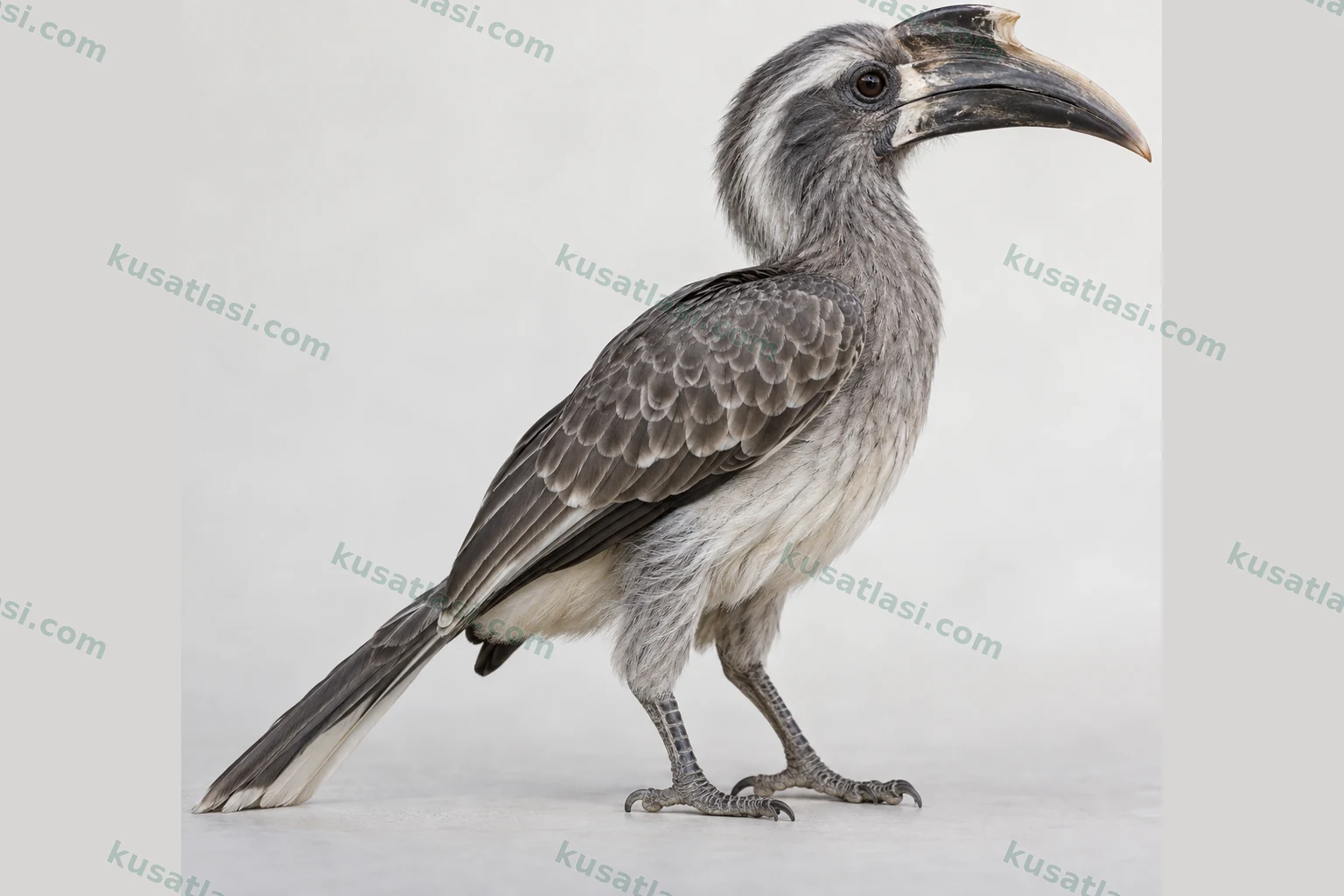
The male has a dark bill with a pale base; the female has a pale upper bill and reddish tip. The same definite sex rule is not applied to young birds.
Check the tail pattern together with the bill; flight style alone does not distinguish the species.
Compare male and female
 FemaleMale
The dark and pale areas of the bill help in adults. Sex is not assigned from the bill tip alone without considering the undeveloped casque and pale bill colours of young birds.
Where to look in its natural range?
Watch high branches in open woodland and thorn woodland. In Arabia, wooded valleys and suitable foothills are also natural habitat. Do not interrupt food deliveries by approaching the cavity entrance.
This is mainly a resident species. West African and Zimbabwean examples give different breeding periods. In the South African account, the first heavy summer rains and an October–November peak in egg laying are important. This calendar is not a single shared season for Arabia or all of Africa.
January
Mainly resident; rainfall, food and local conditions affect breeding timing. The West African specialist account places breeding examples within December–April.
February
Mainly resident; rainfall, food and local conditions affect breeding timing. The West African specialist account places breeding examples within December–April.
March
Mainly resident; rainfall, food and local conditions affect breeding timing. The West African specialist account places breeding examples within December–April.
April
Mainly resident; rainfall, food and local conditions affect breeding timing. The West African specialist account places breeding examples within December–April.
May
Mainly resident; rainfall, food and local conditions affect breeding timing. No verified regional date specific to this month was given; this does not imply local absence.
June
Mainly resident; rainfall, food and local conditions affect breeding timing. No verified regional date specific to this month was given; this does not imply local absence.
July
Mainly resident; rainfall, food and local conditions affect breeding timing. No verified regional date specific to this month was given; this does not imply local absence.
August
Mainly resident; rainfall, food and local conditions affect breeding timing. The Zimbabwean specialist account places breeding examples within August–November.
September
Mainly resident; rainfall, food and local conditions affect breeding timing. The Zimbabwean specialist account places breeding examples within August–November.
October
Mainly resident; rainfall, food and local conditions affect breeding timing. The Zimbabwean specialist account places breeding examples within August–November. The South African Roberts account reports this as a month of peak egg laying.
November
Mainly resident; rainfall, food and local conditions affect breeding timing. The Zimbabwean specialist account places breeding examples within August–November. The South African Roberts account reports this as a month of peak egg laying.
December
Mainly resident; rainfall, food and local conditions affect breeding timing. The West African specialist account places breeding examples within December–April.
Nest, egg and incubation
The female closes the cavity entrance from inside, and the male brings food through the narrow slit. The South African account reports three–five eggs, incubation of about 24 days and a nestling period of 43–49 days. The Arabian specialist book gives two–five eggs and 24–26 days of incubation. The female may emerge when the oldest nestling is 19–34 days old; this does not mean the young leave the nest at the same age.
A series of thin, whistling, plaintive notes given with the bill pointing upward and the wings moving. Written syllables do not replace a real recording or provide certain identification on their own.
Do not play recordings to attract birds; observe quietly, especially near nests.
Species information
Quick identification
African Grey Hornbill Lophoceros nasutus is a woodland bird recognized by its long tail, conspicuous large curved bill, grey head and neck, and pale eyebrow. The body is generally grey-brown, paler below. Adult bill colour differs between the sexes: the male’s is mainly dark with a pale basal area, while the female’s has a more ivory-coloured upper part and a reddish tip. Check the eyebrow together with the bill; a large bill alone does not distinguish the species.
The accepted scientific name is Lophoceros nasutus and the English name is African Grey Hornbill. The name Tockus nasutus in older publications reflects a change of genus. Another hornbill's measurements or breeding period are not transferred without checking source identity. “African” does not mean naturally absent beyond the continent: southwestern Arabian populations are addressed in distribution.
General appearance and posture
The long tail and bill are conspicuous in its silhouette.
The head and neck are grey, while the back and wings are darker and brownish. Pale wing-feather edges create pattern. The pale eyebrow runs above the eye backwards. Light and age change its prominence; a glint is not a real feather line. Eyes are described as brownish-red and feet dark. The strong bill defines the head outline; a suitable side view makes its colour divisions easier to see.
A small casque rises at the upper bill base. It is much less showy than huge casques of large forest hornbills. Size can vary with sex, age and geographical form. Failure to see it in a dark photo does not exclude the species. Bill, pale eyebrow and tail pattern together are more reliable. The undeveloped casque of young birds must be taken into account when assessing their age.
The tail is long and dark, with pale tips or areas on lateral feathers. Pale colour is not equal on every feather. Small red-billed hornbills can have other tail arrangements, so length alone is insufficient. Pale lateral parts may hide when closed. A spread rear or underside view improves comparison. No certain identification should rest on a silhouette without wing and tail detail.
Males, females and young birds
The adult male’s bill is generally dark with a cream-coloured wedge or patch at the base. The female’s upper bill is paler with a reddish tip, while the lower part may be darker. Examine boundaries in good light. A view of the tip alone does not allow the colour pattern of the whole bill to be reconstructed. Mud or carried food is not actual bill colour.
Both sexes share the grey-brown body scheme. General darkness alone is no sex key. The female casque may be smaller, but light and angle affect it. Colour divisions and casque should be used together; without the full bill no certainty is assigned. Food carrying alone does not identify a male at every stage of breeding; both sexes may provide care after the female emerges.
Young may have browner heads and weaker eyebrows. Pale bill base and reddish tip can resemble adult female colours, with casque not yet adult. The head, eyebrow, casque development and overall plumage must be assessed before both age and sex can be assigned with confidence. A small-looking bill alone is not youth either; perspective changes proportions.
Appearance in flight
Flight is slightly undulating, alternating beats and glides. Long tail, large curved bill and relatively rounded wings help in silhouette. Pale tail tips and a paler uppertail appearance can show in good light. Other hornbills also undulate; movement alone is not species diagnosis.
A short tree-to-tree flight may give a good side bill view. There is no need to flush it; watch the next perch. Artificially brightening a distant bird's bill in a photo is unreliable identification. Separate actually visible marks from unseen details; do not invent unverified underwing lines.
Voice and behaviour
Calls are described as thin whistling, plaintive note series. The bird may point its bill upward and move wings with the notes. Seeing this alongside tail, head and body posture helps find it among trees. Written syllables do not replace recordings; several hornbills may call in one wood, so check the source.
It may occur in pairs, family groups or small groups. Larger groups are reported outside breeding in some regions, but this does not mean that every sighting will involve a group. It mostly searches trees and bushes, sometimes ground. Nest food delivery may stand out. Do not obstruct it by approaching the entrance or placing a waiting position in a narrow route.
Similar species
Bill colour pattern is important when comparing it with Pale-billed Hornbill Lophoceros pallidirostris. Cornell distinguishes its paler bill lacking a dark component. In African Grey Hornbill, the dark and pale bill areas that vary between adult sexes are checked together with the conspicuous pale eyebrow. A pale tip alone does not turn female or young into another species.
Red-billed Tockus can differ in whole-bill colour and distribution of white in the tail. Current splits of groups formerly under one red-billed name are respected; a red-billed bird of unknown identity is not given a definite comparison solely from that broad name. Grey head, pale eyebrow, bill divisions and tail pattern belong together.
Global distribution
African Grey Hornbill has a broad sub-Saharan natural range. Its range extends from suitable woodland in West Africa to Ethiopia and East Africa, then south into appropriate parts of Zambia, Malawi, Zimbabwe and Mozambique. Botswana, northern Namibia and woodland in northeastern South Africa are also parts of its regional range. This does not fill Africa continuously; closed forest, open desert and southern climatic regions are not used identically.
The natural range is not limited to Africa. A specialist regional bird book describes resident breeding populations in southwestern Arabia. Not every non-African point is foreign or erroneous. These natural Arabian areas are retained in map checks, not clipped by the name. Conversely, a lone observation does not prove a resident native population anywhere else.
Status within its natural range
Expert accounts give global Least Concern. It can be locally common in suitable wooded savanna and open forest. Cavities, food and weather can influence local breeding. General category alone does not establish high breeding success in a particular region. One site's nest results do not equal the continent's population trend.
A South African study published in 2024 showed associations between rainfall, temperature and breeding outcomes. It does not give identical annual outcomes throughout the species' geography. The map model is a broad prediction based on observations, while the points are a sample of openly licensed records. Colours are not exact breeding limits or guaranteed presence in every woodland; locality, habitat and taxon identity are evaluated together.
Migration
Generally resident, it can form groups or wander locally outside breeding. Unverified long migration lines are not drawn. Rain- or food-related change is not a route without tracking of actual starting and ending points. Natural populations in Africa and Arabia do not mean all birds cross annually between them.
Breeding habitat
Look mainly in wooded savanna, open woodland, thorn woodland and dry scrub. Sparse large trees can be used. The South African account ranges from miombo to drier thorn cover. Treed gardens and some plantings also feature locally. These are not equivalent breeding sites; cavities and surrounding food matter.
Nest site
The nest is usually in a natural cavity in a trunk or large branch. The female seals most of the entrance from inside, leaving a narrow food slit. Regional sources also report other birds' excavations, rock crevices and nest boxes. This is not a recommendation to install any unmeasured box. Opening the seal or looking inside before natural adult emergence disrupts care.
The regional Roberts account gives three–five eggs, incubation by the female lasting roughly 24 days, and a nestling period of 43–49 days. Female emergence is earlier, when the oldest young is 19–34 days, and chicks may reseal the entrance. These ages describe different events: adult emergence is not fledging.
Daily space use
Feeding is mostly among trees and shrubs, but it can descend. Calling on an exposed branch increases visibility; watching one still trunk cavity does not show a full day. Keep distance at nests and delivery routes free. Watching from a distant open position, rather than waiting for a long time by the entrance, allows a more accurate assessment of the bird’s behaviour and food transfer.
What does it eat?
Small animals predominate: regional accounts include insects, spiders, small vertebrates and sometimes bird eggs or nestlings. Fruit is also eaten. Diversity does not mean identical proportions in all populations. A source's animal-food percentage is not extended everywhere without sample context. AVONET’s broad classification as an invertebrate feeder does not categorically exclude all records of fruit or vertebrate consumption.
The South African compilation includes figs, other local fruit, insect groups and small tree frogs. One large item delivered is not the whole day's diet. Nest deliveries and adults' own food do not always have the same observation scope. Specify actual prey identity or general group.
How does it hunt?
Moving between shrubs and trees, it can take prey from leaves, branches and other surfaces, and catch small ground animals. The large bill takes and carries prey, but size alone gives neither prey species nor success. Seeing where the prey was taken is more informative than photographing only an item being carried.
During nesting the male may supply female and young through the narrow slit. Care division may change after the female leaves. Record breeding stage alongside food carrying. Leaving food or offering animals to increase deliveries is not an observation measuring natural feeding; prefer no intervention.
Sealed entrance, continued food
Sealing does not cut nest birds off from outside. Food passes through the slit. Female emergence can change care-sharing and young may narrow the opening again. Female emergence and young leaving the nest are therefore separate events.
Rain and heat are not equivalent
Stander and colleagues' 2024 study compared three hornbill species across three breeding seasons in South Africa's Limpopo. Rainfall was associated with breeding initiation and success; higher air temperatures in African Grey Hornbill were associated with poorer outcomes and changing nestling mass. This concerns a particular semi-arid site. Later breeding timing and altered competition are possibilities discussed, not events already realized throughout the range.
African is not a boundary
English and Turkish names stress Africa, but native populations also occur in southwestern Arabia. A country or continent in a name does not establish endemism. Maps need expert range information for the right taxon rather than a name-derived line. Arabian native breeding areas and isolated records elsewhere do not share an evidence level.
A good view before bill colour
The female's pale upper bill may surprise observers accustomed to dark males. Undeveloped juvenile casques also affect age and sex. Check full bill profile, eyebrow and whole plumage together rather than one bright patch. Edited photographs with altered bill colour are not scientific sex or species keys.