

World Birds IUCN statusLC · Least ConcernGlobal IUCN category. BirdLife v10 (2025); taxon matching: AviList 2026 / IOC 15.2; checked: 29.10.2026. The list year is not the species assessment date. Source and method · BirdLife OrderCoraciiformesRollers and allies FamilyMeropidaeMeropidae
White-fronted Bee-eater
Merops bullockoides
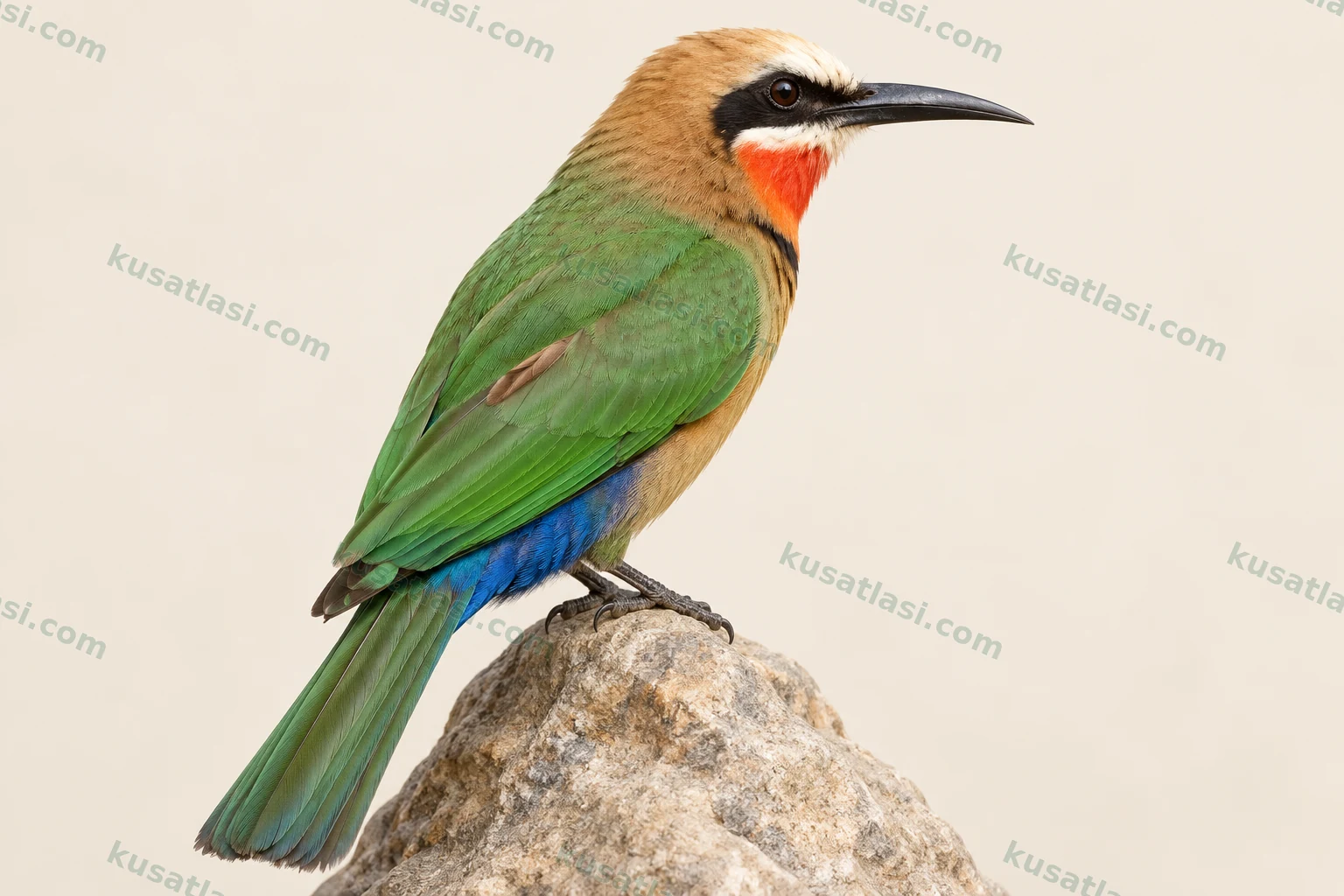
A social bee-eater of wooded savannas in central and southern Africa, distinguished by its white forehead and chin, red throat and dark face mask.
Biometrics
Length
Male23 cm
Female23 cm
Shared species value
Wing length
Male11.18 cm
Female11.18 cm
Shared species value
Weight
Male28–38 g
Female28–38 g
Shared species value
White-fronted Bee-eater
Wooded savannas and river environments of central and southern AfricaObservation guide in its natural range
Look for three features together
Do not rely on a single featureWhite forehead and chin, broad dark mask, red throat.
Green upperparts; warm cream-brownish belly and blue areas on the rear body.
It waits on exposed perches and catches flying insects; it may establish colonies in steep-bank cavities.
Compare male and female
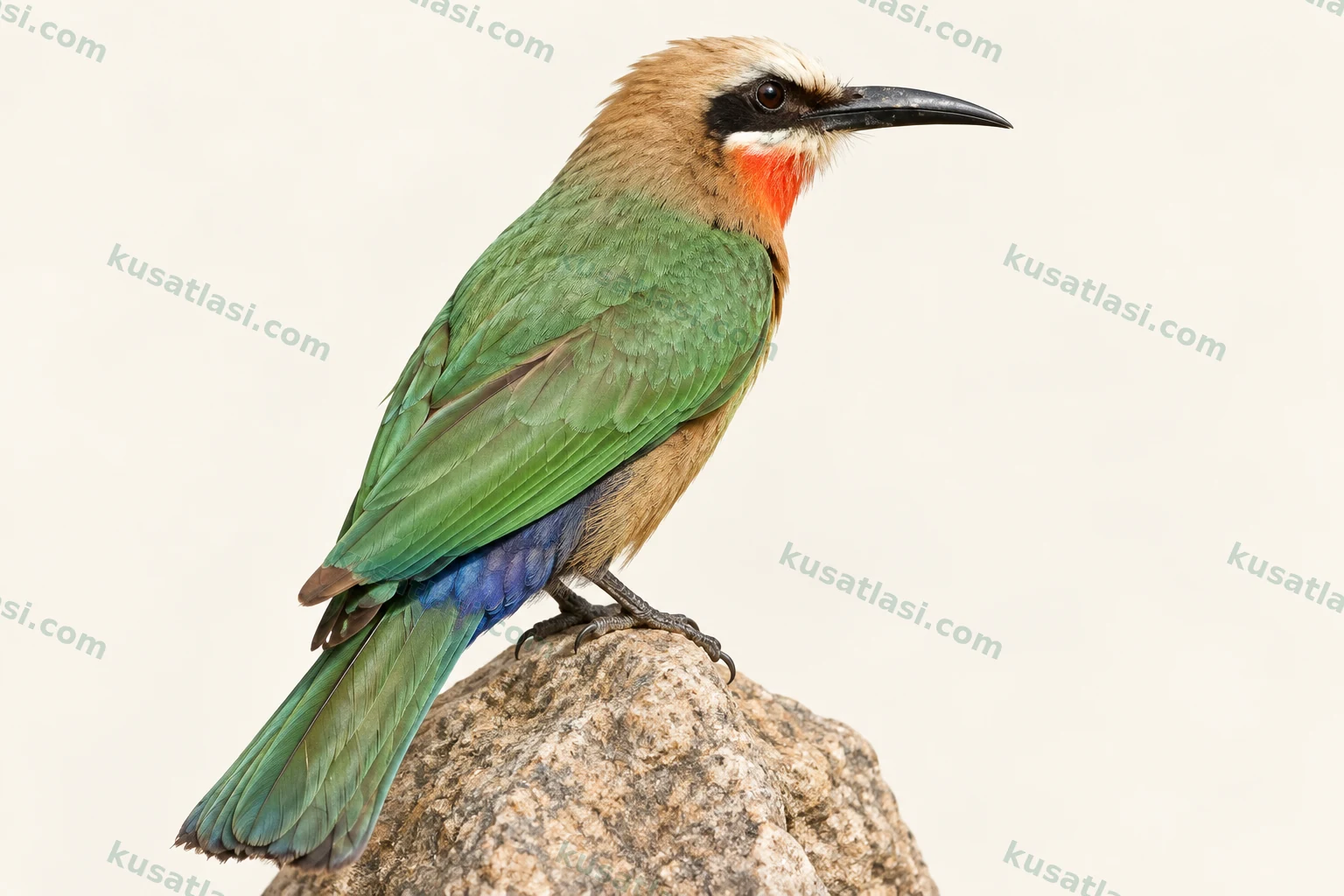 FemaleMale
Adult males and females are similar; young birds may have duller red and blue. Colour brightness or carrying food alone does not establish sex.
Where to look in its natural range?
Look on exposed perches with flying insects and near steep sandy banks, without disturbing the colony.
The species is resident; regional breeding periods do not share one calendar. Even nearby Kenyan colonies may be linked to different seasons.
January
Regular distant migration was not verified; local dispersal and movements around colonies occur. No verified regional date specific to this month was provided; this does not mean local absence.
February
Regular distant migration was not verified; local dispersal and movements around colonies occur. No verified regional date specific to this month was provided; this does not mean local absence.
March
Regular distant migration was not verified; local dispersal and movements around colonies occur. Nakuru, Kenya — populations associated with the long rains: a regional season approximately overlapping the main breeding period.
April
Regular distant migration was not verified; local dispersal and movements around colonies occur. Nakuru, Kenya — populations associated with the long rains: a regional season approximately overlapping the main breeding period.
May
Regular distant migration was not verified; local dispersal and movements around colonies occur. Nakuru, Kenya — populations associated with the long rains: a regional season approximately overlapping the main breeding period.
June
Regular distant migration was not verified; local dispersal and movements around colonies occur. No verified regional date specific to this month was provided; this does not mean local absence.
July
Regular distant migration was not verified; local dispersal and movements around colonies occur. No verified regional date specific to this month was provided; this does not mean local absence.
August
Regular distant migration was not verified; local dispersal and movements around colonies occur. Southern African atlas region: egg-laying records; September–November is the concentrated period.
September
Regular distant migration was not verified; local dispersal and movements around colonies occur. Southern African atlas region: egg-laying records; September–November is the concentrated period.
October
Regular distant migration was not verified; local dispersal and movements around colonies occur. Southern African atlas region: egg-laying records; September–November is the concentrated period. Nakuru, Kenya — other populations associated with the short rains: the main breeding period of different populations, not every individual’s second season.
November
Regular distant migration was not verified; local dispersal and movements around colonies occur. Southern African atlas region: egg-laying records; September–November is the concentrated period. Nakuru, Kenya — other populations associated with the short rains: the main breeding period of different populations, not every individual’s second season.
December
Regular distant migration was not verified; local dispersal and movements around colonies occur. Nakuru, Kenya — other populations associated with the short rains: the main breeding period of different populations, not every individual’s second season.
Nest, egg and incubation
The nest chamber lies at the end of a tunnel in a steep bank. The compiled typical clutch is 2–5 eggs with about 21 days of incubation; three eggs are most frequent in the Kenyan field account. Kenya’s development study found nest departure at 22–42 days, depending on conditions. Helpers may participate in care.
Calls are nasal, short and relatively soft, becoming sharper in alarm. Many individuals’ voices may overlap in a colony.
Do not play recordings to attract birds; observe quietly, especially near nests.
Species information
Quick identification
White-fronted Bee-eater Merops bullockoides is a colourful insect hunter of wooded savannas and riversides in central and southern Africa. White forehead and chin, a broad dark mask across the eye and a red throat provide the first identification combination. The upperparts are green, the breast and belly warm cream-brownish. Blue areas occur on the rump and rear underbody. Red throat alone is insufficient; similar relatives’ head lines, chin colour and natural geography are checked together.
Typical scenes include waiting on an exposed branch, making a short flight towards a flying insect, returning to a perch and exchanging calls with nearby birds. Holes in steep sandy banks may indicate a colony, but not every visible hole is an occupied nest. Identifying the species and counting breeding pairs are different tasks. Look for the white forehead–red throat–dark mask pattern rather than relying on distant holes or a brief green bird in flight.
General appearance and posture
The body is slender, the bill long and slightly downcurved. The bill is black, the eye dark brown and feet dark grey. The white forehead may be followed by a creamy-white area on the front of the head; rear head and nape are warmer brownish cream. A white area lies below the dark face mask, and the chin is white. Throat red lies between the white chin and warm pale breast. Extending red over the whole head or filling the white chin with red changes the true head pattern.
Back and wings appear dark green to blue-green. Flight feathers have dark tips and edges. Rump, undertail region and some feathers above the legs may be dark blue. Posture partly conceals them. Warm belly colour dominates in a bird facing the observer on a branch, whereas a rear view shows green upperparts. Head marks and body pattern must be considered together to avoid treating different angles of one bird as different species or sexes.
Males, females and young birds
Adult males and females look similar. White forehead, red throat, dark mask and green upperparts are expected in both. Blue body areas or brighter red alone do not reliably establish sex. A bird carrying food into a nest hole is not sexed by that role either; helpers may accompany the breeding pair in this species. Labelling every chick-feeding bird mother or father overlooks its social organisation.
Young resemble adults in general pattern, but red and blue may be duller. This can help assess age, although lighting, feather wear and photographic colour balance can partly produce the same effect. One pale photograph does not establish certain age or sex. Positions of white and dark head areas are particularly more reliable for identification than colour saturation alone.
A newly emerged young bird is not immediately expected to behave as an independent hunter. Nakuru research followed hunting competence and attainment of adult plumage as separate stages. A young bird may remain in the group; that does not mean it can never establish its own nest or will always become a helper. Kinship and care roles are established by following marked individuals, not by constructing a definite family tree during a brief visit.
Appearance in flight
After waiting on an open perch, it pursues flying insects. Brief acceleration, gliding and turns during pursuit may take different forms according to prey position. Green upperwings with dark tips, warmer pale underwing colour and dark undertail are visible at suitable angles. Blue rear-body feathers may become more conspicuous in flight. Turning within a small area to hunt insects differs from a scene of steady one-way migratory flight.
Flying over a river or lakeshore does not show fish hunting; flying insects form the basis of feeding. Some prey may be taken near the water surface. Watching aerial hunters does not require blocking a colony hole. From a distant view of an open feeding perch, returning flights and prey carried in the bill may be easier to see.
Voice and behaviour
Some frequent calls are nasal, relatively soft and short; alarm calls may be sharper. Overlapping voices of many colonial birds make one individual’s full call sequence difficult to distinguish. Voice helps locate birds, but a brief call imitation alone is not a certain identification without seeing head pattern and surroundings.
The species both nests colonially and may form social systems in which helpers participate in chick care. Kenyan marked-bird studies also documented close relatives joining ongoing nests later as helpers. A group defending its feeding area does not mean every group in the colony shares one common area. Colony life is not only cooperation; competition for nests and mates and laying eggs in another nest have also been studied.
Similar species
1. Red-throated Bee-eater Merops bulocki has similarly green upperparts and a red throat. White-fronted Bee-eater’s clear white forehead-and-chin pattern is important for comparison; M. bulocki head colours may also vary geographically. The two scientific names denote different taxa; similar names or throat colour do not justify transferring breeding data from one to the other. Geography helps but does not replace the head pattern actually observed.
World distribution
The natural range extends through wooded savannas of central and southern Africa. It reaches from the Gabon and Angola side towards Kenya and farther south through suitable parts of Zambia, Zimbabwe, Botswana, Mozambique and South Africa. Northeastern Namibia’s Zambezi region, Okavango and Chobe are important southern areas. The broad country list does not mean continuous dense forest or presence on every high-mountain slope; open hunting areas and suitable nesting banks both matter.
Status within the natural range
The current global category is Least Concern; local frequency and colony conditions vary. The southern African atlas describes riverine distribution, some more isolated inland populations and use of human-created nesting faces such as sand pits. Such use does not make every excavation safe. Colony-bank collapse, rising water or human disturbance may cause local losses.
Movements and migration
It is generally considered resident, without evidence of regular distant migration. Dispersal outside breeding and local movements may change seasonal recording frequency. Birds spending much time at colonies may also be less visible nearby; fewer observations do not directly mean migration. The tracked Kenyan populations are resident, but their social territories do not trace a route common to the continent. Environmental predictions and sample observations on the map are assessed separately from confirmed breeding points and monthly presence boundaries.
Breeding habitat
It uses wooded savanna, open woodland, scrubby grassland and open landscapes near rivers. A steep sandy or earthen face suitable for excavation matters. The southern African atlas distinguishes mountain forest from lowland woodland; a record in Zimbabwe’s highlands does not necessarily place the bird in high-mountain forest. Kenyan colonies’ breeding roughly overlaps one of the long or short rainy seasons; neighbouring colonies may not start together.
Nest site
A tunnel excavated in a steep riverbank, gully or suitable artificial excavation face ends in a nest chamber. Nakuru research reports cavities extending 100–200 cm. The specialist compilation gives a typical 2–5 eggs and incubation of about 21 days; the commonest clutch in the Kenyan field study was three. Parents and helpers may participate in care. Nest departure varied between 22 and 42 days in the Kenyan development research; no single fixed day is given.
Daily habitat use
It hunts insects from exposed branches and other perches offering a view; feeding space is not confined to the narrow face just in front of a colony. Family groups within a population may defend particular feeding areas. Not every hole in an earthen face is an active nest: old cavities, roosts and unfinished excavations may occur. Colony entrances are left clear; hands, lights or objects are not put into holes, and walking above the bank must not risk collapsing tunnels.
What does it eat?
It eats flying insects, with bees and wasps important prey. Flies, beetles, dragonflies, butterflies and other flying insects are also recorded. A bee percentage in one local feeding study is not the same year-round percentage across the continent. Seasonal and annual changes in Kenyan insect abundance may have affected provision of sufficient chick food. The name bee-eater does not mean a bird eating only bees or eliminating them all.
How does it hunt?
It watches prey from an open perch, catches it in flight and often returns to the perch. Longer aerial pursuits are also possible. Accessibility depends on more than insect numbers: rain and wind can change both insect flight and the bird’s catching task. Prey carried to chicks and prey immediately swallowed by adults are separate observation samples. Kenyan studies show helpers also carrying food to nests; not every bird with an insect in its bill is assumed to be a parent at that nest.
Colony and care group are different scales
Many nests may occupy one earthen bank, yet the care unit and feeding group around each nest can be separate. Helpers may accompany the breeding pair; some individuals join relatives’ ongoing nests after their own attempt fails. A few birds on one branch cannot explain this social organisation. Following marked individuals over long periods helps distinguish kinship and care roles.
Nearby colonies may have different calendars
Nakuru research found populations a few kilometres apart breeding in different rainy seasons. Nearby places therefore need not share one calendar. Besides the main season, second attempts were documented at Baharini in some years. Observing this in one area does not mean every bird raises young twice every year.
Development changes with feeding conditions
In the Kenyan development study, young could develop more slowly during food shortages, resume development as conditions improved and leave the nest. Successful departure ages ranged from 22 to 42 days. The explanation that this flexibility lowers daily energy requirements and allows survival through brief shortages is the researchers’ adaptive hypothesis, not a directly measured sequence of every physiological step.
Cooperation does not remove competition
Helpers carrying food contribute to chick care. Yet laying eggs in other nests and competition for nest holes or mates also occur within colonies. The long-term Nakuru work documents benefits and costs of social life. Reducing these findings to one attractive colony photograph or an unchanging success percentage for all Africa would lose the real diversity of this social system.