

World Birds IUCN statusLC · Least ConcernGlobal IUCN category. BirdLife v10 (2025); taxon matching: AviList 2026 / IOC 15.2; checked: 29.10.2026. The list year is not the species assessment date. Source and method · BirdLife OrderCoraciiformesRollers and allies FamilyMeropidaeMeropidae
White-throated Bee-eater
Merops albicollis
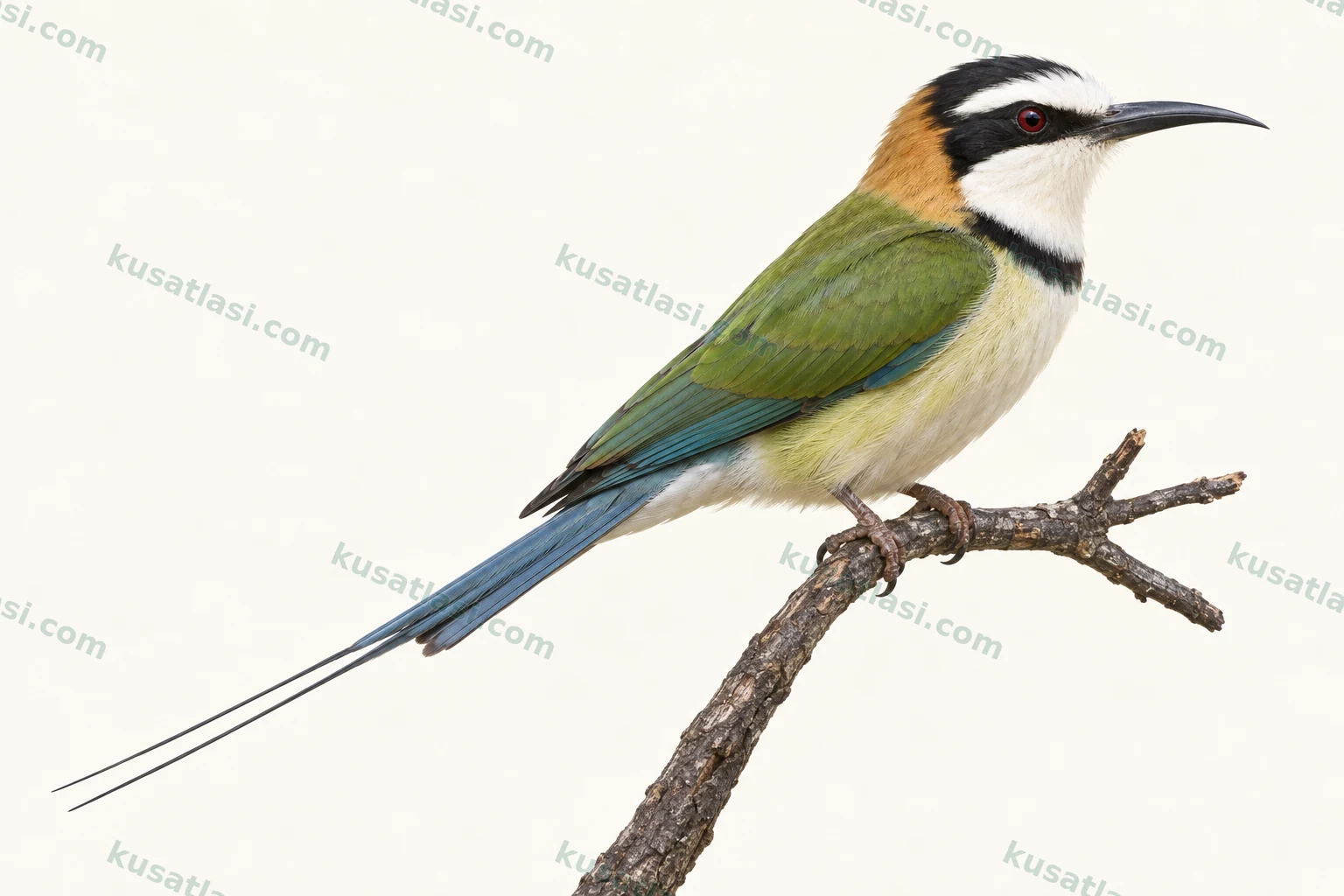
White forehead, broad white eyebrow and white upper throat, with a black crown, eye area and band below the throat. The body is slender and adults have very long central tail feathers.
Biometrics
Length
Male20 cm
Female20 cm
Shared species value
Wing length
Male9.76 cm
Female9.76 cm
Shared species value
Weight
Male20–32 g
Female20–32 g
Shared species value
White-throated Bee-eater
Sahel and southwestern Arabian breeding areas and tropical African nonbreeding areasObservation guide in its natural range
Look for three features together
Do not rely on a single featureLook for the white forehead and eyebrow alongside the black crown and eye area.
A dark band lies below the white upper throat.
Very young birds lack long central tail extensions. A short tail does not identify the sex.
Compare male and female
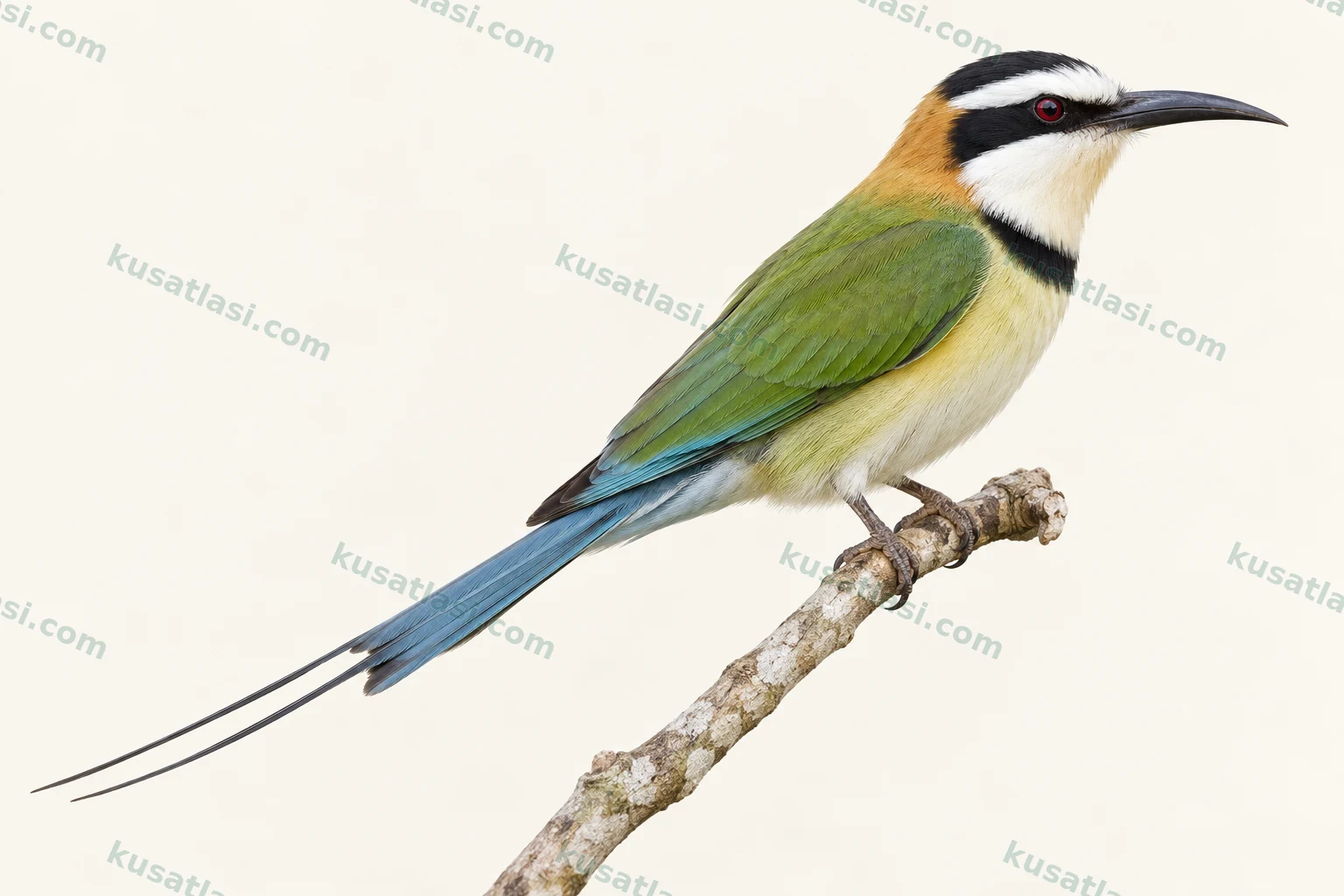 FemaleMale
Adult males and females are similar in colour. Very young birds lack the long extensions of the central tail feathers.
Where to look in its natural range?
Look in dry savanna and open scrub, and in wooded areas and forest edges outside the breeding season.
Breeding seasons vary regionally. The summer rains along the Sahel and spring in Kenya are separate examples. No single calendar applies across the entire range.
January
It is migratory and moves into areas of tropical Africa outside the breeding season. No verified regional date was provided for this month. This does not mean the species is locally absent.
February
It is migratory and moves into areas of tropical Africa outside the breeding season. No verified regional date was provided for this month. This does not mean the species is locally absent.
March
It is migratory and moves into areas of tropical Africa outside the breeding season. The specialist account for Kenya reports a regional nesting season.
April
It is migratory and moves into areas of tropical Africa outside the breeding season. The specialist account for Kenya reports a regional nesting season.
May
It is migratory and moves into areas of tropical Africa outside the breeding season. The specialist account for Kenya reports a regional nesting season.
June
It is migratory and moves into areas of tropical Africa outside the breeding season. The specialist account for the Sahel reports a regional breeding season in the context of rainfall.
July
It is migratory and moves into areas of tropical Africa outside the breeding season. The specialist account for the Sahel reports a regional breeding season in the context of rainfall.
August
It is migratory and moves into areas of tropical Africa outside the breeding season. The specialist account for the Sahel reports a regional breeding season in the context of rainfall.
September
It is migratory and moves into areas of tropical Africa outside the breeding season. No verified regional date was provided for this month. This does not mean the species is locally absent.
October
It is migratory and moves into areas of tropical Africa outside the breeding season. No verified regional date was provided for this month. This does not mean the species is locally absent.
November
It is migratory and moves into areas of tropical Africa outside the breeding season. No verified regional date was provided for this month. This does not mean the species is locally absent.
December
It is migratory and moves into areas of tropical Africa outside the breeding season. No verified regional date was provided for this month. This does not mean the species is locally absent.
Nest, egg and incubation
The nest is an unlined chamber at the end of a tunnel in the ground. The specialist account for Arabia reports 5–7 eggs. Incubation duration and time to first flight from the nest have not been verified for this species.
The call is dry, high-pitched and vibrating. Match it to the bird you see.
Do not play recordings to attract birds; observe quietly, especially near nests.
Species information
Quick identification
The White-throated Bee-eater Merops albicollis is a slender bee-eater with a white forehead, broad white eyebrow and white upper throat contrasting with black areas of the head. The adult's elongated central tail feathers make its outline noticeably longer. A green and bluish body is insufficient on its own. Compare the forehead, eye area, upper throat and black band below it on the same individual. The English name is White-throated Bee-eater. The white throat is distinct from the red throat of another species and from a generally pale belly.
The accepted scientific name is Merops albicollis. Aerops albicollis in older sources is a previous genus combination for the same bird. The modern list treats the species as monotypic. Finding the historical name major does not by itself justify adding a new subspecies or extending the range. A tracking study of a bee-eater between Europe and Africa does not apply to this bird simply because it belongs to the same genus.
General appearance and posture
The crown is black and the broad area crossing the eye is dark. The forehead and broad white stripe over the eye contrast strongly with those dark areas. The forehead white and the eyebrow may look close together, but they do not turn the black crown into a wholly white cap. The head pattern is clearer in a side view that shows the eye area. A single white stripe seen from behind is insufficient for a firm identification.
The upper throat is white. A broad black band crosses the lower neck and breast. The historical museum description notes a bluish lower edge to the band. The band below the white throat and the black around the eye are separate feathered areas. The pale throat may look compressed when the bird lowers its head and broader when it stretches its neck. This change in posture is not a different colour between the sexes or a change of plumage.
The nape and front of the back can show a warm golden or orange tinge. Green and bluish tones occur together over the rest of the upperparts. The old detailed description gives reddish flight feathers with green outer edges. Some outer wing feathers have dark tips. A closed wing need not show the same colours as a spread wing. A change in the angle of the light can make bluish areas look greener without changing the overall body colour.
The tail is bluish, with slightly green areas. In the adult, the two central tail feathers taper and extend past the others. Follow the extension from the base of the tail to distinguish it from a leg, branch or another bird's tail. A bird is not ruled out as this species if the feather is broken or extends beyond the photograph.
The pale appearance of the underparts can vary with greenish tones on the breast and flanks. The belly does not have the same dark green surface as the back. The bill is black, slender and curved downwards. The museum account describes pale brownish feet and a red adult eye. Eye colour can be hard to see in small or shaded images. The head pattern, pale throat and tail shape together provide more information than a photograph of eye colour alone.
Males, females and young birds
The adult female resembles the male in colour and pattern. The white eyebrow, black crown, pale upper throat and dark band below are shared. The length of the central tail streamers varies. Sources report longer streamers in males, but one streamer cannot determine sex with certainty without considering age, feather condition and breakage. An impression of large size in a photograph is insufficient to establish sex.
Young birds have duller colours and may have a more olive tinge to the green upperparts. The museum description notes pale edges to dark feathers on the head and back, a yellowish throat and a less distinct blue edge to the band than in adults. The central tail feathers of very young birds are not elongated. An individual without long streamers should not automatically be called female. Age, head pattern and the body are assessed together.
Appearance in flight
The slender body and long tail help recognise the adult's outline in flight over open country. The pale reddish areas and dark tips of the flight feathers look different from the green surface of the folded wing. A colour on one wing surface should not be attributed to the other. If the pale forehead and throat are briefly visible in flight, a new angle after the bird perches can complete the identification.
Voice and behaviour
The species can occur in groups. A modern field account describes a dry, high-pitched, vibrating call. Earlier observers described some regional calls as softer. These descriptions do not establish a precise sequence of syllables. Match the sound to the bird actually seen. Historical field accounts describe birds dispersing during the day and gathering again in the morning or evening. The daily movements of one group do not establish a fixed routine for all birds.
Similar species
The White-fronted Bee-eater Merops bullockoides has a pale forehead but a red throat. On the White-throated Bee-eater, look for the white upper throat together with the black band below. Compare the European Bee-eater Merops apiaster by its yellow throat and browner chestnut upper head. In both comparisons, consider light, age and head posture. A long tail or green body alone does not provide a certain identification.
Global range
It breeds in the Sahel belt south of the Sahara and in southwestern Arabia. Outside the breeding season it moves to forest edges and wooded areas farther south in tropical Africa. Current specialist sources distinguish the breeding populations of southwestern Saudi Arabia and western Yemen. One Arabian record does not establish a resident population throughout the peninsula.
Status in its natural range
The Sahel breeding belt extends east from Mauritania and Senegal in the west. Nonbreeding records are associated with different habitats reported from southern Senegambia to Uganda, and in some sources as far as northern Angola and northern Tanzania. Old museum localities do not define modern breeding limits. The scarce visits to places such as Oman and Israel described by OSME do not place those countries in the resident core range.
Movements and migration
Seasonal migration is important in the life of this species, and habitat differs between breeding and nonbreeding areas. The specialist account for Arabia reports a Red Sea crossing. A detailed route or sequence of countries followed by all individuals has not been verified. The Sahel breeding season associated with summer rain is not combined with Kenyan spring records into a single global egg-laying period. Observation cells without a stated season do not show a breeding area or tracked migration route.
Breeding habitat
The species breeds in dry savanna, open scrub and areas with soil and scattered trees. Outside breeding it can also occur in moist savanna, forest edges and farmland. A group seen at a forest edge cannot be identified as breeding on habitat alone. Open feeding space and ground suitable for digging tunnels together help explain the breeding habitat.
Nest site
The nest is an unlined chamber at the end of a tunnel dug in level or sloping ground. The specialist account for Arabia reports tunnels 1–2 m long and 5–7 eggs. It lists incubation duration and time to first flight from the nest as unknown for this species. Durations for similar species given in parentheses are not transferred here. Helpers may join breeding pairs in colonies, but each nest is not assumed to have the same number of helpers.
Daily use of habitat
Exposed branches and the surrounding airspace provide good views of the bird's natural movements. A bird entering a hole does not reveal the number of eggs or the bird's sex. Do not open the tunnel entrance or insert a light or tool. Observe the natural comings and goings and leave the soil and vegetation around the nest undisturbed.
What does it eat?
It feeds primarily on insects. Specialist sources report ants, honeybees and various flying insects. The word “bee” in the name does not mean all prey is bees. The historical field accounts examined describe groups catching insects in the air. Numerous captures on one evening do not establish yearly dietary proportions. Reports of fish or small vertebrates in other bee-eaters do not broaden the diet of this species.
How does it catch prey?
It can fly out from a perch to take prey or feed during flight. Historical West African accounts describe groups briefly perching on shrubs and low branches and catching insects flying nearby. A modern specialist account describes striking stinging prey against a branch and rubbing the prey's abdomen. A bill movement is not recorded as bee handling unless this behaviour is actually seen. Putting out food or forcing birds to fly changes their natural prey choices. Record separately the observations where prey can actually be identified.
A long tail suggests age before sex
The adult's central tail feathers extend beyond the main tail. Very young birds lack these extensions. The old museum description also notes the yellowish throat and duller plumage of young birds. A short-tailed bird is therefore not identified as female by its tail alone. Consider age clues, possible feather breakage and the bird's overall appearance together.
Gathering again in the morning and evening
In historical northeastern African observations cited by Dresser, groups dispersed during the day and came together again in the morning and evening. Other West African observations also describe groups catching insects. Behaviour from a particular time and place is valuable in its own context. It does not establish that all birds across Africa form groups of the same size at the same times. Field behaviour varies.
An old locality name is not necessarily a breeding site
The monograph's museum list includes specimens from the Nile, Kordofan, West Africa and coastal sites. A specimen collection date and the date of a nest with eggs provide different evidence. The place where a museum bird was found is not treated as a current nesting site. The habitats used during breeding and migration are considered separately. The old genus name Aerops also requires matching those records to the current Merops identity.
The black border below the white throat
The white and black areas form a distinct pattern on the head. A white forehead and eyebrow accompany the pale upper throat, with a dark band below. A younger bird's more yellowish throat and less blue band edge show why the adult pattern cannot be applied rigidly to all birds. Careful attention to the order of these areas and to age helps identify the bird more reliably than any single feather colour.