

World Birds IUCN statusLC · Least ConcernGlobal IUCN category. BirdLife v10 (2025); taxon matching: AviList 2026 / IOC 15.2; checked: 29.10.2026. The list year is not the species assessment date. Source and method · BirdLife OrderCoraciiformesRollers and allies FamilyMeropidaeMeropidae
African Green Bee-eater
Merops viridissimus
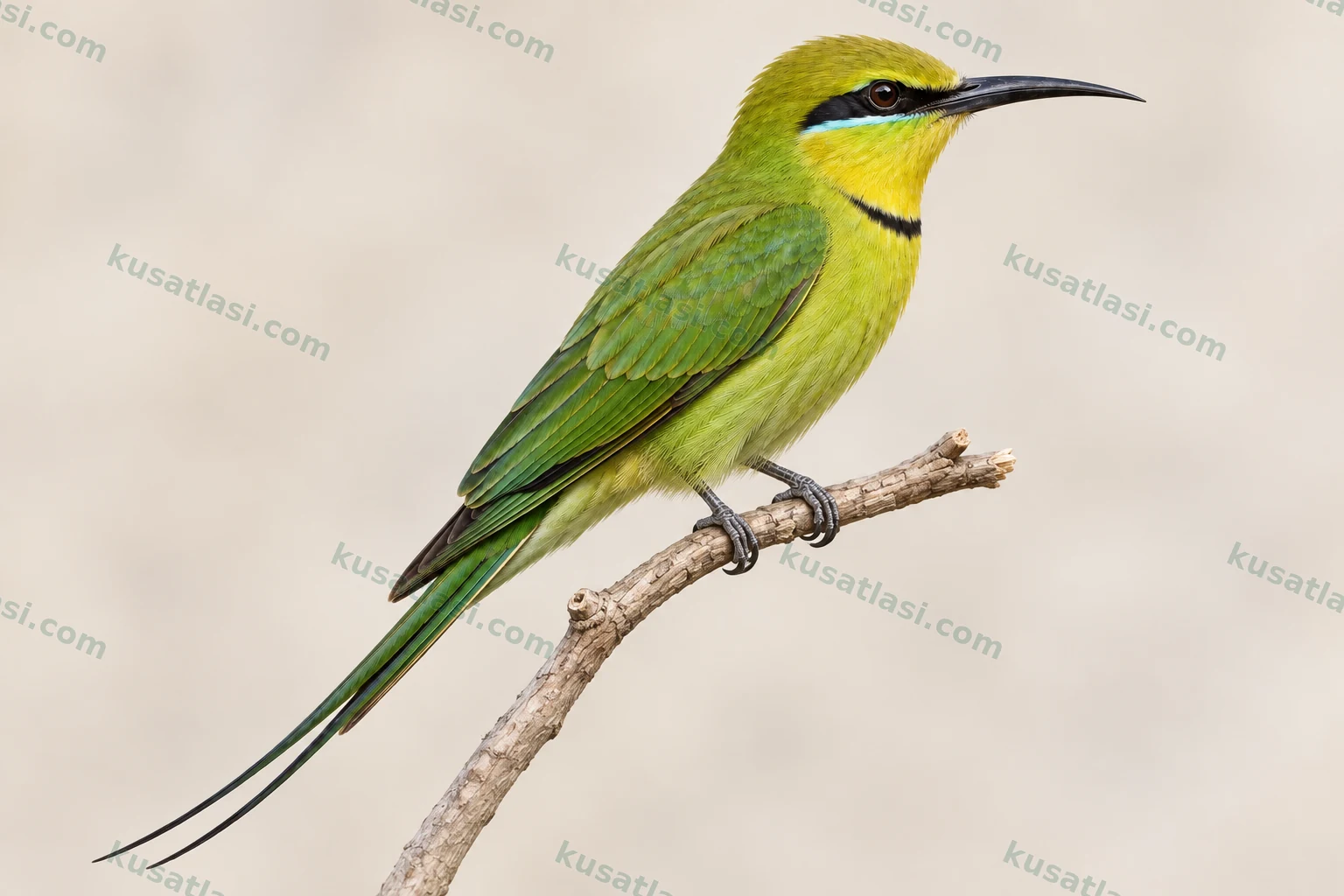
A yellowish-green body, dark eye-stripe, narrow black breast curve and elongated central tail feathers in adults.
Biometrics
Length
Male16–18 cm
Female16–18 cm
Shared species value
Length excludes the elongated central tail streamers, which can add more than 8 cm. The source does not give separate lengths by sex.
Wingspan
Male29–30 cm
Female29–30 cm
Shared species value
Weight
Male12–13.5 g
FemaleData unavailable
African Green Bee-eater
The Sahel and Nile ValleyObservation guide in its natural range
Look for three features together
Do not rely on a single featureA dark eye-stripe and a narrow black curve below the greenish-yellow throat are visible.
Adults have elongated central feathers; these may be missing in young birds or worn plumage.
An open wing shows bronze tones and a dark border at the tips; its appearance changes with the light.
Compare male and female
 FemaleMale
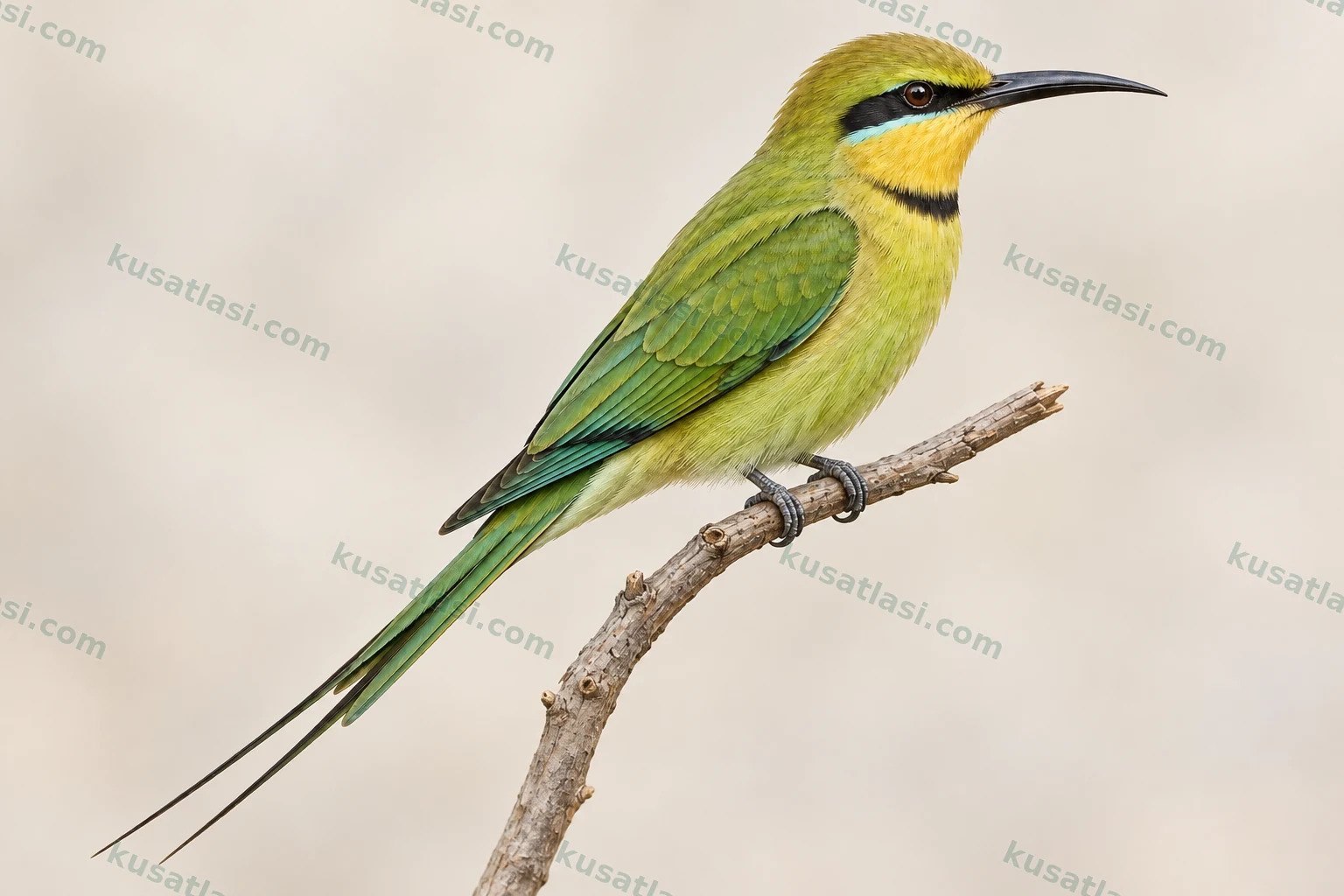
Adult sexes are very similar. Young may be paler with less-developed tail extensions; no single mark gives a certain sex identification.
Where to look in its natural range?
Watch perches in open scrub and around irrigated farmland.
Historical Egyptian examples do not provide a shared breeding calendar for all of Africa.
January
Regional residency, partial migration and dispersal occur; continuous presence at the same place is not assumed. No verified regional date specific to this month was given; this does not mean local absence.
February
Regional residency, partial migration and dispersal occur; continuous presence at the same place is not assumed. No verified regional date specific to this month was given; this does not mean local absence.
March
Regional residency, partial migration and dispersal occur; continuous presence at the same place is not assumed. No verified regional date specific to this month was given; this does not mean local absence.
April
Regional residency, partial migration and dispersal occur; continuous presence at the same place is not assumed. Egypt, a historical example from 1897: A clutch was recorded on 19 April; this does not define the main season throughout the range.
May
Regional residency, partial migration and dispersal occur; continuous presence at the same place is not assumed. No verified regional date specific to this month was given; this does not mean local absence.
June
Regional residency, partial migration and dispersal occur; continuous presence at the same place is not assumed. No verified regional date specific to this month was given; this does not mean local absence.
July
Regional residency, partial migration and dispersal occur; continuous presence at the same place is not assumed. No verified regional date specific to this month was given; this does not mean local absence.
August
Regional residency, partial migration and dispersal occur; continuous presence at the same place is not assumed. No verified regional date specific to this month was given; this does not mean local absence.
September
Regional residency, partial migration and dispersal occur; continuous presence at the same place is not assumed. No verified regional date specific to this month was given; this does not mean local absence.
October
Regional residency, partial migration and dispersal occur; continuous presence at the same place is not assumed. No verified regional date specific to this month was given; this does not mean local absence.
November
Regional residency, partial migration and dispersal occur; continuous presence at the same place is not assumed. No verified regional date specific to this month was given; this does not mean local absence.
December
Regional residency, partial migration and dispersal occur; continuous presence at the same place is not assumed. No verified regional date specific to this month was given; this does not mean local absence.
Nest, egg and incubation
The nest is a tunnel in the ground, dug by both partners. Egyptian examples from 1897/1899 contained 6–7 eggs; incubation and first-flight times in days have not been verified.
The specialist summary describes a descending dry, rolling sound and a brief clicking note; match it with the bird’s appearance and geography.
Do not play recordings to attract birds; observe quietly, especially near nests.
Species information
Quick Identification
African Green Bee-eater Merops viridissimus is a slender bee-eater of open country along the southern edge of the Sahara and in the Nile Valley. Its general colour is yellowish green; the thin black eye-stripe, dark curve between throat and breast and elongated central tail feathers make identification easier when seen together. Geography is considered first, followed by the head, throat, breast band and tail pattern. Yellowish light may make the bird look brighter; colour alone is not certain identification.
Older sources also call the African bird Merops orientalis viridissimus. That name does not make every Asian study of M. orientalis behaviour and biometrics applicable to the African species. Alexander Koenig's observations from Egypt, published in 1920, use Merops viridissimus directly, which is useful for matching the current taxon. His Egyptian colour and nesting observations concern their own region; they do not establish one measurement or breeding calendar for all African subspecies.
General Appearance and Posture
A long, slightly downcurved bill, slender body and relatively short legs create the silhouette of a bee-eater catching flying insects. Its green body feathers make a vivid colour even in dry Sahel surroundings; the dark line through the eye divides the head. The greenish-yellow throat and the black curve crossing the upper breast just below it are parts of the facial pattern. Adult central tail feathers may project beyond the body; worn or broken feathers can make the silhouette look short.
Males, Females and Young Birds
Male and female share the general green appearance; some field guides describe the female's patterning as weaker. One pale colour or long tail feather cannot establish sex with certainty, particularly if feathers are worn. Young birds may look paler than adults, and their extended central tail feathers may not be fully developed. No exact age calendar is written, because detailed species-specific research on which feathers young moult in which month was not verified. Subspecies in Egypt, Sudan and the Sahel can differ in plumage tone, so not every individual should be fitted to the green in a single photograph.
In young birds, pale colour and not yet fully developed tail streamers are assessed together. BirdForum's specialist summary reports a paler appearance on the rear belly that can approach white. Koenig, by contrast, said he did not directly know the young bird and inferred some features from relatives. Those historical guesses are not used as verified juvenile plumage. Adults of both sexes have green and bronze tones; a bluish edge to the face does not automatically turn the bird into the Asian or Arabian species.
Appearance in Flight
This bee-eater waits on an exposed perch and makes a short sally towards a flying insect. In the air, the slender body, pointed wings and feathers extending from the centre of the tail can be seen. In Koenig's Egyptian observations, birds caught insects in flight and sometimes returned to a perch to handle them. Although this movement is widespread in the family, it does not identify the species alone; other Merops species also hunt in the same region. The black eye-stripe, greenish throat and narrow dark breast border can be seen in flight only at a suitable distance and angle. No unverified underwing colour mark is added. Rather than turning a brief green flash into a certain species record without a photograph, wait for the bird to perch again.
Tail extensions may be more obvious in fully feathered adults; they may be shorter in damaged or young birds. Thus, extension length alone does not establish sex or species. In Koenig's Egyptian birds, gold-bronze tones became more apparent when the outer surfaces of the wings opened. The dark tips of the large flight feathers and elongated tail centre are read alongside the perched appearance. These colours depend on light direction; the same bird can look vivid green from one angle and warmer bronze from another. Rather than choosing a colour name at one instant of flight, wait until wing, tail, throat and eye-stripe are visible together.
Voice and Behaviour
Koenig describes Egyptian birds frequently leaving a perch to catch flying insects, sometimes landing to collect insects on the ground and leaving unswallowed hard parts beneath the perch. This is feeding behaviour directly observed in a particular region. His old text also includes an imitation of the voice, but a few syllables written a century ago are not a modern acoustic measurement. Although voice differences are discussed in current species separation, African, Arabian and Asian green bee-eaters should not be distinguished by one written sound match alone. On hearing a voice, check the perched bird's throat, face and region as well.
Open scrub, dry farmland surroundings and insect-rich places near water may be used for perching and hunting.
Similar Species
1. Asian Green Bee-eater Merops orientalis creates the easiest name confusion because of the former broad species concept. It is separate in the current list; its Asian distribution and bluer throat area are compared with the African bird's greenish-yellow throat. An old photograph's label alone is not evidence of the current taxon.
2. Arabian Green Bee-eater Merops cyanophrys is a separate species occurring around Arabia. Blue areas on its face and throat and shorter central tail extensions help the comparison; one worn tail does not provide a firm verdict.
3. Little Bee-eater Merops pusillus is another small green bee-eater in Africa. Throat colour, breast border, tail structure and the habitat where it is found are examined together. “Small and green” is not enough to separate these two species.
Global Distribution
African Green Bee-eater extends eastwards from the Senegal region in West Africa through the Sahel towards Sudan and Ethiopia. Its resident range reaching Egypt along the Nile Valley is another branch of the distribution. In the IOC's three-subspecies arrangement, viridissimus is associated with Senegal to Ethiopia, flavoviridis with Chad to eastern Sudan, and cleopatra with northern Sudan and Egypt's Nile Valley.
Status Within Its Natural Range
These are broad biogeographical summaries framed by country names; they do not mean the entire Sahara is continuously occupied habitat. Oiseaux.net and AVONET associate the species with semi-open, scrubby surroundings. Not every waterside, desert tract or town is equally suitable habitat. When producing a current map, individual observations, specialist range polygons and subspecies identity need to be kept separate.
The current assessment is Least Concern. Suitable perches and insect areas may occur where dry scrub and irrigated farmland meet; treeless stony areas are not equally suitable. Koenig's descriptions of common and sparse sections along the Nile show that even the river corridor was not used continuously at the same density.
Movements and Migration
Koenig's Egyptian observations describe birds present all year; the current specialist summary discusses partial migration particularly in northern populations and dispersal in others. Egyptian residency is therefore not applied to the whole Sahel. Movements tracking local water and insect conditions, regular seasonal migration and expansion of the range over time are separate processes. No shared intercontinental route is drawn without records supporting which group moves when and where. A bird occupying the same perch for several days does not prove year-round residence there either.
Breeding Habitat
The species occurs in arid and semi-arid open country near sparse shrubs and branches usable as perches. AVONET's habitat classification emphasizes scrub and semi-open structure; Egyptian birds in the Nile Valley may also benefit from insects near water and irrigated farmland. It would be wrong to describe these two geographical settings with one unchanging plant list. Suitable soft ground or a fairly steep face enables a nesting burrow to be excavated. Modern sources do not show that every subspecies uses only the same soil type, however.
Nest Site
In Koenig's Egyptian account published in 1920, nests are tunnels dug in the ground, ending in a widened chamber where eggs are laid. The birds used vegetated earth mounds, and both partners took part in digging. In 1897 and 1899 he examined several nests containing six or seven eggs and measured one particular nest's tunnel at 130 cm. These are regional historical examples, not obligatory egg counts and depths for every subspecies. Incubation duration and age at first flight are not supplied by this source as verified species values. Food-carrying and entry-and-exit behaviour are observed without opening the nest entrance.
Daily Space Use
The bird may use an exposed branch, fence or similar raised point to watch for prey. Koenig's direct Egyptian observations recorded short flights towards insects followed by a return to the perch, and sometimes foraging on the ground. These observations show part of a behavioural repertoire that may vary with water source, season and insect diversity. They do not show that the species spends its entire day only in the air or only on the ground. Open hunting space, a perch and an undisturbed soil-nest setting should be considered together.
What Does It Eat?
Koenig's original Egyptian observations clearly describe African Green Bee-eaters feeding on flying insects. Alongside bees and other hymenopterans, he mentions insects such as dragonflies, beetles and butterflies; he also saw them sometimes take insects from the ground. The stomachs of birds he examined contained hard insect parts. This is a concrete Egyptian field record, not evidence that all Sahel populations eat the same share of bees in every month. The name “bee-eater” should not suggest that it eats only bees either. AVONET's diet classification provides the general framework of an invertebrate-eater, not percentage dietary lists for every subgroup.
How Does It Hunt?
The bird usually watches from an exposed perch, makes a short sally towards a flying insect and, if successful, sometimes returns to its perch. Koenig separately observed catching insects in the air and collecting them on the ground. His Egyptian notes also mention hard parts difficult to swallow later found beneath the perch. These behaviours are based on direct testimony; his estimate of daily food consumption, however, is not a measured energy budget and is not repeated as exact grams. No quantitative research confirming one prey type as dominant everywhere or a fixed flight duration was verified. The visible nature of prey, perch location and date are recorded separately.
Historical Names May Not Have the Same Scope
African Merops viridissimus, Arabian M. cyanophrys and Asian M. orientalis are separate species in the current list. In 1920, Koenig described the Egyptian bird as viridissimus and separately compared head and throat colours of Indian and Arabian birds. However, he did not consider it necessary to separate the Egyptian cleopatra form; the current subspecies arrangement does not follow all his taxonomic interpretations unchanged. An old publication's observations can be used while its classification is compared with the current list.
A Green Bird Can Look Bronze with Open Wings
Koenig described in detail the difference between green feathers seen in the hand and a living bird's gold-bronze reflection in flight. Warm colours becoming prominent when light strikes the wing at another angle does not mean every tonal difference between photographs is another species or sex. The dark eye-stripe, throat border and tail structure are assessed together; a bronze wing alone does not establish identity with certainty.