

World Birds IUCN statusAccording to source taxonGlobal IUCN. BirdLife v10 (2025); taxon matching AviList 2026 / IOC 15.2; checked: 29.10.2026. The list year is not the species’ assessment date. Source and method OrderPiciformesWoodpeckers and allies FamilyLybiidaeLybiidae
White-headed Barbet
Lybius leucocephalus
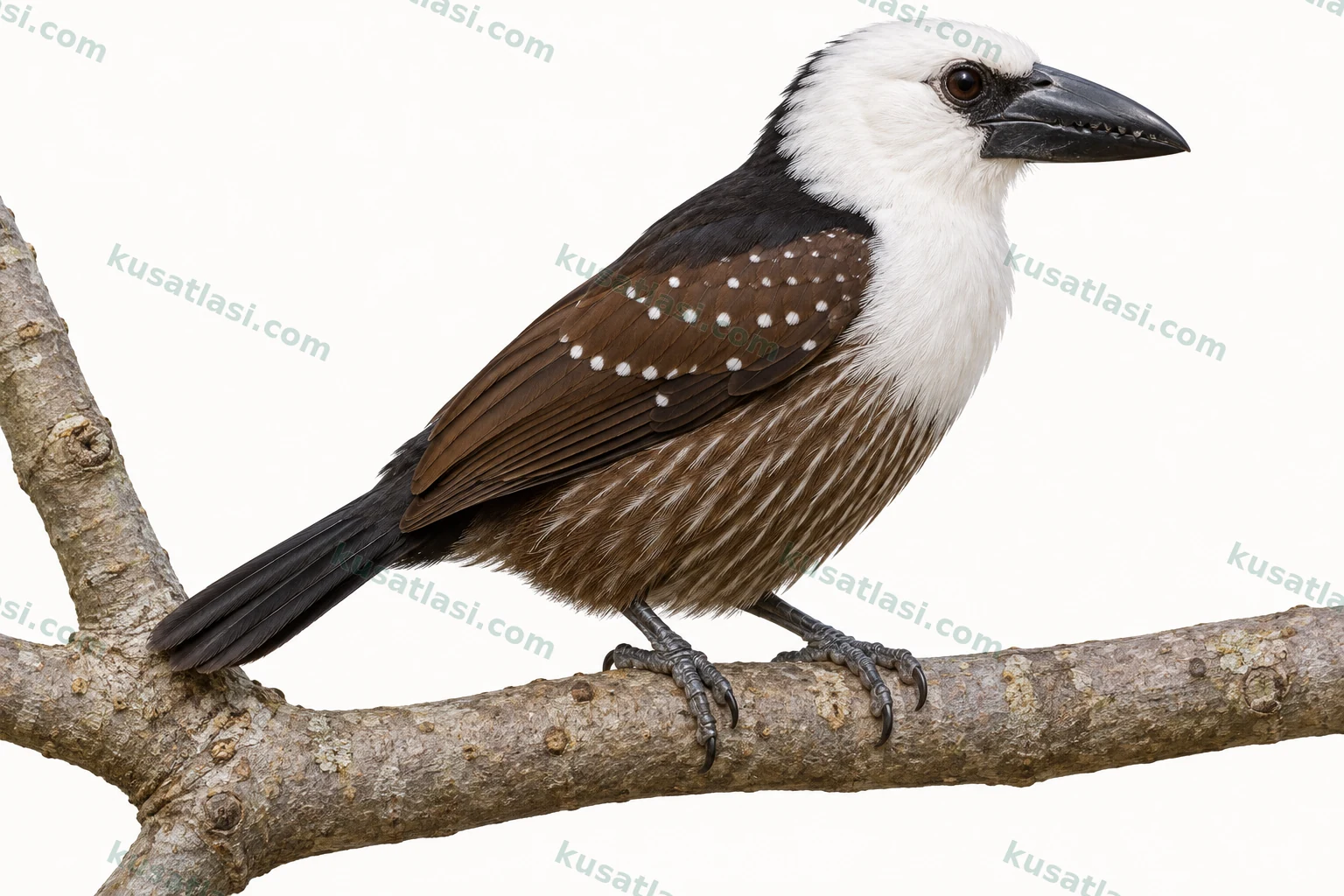
White head and neck, thick black bill. The underparts and the white or dark tail vary by region and do not indicate sex.
Biometrics
Length
Male18–20 cm
Female18–20 cm
Shared species value
Wingspan
MaleData unavailable
FemaleData unavailable
Weight
Male56–81 g
Female64–72 g
White-headed Barbet
Northern equatorial African woodland belt and an isolated southwestern Angolan populationObservation guide in its natural range
Look for three features together
Do not rely on a single featureExtensive white head and neck, with a thick black bill.
Stocky. The underparts are white in some forms and dark with fine pale streaks in others.
Assess the pattern of white on the tail and wing in the context of the local form.
Compare male and female
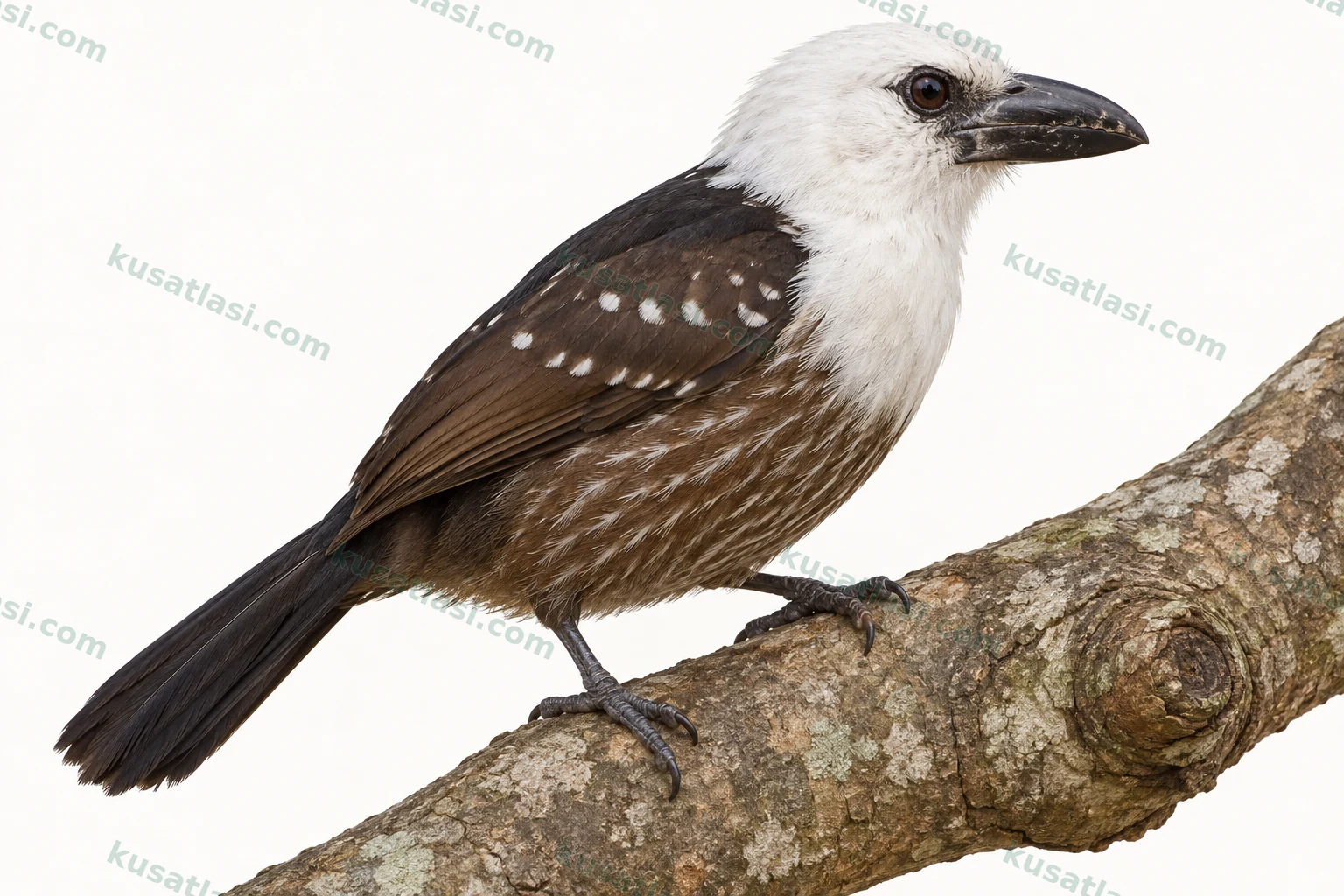 FemaleMale
Males and females are similar. A white belly, white tail or the extent of a wing patch may reflect regional variation and is not a reliable sex character.
Where to look in its natural range?
Open woodland, wooded savanna, stream edges and places with large fig trees. In Angola, local miombo and forest edges.
The breeding season varies by region. The specialist account reports August–December for Kenya, which is not extrapolated across the range.
January
Generally resident. No regular long-distance migration route has been verified. No verified regional date specific to this month was given. This does not mean local absence.
February
Generally resident. No regular long-distance migration route has been verified. No verified regional date specific to this month was given. This does not mean local absence.
March
Generally resident. No regular long-distance migration route has been verified. No verified regional date specific to this month was given. This does not mean local absence.
April
Generally resident. No regular long-distance migration route has been verified. No verified regional date specific to this month was given. This does not mean local absence.
May
Generally resident. No regular long-distance migration route has been verified. No verified regional date specific to this month was given. This does not mean local absence.
June
Generally resident. No regular long-distance migration route has been verified. No verified regional date specific to this month was given. This does not mean local absence.
July
Generally resident. No regular long-distance migration route has been verified. No verified regional date specific to this month was given. This does not mean local absence.
August
Generally resident. No regular long-distance migration route has been verified. Kenya, specialist species account. This is a regional nesting period. Other populations are not assumed to follow the same calendar.
September
Generally resident. No regular long-distance migration route has been verified. Kenya, specialist species account. This is a regional nesting period. Other populations are not assumed to follow the same calendar.
October
Generally resident. No regular long-distance migration route has been verified. Kenya, specialist species account. This is a regional nesting period. Other populations are not assumed to follow the same calendar.
November
Generally resident. No regular long-distance migration route has been verified. Kenya, specialist species account. This is a regional nesting period. Other populations are not assumed to follow the same calendar.
December
Generally resident. No regular long-distance migration route has been verified. Kenya, specialist species account. This is a regional nesting period. Other populations are not assumed to follow the same calendar.
Nest, egg and incubation
The nest is in a tree cavity, and helpers may be present. The specialist account gives 2–4 eggs and 15–21 days of incubation. Time to first flight was not verified.
Repeated short whistles. Rapid, chattering calls are heard in small groups.
Do not play recordings to attract birds; observe quietly, especially near nests.
Species information
Quick identification
The White-headed Barbet Lybius leucocephalus is an African bird with a white head and neck, a thick black bill and black-and-white plumage. It looks stocky and large-headed. The colour of its underparts and tail varies markedly by region. In some populations the underparts are entirely white, while in others they are dark with fine pale streaks. These differences are unsuitable for distinguishing males from females.
Look beyond the white crown and check how far the white extends on the head, the thickness of the bill and the wing, tail and underpart patterns of the same individual. Other black-and-white birds also have white heads. If a photograph has no locality information, take particular care to keep the markings of different regional forms separate. Seeing the head and body together gives a better impression of the bird's stocky build.
General appearance and posture
The adult's white head contrasts strongly with its dark back and wings. Toothlike projections line the edge of the thick black bill. They are part of the bill itself, unlike mammalian teeth. The head looks large relative to the body on a perched bird, but posture and fluffed feathers alone do not reveal its measurements or sex.
In the nominate form, which ranges from South Sudan to northwestern Tanzania, the tail is dark and much of the underparts is dark with whitish streaks. The senex form east of Kenya's Rift Valley has a white tail and white underparts. The leucogaster form of southwestern Angola combines white underparts with a dark tail. These three patterns within the species show why a general black-and-white description is insufficient.
Males, females and young birds
Adult males and females have similar basic plumage. A whiter belly or a white tail alone is unsuitable as a sex character. First consider the individual's regional population. When two birds stand side by side, different postures do not establish that one is the mother and the other the father. Family relationships require separate behavioural evidence.
In young birds, the white areas of the head may look greyish brown, and the bill may appear less dark and have less conspicuous projections than an adult's. These features can help assess age. No single timetable of plumage changes has been verified for every stage of development across all subspecies. A bird whose head looks grey in shade should not immediately be judged young. Assess the visible plumage and bill features together.
If colour does not reveal the sex, leave it undetermined. Measurements or regional plumage differences do not establish it with certainty.
Appearance in flight
In a short flight, the contrast between the white head and dark upperparts may stand out first. Check whether the tail is white or dark and whether the wing white appears as small spots or as a more concentrated area across the shoulder. In the Angolan form, white underparts, a dark tail and the pale wing area are meaningful together. Tail colour alone cannot distinguish all the regional forms.
The small underwing coverts also vary by region. This area is dark in white-tailed senex and white in the Angolan form. Assigning the same position and extent of white on the spread wing throughout the species would be misleading. If the angle or distance hides the details, wait for the bird to perch again and check the features then. Do not assume features that were not seen.
Voice and behaviour
The specialist identification account describes repeated short whistled sounds and rapid, chattering calls heard in groups. Sound may help locate the bird in open woodland. Several birds calling together does not establish that all are helping at the same nest. To distinguish birds gathering at a food tree from a breeding group, look for activity directed towards the nest.
Cornell's species account describes breeding pairs that may typically have one or two helpers. Helpers may assist with cavity preparation, feeding the chicks and defending the immediate surroundings. How often this occurs across all pairs is uncertain. Three adults visiting one nest does not establish that all three laid eggs. In group breeding, helping and parenthood are separate roles.
Similar species
Chaplin's Barbet Lybius chaplini also has a white head and dark bill, with distinctive red around the eye. Its natural range is restricted to south-central Zambia. When comparing it with regional forms of White-headed Barbet, consider the red facial area together with geography. A white belly alone is insufficient.
Stactolaema leucotis is a smaller barbet patterned in dark brown and white. It has a white stripe behind the eye rather than extensive white on the head and neck. The facial white varies regionally, but the white ear patch is important. Look closely at whether the white covers the head or lies behind the eye.
World distribution
The natural range includes a fragmented woodland belt from northern Nigeria and Cameroon through Chad, the Central African Republic and northern Democratic Republic of the Congo to South Sudan, Uganda, Kenya and Tanzania. The subspecies do not occupy all the same places within this broad area. The geography of the white-tailed East African forms and the darker-tailed forms farther west matters for identification.
The leucogaster population in southwestern Angola is separated from the main range. Records around Lubango and Tundavala belong to this isolated population. The wide area between the two parts is not coloured in as continuous natural range simply because the species occurs at both ends. A sighting in Angola also does not establish that the whole country is occupied breeding habitat.
Status within its natural range
The current taxonomy used here treats senex and leucogaster as forms within a broad Lybius leucocephalus. The list category for this scope is Not Evaluated. A conservation assessment drawn up for narrower species limits cannot be applied to the whole without checking its scope. The very local and scarce Angolan form should be considered separately from conditions in the main range belt.
Movements
Specialist accounts treat it as resident, and no regular intercontinental migration route has been verified. Movement between fruiting trees or failure to find it in the same place on different dates is insufficient evidence of seasonal migration. Map estimates and dated observations are read separately. They do not establish that every estimated area contains a nest or that the same number of birds lives there each month.
Breeding habitat
Specialist accounts include open woodland, wooded savanna, streamside trees and places with large fig trees. In some regions the birds may also use trees in gardens and around farmland. This does not make a completely treeless field or every urban garden equivalent habitat. Regional vegetation and tree maturity both matter.
Nest site
It nests in tree cavities, and some populations have reportedly accepted nest boxes. Helpers may join the pair in excavating a cavity. The specialist account gives 2–4 eggs and an incubation period of 15–21 days. These are not identical periods measured separately for every subspecies. The time until the young first fly could not be verified with enough evidence in this research. Development times from other barbets are not used in its place.
Daily use of space
A food tree, a nest cavity and an exposed branch where the bird is seen serve different purposes. Individuals observed in Angola moved between a wooded edge near a stream and rocky miombo scrub. The researchers discussed possible dependence on a nearby large forest patch as an interpretation, not as observed continuous use of that forest. Watch the adults' arrivals from a distance and leave the nest cavity undisturbed.
What it eats
Fruit, especially figs, is important in its diet. Specialist accounts also list insects, including termites and flies. A fruit-rich diet does not mean that the same plant is eaten every day of the year. Consider seasonal fruit availability and the demands of feeding chicks separately. No single annual dietary percentage has been verified across the range.
How it obtains food
It can be seen taking fruit from trees and shrubs. A direct observation near Tundavala in Angola in 2017 recorded it eating fruit of Searsia tumulicola. The record establishes that it ate fruit of that plant on that occasion. It does not establish dependence on that fruit alone. Seeing a bird perched on a fruiting branch is different evidence from watching it pluck and swallow a fruit.
The thick bill also serves to take food and prepare cavities. Projections on the bill edge do not show that it cracks a particular seed or crushes every fruit stone. Eating fruit may be associated with seed transport, but no unmeasured dispersal distance, germination rate or numerical effect for individual plant species is presented for this bird.
Different tails within one species
Seeing either a white or dark tail alongside the white head might initially suggest two different sexes. The species account and morphological comparisons link these differences to regional forms. Kenya's senex combines a white tail and white underparts, while Angola's leucogaster has white underparts and a dark tail. Reading one feature on its own can lead to the wrong interpretation of both taxon and sex.
Helpers and parents have different roles
Seeing more than two adults around a tree cavity is a noteworthy aspect of this species' behaviour. Cornell's specialist account describes helpers joining the pair in cavity preparation, feeding and defence. How widespread this is remains uncertain. A helper bringing food to a chick does not establish that it is the chick's biological parent. The composition of a breeding group and evidence of relatedness are separate matters.
Rediscovery is not a new origin
The rediscovery of the Angolan form at Tundavala after a long gap in records does not mean a new species arose there or that it arrived from elsewhere that year. The research reconfirmed the presence of a previously known population. A lack of records differs from confirmed extinction. Failure to find the birds during long searches is an important warning, but does not establish that the last individual has disappeared.
Taxonomic boundaries shape conservation interpretation
An assessment treating the Angolan form as a separate species covers a different scope from the current list that combines several regional forms in one species. Transferring categories on the basis of similar names can obscure local risk or put the broader species in the wrong category. Check which populations the assessment includes alongside its scientific name. The presence of more widespread populations does not remove regional rarity.