

World Birds IUCN statusLC · Least ConcernGlobal IUCN category. BirdLife v10 (2025); taxon matching: AviList 2026 / IOC 15.2; checked: 29.10.2026. The list year is not the species assessment date. Source and method · BirdLife OrderPiciformesWoodpeckers and allies FamilyPicidaePicidae
White-wedged Piculet
Picumnus albosquamatus
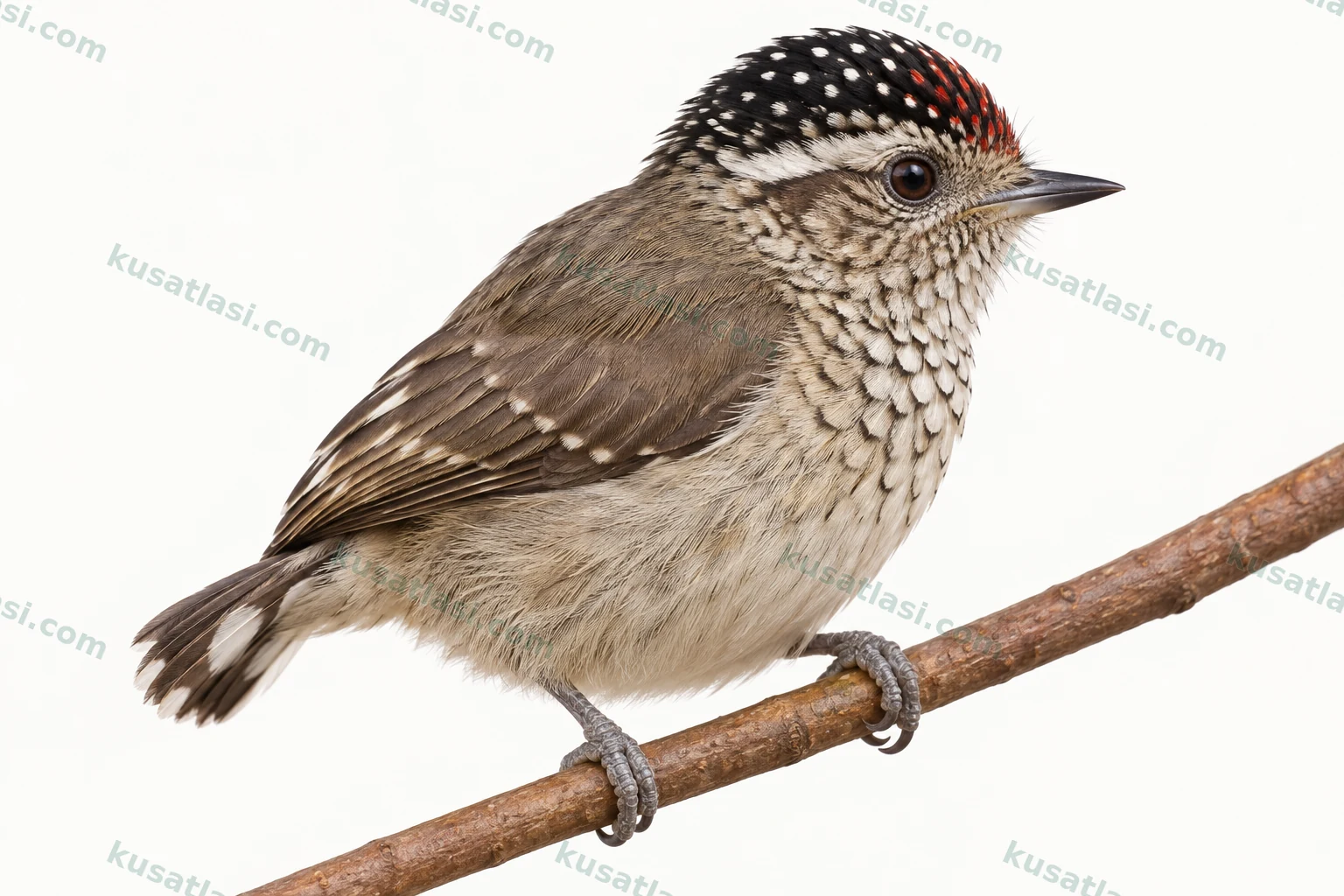
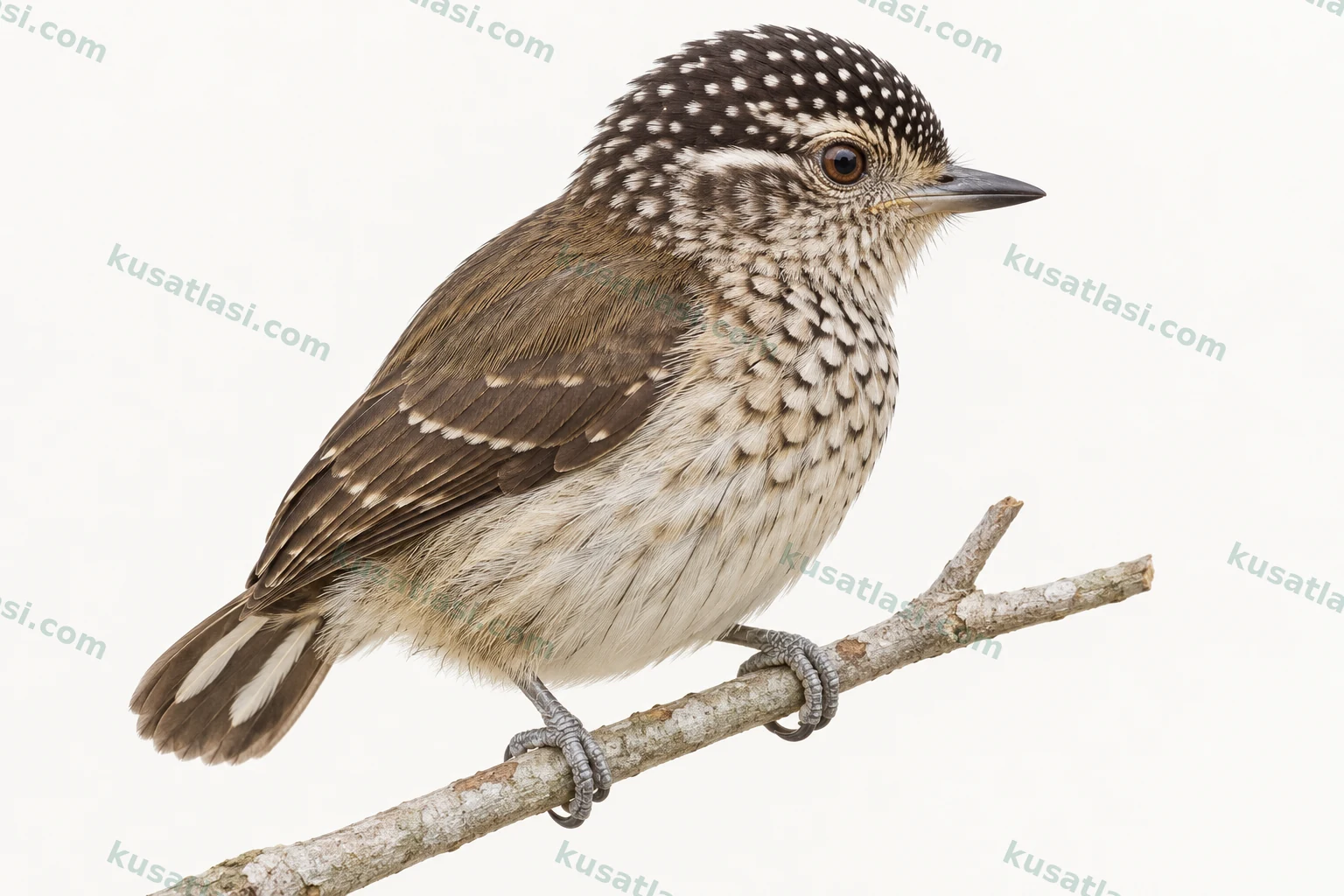
A dark head with pale spots and scaly-looking underparts. The adult male has a red forehead. Differences between the nominate form and guttifer should be kept separate from sex differences.
Biometrics
Length
Male10–11 cm
Female10–11 cm
Shared species value
Wing length
Male5.3 cm
Female5.3 cm
Shared species value
Weight
Male9–13 g
Female9–13 g
Shared species value
White-wedged Piculet
Bolivia, central and southern Brazil, northern Paraguay, and a documented record in southeastern PeruObservation guide in its natural range
Look for three features together
Do not rely on a single featureDark edges on pale feathers make a scale or wedge pattern.
Dark with pale spots. The adult male has red on the forehead and front of the crown.
The differences in pattern between guttifer and the nominate form do not distinguish males from females.
Compare male and female
 FemaleMale
The adult male has a red forehead and front of the crown. The female has a dark head with pale spots. A verified key to all juvenile stages was not found.
Where to look in its natural range?
Look in habitats with trees and branches. The Pantanal feeding records and the Rio Claro cavity nest are regional examples.
The 2008 breeding observations from Rio Claro are local examples. They do not establish the same laying months throughout the range.
January
Resident. No annual long-distance route was verified. No verified regional date was given for this month. This does not imply local absence.
February
Resident. No annual long-distance route was verified. No verified regional date was given for this month. This does not imply local absence.
March
Resident. No annual long-distance route was verified. No verified regional date was given for this month. This does not imply local absence.
April
Resident. No annual long-distance route was verified. No verified regional date was given for this month. This does not imply local absence.
May
Resident. No annual long-distance route was verified. No verified regional date was given for this month. This does not imply local absence.
June
Resident. No annual long-distance route was verified. No verified regional date was given for this month. This does not imply local absence.
July
Resident. No annual long-distance route was verified. Rio Claro, São Paulo, 2008. Young were observed in the cavity, and flight was recorded later in the month.
August
Resident. No annual long-distance route was verified. No verified regional date was given for this month. This does not imply local absence.
September
Resident. No annual long-distance route was verified. No verified regional date was given for this month. This does not imply local absence.
October
Resident. No annual long-distance route was verified. The same cavity in Rio Claro, 2008. A second breeding event was recorded.
November
Resident. No annual long-distance route was verified. No verified regional date was given for this month. This does not imply local absence.
December
Resident. No annual long-distance route was verified. No verified regional date was given for this month. This does not imply local absence.
Nest, egg and incubation
The nest is a tree or branch cavity with a vertical tunnel. At Rio Claro, two young were seen and at least 11 days elapsed from observation to flight. That is not the entire development period. Typical clutch size and incubation duration were not verified. Protect supporting branches and cavity entrances.
No detailed reliable call key was verified for the species. Bill strikes and calls are assessed separately.
Do not play recordings to attract birds; observe quietly, especially near nests.
Species information
Quick identification
The White-wedged Piculet Picumnus albosquamatus is a small piculet with pale spots on its dark head and dark feather edges on its pale underparts. On the breast the markings often look like scales or a series of small wedges. Adult males have red on the forehead and front of the crown. In females the same area is dark with pale spots. Several close relatives share red on the head, so check the breast pattern, upperparts and region together.
The English name is White-wedged Piculet. The current species includes the subspecies albosquamatus and guttifer. Old museum books may list the two names as separate species. Do not treat the two patterns as male and female without checking those names. Regional differences within the currently accepted species are separate from differences between the sexes.
General appearance and posture
The historical description of the nominate albosquamatus form gives a dark brownish back, rump and shoulders with few faint pale spots. The wing coverts are dark brown with paler edges and small pale markings. Yellowish outer edges and creamy pale inner edges are described on the long wing feathers. Dark edges surround the pale underpart feathers, and the breast feathers may also have a dark line extending from the centre. The markings are not all crossbars of equal width.
The rear of the head and nape are dark with small pale spots. The pale feathers of the face and neck sides have dark edges. The ear area can look browner. Dark edges on the chin and throat feathers lead into the scaly appearance of the breast. The belly and undertail may show a warm creamy white colour and dark central lines. The bill is dark. Losing sight of small spots in shade does not mean the entire head lacks a pattern.
In the historical account of guttifer, the pale spots on the back and rump are more conspicuous. The face and throat can have pale drop-shaped marks against a darker ground. The combination of dark edges and dark central lines on the breast feathers gives varying degrees of scaling below. These are descriptions of geographic forms, and do not make every dark bird male or every pale bird female. Compare regions under the same light and, if possible, from a similar angle.
Although this bird is in the woodpecker family, the proportions of large woodpeckers do not all apply to it. The short tail and small body can give the perched bird a very different sense of scale.
Males, females and young birds
The red feather tips on the adult male's forehead and front of the crown are useful. The rest of the head stays dark with pale spots. Adult females have no red, and the top of the head is dark with pale spots. A historical description of more extensive red on a male guttifer does not mean the red extends to the same limits in all regions. Lowering the head may hide part of the red.
This review did not verify a reliable separate key to all juvenile plumage stages. A plain head resembling that of an adult female does not establish that the bird is female or young. Direct context such as food being given to a young bird helps with age. Not every bird near the same cavity is assumed to belong to the same brood. The head and back patterns of the two subspecies are not combined into a single juvenile appearance.
Appearance in flight
Pale areas on the wing and tail can show in a short flight, but a perched bird gives a better view of the scaly breast and head markings. Before using a pale feather patch, check whether it was on the wing or the tail. The underparts darkening as the bird flies away does not mean the feathers themselves are black. Seeing the branch on which the same bird lands can supply the details missing from a brief silhouette.
Voice and behaviour
This review did not verify a reliable written key distinguishing this species' detailed call rhythm from other piculets. A bill strike heard on a trunk and a vocal call are different behaviours. If possible, link a sound from hidden vegetation to a bird whose head and breast pattern can be seen. The distance from which a small bird is heard does not establish its number or age.
The Rio Claro study documents that both adults took part in caring for the young. A bird feeding on a branch and one carrying food to the young are recorded as different behaviours. Do not approach a cavity entrance to see a young bird waiting there or looking out. Keeping the supporting branch intact is more important than clearing the surroundings for a better photograph.
Similar species
The White-barred Piculet Picumnus cirratus has dark markings on pale underparts that are more often arranged in crossbars. In the White-wedged Piculet, dark edges of the breast feathers form a pattern like scales or wedges. The two patterns can blur at a distance, so check the whole breast. The red forehead of the male does not distinguish them on its own.
The small body and contrasting underparts can also resemble Picumnus dorbignyanus. The specialist Peruvian account emphasises regularly scaled underparts for that species. Regional variation and intermediate appearances mean that one feather mark cannot establish the identification. Consider location and several visible features together.
World distribution
The current checklist places the nominate form from northern Bolivia to southwestern Brazil and adjacent northern Paraguay. It lists guttifer in eastern Mato Grosso and in parts of Pará, Maranhão, Goiás and Minas Gerais in Brazil. These are broad geographic areas. Not every part of every state is occupied breeding habitat. A national border is not the same as the boundary of suitable habitat.
Status within the natural range
Peru's records committee accepted the species for the country after reviewing a documented male at Pampa Juliaca, Pampas del Heath. This verifies presence in southeastern Peru. It does not justify extending the species to all of Peru or the whole Amazon forest. A photograph and museum specimen provide a different level of evidence from a description of a possible silhouette. A new country record also does not show the bird first arrived that day.
Movements and migration
Referenced species data classify it as resident. The studies examined do not give a regular long-distance migration route. Diet sampling in the Pantanal's dry and flood periods did not track the movements of the same birds between those periods. Records in one habitat in two seasons do not prove that individual birds use the same branch all year. The map does not draw an annual route or unverified seasonal boundaries.
Breeding habitat
Habitats with trees and branches are important for feeding and nesting. The northern Pantanal study covers a seasonally flooded area. The Rio Claro breeding study concerns a different local setting. Flood conditions from one region are not transferred automatically to the other study's nest site. Each site is considered in light of its vegetation and its use by the birds.
Nest site
The nest studied at Rio Claro was an unlined cavity with a vertical tunnel, excavated inside a fallen branch suspended among climbing plants, 5 m above ground. Two young were seen and a second breeding event was later recorded in the same cavity. Two young do not establish the initial clutch size. Typical clutch size and incubation duration were not verified. At least 11 days from observation to flight is not the entire period of juvenile development.
Daily use of space
A branch used for feeding does not serve the same function as a branch supporting a nest. A fallen piece of wood held above ground by plants can support a nest. This does not establish that all fallen branches lying on the ground are used. Watch cavity entrances, climbing plants and supporting branches without disturbance. Do not open a cavity to count the young.
What it eats
In a 2026 study, 24 birds were captured in dry and flood periods in the northern Pantanal from 2008 to 2018. Identifiable food remains were found in 14 of them. All 271 prey items were adult ants. No detectable difference in ant counts per bird between the two periods was a result of this local sample. It does not prove that the species never eats other foods anywhere in its range. A separate Rio Claro study of care of the young recorded larvae and small unidentified foods. Adult diet and food carried to young did not come from the same sample.
How it finds food
The piculet searches for food on branches and tree surfaces. Taking a food item in the bill and merely excavating a cavity are separate behaviours. The Pantanal capture study examined food remains. Its procedure is not advice for observers to catch a bird or repeat the procedure. Watching undisturbed feeding from a distance and noting the surface used is enough. If the prey cannot be seen, a bill strike on bark does not identify an ant or larva.
The feather edges create a scaly look
Dark edges around pale breast feathers resemble overlapping small scales. This is different from continuous crossbars across the whole body. The spaces between feather edges may change when the bird fluffs its plumage. A darker area in an image does not necessarily indicate another subspecies. Consider the arrangement of feathers as well as lighting.
What the ant sample establishes
Ants were the only identified food group in the northern Pantanal samples. This is strong local evidence. It should not become an invariable diet for the whole continent. Food brought to young in particular was studied by another method in a different context. Reporting the finding with the sampled birds and locality preserves both its value and its limits.
At least 11 days is not the full age
An observation that starts when a young bird is already present does not mean it hatched that day. The minimum 11 days followed in Rio Claro therefore do not describe the entire juvenile period. Seeing two young in a nest does not show how many eggs were laid initially. Keeping the meaning of each duration and count clear avoids filling gaps in breeding information with false certainty.
Two historical names within one current species
Hartert used separate headings for the nominate albosquamatus and guttifer, showing that the historical classification differed from the current one. The current species includes both forms. Matching colours of Brazilian and Bolivian specimens as sex differences misrepresents geographic variation. Checking the date and the taxon boundaries of a source prevents two accurate descriptions from being combined into an inaccurate bird. Keeping the subspecies name and specimen locality makes an old collection record more useful in a current comparison.