

World Birds IUCN statusLC · Least ConcernGlobal IUCN category. BirdLife v10 (2025); taxon matching: AviList 2026 / IOC 15.2; checked: 29.10.2026. The list year is not the species assessment date. Source and method · BirdLife OrderPiciformesWoodpeckers and allies FamilyPicidaePicidae
African Piculet
Verreauxia africana
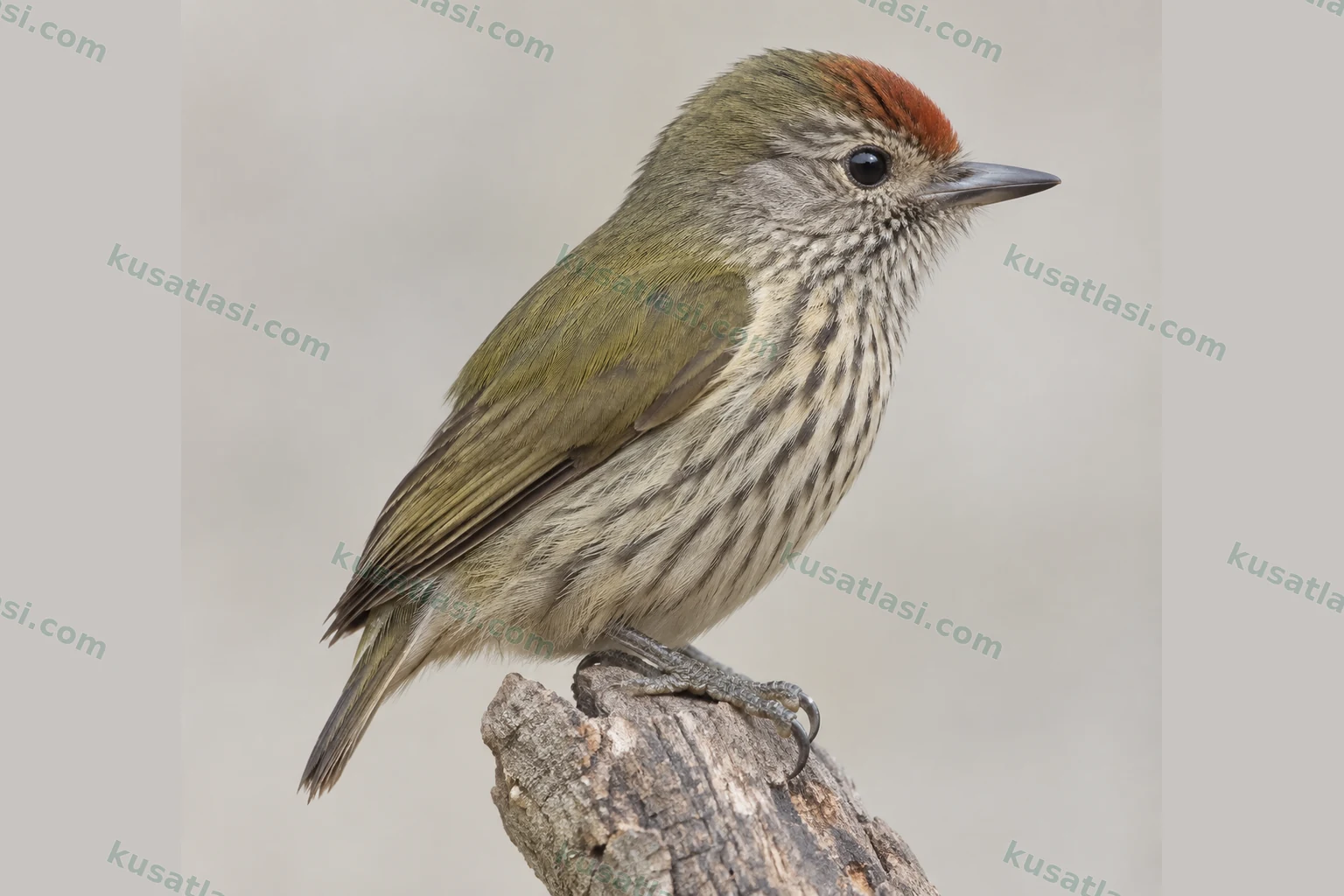
A tiny, short-tailed forest bird with a green back, grey-olive underparts and small white facial lines. The adult male has a rusty-chestnut forehead patch.
Biometrics
Length
Male9–10 cm
Female9–10 cm
Shared species value
Wing length
Male4.8 cm
Female4.8 cm
Shared species value
Weight
Male7–10.5 g
Female7–10.5 g
Shared species value
African Piculet
Humid forests of West and Central AfricaObservation guide in its natural range
Look for three features together
Do not rely on a single featureCheck the proportions of the bird examining low vines and thin stems.
The male has a rusty-chestnut patch; the female’s forehead resembles the head. A hidden forehead patch must not be treated as absent.
Look for the bare reddish area together with small white facial lines.
Compare male and female
 FemaleMale
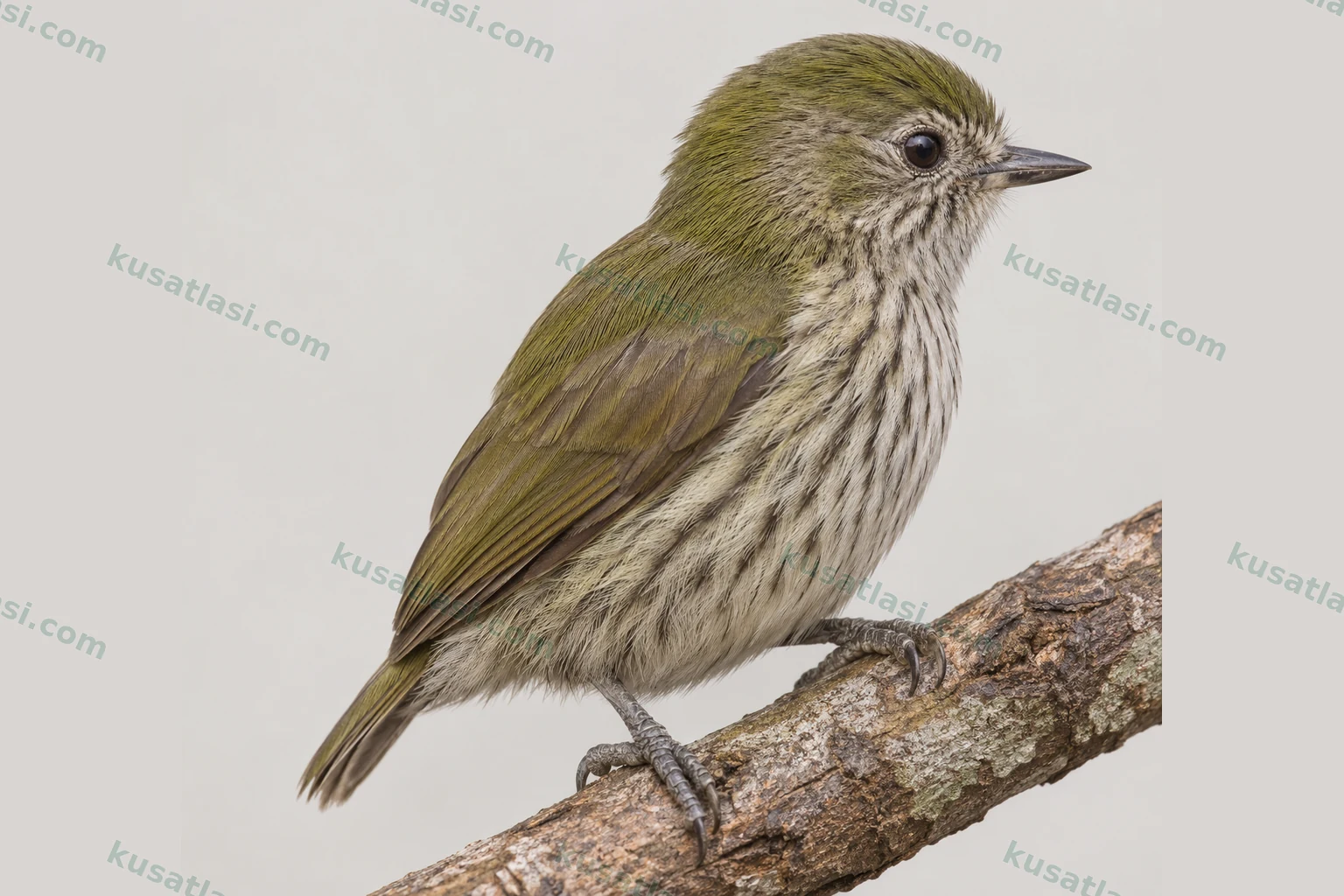
The adult male has a rusty-chestnut forehead patch; the female’s forehead is closer in colour to the rest of the head. Young birds’ warm tones and viewing angle are considered separately.
Where to look in its natural range?
Through natural gaps in dense undergrowth, watch thin stems and the movements of the short-tailed bird.
No definite breeding months apply across the whole range. October–January cavity excavation and March nest departure in the Gabon study are separate stages, not merged as a laying calendar.
January
This is primarily a resident forest bird; regional short-movement records do not establish a definite annual migration route. Northeastern Gabon, Brosset and Erard 1986: cavity excavation was observed; no eggs were seen.
February
This is primarily a resident forest bird; regional short-movement records do not establish a definite annual migration route. No verified regional date specific to this month was supplied; this does not imply local absence.
March
This is primarily a resident forest bird; regional short-movement records do not establish a definite annual migration route. Northeastern Gabon, record dated 4 March: a young bird left the nest; this is not a laying date.
April
This is primarily a resident forest bird; regional short-movement records do not establish a definite annual migration route. No verified regional date specific to this month was supplied; this does not imply local absence.
May
This is primarily a resident forest bird; regional short-movement records do not establish a definite annual migration route. No verified regional date specific to this month was supplied; this does not imply local absence.
June
This is primarily a resident forest bird; regional short-movement records do not establish a definite annual migration route. No verified regional date specific to this month was supplied; this does not imply local absence.
July
This is primarily a resident forest bird; regional short-movement records do not establish a definite annual migration route. No verified regional date specific to this month was supplied; this does not imply local absence.
August
This is primarily a resident forest bird; regional short-movement records do not establish a definite annual migration route. No verified regional date specific to this month was supplied; this does not imply local absence.
September
This is primarily a resident forest bird; regional short-movement records do not establish a definite annual migration route. No verified regional date specific to this month was supplied; this does not imply local absence.
October
This is primarily a resident forest bird; regional short-movement records do not establish a definite annual migration route. Northeastern Gabon, Brosset and Erard 1986: cavity excavation was observed; no eggs were seen.
November
This is primarily a resident forest bird; regional short-movement records do not establish a definite annual migration route. Northeastern Gabon, Brosset and Erard 1986: cavity excavation was observed; no eggs were seen.
December
This is primarily a resident forest bird; regional short-movement records do not establish a definite annual migration route. Northeastern Gabon, Brosset and Erard 1986: cavity excavation was observed; no eggs were seen.
Nest, egg and incubation
The nest is a cavity in a thin, dead woody stem. The expert monograph reports usually two eggs and care by both sexes; species-specific incubation and nestling durations could not be verified.
The bird gives a thin, high-pitched, prolonged song; strikes while probing wood are distinguished from occasional drumming.
Do not play recordings to attract birds; observe quietly, especially near nests.
Species information
Quick identification
The African Piculet Verreauxia africana is a tiny, very short-tailed relative of woodpeckers, sought in dense humid-forest undergrowth. Its upperparts are greenish and underparts more grey-olive. The bare reddish area around the eye and small white facial lines matter in a good view. The adult male has a rusty or chestnut-red patch on the forehead; the female's forehead is closer in colour to the rest of the head. It must not be drawn or described as a bird with an entirely bright red head. Small size, the very short tail, facial area and plumage pattern are used together for identification.
Clinging to thin stems and striking the surface with its bill may make it resemble woodpeckers climbing a large trunk. Nevertheless, searching only high, exposed trunks is not a good starting point. Watch low branches, vines and tangled plant stems carefully. If the forehead of a head glimpsed through leaves cannot be seen, do not immediately assign sex. White facial lines may also disappear behind cover; a feature not seen must not be declared certainly absent.
General appearance and posture
The small, rounded body and extremely short tail form proportions unlike those of long-tailed songbirds. The bill is short, pointed and dark; the bird probes thin woody surfaces when feeding. Wings and tail have darker areas that look less bright than the green back. Grey underparts may darken in forest shade, while the green back can disappear among reflected leaf light. Compare proportions and the head area as well as colours, rather than interpreting them from one photograph's white balance.
Short explicitly states that the tail is not a stiff prop like that of large woodpeckers. A plate showing a long, pointed woodpecker tail supporting the body would therefore mislead identification. In natural observation, examine the foot gripping a stem, the short tail and the bill investigating a thin surface. Inferring toe number from a partly visible foot or treating an arbitrary illustration as anatomical evidence is unreliable.
Males, females and young birds
The rusty-chestnut forehead patch of an adult male is the most useful sex difference. In females, this area blends with the grey-olive tones of the head. The red eye surround and greenish back are not exclusive male features. A forehead hidden behind a branch, darkened by shade or turned away can make a male seem female. Several moments showing the face at a suitable angle should therefore be assessed. Do not automatically consider a single larger-looking bird male; even on the same branch, differing distances change apparent size.
Young birds may show grey and pale warm tones mixed into green upperparts; grey and reddish-brown underparts produce an appearance different from adults. The monograph also describes young birds' eyes as browner rather than the adults' red. Without considering age and sex together, not every warm head tone should be treated as the adult male's forehead patch. Nor should a few juvenile features serve as a definite template for adult females. Brief views in forest shade require species confirmation before fine age details.
Appearance in flight
It may be seen making short flights between stems or small branches in dense vegetation. A small green bird darting away and vanishing behind leaves cannot be identified by flight speed alone. The extremely short tail needs checking again once the bird lands. Facial lines and forehead patches are often invisible in flight, so the perched view is more useful for identification. Do not look for it as a bird soaring for long periods in the open.
The Gabon study recorded a butterfly-like flight in which a male followed a female. This does not mean that every brief flight is courtship or that all birds perform the same behaviour in a particular month. Feeding, approaching a neighbour and interaction with a mate can only be separated using behaviour before and afterwards. A momentary airborne view does not replace evidence of eggs or young. Instead of shaking the undergrowth to make the bird fly, use the viewing gap created by its own movements.
Voice and behaviour
The Gabon field study describes a thin, high-pitched, prolonged song; bill strikes can also help locate the small bird. Researchers occasionally observed drumming on thin dry stems. Not every sound while probing wood is a display towards a mate or rival: food-extraction strikes and communication must be distinguished. Confirm a thin sound from low scrub with the bird's short tail and head pattern.
It may forage alone, in pairs or with other insectivorous birds. Joining mixed bird parties and groups following ant swarms was recorded in Gabon. Presence in such a group is not evidence of shared nesting. Field observations show that striking thin stems and opening their fibres can give access to insect larvae. Two birds on one stem might be mates, but this interpretation is not confirmed without behaviour such as care of young.
Similar species
1. The Gabon Woodpecker Dendropicos gabonensis, with its green back, is a possible comparison during a brief forest view. Its more pronounced woodpecker body and tail and strong spotting or streaking below are important. Assess the African Piculet's tiny, short-tailed build and grey-olive underparts together. Red on the head does not distinguish them alone; the red area's location, facial pattern and body pattern must also be seen.
2. The Speckled Tinkerbird Pogoniulus scolopaceus is another small bird of humid forest. Its larger bill, scaled upperparts and conspicuous streaking below differ from the piculet's small white facial lines and plainer underparts. Green colour or small size alone is insufficient. When comparing its regular rapid call with the piculet's thinner song, confirm that the sound comes from the bird actually seen; in a mixed flock it is easy to attribute a neighbour's voice to the wrong bird.
World distribution
The African Piculet is associated with the humid-forest belt of West and Central Africa. The current taxonomic record uses Verreauxia africana; Sasia africana may appear in older sources for the same species. Forest connections from Cameroon, Gabon and the Congo Basin east to western Ugandan forests and south to northern Angola are important. West African records also show that the bird must not be sought only in the continent's centre. Conversely, the name African does not justify spreading it across every savanna or dry area.
Status within its natural range
Older information has been corrected in parts of the range. Robert Dowsett's Nigerian review notes doubts about whether the old Lokoja record fitted the bird's usual forest conditions and nest site, whereas a well-described 2005 observation in Afi River forest supported addition to the national list. A country name or one old mark is therefore insufficient. An older book's range boundary does not take precedence over later documented observations.
The global conservation category is low risk. This broad category does not mean equal abundance in every forest fragment or immunity to habitat loss. Local commonness in Gabon does not determine densities in other countries. Observation points here mark records; empty areas do not directly measure absence, nor clustered points population density.
Movements
The species is considered mainly resident, not a regular intercontinental migrant. The Gabon study reported birds recaptured months later and one found 2.5 km from its ringing site. These document local movement, not a distance followed by every individual or a monthly migration line. Short movements within a forest and seasonal movements across countries are different matters. No verified continent-scale route is available for this species, so speculative arrows are not drawn on the map.
Breeding habitat
Dense understorey of humid forest and well-developed secondary vegetation are used. The Gabon study especially describes places with vines, broad-leaved undergrowth and dense stem growth. This does not mean that it selects only disturbed forest everywhere; it has also been recorded in primary forest. Open dry scrub and the dense understorey of humid forest are not equivalent habitats. Regrowth around a small opening is not interchangeable with a fully cleared field.
Nest site
It excavates a cavity in a thin, dead woody stem or short trunk section. Short's expert monograph reports usually two eggs and care by both sexes; reliable incubation and nestling durations specific to this species could not be verified. Females excavating small cavities in dead stems still standing in the ground were observed in Gabon from October–January, but no eggs were seen in those cavities. Cavity excavation is therefore not used as a synonym for laying. A March nest departure in the same study does not mean that the eggs were laid that month either.
Transferring the 13-day incubation of other Neotropical piculets to this African species would be wrong. Even if a nest is visible from outside, there is no need to shine light inside, open the stem or disturb the bird to count eggs. The known small nest entrance also does not prove that every similar forest hole belongs to this species.
Daily habitat use
In the study, birds mostly fed in low dense cover, examining thin live or dry stems. Tall trees alone do not explain the daily feeding surfaces used. Connections between forest floor and low branches, vines and standing dead stems can be watched. Wait for the bird's natural movement to provide a view rather than cutting plants to draw it out from behind a branch. One observation cannot establish that the same stem is a nest, roost or all-day activity site.
What does it eat?
The African Piculet feeds on small invertebrates; insect larvae inside wood or plant stems are important. Larvae, insect eggs and ants were recorded in the Gabon study. Neither claiming an exclusively ant diet nor excluding ants entirely fits the observations. Larvae and adult insects are different developmental stages; appearing in the same list does not make the terms interchangeable. These foods are local records, without percentages for all Africa.
How does it forage?
It grips a thin branch or stem, strikes the bark and can open fibres to reach hidden food. Stems approximately 1–5 cm in diameter, especially 1–2 cm, were observed being used in Gabon. Small size does not mean that it cannot extract food by striking surfaces with its bill. Conversely, not every strike proves a successful larval capture.
It may join mixed insectivorous bird parties. Being in a group following an ant swarm does not establish that it targets only ants; the food taken into the bill must be seen separately. The observer's best clue is to find the short-tailed bird examining a stem and follow its movements. Without matching a noise to the seen individual, another woodpecker's nearby strike is not attributed to this species.
The dryness and structure of feeding stems help explain why leaving some dead plant material in a forest may be valuable. There is no figure showing a guaranteed population increase from retaining a particular quantity of dead wood. A nesting stem and the one currently used for feeding need not be the same. Leaving food or insects to bring the bird close must not replace natural feeding observation.
Small size, different support
The African Piculet is not simply a scaled-down large woodpecker. Its extremely short, soft tail does not function as the long stiff tail used by other woodpeckers to brace against a trunk. Bare skin around the eye and small facial lines also illustrate different body arrangements within the family. Comparing these proportions on a thin stem is more meaningful than looking only at red on the head. Membership of the woodpecker family does not require identical nesting durations or foot details across all species.
Its old name does not mean another bird
Research published under Sasia africana can concern the same African Piculet. The current name Verreauxia africana does not automatically make older measurements those of another species; every record must nonetheless be matched by scientific name and geography. Molecular research has examined relationships between African and Asian piculets. This relationship does not imply that Asian species naturally inhabit African forests or that their breeding measurements can be transferred to the African bird.
Drumming and feeding strikes
Short's 1982 monograph states that communicative drumming had not been adequately described at that time, whereas Brosset and Erard's 1986 Gabon study records occasional drumming on a thin dry stem. These texts reflect knowledge at different dates. Earlier uncertainty is no reason to ignore a later observation. Equally, not every feeding strike is a drumming display; its behavioural context and repetition must be observed.
Seeing a cavity does not reveal the eggs
Females were observed excavating cavities in Gabon, but laying was not seen inside those cavities. This distinction affects calendar interpretation: October–January excavation is not a confirmed laying season for those months. Comparative nesting studies on other piculets also show that details of the African species remain undescribed. Instead of filling gaps with a related species' number of days, keep the known two-egg pattern separate from unverified incubation and young-development durations.