

World Birds IUCN statusLC · Least ConcernGlobal IUCN category. BirdLife v10 (2025); taxon matching: AviList 2026 / IOC 15.2; checked: 29.10.2026. The list year is not the species assessment date. Source and method · BirdLife OrderPiciformesWoodpeckers and allies FamilyPicidaePicidae
White Woodpecker
Melanerpes candidus
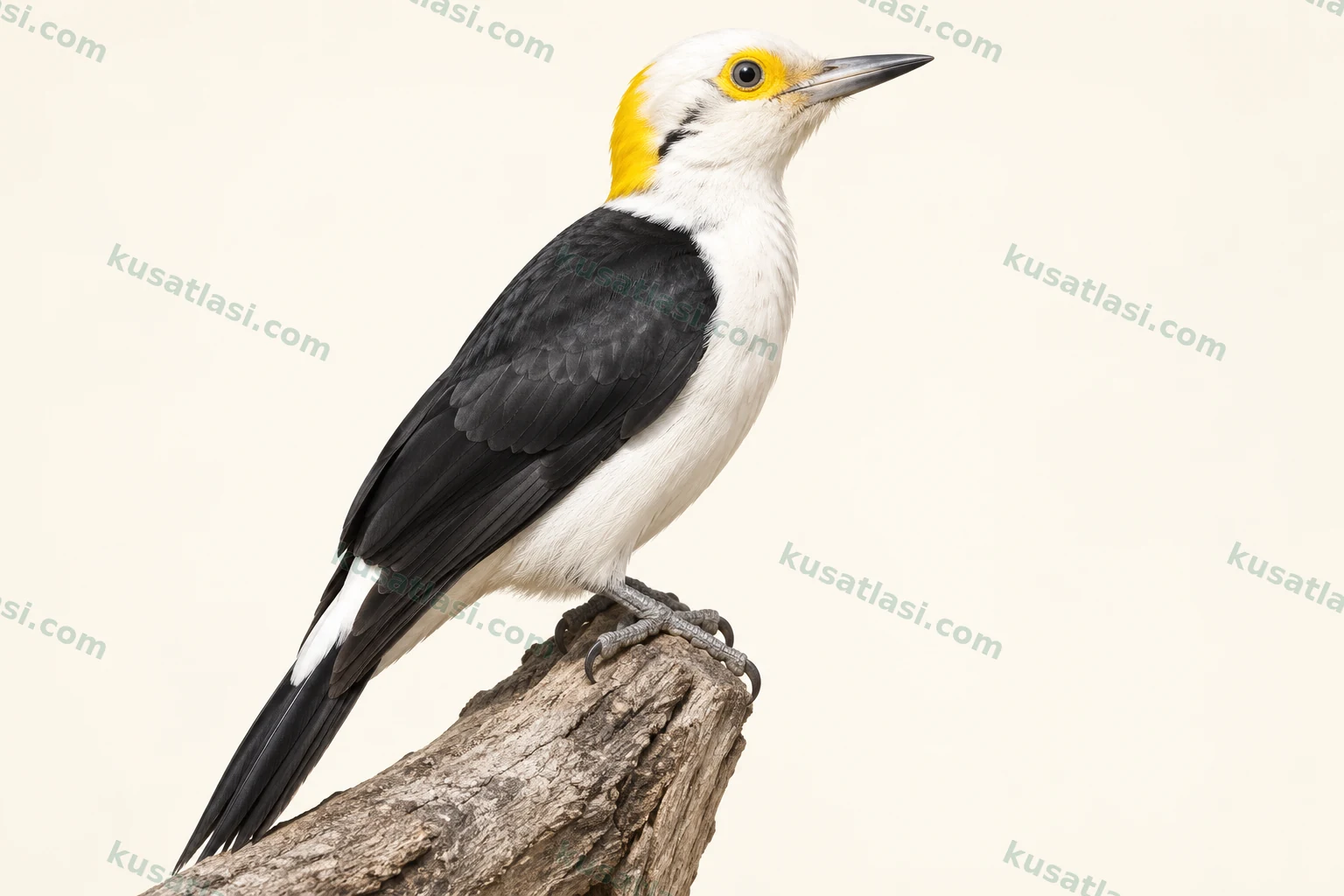
This woodpecker lives in open South American woodland and is distinguished by its white head and underparts, black back and broad yellow eye surround.
Biometrics
Length
Male24–29 cm
Female24–29 cm
Shared species value
Wing length
Male15.72 cm
Female15.72 cm
Shared species value
Weight
Male98–130 g
Female114 g
Female mass of 114 g is the published mean of three female specimens from around El Tirol, Itapúa, Paraguay (Foster & Johnson 2017, p. 18; range 107–120 g). This small regional sample is not a species-wide mean. The male value comes from a separate source.
White Woodpecker
Open South American woodland east of the AndesObservation guide in its natural range
Look for three features together
Do not rely on a single featureCreamy-white head; broad bare yellow skin around a pale eye.
Black back and wings, white underparts; a narrow black line runs from below the eye to the back.
Yellow nape in adult males; young of both sexes may have yellow there.
Compare male and female
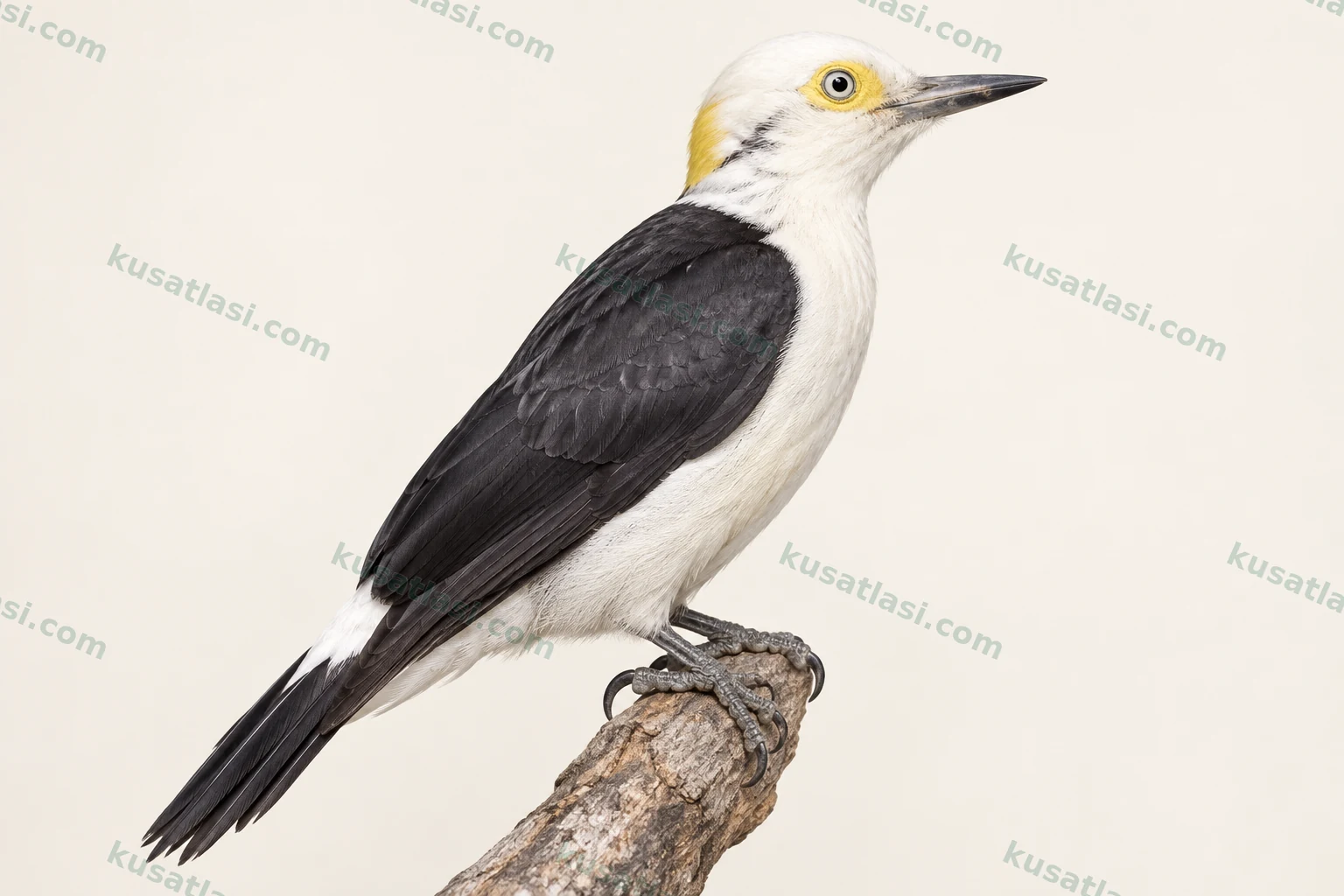 FemaleMale
The adult male has a yellow nape, while the adult female’s nape is creamy white. Both sexes may have yellow on the belly; a yellow nape in a young bird does not establish that it is an adult male.
Where to look in its natural range?
Look for small groups in wooded savannas, forest openings and fruit trees.
The species is generally resident. Its nesting calendar is regional and is not assumed to be identical in northern and southern populations.
January
Resident; daily group flights do not establish a migration route. No verified regional date specific to this month was provided; this does not mean local absence.
February
Resident; daily group flights do not establish a migration route. No verified regional date specific to this month was provided; this does not mean local absence.
March
Resident; daily group flights do not establish a migration route. No verified regional date specific to this month was provided; this does not mean local absence.
April
Resident; daily group flights do not establish a migration route. No verified regional date specific to this month was provided; this does not mean local absence.
May
Resident; daily group flights do not establish a migration route. No verified regional date specific to this month was provided; this does not mean local absence.
June
Resident; daily group flights do not establish a migration route. No verified regional date specific to this month was provided; this does not mean local absence.
July
Resident; daily group flights do not establish a migration route. No verified regional date specific to this month was provided; this does not mean local absence.
August
Resident; daily group flights do not establish a migration route. No verified regional date specific to this month was provided; this does not mean local absence.
September
Resident; daily group flights do not establish a migration route. Bolivia, Paraguay, southern Brazil and northern Argentina — older compilation: regional nesting records, not a calendar shared by the whole range.
October
Resident; daily group flights do not establish a migration route. Bolivia, Paraguay, southern Brazil and northern Argentina — older compilation: regional nesting records, not a calendar shared by the whole range.
November
Resident; daily group flights do not establish a migration route. Bolivia, Paraguay, southern Brazil and northern Argentina — older compilation: regional nesting records, not a calendar shared by the whole range.
December
Resident; daily group flights do not establish a migration route. No verified regional date specific to this month was provided; this does not mean local absence.
Nest, egg and incubation
It nests in tree cavities. An older compilation based on captive records reports 3–4 eggs and incubation by both adults. A single young bird left the nest at 36 days; this is not a certain age at first flight for the whole wild species. Incubation duration was not verified.
Its calls are loud and sharp and can be prolonged. Repeated call series help locate small groups.
Do not play recordings to attract birds; observe quietly, especially near nests.
Species information
Quick identification
White Woodpecker Melanerpes candidus lives in open, sparsely wooded South American landscapes and has a largely white head and body. Broad white and black areas give it a different appearance from many finely patterned relatives. Head, front of the neck and underparts are creamy white; back and wings are black. White occurs at the tail base and on the rump, while the tail’s end is dark. Bare yellow skin around the eye is especially striking at close range. It is not the pupil or iris that is yellow: the eye itself looks pale, whitish or light grey.
A thin black line runs backwards from below the eye along the neck to the dark back. This line, broad yellow eye surround and white head form a good identification combination. Yellow on the belly varies in extent and brightness and is not a male-only mark. The bird is usually seen in small groups and can cross openings between trees in fairly straight flight. Several birds flying together do not make every white bird the same species; eye surround, head line and wing colour are checked from a suitable angle.
General appearance and posture
The body is medium-sized, the bill dark and chisel-tipped. Its base may look paler. Feet grip the bark when the bird clings to a trunk; it may also take a more horizontal posture on a branch. The head is not invariably pure white: cream, off-white and pale brownish appearances occur. Black upperparts may show a slight bluish gloss in the light; flight-feather tips look browner. The transition from white tail base to dark end forms irregular lines on some feathers.
A white rump does not mean a wholly white back. From behind, the dark wings and back are assessed with the white below. Moving behind a branch or turning changes the visible proportions of colour. The large white head area may be recognised from afar; a closer view that does not disturb the bird is needed for the narrow black line and yellow eye skin.
Males, females and young birds
The adult male has a narrow lemon-yellow nape patch. The same area in an adult female is creamy white. This mark is used only when the nape is clearly seen; yellow may be hidden on a bird facing forward or lowering its head. Both adult sexes have broadly similar bodies and both may show a yellow belly patch. Depicting the female as entirely without yellow confuses the sex difference on the nape with variable belly colour.
In young birds, dark feathers may be browner and less glossy, pale feathers a dirtier cream. Yellow below is generally duller. An important age distinction is that both young males and young females can have a yellow nape; in young males the yellow may extend farther onto the crown. A yellow nape therefore does not make every bird an adult male without age assessment. Short’s compilation explicitly separates this juvenile detail.
A young bird’s grey-looking eye and the colour of bare skin around it are separate features. A bluish eye surround was reported in a single captive-reared young bird; this limited record is not a compulsory colour for every wild juvenile. Age assessment needs gloss, feather colour and head pattern together. Some shaded feathers or a photograph’s warm cast do not alone prove another sex or subspecies.
Appearance in flight
Unlike the conspicuously undulating flight of many woodpeckers, this species can fly more directly. It makes relatively long crossings of open landscapes and may land on dead trees before continuing. Contrast between white body and broad dark wings remains in flight. White appears at the wing bend; underwing-coverts are dark and flight feathers greyer brown. No single angle shows every mark at once.
A small group crossing an opening together fits the species’ social behaviour. Direction alone does not establish regular long-distance migration. When the bird perches again, white head, yellow eye surround and age-related nape marks can be examined anew.
Voice and behaviour
Calls are loud, sharp and can be prolonged; both single calls and repeated series are heard. Perched and flying birds’ voices help locate the group. A written sound imitation does not replace a real recording, and a similar distant call is not a certain identification without head and body views. Group displays involving head and body bowing, swaying and movements between branches have been reported.
Feeding groups may visit fruit trees, insect-bearing branches and bee or wasp nests. Sharing a prey source does not establish that every group member belongs to one family or raises young cooperatively. In a detailed Brazilian observation, a male approaching a wasp nest withdrew when attacks intensified and then returned. The bird is not immune to stings; its behavioural sequence may help reduce the danger.
Similar species
1. White-fronted Woodpecker Melanerpes cactorum is smaller, greyer and more finely patterned in shared South American areas. White concentrates at the front of its head; the dark back carries pale lines. White Woodpecker differs in its broadly white head and underparts, extensive yellow eye surround and black back. Both can occur in groups, so grouping alone does not distinguish them.
World distribution
White Woodpecker is associated with open and sparsely wooded areas east of the Andes in South America. Inland and southern Brazil, eastern Bolivia, Paraguay, western Uruguay and suitable parts of northern Argentina are important components. More scattered records occur in southern Suriname and around Amazonia. This does not imply equally dense use of the entire Amazon forest interior. Openings, edges and wooded savannas differ from closed dense forest interiors.
Status within the natural range
The current global category is Least Concern. Local abundance is not uniform across its broad range; a large group in one fruit tree does not demonstrate good condition of every surrounding habitat. Paraná floodplain feeding research and Campinas wasp observations represent different local settings. It can use human-modified landscapes, but conserving trees that provide nest cavities and varied foods still matters.
Movements and migration
It is generally considered resident, without a verified regular intercontinental migration route. Birds crossing open spaces may be travelling between daily feeding sites. Changing fruit, insect and social-wasp colony resources may affect local wandering; returning to one fruit tree does not prove year-round residence at that spot. Habitat predictions and georeferenced record samples are read separately on the map. An unrecorded empty cell is not certain absence, nor a model-coloured area a confirmed breeding site.
Breeding habitat
It may use sparsely wooded savannas, forest edges, openings, farmland woodland and orchards. A suitable nest tree or cavity is a separate requirement that an open feeding landscape cannot provide alone. An older compilation reports September–November nesting in Bolivia, Paraguay, southern Brazil and Argentina; this regional calendar is not transferred to every northern population.
Nest site
It breeds in tree cavities. Captive records cited by Short include 3–4 eggs and incubation by both adults. In the same old record, the single surviving young left the nest at 36 days. This is not a measured age at first flight for every wild nest. No directly verified species-wide incubation duration was found, so no certain day count is given. Birds near nests are watched from afar; opening the cavity, climbing a branch or shining a light inside are inappropriate ways to obtain developmental information.
Daily habitat use
Dead trees, exposed branches, fruiting trees and insect colonies have different daily feeding roles. The Campinas observation took place in a park in trees around a pond; the birds were not fishing in it. Spending a long time at one wasp nest also does not show the species spends every day on that one prey. Perch, feeding site and nest tree may be separate within a landscape.
What does it eat?
Alongside fruit and other plant foods it eats various insects and the young of bees and wasps; honey has also been reported. The 2003 study examining stomach contents of nine birds from the Paraná floodplain found animal foods, notably ants and social wasps. This limited sample does not prove an exclusively insect diet all year. Groups visiting orchards and stomach samples from birds caught in a particular season reveal different aspects of feeding.
How does it forage?
It gathers insects on branches and bark and strikes with the bill to reach them when necessary. The sequence at a social-wasp nest may be more complex. In Campinas, the male first struck the supporting branch repeatedly, retreated when attacks increased and approached again. Once fewer wasps remained on the surface, it opened the outer envelope and ate young in the cells. The explanation that repeated strikes induced wasps to leave is the researcher’s interpretation, not a controlled experiment separating all factors. Do not approach a nest or provoke wasps to watch this hunting behaviour.
Yellow eye skin is not eye colour
The conspicuous yellow ring is bare skin; the eye itself is pale. A drawing that treats yellow iris and yellow skin as the same feature changes the bird’s face. The adult male’s yellow nape patch and the shared, variable yellow belly are different traits too. These small anatomical distinctions matter as much to correct identification as the broad white-and-black appearance.
A patient approach to a wasp nest
Three woodpeckers were present in Sazima’s documented Campinas event, but initially one male continued the branch-striking approach. In the portion the researcher followed, striking lasted 23 minutes and feeding on the nest 18 minutes; the beginning was not seen, so the total duration was unknown. This differs from the sudden nest attack of some other birds. Nevertheless, retreating and scratching its head show that attacking wasps still posed a danger.
A group is not necessarily a shared family
Several birds at one prey source show social feeding. Their relationships, participation in chick care or merely sharing food must be investigated separately. The species’ group behaviour has long been known, but details of its breeding system are less clear. A feeding group is not automatically labelled a family raising young together.
The limits of an old young-bird record
One basis for the frequently repeated account of nest departure at about five weeks is a single young bird leaving at 36 days in an old captive record. Place and sample size change what the number means. The record gives real developmental information; it does not prove the same days apply to every wild nest. Incubation and development in the nest are separate stages too.