

World Birds IUCN statusLC · Least ConcernGlobal IUCN category. BirdLife v10 (2025); taxon matching: AviList 2026 / IOC 15.2; checked: 29.10.2026. The list year is not the species assessment date. Source and method · BirdLife OrderPiciformesWoodpeckers and allies FamilyPicidaePicidae
African Gray Woodpecker
Dendropicos goertae
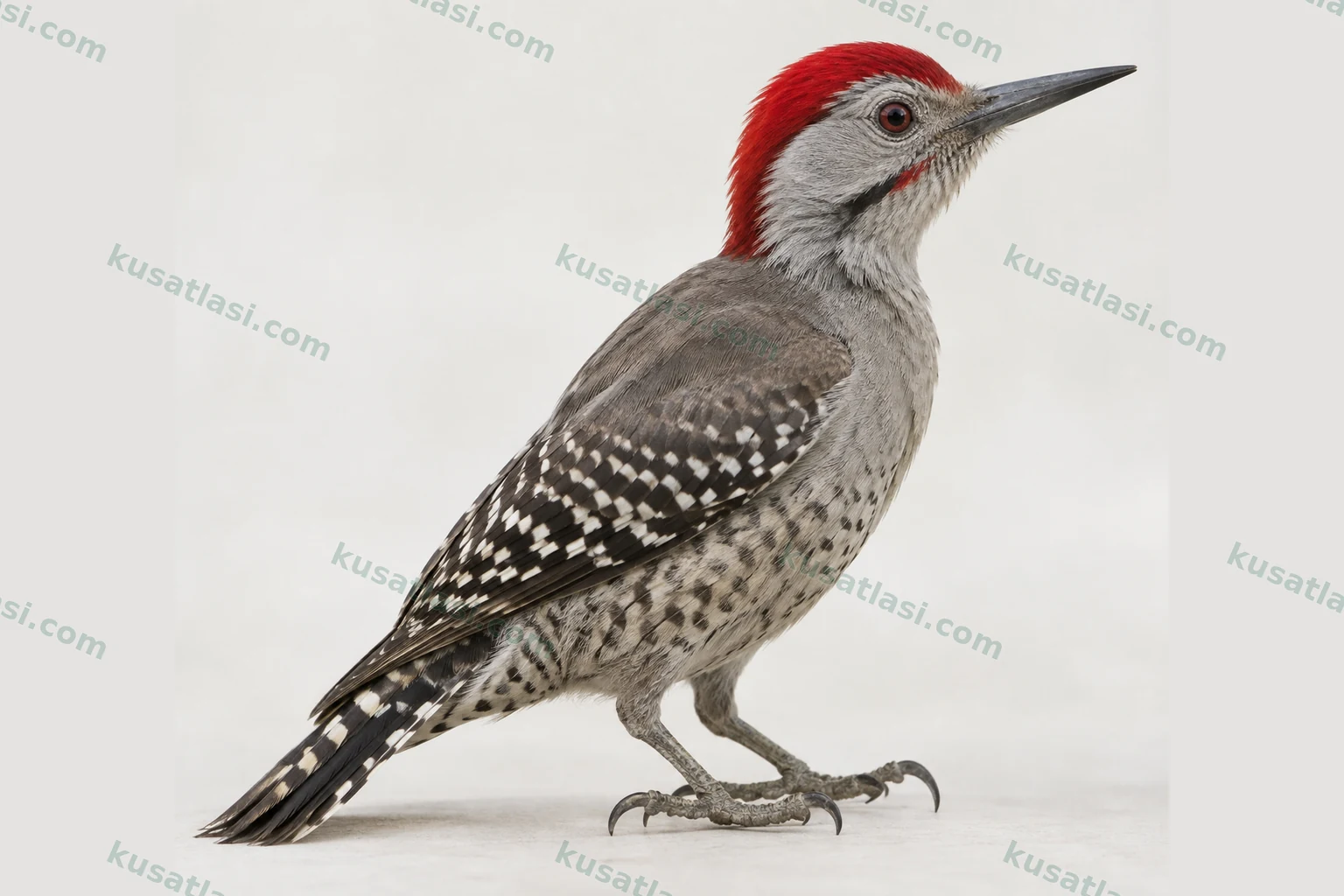
Identification combines the grey head and underbody, olive to yellow-green back, barred wings and tail and small warm-coloured belly patch. The adult male has a red crown and the adult female a grey crown.
Biometrics
Length
Male20 cm
Female20 cm
Shared species value
Wing length
Male10.8 cm
Female10.8 cm
Shared species value
Weight
Male43–52 g
Female36–45.5 g
African Gray Woodpecker
Patchy distribution in suitable woodland from West Africa into central and eastern AfricaObservation guide in its natural range
Look for three features together
Do not rely on a single featureThe head and underbody are grey and the back olive to yellow-green; a bold black-and-white facial pattern is not expected.
The patch colour can vary; its size and the wing and tail bars are assessed together.
Although the adult female has a grey crown, young of both sexes may show red.
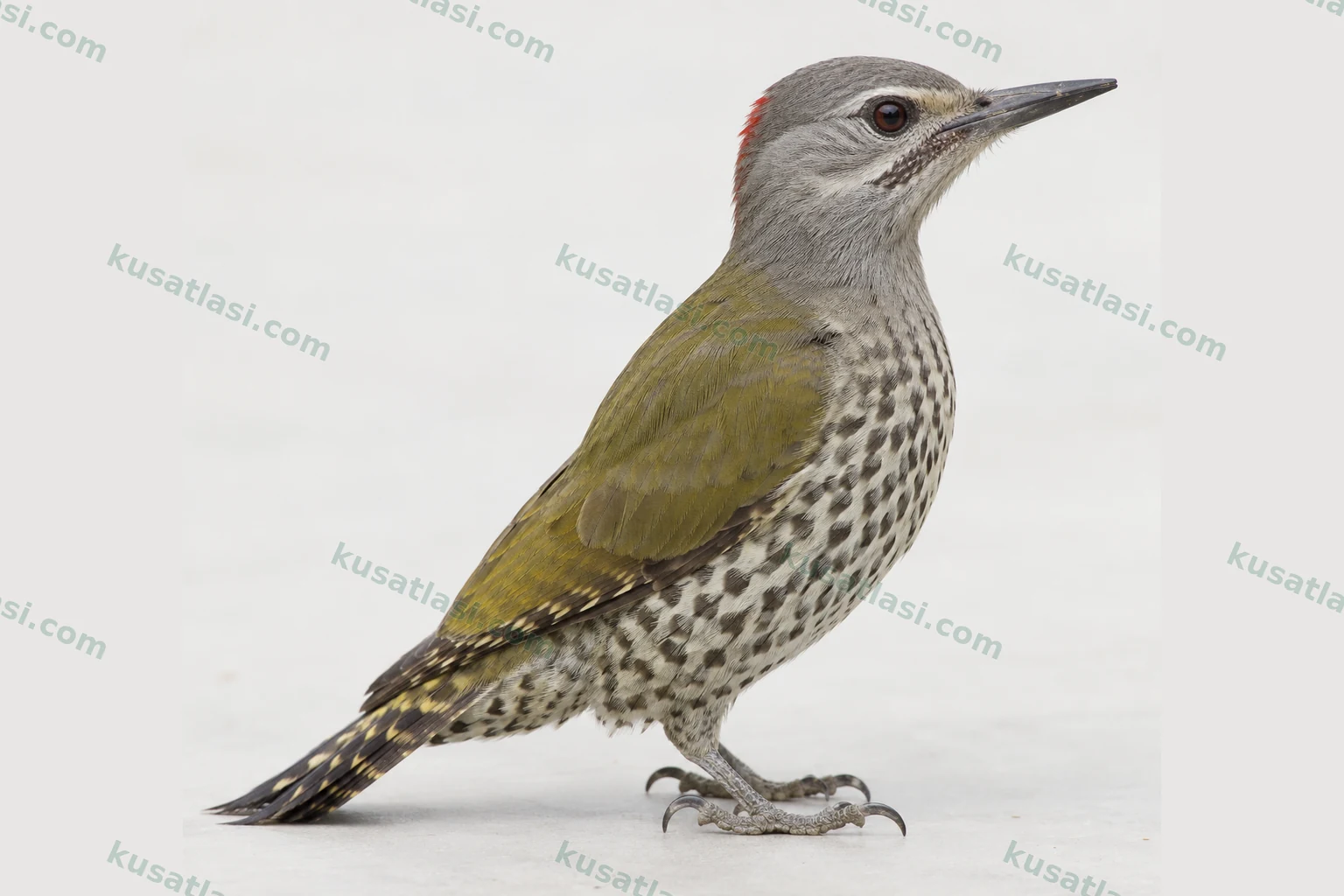
Compare male and female
 FemaleMale
In adults seen well, the male may show a red crown and the female a grey one. Young of both sexes can have red on the crown, so this rule is not applied without knowing the age.
Where to look in its natural range?
Watch palm groves, riverine woodland, savanna trees and gardens with large trees. Observe foraging on trunks and on the ground together; do not open tree cavities.
The species is basically resident. The specialist account gives West African breeding examples in December–June and East African examples in February–July and September–November. These are neither one shared calendar for all countries nor monthly probabilities of presence.
January
The species is basically resident. Regional breeding examples are not a shared calendar for the whole continent. This month falls within the December–June breeding examples in the West African specialist account.
February
The species is basically resident. Regional breeding examples are not a shared calendar for the whole continent. This month falls within the December–June breeding examples in the West African specialist account. This month falls within the February–July/September–November breeding examples in the East African specialist account.
March
The species is basically resident. Regional breeding examples are not a shared calendar for the whole continent. This month falls within the December–June breeding examples in the West African specialist account. This month falls within the February–July/September–November breeding examples in the East African specialist account.
April
The species is basically resident. Regional breeding examples are not a shared calendar for the whole continent. This month falls within the December–June breeding examples in the West African specialist account. This month falls within the February–July/September–November breeding examples in the East African specialist account.
May
The species is basically resident. Regional breeding examples are not a shared calendar for the whole continent. This month falls within the December–June breeding examples in the West African specialist account. This month falls within the February–July/September–November breeding examples in the East African specialist account.
June
The species is basically resident. Regional breeding examples are not a shared calendar for the whole continent. This month falls within the December–June breeding examples in the West African specialist account. This month falls within the February–July/September–November breeding examples in the East African specialist account.
July
The species is basically resident. Regional breeding examples are not a shared calendar for the whole continent. This month falls within the February–July/September–November breeding examples in the East African specialist account.
August
The species is basically resident. Regional breeding examples are not a shared calendar for the whole continent. No verified regional date specific to this month was given; this does not mean local absence.
September
The species is basically resident. Regional breeding examples are not a shared calendar for the whole continent. This month falls within the February–July/September–November breeding examples in the East African specialist account.
October
The species is basically resident. Regional breeding examples are not a shared calendar for the whole continent. This month falls within the February–July/September–November breeding examples in the East African specialist account.
November
The species is basically resident. Regional breeding examples are not a shared calendar for the whole continent. This month falls within the February–July/September–November breeding examples in the East African specialist account.
December
The species is basically resident. Regional breeding examples are not a shared calendar for the whole continent. This month falls within the December–June breeding examples in the West African specialist account.
Nest, egg and incubation
The pair excavates a cavity in a dead tree or a dead section of a living tree; palms may also be used. A typical clutch of two–four eggs is reported. Reliable species-specific incubation and nest-departure periods were not verified, and another woodpecker’s duration has not been substituted.
The call is a repeated series of thin, lively notes. Sources differ in their interpretation of rising and falling notes; a written syllable or direction of sound alone does not give certain identification.
Do not play recordings to attract birds; observe quietly, especially near nests.
Species information
Quick Identification
The African Gray Woodpecker, Dendropicos goertae, is a medium-sized woodpecker recognised by its grey head and underbody, olive to yellow-green back and small warm-coloured belly patch. The male has red on the crown, while the adult female's crown is grey. Softer colour transitions predominate rather than large, sharply contrasting black-and-white facial patterns. Identification combines the grey head and breast, greenish back, wing and undertail barring and size of the belly patch. Not every greenish woodpecker clinging to a tree is this species.
Cornell's current account matches the English name African Gray Woodpecker to Dendropicos goertae. Older publications may use Chloropicus or Mesopicos as the genus. Those name changes do not mean different birds, but information on the Eastern Gray Woodpecker formerly included in a broader species must not be silently transferred here. This account concerns the accepted taxon Dendropicos goertae.
General Appearance and Posture
The compact body, straight bill projecting in front of the head and short stiff tail braced against the trunk are conspicuous. Understanding the tail as a support helps explain the posture on a tree.
The upper bill is dark and the lower part may be slightly paler. The front of the head and face are grey-toned; fine pale eyebrow and facial lines may be visible depending on the individual and light. These fine lines are less marked than other woodpeckers' bold black-and-white facial patterns. The eye is described in reddish or brownish shades. Eye colour is not fixed from one photograph's white balance; it is considered with surrounding feathers and the overall head pattern.
The back looks olive or yellow-green and the underbody paler grey. Pale transverse marks occur on the wing. The red area near the upper base of the tail may be hidden by leaves or the folded wing depending on posture. The small central belly patch can appear yellow-orange, orange or red. Cornell specifically notes its variable colour. A red-looking patch alone therefore does not establish Eastern Gray Woodpecker: its size, wing bars and undertail must be checked together.
The bird may seek prey on a branch or while clinging upright to a trunk. As it moves along the trunk, the feet grip and the tail provides support. A view of the tail tip touching a tree does not mean all feeding takes place on trunks. Posture differs when looking for ants on the ground or working on a thinner branch. The photographed position represents only one moment of natural movement and must be interpreted that way.
Males, Females and Young Birds
The crown is the most useful sex character among adults. The male has a red crown area, whereas the adult female's crown is grey. This mark is useful in good light with the whole crown visible. A red-looking nape is not the same as a clear view of the crown. A head behind the body, shaded crown or blurred image may leave insufficient evidence to determine sex.
Young can have duller upperparts than the adult's bright olive tones, more strongly streaked underparts and a smaller, paler belly patch. The specialist account reports that young of both sexes may have red on the crown. A red crown is therefore not a certain male sign in every bird of unknown age. Juvenile features should be assessed first. Without seeing feather-tip condition and the whole body pattern, a crown photograph alone cannot settle both age and sex.
Sources recognise five geographic subspecies. Not every difference in head or underbody tone reflects age or sex. Light, feather wear and geographic form can affect appearance together. Rather than seek an unchanging colour sample, examine the relationship of the basic marks: grey head and breast, greenish back, barred wings and tail, and small belly patch. A subspecies name requires reliable locality and appropriate comparison.
Appearance in Flight
The undulating progress typical of woodpeckers may be seen in flight, with a rise over several wingbeats alternating with descending sections. As this style is widespread in the family, it does not separate the species alone. Seeing the grey head and underbody again after landing is more useful than a short flying silhouette. The red area near the tail may briefly stand out at take-off.
Wing bars and pale-and-dark undertail marks help comparison with Eastern Gray Woodpecker. Seeing them requires a view of the spread wing or underside of the tail. A closed-wing photograph does not reveal an unseen underside pattern. Distance and backlighting can hide the wing bars. In such views, record the missing marks rather than assigning a definite species from undulating flight alone.
Voice and Behaviour
The call is described as a repeated series of thin, lively notes. Specialist sources differ in their written interpretations of rising and falling notes, so no single direction or syllable is used as a certain key here. Hearing a brief call may help locate the bird, but its origin in the observed individual should be checked. In woodland with several woodpeckers, a distant sound is not combined with the image of a nearby bird.
Feeding in pairs or small groups is reported in West Africa, whereas eastern observations may more often concern single birds. This regional difference is not compulsory for every encounter. It can work around bark and wood, descend for ants or occasionally catch flying insects. Using the bill to extract food and striking a tree for communication are not recorded as one and the same behaviour.
Similar Species
Eastern Gray Woodpecker, Dendropicos spodocephalus, is very similar. African Gray Woodpecker generally has a smaller belly patch and more distinct wing and tail bars. A large dark red belly area may support the other species. Colour alone is unreliable because African Gray Woodpecker can also have a red patch. Geography is assessed with the complete plumage pattern; information in an older combined account is not mixed between the present separate taxa.
When comparing Olive Woodpecker, Dendropicos griseocephalus, the general tone of breast and underbody matters. African Gray Woodpecker is paler and greyer below, while the other species is more olive overall. Yet green reflected shade can make grey feathers look greenish. Head, breast and back should be examined under the same lighting. Moving on a tree trunk or having a green back does not replace identification.
Global Distribution
The African Gray Woodpecker's natural range forms a broad but not everywhere continuous belt across sub-Saharan Africa from west to east. Sources include regional populations from Senegal and The Gambia east to suitable parts of Sudan and Ethiopia, and from Cameroon to western Kenya and northwestern Tanzania. Central African distribution may be more fragmented. The form meridionalis, described in southern Gabon, northwestern Angola and south-central Democratic Republic of the Congo, also belongs to the species' geographic diversity.
This does not mean that whole countries are fully occupied. Woodland presence, local elevation and regional habitat structure matter. The map model is a general range prediction, while observation cells sample openly licensed records. Coloured areas are not presented as complete breeding boundaries, and one record cell does not prove regular breeding. Records of the neighbouring Eastern Gray Woodpecker use its different scientific name.
Status Within Its Native Range
The specialist assessment places the species globally in Least Concern. Being common in suitable places does not mean equal frequency in every woodland. Its use of open woodland, riversides, palm groves and some gardens gives it a broad habitat range, but suitable wood and tree structure still matter for nesting. The global category alone is insufficient when assessing local tree loss.
Social appearance, elevation and breeding time may differ between western and eastern areas. These differences are described without applying one country's data across the continent. Some older sources differ in genus or species limits, so the taxon behind range information must actually be Dendropicos goertae. A historical combined map cannot be used as the present boundary of two separate species.
Migration
The African Gray Woodpecker is basically resident. The specialist source reports some local wandering outside breeding, not regular long-distance intercontinental migration. A sequence of countries is not drawn as a route without tracking data showing where movement begins and ends. Especially where trees are patchy, a new record is not equivalent to permanent range expansion. Rainfall, prey availability, observation effort and possible temporary wandering need separate consideration.
Breeding Habitat
The species inhabits varied wooded environments. Savanna trees, open forest, forest edges, riverine forest strips, gardens with large trees and some mangroves provide suitable areas. Natural and cultivated palm groves can both be used. A woodland record does not always mean closed rainforest. Tree type, openness of cover and nearby water together provide a more useful description of its surroundings.
The species uses lowlands in West Africa and also higher woodlands in eastern areas. The specialist elevational range is not interpreted as every population selecting the same altitude belt. Habitat assessment considers trees on which it can seek prey around trunks and branches, rather than only an elevation number.
Nest Site
The pair excavates a tree cavity. A dead trunk or a dead section of a living tree can be used, in various trees including palms. The specialist account describes cavities about 25–30 cm deep and nests in tall trees; this does not mean every nest has identical dimensions. The typical clutch is two–four eggs. Reliable species-specific incubation and nest-departure periods were not verified; another woodpecker's day counts are not substituted.
Daily Space Use
The bird may feed around trunks, branches and bark and descend to look for ants and termites. One individual using different surfaces shows why watching a single feeding layer may be insufficient. At a riverside or palm grove, watching both trunks and finer branches helps. Approaching a cavity tree must not interrupt adult entry and exit. Opening old holes, checking inside by hand or forcing a bird out are not suitable observation methods.
What Does It Eat?
It mainly eats insects and their larvae. The specialist description includes prey around wood and bark and ants and termites on the ground. AVONET also classifies it as a woodland bird feeding on invertebrates. That broad classification gives no diet proportion for each prey group; equal percentages across different regions are not assumed.
Small crabs taken around roots in mangroves are also reported. This does not mean that crabs are the staple food of every population. Searching palm groves provides opportunities to encounter insects using those plants. An insect being an agricultural pest is not, without further research, converted into a claim of measured economic benefit in any field.
How Does It Hunt?
While clinging to a trunk, it grips with its feet and uses the stiff tail as support. It can probe bark with its bill, extract prey around wood and move along branches. It also searches on the ground. Occasional catching of flying insects does not mean that staying continuously airborne is its main feeding method. Records should distinguish clearly whether prey came from trunk, leaf, ground or air.
Bill strikes on wood are not always communication. Repeated blows when extracting prey and series that may signal to other birds must be considered in their observational context. Stripping bark or opening an ant nest to see a woodpecker better changes natural behaviour. Waiting from an existing open spot is a better way to see the surface it uses without disturbance.
Age Comes Before Sex
An adult male can be recognised by a red crown and an adult female by a grey one. The specialist account nevertheless states that young of both sexes may have red on the crown. This shows why a simple colour rule cannot be used without age information. Duller upperparts, streaked underbody and small belly patch of a young bird also need consideration. Red on the crown alone does not make every individual male.
One Bird, Several Genus Names
Older publications and compilations may list this woodpecker as Dendropicos, Chloropicus or Mesopicos. Not every old record under one of those names automatically matches current species limits; historical combinations with Eastern Gray Woodpecker especially require checking. AVONET's taxonomic matching table explicitly preserves links between these genera. When an old measurement is used, one can therefore check the actual taxon behind the record rather than the name alone.
The Importance of Dead Wood for Nesting
A dead part of a living tree may provide a place to excavate. This does not give every dead branch equal value: wood condition, position and surrounding feeding area matter. The cavity an excavator creates can provide a structure for other organisms, but direct records are needed to establish which organism later uses a particular hole made by this species. The cavity tree should be preserved during observation, without intervention to see the nest interior.
Numbers Measure Different Things
Understanding what numbers mean allows correct comparisons between species. A verified incubation day count was not found for this species; unknown fields have not been filled from similar birds.