

World Birds IUCN statusLC · Least ConcernGlobal IUCN category. BirdLife v10 (2025); taxon matching: AviList 2026 / IOC 15.2; checked: 29.10.2026. The list year is not the species assessment date. Source and method · BirdLife OrderPiciformesWoodpeckers and allies FamilyPicidaePicidae
White-spotted Woodpecker
Veniliornis spilogaster
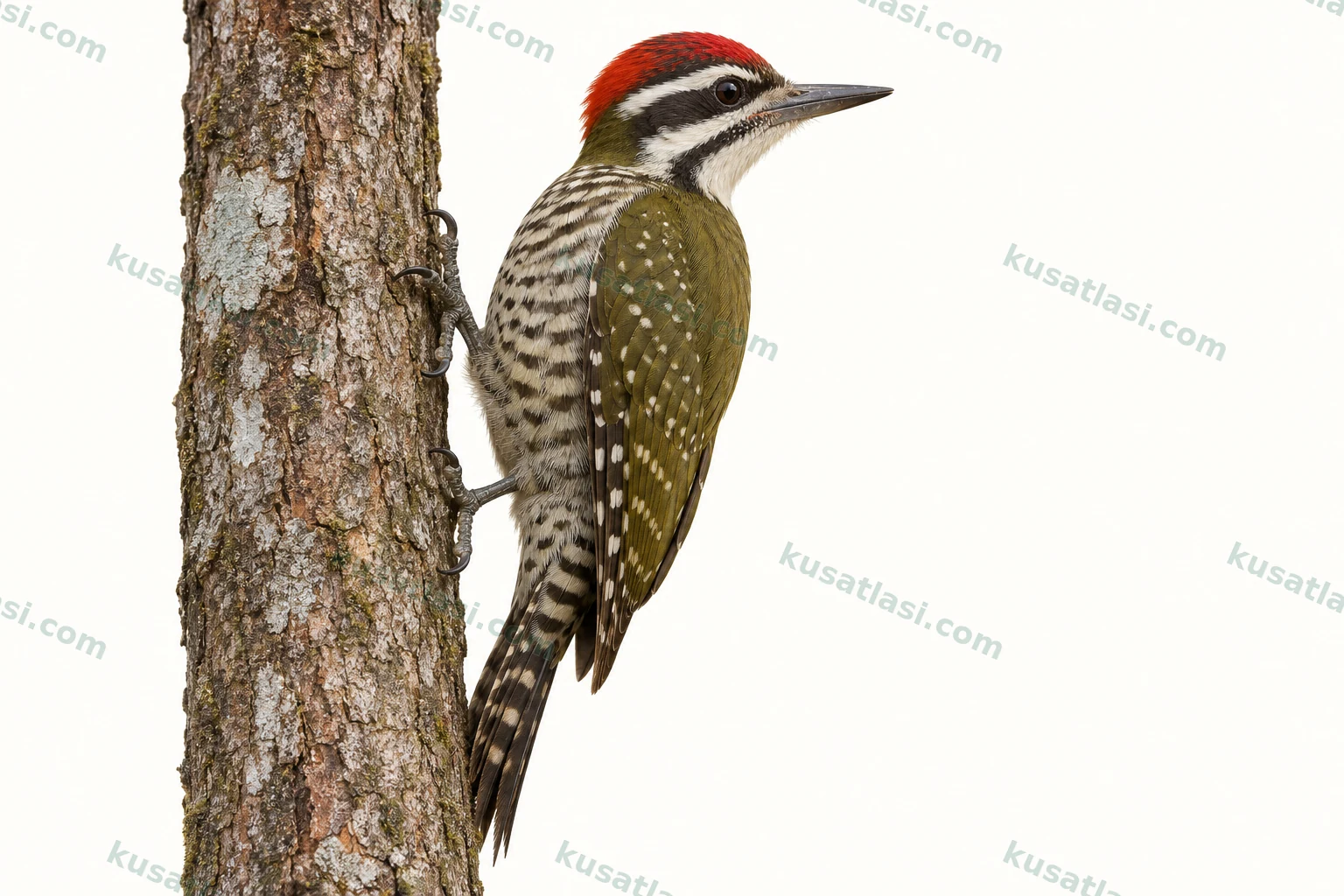
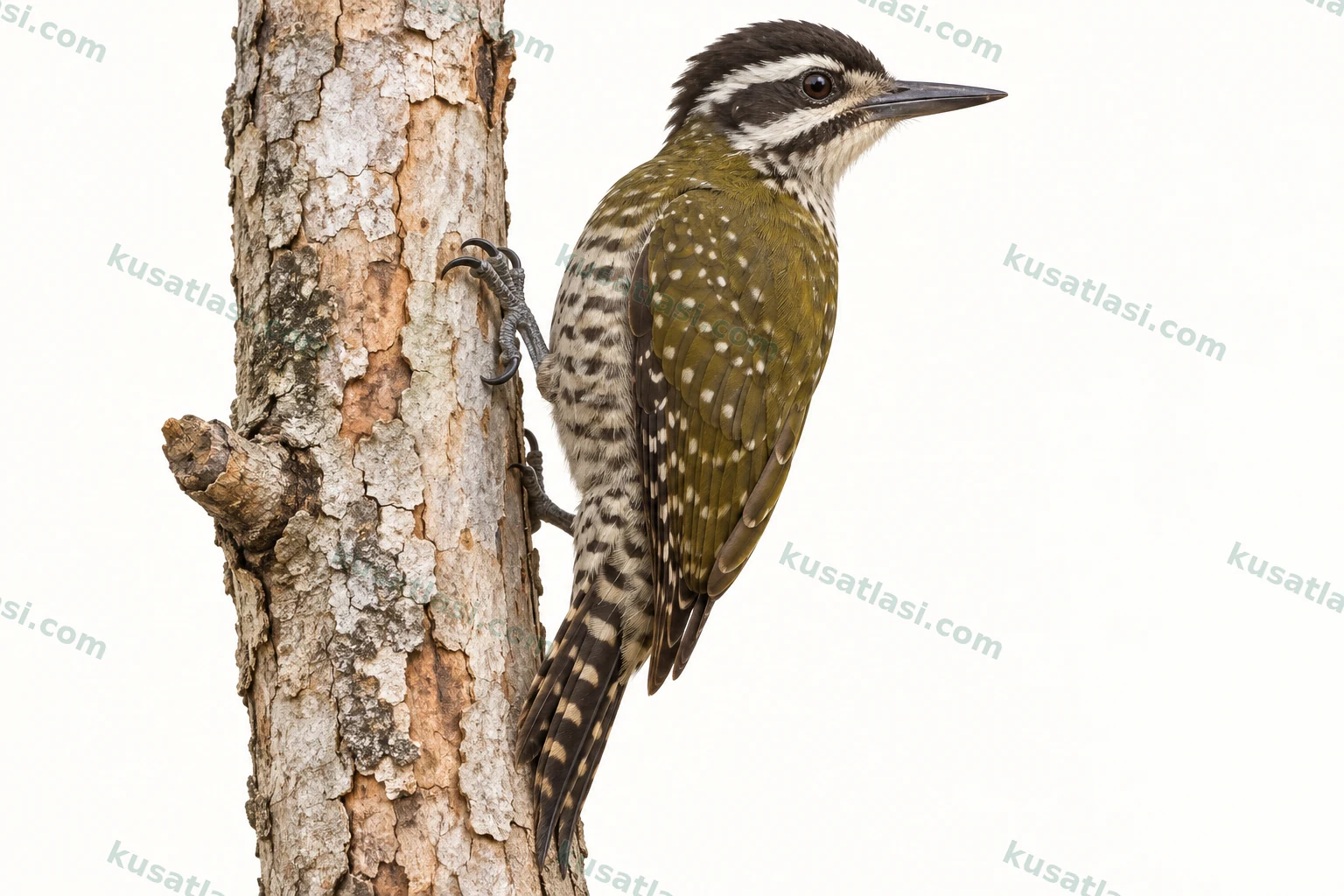
A small olive-toned woodpecker with dense pale spots and bars. Two pale facial stripes and the pale throat help identify it. The adult male has red on the crown.
Biometrics
Length
Male16–20 cm
Female16–20 cm
Shared species value
Wing length
Male9.6 cm
Female9.6 cm
Shared species value
Weight
Male38–42 g
Female36–40.3 g
White-spotted Woodpecker
Southeastern Brazil, southeastern Paraguay, Uruguay and northeastern ArgentinaObservation guide in its natural range
Look for three features together
Do not rely on a single featureTwo pale stripes above and below the eye, and a pale throat with fine dark streaks.
Pale yellowish spots and bars on an olive ground. The tail is also barred.
The adult male has red on the crown. If age is uncertain, the absence of red does not establish sex.
Compare male and female
 FemaleMale
The adult male has red on the crown. The female has a dark crown with pale spots. The historical juvenile male description is not a universal key for all young birds.
Where to look in its natural range?
Forests, forest edges, secondary woodland and parks with enough trees. Look on trunks and branches.
The dated 2012 nest with a young bird in São Paulo is a local example. It does not give a laying month for the whole range.
January
Resident. No regular long-distance migration was verified. No verified regional date was given for this month. This does not imply local absence.
February
Resident. No regular long-distance migration was verified. No verified regional date was given for this month. This does not imply local absence.
March
Resident. No regular long-distance migration was verified. No verified regional date was given for this month. This does not imply local absence.
April
Resident. No regular long-distance migration was verified. No verified regional date was given for this month. This does not imply local absence.
May
Resident. No regular long-distance migration was verified. No verified regional date was given for this month. This does not imply local absence.
June
Resident. No regular long-distance migration was verified. No verified regional date was given for this month. This does not imply local absence.
July
Resident. No regular long-distance migration was verified. No verified regional date was given for this month. This does not imply local absence.
August
Resident. No regular long-distance migration was verified. No verified regional date was given for this month. This does not imply local absence.
September
Resident. No regular long-distance migration was verified. No verified regional date was given for this month. This does not imply local absence.
October
Resident. No regular long-distance migration was verified. São Paulo, Brazil, 2012. A well-developed young bird was observed at the cavity entrance, with a female carrying food.
November
Resident. No regular long-distance migration was verified. No verified regional date was given for this month. This does not imply local absence.
December
Resident. No regular long-distance migration was verified. No verified regional date was given for this month. This does not imply local absence.
Nest, egg and incubation
The bird nests in tree cavities. The São Paulo example was about 4 m up in a dead branch of a living tree. Typical clutch size, incubation duration and time to flight from the nest were not verified. Do not disturb cavity entrances.
A vocal small woodpecker. Calls and bill strikes are assessed separately. A detailed species-specific call key was not verified.
Do not play recordings to attract birds; observe quietly, especially near nests.
Species information
Quick identification
The White-spotted Woodpecker Veniliornis spilogaster is a small woodpecker with dense pale spots and crosswise markings on a dark olive-toned body. Two pale stripes run above and below the eye and help identify the bird together with the pale throat. Males show red on the crown and upper rear of the head. Adult females lack this red. Red on the head alone is insufficient, since males of other small woodpeckers in the same region also have red markings.
The English name is White-spotted Woodpecker. The current heading is matched to the AviList taxon Veniliornis spilogaster. Some current specialist sources use Dryobates spilogaster for the same species. The different genus placement does not signify a different bird. Picumnus spilogaster is a separate taxon. Its records are not merged with this species just because the second word of the scientific name is the same.
General appearance and posture
The back, rump and shoulders have pale yellowish markings on a dark olive ground. Some look more like short crossbars than round spots. The wing coverts also have pale spots. The tail is dark brownish black with paler bars. The historical museum account describes yellow and white separately on different feather surfaces, so no single colour describes the entire pale pattern.
A dark olive area separates the two pale stripes on the side of the head. The chin and throat are pale with fine dark streaks. Markings on the breast, flanks and underwing may look spotted, while other underparts can look more strongly barred. Small elements of the pattern merge where feathers overlap. A very white-looking photograph does not mean that every part of the actual plumage is pure white. Warm light can also accentuate yellowish colour.
When the bird clings to a trunk, its back pattern is easy to see, but a branch may hide the lower facial stripe. Waiting for the bird to turn sideways can reveal both stripes and the pale throat together. Looking only at the head before the body is visible gives too much weight to the red shared by similar species. Seeing the upperparts and underparts of one bird makes the identification more securely based on the full set of colours and patterns.
A nearby bird that looks larger is not automatically a male.
Males, females and young birds
The adult male has red-streaked feathers on the dark crown and upper rear of the head. Small pale markings on the forehead should not be confused with this red area. The adult female has dark crown feathers with pale shaft streaks and spots, without the male's red. If the red crown is hidden in shadow, a single view is not enough to identify the bird as a female. An adult sex key does not directly apply when the age is uncertain.
Hargitt's juvenile male specimen resembles the adult male, but has a paler face and neck, more conspicuous pale facial stripes and pale feather shafts alongside red tips on the crown. The warm yellowish tone of the underparts is weaker, and the pale crosswise markings on the back and wings are described as narrower. This is a description of the juvenile male specimen examined. It does not independently establish that every juvenile female shows the same transition.
The absence of red on a bird of unknown age does not establish that it is an adult female. Consider moult and whether the crown is hidden. A direct observation of a nearby adult feeding a young bird strengthens the age assessment. Two birds on the same branch do not establish that link on their own. Marks for one individual of a species should not be assembled from separate photographs of different birds.
Appearance in flight
Pale wing spots and tail bars can support identification when visible. Several small woodpeckers also have pale wing markings, so a spot seen during a brief flight is not conclusive. Once the bird lands on a trunk, check the facial stripes and underpart pattern again. Failing to see red on the head in flight does not establish that the bird is female.
Voice and behaviour
The specialist Cornell account describes a vocal small woodpecker. A specialist field archive in Paraguay also documents its tapping sound. A bill strike and a vocal call are different behaviours, and neither is a direct equivalent of the other. If possible, match a sound from the far side of a tree to a bird you can see. This review did not verify a new detailed sound key that transcribes the full set of calls.
Field sources describe observations of single birds and pairs. Leaves can hide much of the bird as it moves along trunks and branches. A brief view of a red head or pale facial stripe is best followed by checking the body's spots and bars. Working with the bill on a tree can be feeding, cavity excavation or tapping. The movement alone does not identify its function.
Similar species
The Little Woodpecker Veniliornis passerinus is also olive-toned with barred underparts and a red crown in the male. These shared marks do not give a certain identification. Consider geographic variation in facial pattern together with the White-spotted Woodpecker's two pale facial stripes, throat and overall body pattern. With a poor view, do not force a choice between the two species.
World distribution
The species' native range extends from southeastern Brazil into southeastern Paraguay, Uruguay and northeastern Argentina. The Atlantic Forest region and adjoining wooded areas are central to its geographic setting. This does not justify shading the whole Brazilian Amazon or the southern tip of Argentina as continuously occupied. Read the region and habitat as well as the country in occurrence records.
Status within the natural range
It is recorded in forests, forest edges, well-developed secondary woodland and parks with enough trees. A nest observation in a São Paulo park associated with native vegetation limits the idea that the bird can breed only in closed old forest. A single park record does not establish equal density in every city centre. Model colour on the map does not imply verified breeding in every wooded area. Observation cells are explained separately from the estimated area.
Movements and migration
Specialist data with citations classify the species as resident. The sources examined did not provide a regular annual long-distance migration route. Crossing between forest patches or moving locally to feed is not shown as an intercontinental migration line. More sightings in one month should be considered alongside breeding, vocal activity, leaf cover and observation effort. A dated observation does not establish absence in the months when the bird was not seen at that site.
Breeding habitat
The species inhabits wooded settings, forest edges and secondary forest. Habitat that retains natural or excavated tree cavities provides different resources from a park of open lawn. Seeing a feeding bird and finding a nest are separate kinds of evidence. A nest observation is considered alongside use of the structure and behaviour of the young.
Nest site
A 2023 paper describes a nest observed in São Paulo on 10 October 2012. It was a cavity in a dead branch of a living tree, about 4 m above ground. The slant of the branch made the entrance face somewhat downwards. A well-developed young bird put its head out, and a nearby female carried a worm or larva in her bill. This direct observation demonstrates cavity use. It does not establish typical clutch size, total incubation duration or time to flight from the nest. The sources examined did not verify those three values.
Daily use of space
Finding food on trunks and branches and carrying food to young are different uses of the habitat. A dead branch can occur on a living tree, so the entire tree does not need to be dead. Do not approach the cavity entrance, cut the branch or shine a light inside. The structure supporting the nest forms part of the habitat of this bird and other cavity users.
What it eats
The species account lists insects taken from tree trunks and small fruits. Functional data with references classify invertebrates as the main food group. The use of fruit does not make it the entire diet. In the São Paulo nest record, the worm or larva carried in the bill gives direct evidence of animal food in care of the young. No seasonal food percentages were verified for the entire range. Seeing one food item does not establish an annual proportion.
How it finds food
The bird searches for food on trunk and branch surfaces. Seeing what it actually takes when the bill contacts the bark makes a feeding record stronger. Counting every strike of the bill as insect consumption can confuse feeding with cavity excavation and audible tapping. If a bird moves behind a branch, waiting for it to emerge onto another branch may give a better view than approaching and interrupting its movements. Do not obstruct a food-carrying adult or use calls or food to delay its return to the young.
The name does not describe the shape of every spot
Some pale markings above are yellowish and resemble short crossbars. Spots and stripes occur together on the underparts as well. Looking only for round, pure white spots therefore makes the bird hard to identify. The body area bearing a mark is as useful as its colour. Seeing the head, throat and back of the same bird strengthens the identification.
A dead branch in a living tree
The tree with the São Paulo nest bore green leaves, while the branch used was dead. Classifying entire trees only as living or dead can miss the small structure used for the cavity. Recording the branch's condition separately from that of the tree describes the breeding setting more accurately. One observation does not establish that all nests occur at the same height.
Read the whole scientific name in older sources
Veniliornis and Dryobates placements can refer to the same target bird. Picumnus spilogaster is a different bird. The shared second name is no reason to combine nest records or measurements. Check genus, species, locality and date of publication together. This keeps information about different birds with the same word in their names from being transferred between them.
A juvenile male differs from an adult female
The juvenile male in the historical museum account had red tips and pale shaft marks on the crown feathers. The adult female's crown pattern was described without red. This illustrates why age and sex are separate questions. If part of the head is hidden, failing to see red does not prove the bird is female. Assess the whole plumage and the age context. A single museum specimen does not provide a universal schedule for all age transitions. If age is unknown, record it as such.