

World Birds IUCN statusLC · Least ConcernGlobal IUCN. BirdLife v10 (2025); taxon matching AviList 2026 / IOC 15.2; checked: 29.10.2026. The list year is not the species’ assessment date. Source and method · BirdLife OrderPiciformesWoodpeckers and allies FamilyPicidaePicidae
White-headed Woodpecker
Leuconotopicus albolarvatus
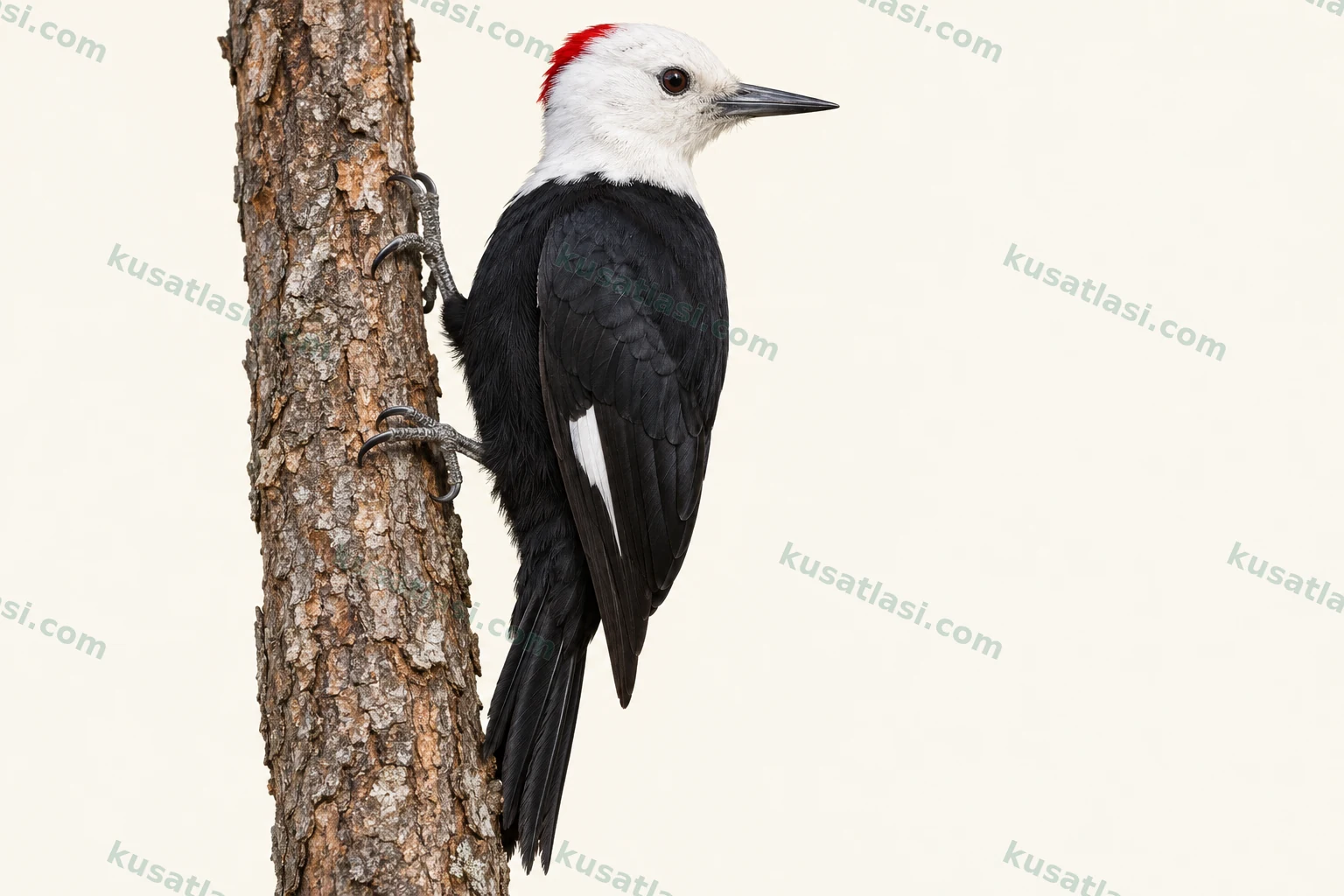
Black body, extensive white head and white wing area; adult males have a small red patch at the back of the head.
Biometrics
Length
Male24 cm
Female24 cm
Shared species value
Wingspan
Male38–43 cm
Female38–43 cm
Shared species value
Weight
Male55.6–68 g
Female52.6–66.4 g
White-headed Woodpecker
Southern British Columbia and mountain pine forests of the western USAObservation guide in its natural range
Look for three features together
Do not rely on a single featureWhite face, crown and throat; red rear crown in the adult male.
Black back and belly; white at the bases of the outer feathers on the spread wing.
Red can lie nearer the middle of the crown; it is not confused with the adult male mark.
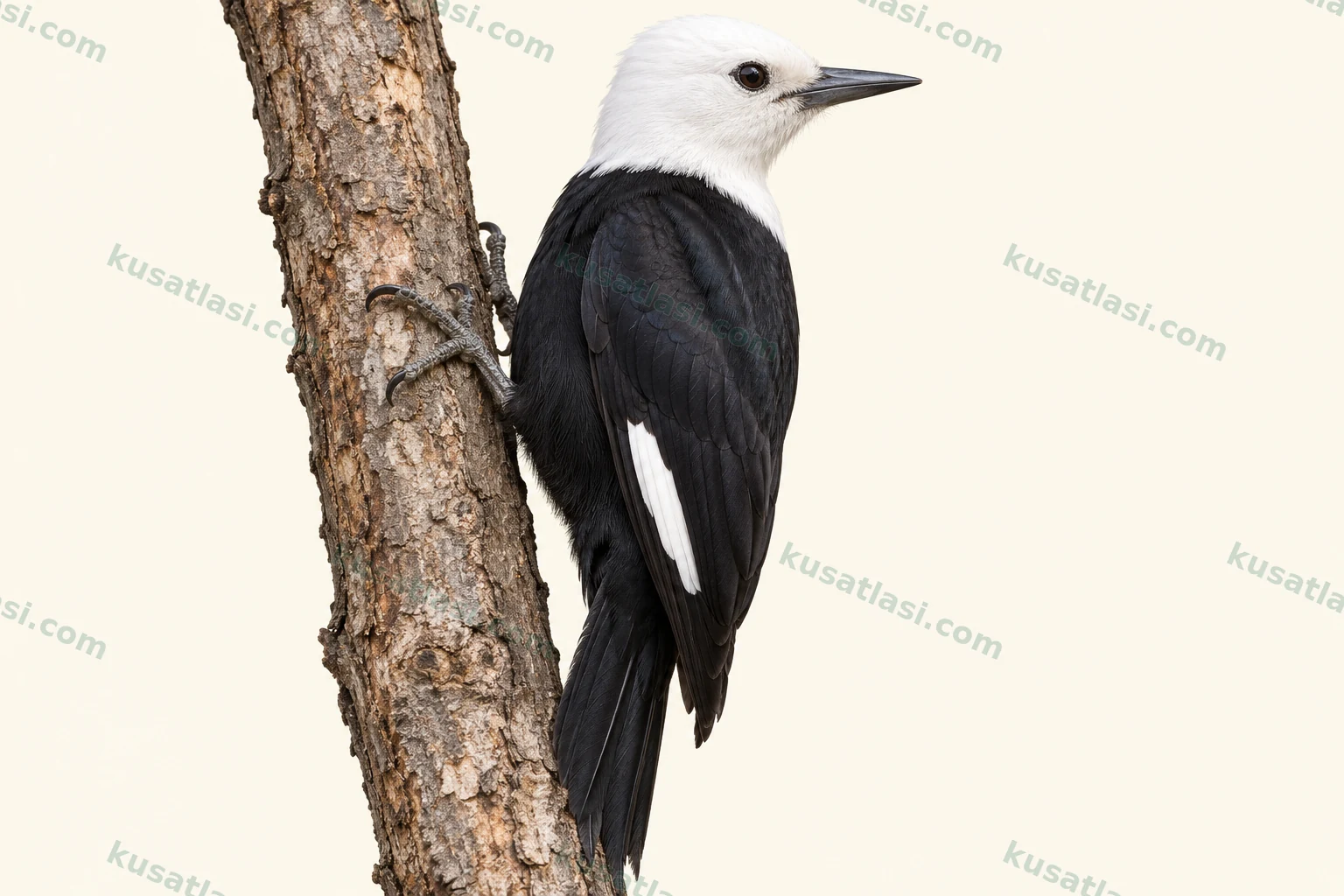
Compare male and female
 FemaleMale
The adult male has a red rear-crown patch, the female a white head; red can lie in a different position in young birds.
Where to look in its natural range?
Mature large-coned pines, partly open forest and dead trunks suitable for nest excavation.
The dated British Columbia account records eggs in May–June and young from late May into July; this is not a shared calendar for the entire range.
January
Generally resident; limited wandering after breeding and winter descent in some individuals. No verified regional date specific to this month was given; this does not mean local absence.
February
Generally resident; limited wandering after breeding and winter descent in some individuals. No verified regional date specific to this month was given; this does not mean local absence.
March
Generally resident; limited wandering after breeding and winter descent in some individuals. No verified regional date specific to this month was given; this does not mean local absence.
April
Generally resident; limited wandering after breeding and winter descent in some individuals. No verified regional date specific to this month was given; this does not mean local absence.
May
Generally resident; limited wandering after breeding and winter descent in some individuals. Canada, British Columbia: egg records in the dated regional account. Canada, British Columbia: nestling records from late May to mid-July.
June
Generally resident; limited wandering after breeding and winter descent in some individuals. Canada, British Columbia: egg records in the dated regional account. Canada, British Columbia: nestling records from late May to mid-July.
July
Generally resident; limited wandering after breeding and winter descent in some individuals. Canada, British Columbia: nestling records from late May to mid-July.
August
Generally resident; limited wandering after breeding and winter descent in some individuals. No verified regional date specific to this month was given; this does not mean local absence.
September
Generally resident; limited wandering after breeding and winter descent in some individuals. No verified regional date specific to this month was given; this does not mean local absence.
October
Generally resident; limited wandering after breeding and winter descent in some individuals. No verified regional date specific to this month was given; this does not mean local absence.
November
Generally resident; limited wandering after breeding and winter descent in some individuals. No verified regional date specific to this month was given; this does not mean local absence.
December
Generally resident; limited wandering after breeding and winter descent in some individuals. No verified regional date specific to this month was given; this does not mean local absence.
Nest, egg and incubation
Both sexes excavate the tree cavity. Four or five eggs are usual; the Oregon–Idaho study found an average of about four. Both sexes incubate for about 14 days; young leave the nest at about 26 days.
High, sharp calls of two or three syllables, longer trembling series and regular, relatively slow drumming are heard.
Do not play recordings to attract birds; observe quietly, especially near nests.
Species information
Quick identification
White-headed Woodpecker Leuconotopicus albolarvatus is a black-bodied, white-headed woodpecker of mountain pine forests in western North America. White face, crown and throat contrast strongly with black back, belly and tail. A white area is also visible on the open wing. Head whiteness is not merely a thin eyebrow or cheek stripe; it covers much of the head.
The adult male has a small red patch at the rear of the head; the adult female lacks it. In young birds, red can appear nearer the middle of the crown. Not every bird showing red is therefore an adult male. Head, wing and body are checked together, without treating age and sex as the same thing.
General appearance and posture
The body is slender, the bill short and pointed and the tail fairly long. On a tree trunk, the pale head draws attention from afar, while the black body can be overlooked more easily against dark bark. White head and throat and the white at the bases of the outer flight feathers are separate marks. White can sometimes be partly concealed on a folded wing and checked again as the bird moves.
The bird is often seen foraging on a pine trunk, branch or cone. Clinging to a cone to extract seeds may look different from the image of a woodpecker forcefully excavating only dry trunks. It sometimes lifts pieces of bark or examines clusters of needles. Watching where the bill works and the surface supporting the foot helps establish whether it is seeking seeds or insects at that moment.
The bill of the gravirostris subspecies of southern California's mountains is larger than in the more widespread albolarvatus. This regional difference does not make male and female separate species. Rather than measuring a distant bill, establish the species first with white head, black body and wing marks; a subspecies interpretation requires location and sufficient detail together.
Males, females and young birds
Both adult sexes share the same basic black-body and white-head pattern. The male's red area lies on the rear crown, not the entire head. This region is white in the female. A male's red mark can be hidden when only the face is visible. It can therefore be misleading to name a bird definitely female from a frontal view without seeing the back of the head.
In young birds, red can lie nearer the middle of the crown rather than the adult male's rear-head patch. Its location is examined separately when assessing age. The white head and black body also help identify young birds, but one red feather area does not settle age and sex simultaneously. Detail that could not be seen is not filled in as present or absent.
During breeding, both male and female excavate the nest cavity, incubate eggs and care for young. The male generally incubating at night does not mean every bird seen at the nest by day is female. In some populations, sexes can forage at different heights or intensities; this behaviour varies with region and season and is not a fixed sex key for the whole range.
Appearance in flight
White on the outer part of the spread wing is an important mark that can be hidden on the folded wing. Seeing it with black body and white head strengthens identification. The entire wing is not white; dark parts of the flight feathers remain. Even a brief wing opening while changing branches can show the pattern, but one light flash is not treated as a permanent patch.
Undulating flight combining wingbeats and short glides can be seen. This general woodpecker flight alone does not distinguish the species. Other woodpeckers in the same forest can move similarly; check head colour and back pattern again. The male's slow exaggerated wing movements in courtship or encounters with another male are distinguished from normal long-distance flight.
Voice and behaviour
A frequent call is a high, sharp, rapid sequence of two or three syllables; longer trembling series can also be given. Drumming made by striking a trunk with the bill differs from a call produced by the throat. Its drum is described as looser, slower and more regular than in some similar-sized woodpeckers. Vocal resemblance alone does not establish identity; the visible bird and pine-forest setting are considered too.
Partners may be more vocal and active in spring. They maintain contact near the nest through calls or light tapping. Some pairs can roost together throughout the year. Rapid upward movement on a trunk when facing a rival, or standing nearby with the neck extended, are also recorded behaviours. These are assessed by watching the full interaction without confusing it with ordinary feeding.
Similar species
Acorn Woodpecker Melanerpes formicivorus can resemble it at a distance through pale face and dark body. The arrangement of pale and dark head areas and the red crown differ from White-headed Woodpecker's extensive white head. When only a pale part of the face is visible in tree shade, check the whole head and belly pattern again.
Leuconotopicus villosus differs in its striped head and pale back area; White-headed Woodpecker has a black back and mostly white head. Clark's Nutcracker Nucifraga columbiana is another comparison, with a pale-grey head and bill that can suggest a woodpecker; corvid body proportions and grey-and-black feathers are checked together. Eating pine seeds does not make the two species the same bird.
World distribution
It is characteristic of mountain and inland pine forests of western North America. The range extends from southern British Columbia through suitable forests around Washington, Oregon and Idaho to California's Sierra Nevada and southern mountains. It is not evenly distributed in every western forest; large-coned pines and trees suitable for excavation are especially important.
Status within its natural range
The current list gives the global status as Least Concern. Small populations at the northern range boundary or particular forest regions can nevertheless be more sensitive. The older detailed British Columbia account describes sparse resident occurrence in Okanagan and neighbouring valleys, without accepting undocumented distant reports as confirmed natural range. A dated regional assessment is not used as today's population count for the entire continent.
Northern Blue Mountains research showed sparse, clustered occurrence in the forests studied. Failure to detect the bird at most recording stations does not mean forests elsewhere are empty too. Habitat suitability predictions and actually recorded individuals form separate map layers; every suitable coloured area is not assumed to be a breeding site.
Migration
It is generally resident. A few individuals can move to lower elevations in winter, and limited wandering after breeding is also described. Food seeking is thought to play a part, but no single annual route is verified for every bird. Using different woodland as pine cone crops and insect availability change does not mean regular long-distance intercontinental migration.
Breeding habitat
It breeds in mountain forests with mature pines and patches of open cover. Ponderosa and sugar pines are important; old living trees provide food and dead or decaying trunks offer nest sites. An area uniformly burned throughout, or stripped of every dead tree, may not meet both needs together. Postfire research showed the need to consider a mosaic of different burn severities.
Nest site
The nest is a cavity excavated in a dead tree or dead part of a living tree, with both adults contributing. A new cavity is generally made each year and the same tree sometimes reused. Ten-year research in Oregon and Idaho recorded an average of about four eggs. The specialist species account describes clutches of four eggs or of five eggs as usual, with smaller or larger clutches less frequent. Incubation lasts about 14 days and the interval from hatching to nest departure about 26 days.
Both sexes incubate and feed the young. Nest departure does not mean that a young bird gives up all support that same day; Cornell describes young separating from their parents by autumn. Rather than approaching a nest hole to bring the bird out, watch adults carrying food from a distance.
Daily habitat use
Living cone-bearing pines, barked trunks and clusters of thin branches are different parts of the feeding habitat. The bird is not expected to remain only beside its nest tree during the day. Tree species, cone crop and arrangement of open and closed forest patches matter together. A bird seen on a dead tree does not show that its food comes exclusively from dead trees.
What does it eat?
Pine seeds are a conspicuous part of the diet. Large-coned ponderosa, sugar, Jeffrey and Coulter pines may be used. Insects and larvae are also taken in warmer periods and during breeding; ants, termites, beetles and other small invertebrates are included. Pine sap may be used too. These resources vary by season and region, so the bird is not portrayed as eating only seeds throughout the year.
How does it forage?
Clinging to a cone, it separates scales or strikes to extract seeds. It sometimes eats a seed in the cone and sometimes carries it elsewhere for processing. When seeking insects it lifts bark, probes cracks and examines needle clusters. This method explains why constant loud excavation is unnecessary; head and wing marks of a quietly feeding bird can still be watched.
It can open rows of shallow holes to obtain sap. Old holes on a trunk do not prove that the bird which made them is there now. Sex differences in feeding height or method have been recorded, but are not identical in every region. Rather than inferring sex from behaviour, check the red mark at the back of an adult's head too.
Dead trees and living pines serve different functions
A decayed trunk suitable for excavation provides only part of the bird's habitat. Mature pines supplying winter seeds are also needed. Postfire Oregon research showed the importance of larger decayed dead trunks near nests. The same result does not say that removing all living pines is beneficial. Nest sites and feeding sites must be considered together.
The same management can have different effects at different scales
The Oregon and Idaho nest research of 2012–2021 compared forest treatments at small-area and broader surrounding scales. The direction of the relationship between burning or tree removal and chick survival could change with scale. This shows why one intervention should not be called good or bad everywhere. Eggs, chicks and adult feeding may not respond identically to the same conditions.
Sounds identified by a computer are checked too
In the Northern Blue Mountains study, researchers listened again to predictions from automatic sound classification. A computer suggesting the species name was thus not accepted directly as a definite record. Actual occurrence points and the possibility of nondetection were assessed separately. The sparse-distribution result is meaningful in the context of the two forests studied, not a population measure for all North America.
Red patch position can indicate age
The red area at the back of an adult male's head can be nearer the middle of the crown in a young bird. Looking only for red in a photograph misses this distinction. Seeing its position when the bird turns its head can be more useful than estimating size from a distance. Absence of red in an adult female is assessed only when that head region can be seen.