

World Birds IUCN statusLC · Least ConcernGlobal IUCN category. BirdLife v10 (2025); taxon matching: AviList 2026 / IOC 15.2; checked: 29.10.2026. The list year is not the species assessment date. Source and method · BirdLife OrderPiciformesWoodpeckers and allies FamilyPicidaePicidae
White-throated Woodpecker
Piculus leucolaemus
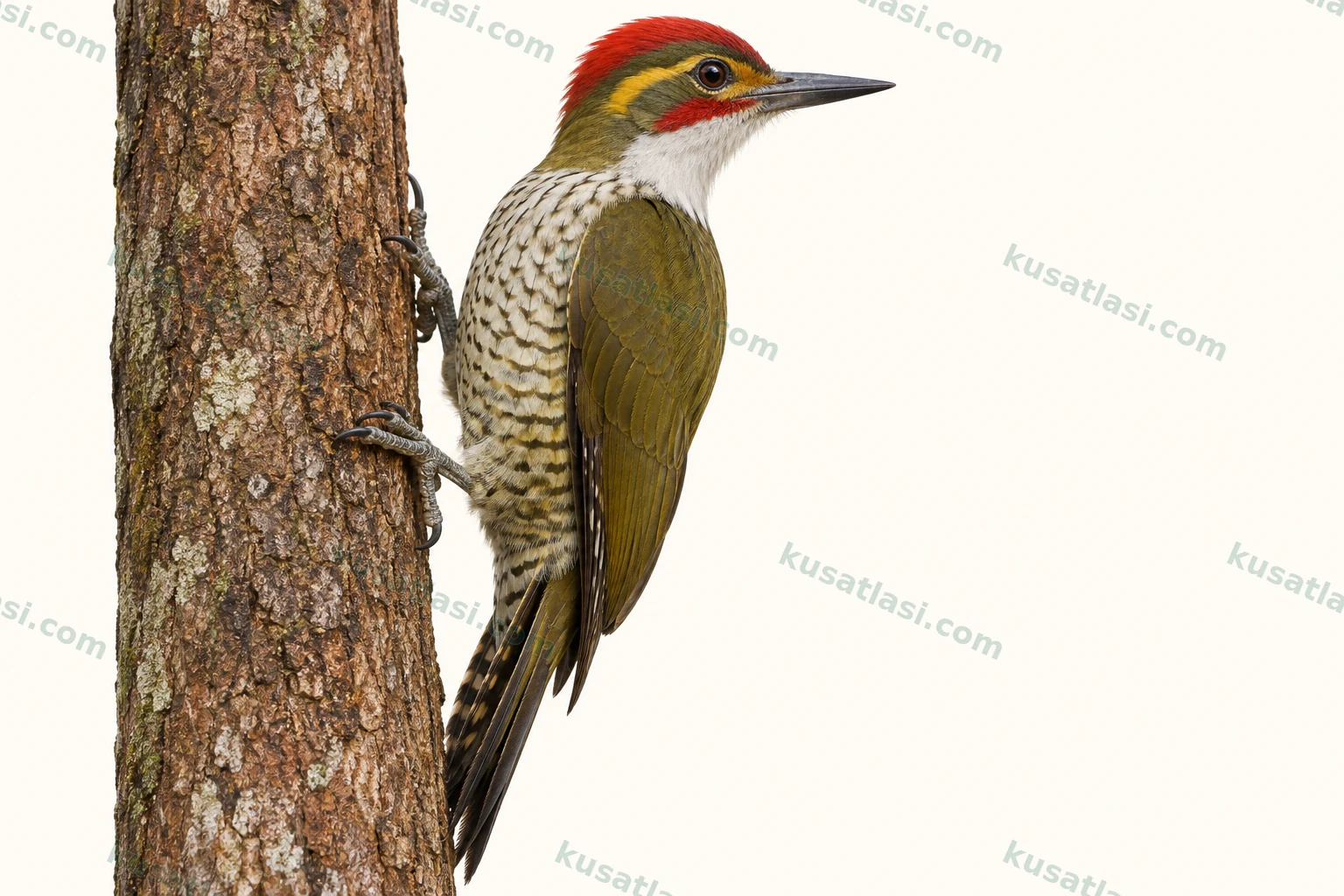
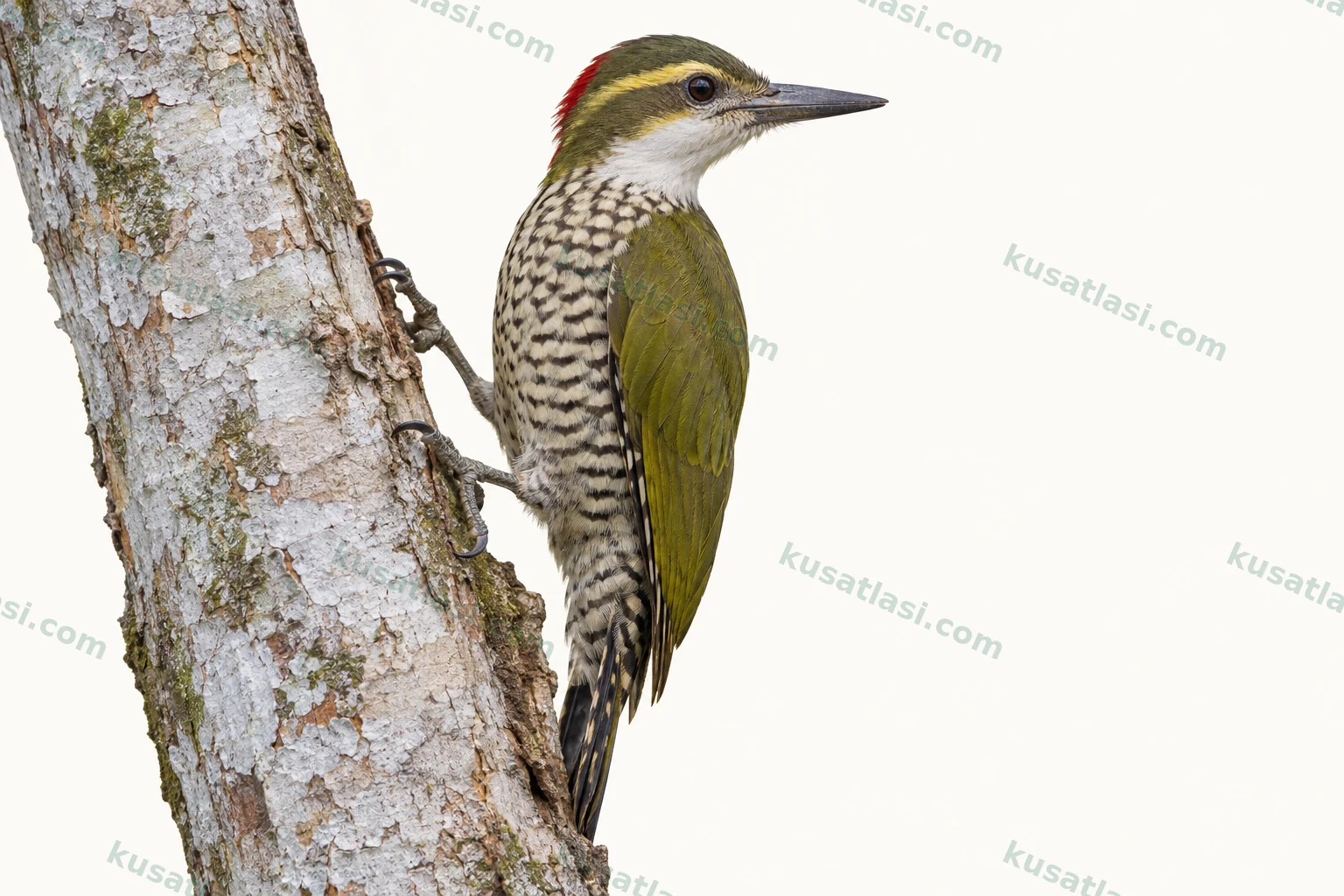
In Amazonian forests, look for olive-green upperparts, a pale throat and a yellow facial stripe. The breast looks scaly and the belly is barred. Males have red on the front of the head and the moustachial stripe. In females, red is confined to the back of the head.
Biometrics
Length
Male19–20 cm
Female19–20 cm
Shared species value
Wing length
Male11.95 cm
Female11.95 cm
Shared species value
Weight
Male69 g
Female69 g
Shared species value
White-throated Woodpecker
Amazon lowlands and eastern Andean foothillsObservation guide in its natural range
Look for three features together
Do not rely on a single featureThe throat is yellowish white and the facial stripe is yellow.
The upperparts are green. The scaly breast gives way to bars on the belly.
The front of the crown and the moustachial stripe are not red in the female.
Compare male and female
 FemaleMale
The male has a red forehead, crown and moustachial stripe. The female has an olive front of the head and moustachial area, with red at the back of the head. One head marking alone does not establish juvenile age.
Where to look in its natural range?
Humid forest and its edges. Look for the bird feeding on branches in the middle and upper layers.
A young bird was documented inside a cavity in Pará in October 2020. That observation is not an egg-laying calendar for the whole range.
January
Resident. No regular long-distance migration was verified. No verified regional date was given for this month. This does not imply local absence.
February
Resident. No regular long-distance migration was verified. No verified regional date was given for this month. This does not imply local absence.
March
Resident. No regular long-distance migration was verified. No verified regional date was given for this month. This does not imply local absence.
April
Resident. No regular long-distance migration was verified. No verified regional date was given for this month. This does not imply local absence.
May
Resident. No regular long-distance migration was verified. No verified regional date was given for this month. This does not imply local absence.
June
Resident. No regular long-distance migration was verified. No verified regional date was given for this month. This does not imply local absence.
July
Resident. No regular long-distance migration was verified. No verified regional date was given for this month. This does not imply local absence.
August
Resident. No regular long-distance migration was verified. No verified regional date was given for this month. This does not imply local absence.
September
Resident. No regular long-distance migration was verified. No verified regional date was given for this month. This does not imply local absence.
October
Resident. No regular long-distance migration was verified. Pará, Brazil. A chick was observed in a cavity and parental care was recorded. This does not date egg laying.
November
Resident. No regular long-distance migration was verified. No verified regional date was given for this month. This does not imply local absence.
December
Resident. No regular long-distance migration was verified. No verified regional date was given for this month. This does not imply local absence.
Nest, egg and incubation
A young bird was documented in a cavity in a living tree in Pará. The total numbers of eggs and young, the full incubation period and the time to first flight were not verified.
The main call is a harsh, hoarse scream. Match it to the bird in view.
Do not play recordings to attract birds; observe quietly, especially near nests.
Species information
Quick identification
The White-throated Woodpecker Piculus leucolaemus is an Amazonian woodpecker with green upperparts and patterned underparts. Look for the yellow stripe along the face, the pale throat and the scaly pattern on the breast. Farther down the belly, the pattern becomes barred. A green back or red on the head is not enough to separate the similar woodpeckers in the region. The pale throat, dark eye and shape of the breast markings make a more useful combination.
Its English name is White-throated Woodpecker. Current taxonomy uses Piculus leucolaemus, while museum catalogues record older genus combinations such as Chloronerpes leucolaemus. A change of name does not mean every older record refers to another bird. However, measurements of other Piculus woodpeckers in older, broader classifications are not transferred to the current species. Read the complete scientific name together with the locality.
General appearance and posture
Hargitt’s museum description gives the back, rump, shoulders and wing coverts as golden olive-green. This does not mean that all the bird’s plumage is bright yellow. The tail is mainly dark brownish black, with green edges at the bases of some feathers. In the shade of a tree, the back may darken enough to look the same colour as the tail. In a clearer view, compare the green upperparts with the dark tail.
The sides of the face and neck are olive-toned. A golden-yellow stripe starts at the base of the upper bill, crosses the face and extends onto the side of the neck. The chin and throat are yellowish white. The name “White-throated” does not mean the area must look like a glaring patch of pure white. Seeing where the stripe crosses the head is more informative than glimpsing one yellow point in shade. As the bird turns its head upwards, the border of the throat may also become visible.
The upper breast and lower belly do not carry the same pattern. The modern field account emphasises scaling on the breast and barring lower down. The older museum description also records variation with age and among specimens. Short lines visible in one photograph are not assumed to continue in the same direction over the entire underside. Look separately at the breast feather margins and the more regular bands on the belly.
Males, females and young birds
The adult male has a red forehead, crown and rear of the head. There is also red on the cheek extending into the moustachial stripe. The female has a golden-olive forehead and crown and lacks the red moustachial stripe. She still has a red patch on the back of the head. Red on the head alone therefore does not establish that the bird is male. Check whether it covers the forehead and crown and extends beneath the cheek.
A branch obscuring the front half of the head makes it difficult to distinguish the female’s red rear head from the male’s red crown. Sex may remain uncertain in such a view. Slightly paler underparts are not treated as a distinct female body colour. Both sexes share the green back and patterned body.
Hargitt reports elongated pale centres and dark bands just before the tips of breast feathers in immature specimens. This detail does not imply that all young birds have one particular head colour. To avoid confusing the catalogue’s description of immaturity with that of an adult female, state which feather feature supports the age identification. If the breast cannot be seen well, a single blurred photograph does not establish the age. Red on the head alone likewise does not identify every stage of development.
Appearance in flight
In the original museum description, the inner parts of the flight feathers are rufous-brown, with darker tips, and the wing lining is a warm light brown. These areas differ from the olive-coloured outer surface of the folded wing. A warm flash on the wing in a short flight can help with identification, but similar Piculus species also show warm wing tones. Look at the throat and breast again after the bird lands.
Voice and behaviour
Cornell’s field account describes the main call as a harsh, hoarse scream. The voice alone is not a fixed key under all forest conditions. When matched to a bird seen at the same time, it can support evidence from the head, throat and body. The species can forage in the middle and upper forest layers and joins feeding groups with other species. Since a flock may contain several species, follow the face and underpart markings of each bird separately.
Similar species
The Yellow-throated Woodpecker Piculus flavigula has a yellower face and throat. In the White-throated Woodpecker, assess the pale throat together with the limited yellow facial stripe. The scaly breast pattern and dark eye are useful when comparing it with the Golden-green Woodpecker Piculus chrysochloros. Green upperparts or a red crown alone do not distinguish them. If the throat is hidden in shade, wait for the bird to move naturally and give another view. The region’s green woodpeckers should not all be grouped under one name.
World distribution
Its Amazonian range extends from southern Colombia to eastern Ecuador and Peru, northern Bolivia and Amazonian Brazil. Read the current taxonomic account together with the specialist regional checklist. They do not establish that the species occurs at the same frequency throughout a single unbroken strip of forest. Localities of other green woodpeckers along Brazil’s Atlantic coast are not added to this species’ range.
Status within its natural range
The specialist account for Peru highlights the Amazonian lowlands and eastern Andean foothills. A documented breeding observation from Pará also establishes local presence farther east in Brazil. Presence in a country does not imply occupancy throughout it. Different local populations and gaps in the records should not be obscured by one broad shaded area. The map distinguishes predicted range from evidence of actual nests and individual sightings.
Migration
The referenced functional data classify the species as resident, and no regular annual long-distance migration route has been confirmed. Moving through the forest with a feeding group is not intercontinental migration. Seeing a bird in a particular month does not establish that the species breeds then throughout its range. The October record of a young bird in Pará is regional breeding evidence only. It is not transferred to other Amazonian countries as a single breeding calendar or seasonal range boundary. The licensed record cells show examples rather than a complete population census.
Breeding habitat
The bird uses humid lowland and foothill forests, forest edges and some regenerating woodland. The green body may be difficult to see under the foliage. Watching movement in the upper branches can give a clearer view of the head. Habitat information does not imply that nests occur at every suitable point. Forest structure and confirmed breeding records are distinct kinds of information.
Nest site
In 2020 Leite and Barreiros documented a young bird in a cavity in a living tree in Pará and watched the adult male remove a faecal sac. The cavity entrance was 5.70 m above the ground. This is the measurement of one nest rather than a range for the species. Since the inside could not be seen, the total numbers of young and eggs, the full incubation period and the time to first flight were not confirmed.
Daily habitat use
Branches in the middle and upper forest layers serve for feeding and movement. Watch visits to a cavity from outside and at a distance. Do not open the entrance, cut a branch or steer the bird towards the cavity to see inside. A bird moving from one tree to another does not in itself indicate that a nest has been abandoned. Feeding locations, cavity cleaning and direct observations of care for young are recorded separately.
What does it eat?
The referenced diet compilation classifies this species among birds that eat invertebrates and forage around tree bark. The sources did not provide a quantitative study showing which insect is this species’ main food throughout the year. Percentages of ants or termites reported for related woodpeckers are not transferred to this bird. A broad diet classification is not presented as a count from actual stomach samples.
How does it forage?
While the bird forages in the middle and upper forest layers, observers can watch where its bill touches the trunks and branches. Joining other species in a feeding group does not mean it eats all their foods in the same proportions. When possible, record the movement of the bill together with the food item seen. If the item cannot be distinguished, do not give it a definite prey name. Repeated movements of one bird are not counted as different individuals. Peeling bark from a branch for observation or placing food on the tree may change natural behaviour. Leave the area the bird uses on its own undisturbed.
The position of the red helps identify sex
Both males and females can have red on the rear of the head. In males, it also covers the forehead and crown and extends into the moustachial area. In females, the front of the head and the moustachial area are olive-yellow. The anatomical location matters more than the presence of a red spot. Calling a bird male from only a red rear head in a photograph that hides the front would mistake a shared feature for a sex-specific one.
The breast and belly have different markings
The scaly breast gives way to bars towards the belly. When a leaf hides the breast, seeing the belly bars alone may obscure this distinction. Stating the part of the body where a pattern was seen is more useful than describing all the underparts with one adjective. The age-related feather details in older museum specimens also show why every bird need not look exactly the same.
Care behaviour is separate evidence
The Pará nest study recorded the male removing a faecal sac. This direct observation of care does not show how incubation was divided throughout the day or how many eggs were laid. One young bird seen at the nest entrance is not a total count of the brood. By specifying what a limited observation actually documents, the study adds to the natural history of the species without supplying timings for stages that were not seen.
Gaps in records and actual absence
A green bird can be difficult to notice among foliage. A valley without records on the map should not be read as having no birds anywhere in its suitable forest. Conversely, one record does not establish a resident population in all the surrounding grid cells. Keeping potential range, an individual encounter and direct nest evidence separate makes the map more informative and lets future records add to what is known.