

World Birds IUCN statusNT · Near ThreatenedGlobal IUCN. BirdLife v10 (2025); taxon matching AviList 2026 / IOC 15.2; checked: 29.10.2026. The list year is not the species’ assessment date. Source and method · BirdLife OrderFalconiformesFalcons FamilyFalconidaeFalconidae
White-fronted Falconet
Microhierax latifrons
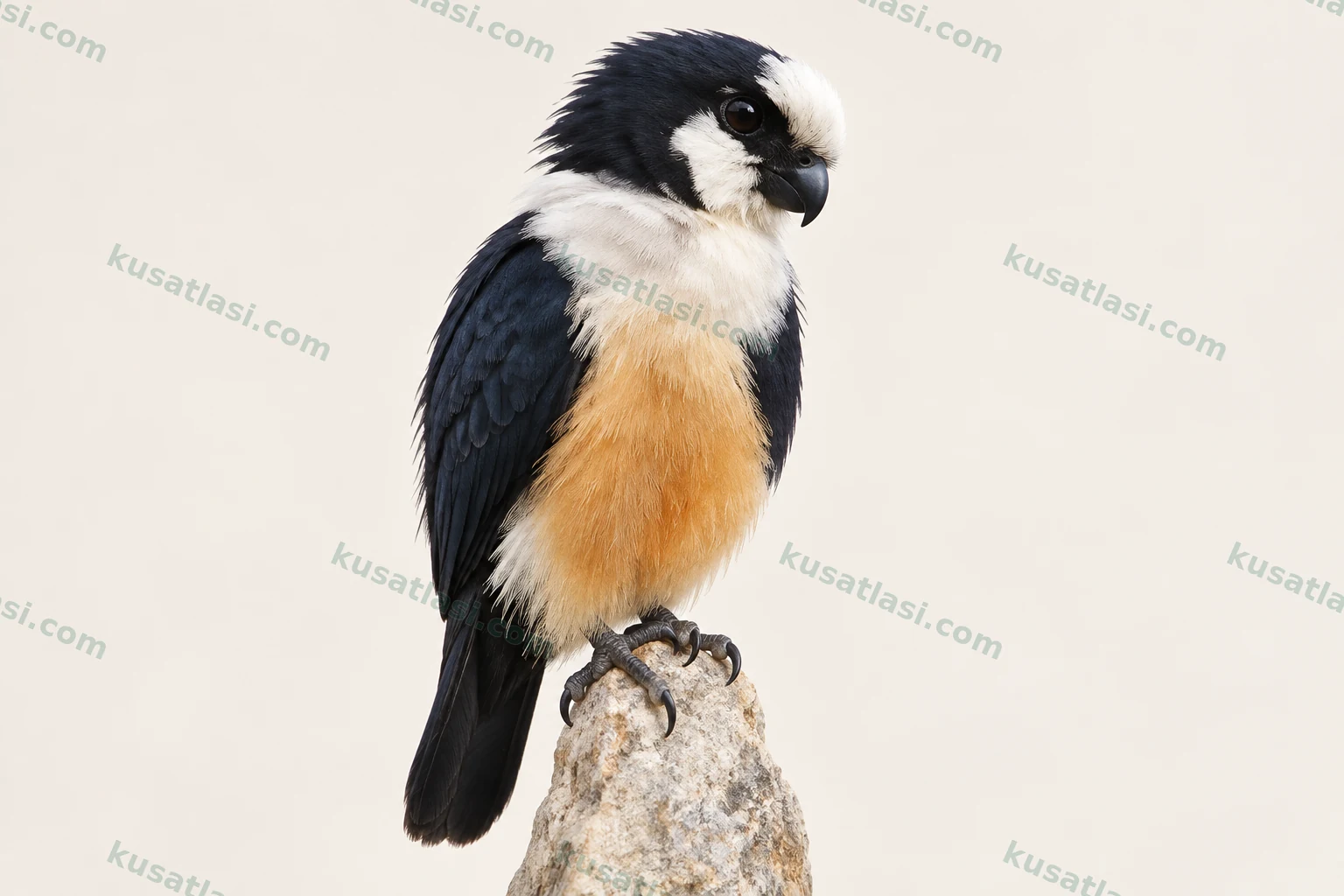
A small northern Bornean falconet with black upperparts and pale breast; the male may show a white front of the head, females and young a warmer one.
Biometrics
Length
Male14–17 cm
Female14–17 cm
Shared species value
Wingspan
Male28–31 cm
Female28–31 cm
Shared species value
Weight
Male41.2 g
FemaleData unavailable
White-fronted Falconet
Northern Borneo — Sabah and northeastern Kalimantan near the borderObservation guide in its natural range
Look for three features together
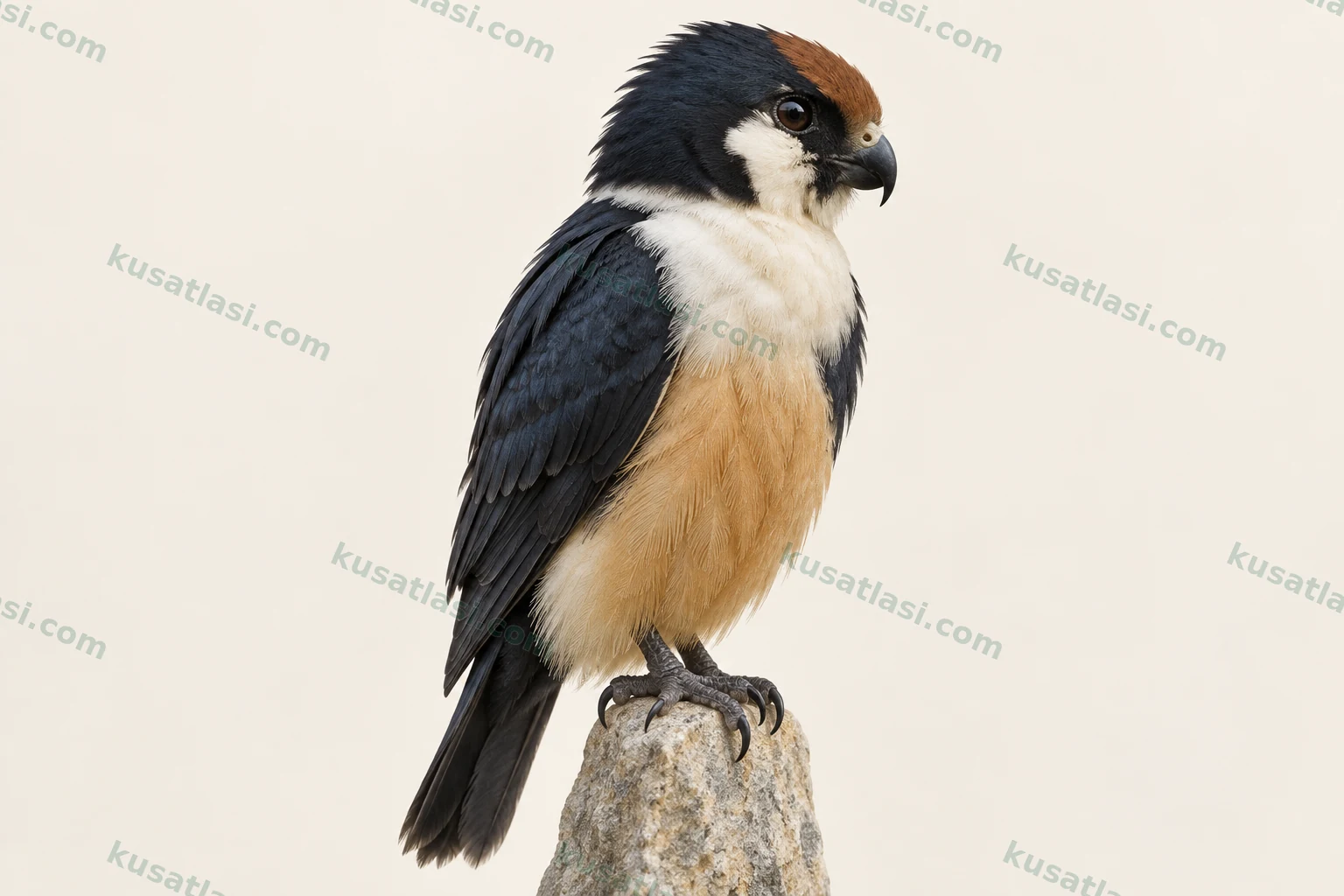
Do not rely on a single featureBroad white forehead and forecrown in the male; warmer tones in females and young, with age and sex uncertainty retained.
Black upperparts and flanks; pale breast and pale orange-sandy belly.
Short sallies for insects from high open branches; single birds, pairs or small groups.
Compare male and female
 FemaleMale
The established description gives the male a white front of the head and the female a rufous-sandy one. The 2025 review stresses uncertainty about age, sex and plumage changes; head colour alone does not determine sex reliably.
Where to look in its natural range?
Look on high dry branches at forest edges and gaps for small groups watching for flying prey.
Dated young-bird and nest records from Sabah are shown; the complete breeding season has not been established.
January
Resident; regular long-distance migration has not been verified. No verified regional date specific to this month was given; this does not mean local absence.
February
Resident; regular long-distance migration has not been verified. No verified regional date specific to this month was given; this does not mean local absence.
March
Resident; regular long-distance migration has not been verified. No verified regional date specific to this month was given; this does not mean local absence.
April
Resident; regular long-distance migration has not been verified. No verified regional date specific to this month was given; this does not mean local absence.
May
Resident; regular long-distance migration has not been verified. No verified regional date specific to this month was given; this does not mean local absence.
June
Resident; regular long-distance migration has not been verified. Sabah — historical nest records: young leaving nests were reported; this is not an egg-laying month.
July
Resident; regular long-distance migration has not been verified. Danum Valley — July 2018: a young bird receiving food from an adult at a nest entrance was recorded.
August
Resident; regular long-distance migration has not been verified. No verified regional date specific to this month was given; this does not mean local absence.
September
Resident; regular long-distance migration has not been verified. No verified regional date specific to this month was given; this does not mean local absence.
October
Resident; regular long-distance migration has not been verified. No verified regional date specific to this month was given; this does not mean local absence.
November
Resident; regular long-distance migration has not been verified. Sabah — historical nest records: young leaving nests were reported; this is not an egg-laying month.
December
Resident; regular long-distance migration has not been verified. No verified regional date specific to this month was given; this does not mean local absence.
Nest, egg and incubation
An old woodpecker or barbet tree hole is used. A specialist source reports two eggs; records with two and three chicks are separate. Incubation duration and age at first flight could not be verified; an adult landing at a hole alone is not evidence of an active nest with eggs.
Repeated short vibrating calls; the functions of the repertoire have not been verified in detail.
Do not play recordings to attract birds; observe quietly, especially near nests.
Species information
Quick identification
White-fronted Falconet Microhierax latifrons is a very small compact raptor of northern Borneo. Black upperparts, pale breast and pale orange-sandy belly are assessed together. The adult male has a conspicuously white forehead and forecrown. The same head area is described as rufous-chestnut or warm sandy in the female, although age and moult can complicate this appearance. On a small bird sitting upright on an exposed branch, head pattern, short hooked bill and dark wings and tail are considered together.
Its small size can make it look like a passerine at a distance. Its tightly built body, hooked bill and short sallies to take airborne prey nevertheless help reveal a falcon. More than one bird on a branch is not unusual. Two neighbours are not named a male–female pair merely because there are two; whether small groups are families or other social associations is not always known.
General appearance and posture
Back, wings and tail look dark black; suitable light can reveal bluish gloss on the upper feathers. The flanks and outer leg feathers are black. Pale throat and breast grade into a pale warm colour towards the belly. The eye is brown. Bill, bare area at its base and legs look dark slate-grey to black. When viewing a bird high in a tree, not all these small features may be equally clear.
The male’s white forecrown may extend above the level of the eye’s rear edge. The boundaries of the pale cheek, dark facial line and black rear head matter together. The entire head is not white. Nor is the warm belly tone described as a patch turning the whole breast dark rufous. Glossy black upperparts can look matt in shade and bluer in sunlight; this light effect is not a separate plumage form.
Resting on a bare or sparsely leafy branch provides a view of the surroundings. Two males documented in northeastern Kalimantan in 2011 sat in a tall dead tree beside a road through secondary forest. One ate a cicada while the other watched for flying prey. This direct observation illustrates an open-view hunting perch, not proof that the birds shared or caught prey cooperatively.
Males, females and young birds
The established description separates the male’s white front of the head from the female’s warmer rufous-sandy front. Cornell’s specialist account also notes this contrast. A 2025 specialist review nevertheless highlights insufficient study of female plumage. Age and definite sex of pale- or dark-headed birds are not known in every photograph; variable colours should not be forced into one unchanging male–female scheme.
A young bird’s forehead and cheek can be sandy, and the underparts appear warmer, potentially resembling an adult female. A lighter brown eye and paler slate-coloured bill have been reported, but light and distance limit these features on high-perched birds. Age assessment considers overall feather development and direct behaviour such as receiving adult food alongside head colour.
Two white-headed birds together need not include a female. They may be adults of one sex or individuals of uncertain age. The 2025 review discusses seasonal moult and cooperative breeding as possible explanations, not proven conclusions. Sex and age that cannot be safely established in the field remain separate from general species identification.
Appearance in flight
Dark wings and tail conspicuous against the small body contrast with the pale breast. When hunting, the bird leaves its perch for an airborne insect; the 2011 field record observed short curved flights followed by return to the original perch with prey. These sallies are not evaluated on the same scale as large falcons ranging for long periods over open country.
White on the head may be invisible in a distant or backlit flying silhouette. Waiting for it to land and checking forehead, breast-belly tone and tail pattern is more reliable. Possible range overlap with the similar Black-thighed Falconet exists in northern Borneo; a flying bird is not named merely by assuming that no other falconet occurs there.
Voice and behaviour
Specialist accounts describe repeated short vibrating calls. Voice information is limited; a breeding or alarm function is not assigned to every call. An observer hearing it at a forest edge can look at high open branches. Sound is matched with its visible source to avoid confusion with small passerines or other raptors in the same tree.
It may occur singly, in pairs or small groups. Direct observations from Maliau Basin describe neighbouring birds using their bills to preen each other’s head and neck feathers. Feather maintenance and social relationships may be involved, but those observations did not experimentally establish a primary function. Close spacing does not mean shared nest care.
Similar species
Black-thighed Falconet Microhierax fringillarius is a close lookalike of more western and southern Borneo. The 2012 field description separates White-fronted Falconet by its broader white front of the head, paler belly, absence of the conspicuous curved white line behind the eye, and unbarred dark undertail. These marks are combined; warmer head colour in female and young birds must also be considered.
Small swallows and swifts can mislead through their size in flight. The perched falconet’s short hooked bill, upright compact posture and prey-watching behaviour matter. Aerial insect capture occurs in many birds and is not diagnostic alone. Without a good view, a distant silhouette is not identified solely by size.
World distribution
The natural range is tied to northern Borneo; the best-known populations are in Malaysia’s Sabah state. Scientifically documented records also come from northeastern Kalimantan in Indonesia near Sabah’s border. It is therefore not described as endemic to one country alone. Restriction to Borneo does not mean continuous occupancy of every forest on the island.
Irham, Meijaard and van Balen’s 2012 publication described two males seen at Simenggaris on 1 June 2011 in detail. An earlier group at Sebakis in 2005 was recorded cautiously because of poor light. The publication shows an extension of the older Sabah-centred distribution account; it does not turn one observation point into a large Kalimantan breeding area.
Status within its natural range
The conservation category is Near Threatened. Restricted range and loss or degradation of lowland forest are the main concerns. The 2025 specialist review highlights outdated population estimates and limited breeding and social-behaviour data. Scarcity is not inferred from one observer’s success that day; forest area and long-term monitoring are considered together.
Old or unverified Sarawak reports are treated separately. Presence on an old checklist does not show regular occurrence throughout the state today. Without reliable current records, whole country or state boundaries are not read as completely occupied species range.
Movements
It is classified as resident; regular long-distance migration has not been verified. Insect-catching sallies from a perch and movements within a forest are daily space use. Young birds seen in different months do not show a migration line between distant countries. Reliable individual tracking data on distances travelled between forest patches were not found.
Breeding habitat
Low-elevation natural and secondary forest, forest edges and gaps in tree cover are important. High dry branches with a clear view are used to watch for prey. Some observations come from peat-swamp forest and tree-covered production land. Occurrence there does not mean that every treeless production area performs the same role as natural forest.
Nest site
Nesting is reported in old tree holes of woodpeckers or barbets. The specialist review cites two eggs; nests with two chicks and a record with three chicks also exist. Chick number is not confused with egg number. Reliable incubation duration and time to first flight were not found. Sabah has records of young leaving nests in June and November; March–April nesting information is not an unchanging boundary for the whole year.
The 2025 review also discusses a July record of a young bird receiving food from an adult at a cavity entrance. An adult landing at a hole does not alone prove eggs inside. Do not cut branches, open cavities or obstruct the adults’ access; observe normal hunting from high perches at a distance.
Daily habitat use
During active hours, birds scan for flying insects from branches offering an open view. Several may use one tree; this does not mean they surround prey together. The 2025 authors observed hunting from a shared perch tree but did not observe cooperative hunting parties or regular prey sharing. Data are insufficient for daily range size or exact distances used by individuals.
What does it eat?
Flying and other large insects are the basic food. The specialist review reports dragonflies, bees, beetles, cicadas, grasshoppers, butterflies and moths. Vertebrate prey records include small birds and lizards. These are not systematic stomach or faecal samples assigning fixed annual food percentages; one large prey item does not make the species primarily a bird hunter.
How does it hunt?
It watches from a bare branch, takes prey in a short flight and often returns to its perch to eat. The 2011 Simenggaris observations directly documented birds eating a cicada and making curved sallies for flying insects. Aerial capture does not mean all prey is taken at the same height; the 2025 review describes ground capture as a less frequent observation.
Records show young birds receiving insects from adults. A male beside a female eating a large moth was discussed as possible courtship feeding; not every similar event is proven courtship feeding. Who caught the prey, who ate it and whether ages were reliably known are kept as separate observations.
A tall dead tree is a perch and lookout
The two males in northeastern Kalimantan in 2011 were seen atop a dead tree about 20 metres tall beside a road through secondary forest. An open perch permits watching small airborne prey. The record also scientifically supports occurrence on the Indonesian side of the border. One perch tree does not demonstrate breeding throughout a large surrounding area; occurrence and breeding evidence are different kinds of information.
They preen each other’s head feathers
Thorley’s Maliau Basin observations describe birds in small groups briefly preening their neighbours’ head and neck feathers in the morning. Since a bird cannot reach every part of its own head equally easily with its bill, mutual preening may contribute to cleanliness. Maintenance of social bonds has also been discussed. These are possible explanations of observed behaviour, not experimentally separated definitive causes in this species.
A photographed twosome need not be a breeding pair
The 2025 review found many photographs showing two white-headed birds side by side. The authors stress the need for better study of age, sex and plumage. Automatically labelling them male and female can misdirect both colour description and breeding interpretation. The suggestion of family members or cooperative breeding helpers in groups is not treated as a result without direct nest observations.
Small size does not restrict prey to small items
Insects are the principal prey, but small birds and lizards have been recorded. The 2025 specialist synthesis distinguishes photographically documented large insects from bird prey. Collections of photographs may overrepresent striking large prey, so they are not converted to daily diet percentages. Interpreting a small bird’s size as requiring every prey item to be tiny is equally misleading.