

World Birds IUCN statusNT · Near ThreatenedGlobal IUCN. BirdLife v10 (2025); taxon matching AviList 2026 / IOC 15.2; checked: 29.10.2026. The list year is not the species’ assessment date. Source and method · BirdLife OrderPsittaciformesParrots FamilyPsittaculidaePsittaculidae
White-naped Lory
Lorius albidinucha
Endemic to New Ireland’s mountain forest: red body, green wings and white nape behind a black cap.
Biometrics
Length
Male26–28 cm
Female26–28 cm
Shared species value
Wing length
Male15.93 cm
Female15.93 cm
Shared species value
Weight
MaleData unavailable
Female120–146 g
White-naped Lory
New Ireland, Bismarck ArchipelagoObservation guide in its natural range
Look for three features together
Do not rely on a single featureSee the white patch behind the black cap.
Do not separate it from the purple-bellied lory by the red body alone.
Compare male and female
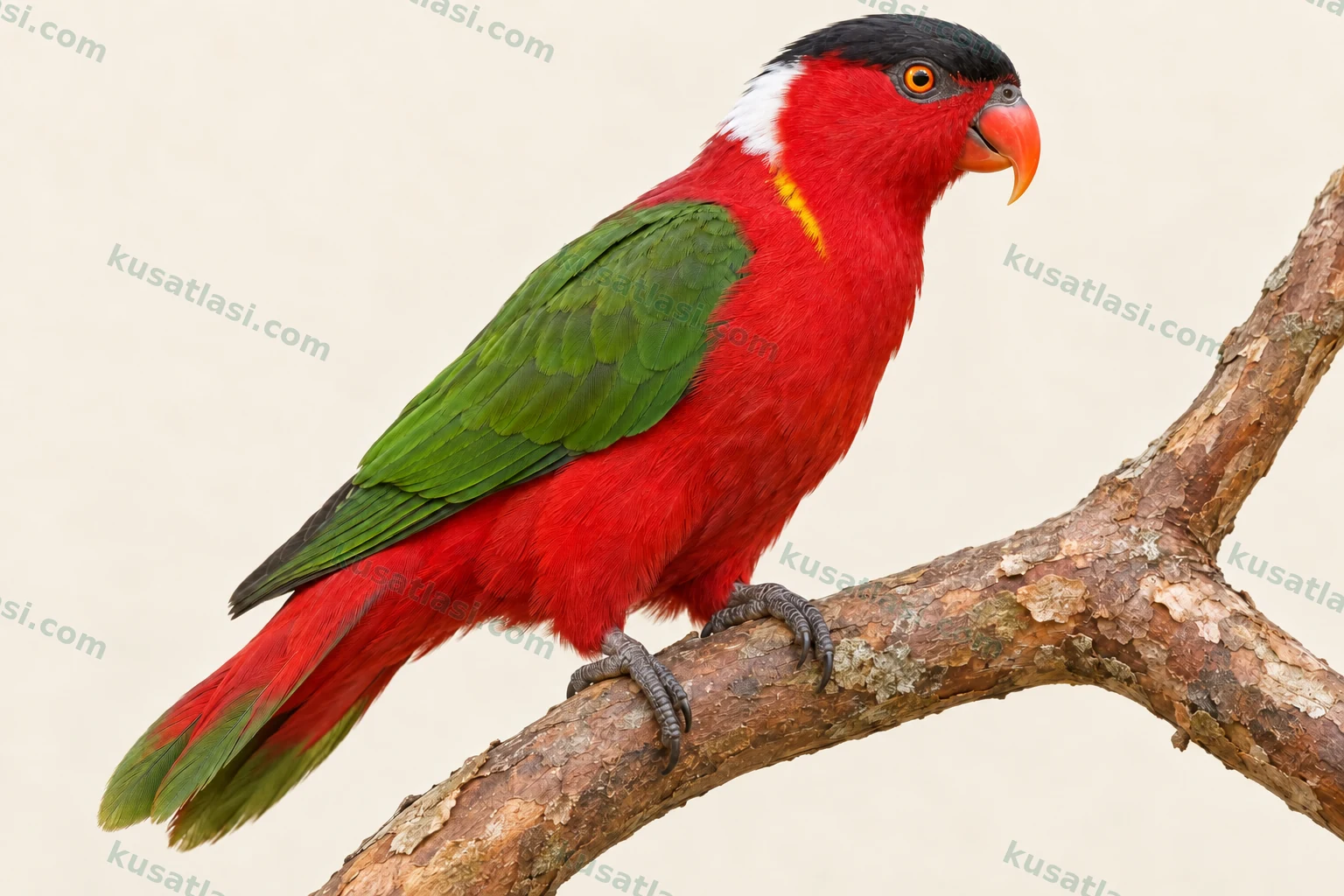 FemaleMale
Adults are similar; a detailed juvenile identification key was not found.
Where to look in its natural range?
Mountain forests in the island’s central and southern parts.
Breeding months could not be verified; the 1976 and 2026 field records are not a breeding calendar.
All months: A regular long-distance migration route was not verified. No verified regional date is given for this month. This does not imply local absence.
January
February
March
April
May
June
July
August
September
October
November
December
Nest, egg and incubation
Tree-cavity use is classified as presumed in a scientific review; egg number and development durations could not be verified.
Older written accounts describe a weak rising whistle-like call; the first recordings were documented during the 2026 expedition.
Do not play recordings to attract birds; observe quietly, especially near nests.
Species information
Quick identification
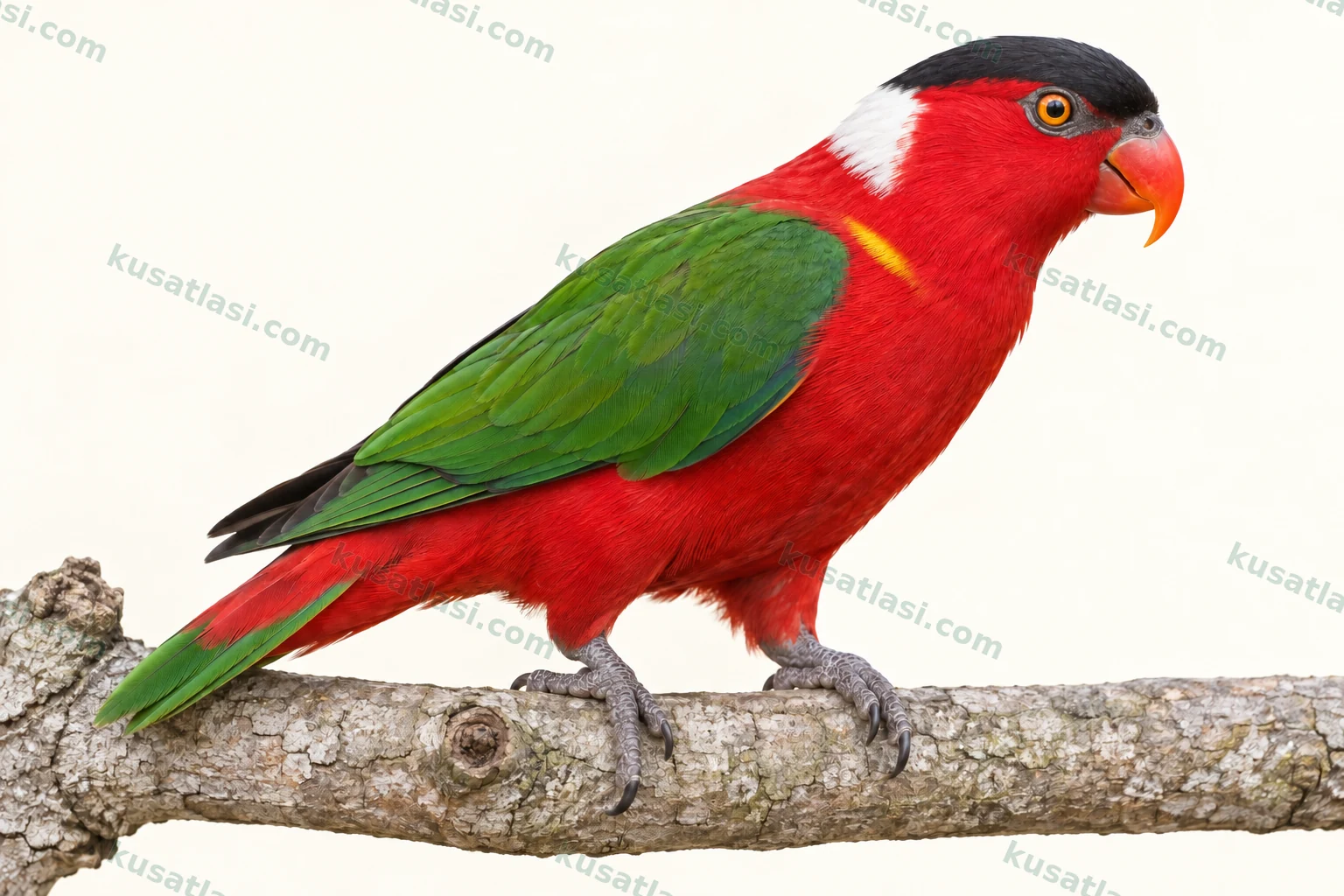
The White-naped Lory Lorius albidinucha is a red-and-green parrot endemic to New Ireland in Papua New Guinea. The white patch behind its black cap is important for identification. Check the green wings, red body and nape mark together. Its name does not mean that the whole head is white; the true nape patch can be hidden in a frontal view.
The English name White-naped Lory refers to the same taxon as the current scientific name. Older publications may use Domicella albidinucha or Lorius albidinuchus. Once record identity is verified, these can be matched to this species; measurements of another lory are not transferred merely because its name is similar. New Ireland and New Britain are different islands. Reliable locality information is an important part of visual identification.
General appearance and posture
Adults have a predominantly red body and black forehead and crown. There is a pale patch at the back of the neck and narrow yellow lines along the neck sides. The red tail has a broad green terminal area. The specialist account also describes an orange-red bill and yellow-orange eyes. Assess these colours in natural light with a clear view; one dark photograph does not show that a colour is genuinely absent.
A bird turning its head towards its body may reveal the white nape more clearly; from another angle the cap hides it. Yellow lines on both sides are not the same as an entirely yellow breast. Wait for natural movements to check the head, breast, wings and tail on the same bird. A red body alone does not distinguish every lory on New Ireland.
Males, females and young birds
The specialist account describes adult males and females as similarly coloured. Red brightness, apparent size of the white nape in a photograph and the way a bird grips a branch are therefore not reliable sexing keys. Similar appearance within an adult pair is normal. If sex is unverified, leaving that field unspecified is better than selecting an unreliable label.
A detailed juvenile plumage sequence and identification key could not be verified in reliable sources. A brown juvenile bill or dark juvenile eye from another lory is not added as an invariant character of this species. Dull plumage alone does not establish that a bird is young. Light, image quality and feather condition can affect the same appearance.
Because nesting dates and development duration are unknown, proximity alone does not establish the age relationship between an adult and a bird beside it. Several lories may use one tree; standing together does not prove a parent–offspring relationship. Recording the identity and natural behaviour of followed individuals separately gives any later age verification a firmer basis.
Appearance in flight
The upper surface of a folded green wing is not the same area as the underside of an open wing. The specialist account describes a yellow underwing band. When visible, assess it with the red body, cap and nape. A single yellow underwing patch does not establish identity among similar lories; related species may also have yellow underwing markings.
On a fast-flying bird it may be difficult to see the white nape and tail-tip colour at once. Do not fill unseen details by guessing. Flight direction can indicate the tree or slope towards which the bird is moving at that moment; it is not evidence of an inter-island migration route.
Voice and behaviour
An older specialist description mentions a weak, rising, whistle-like call. The species' voice was first documented in recordings during the 2026 expedition. An old written description and a new recording are different forms of evidence. Where possible, match a heard call to the nape and body marks of the same bird; a general parrot-like call alone is insufficient for certain identification.
The recent expedition in New Ireland's mountain forest first noticed the call and then documented the bird visually. This shows that voice can help in searching. A short silent observation does not prove local absence; lack of a recording is not lack of the bird. In mixed lory groups, the bird producing each call must be followed separately.
Similar species
The Purple-bellied Lory Lorius hypoinochrous is a similar species to compare on the same island. Examine its purple-blue lower belly and upper legs together with the white area around the nostrils. The White-naped Lory's white nape and red underparts must also be seen. If leaves hide these areas, a red body alone does not separate the two.
The Yellow-bibbed Lory Lorius chlorocercus is evolutionarily close but occurs in the Solomon Islands. Genetic relationship does not mean the same species or range. A photograph from another island is not used as a reference for White-naped Lory without its locality. Species name, geography and actual colour patches must agree.
Global range
Its natural range is restricted to New Ireland in the Bismarck Archipelago. Mountain forests of the central and southern island form its main geographical setting. The island lies off northeastern Papua New Guinea; the range is not extended across all mainland forests or neighbouring New Britain. Nor is every point on New Ireland assumed to be suitable breeding habitat.
A February 1976 study recorded it in upper-slope forest of the Hans Meyer Mountains. The 2026 expedition also documented sites in the island's southern mountains. Presence in the same broad region at two different dates does not reveal population size throughout the intervening years. The dates of old localities and new records are retained separately.
Status within its natural range
Its global category is Near Threatened. Renewed documentation does not mean threats have disappeared or the population has increased. Mountain-forest condition matters. Difficult access may help explain a long scarcity of records; that explanation is not a census measuring the entire population trend.
Movements and migration
The sources do not provide a regular long-distance seasonal migration route. No comprehensive tracked route was found for island movements between feeding areas either. Seeing it on two mountain slopes does not prove migration between two islands. The map shows its natural island geography; unverified migration arrows are not created.
Breeding habitat
Mountain forest is a verified habitat. However, seeing it in a particular forest does not establish an active nest there. The specialist parrot account does not document its breeding season. The old February fieldwork and the recent spring expedition are not automatically labelled as two breeding seasons.
Nest site
A 2013 scientific review lists White-naped Lory among species presumed to depend on tree cavities. That classification is not a detailed direct nest observation of this species. Typical egg number, incubation and fledging durations could not be verified. Values from a related lory are not transferred to fill the gap.
Daily habitat use
The 1976 study recorded it alongside Purple-bellied Lory in the 500–750 m belt. Co-occurrence does not mean continual use of the same tree or the same nest. Feeding above trees does not show that every opening below is suitable habitat. Habitat use is recorded within the observed place and date.
What does it eat?
The specialist account lists fruit and flowers of wild oil palm as foods. AVONET classifies it among nectar-feeding parrots; that classification alone does not identify plant species or meal proportions. The amounts of nectar, pollen and other flower parts taken on each visit would need separate measurement.
How does it obtain food?
For this lory the relevant question is usually how food is gathered. The foreign sources examined did not provide a detailed hunting sequence or daily food percentages for the entire population. Observed fruit and flower visits are recorded as the behaviour actually seen. Prepared mixes fed to captive parrots are not treated as this wild species' natural diet.
Sharing a tree with another lory does not prove that both eat the same food item. Reaching for fruit, touching flowers and merely waiting on a branch are separate observations. Watch natural visits instead of feeding birds to make them visible; a feeding-tree record is not a breeding-nest record.
Documented again does not mean returned from absence
In 2026 the expedition team photographed White-naped Lory and recorded its voice in New Ireland's Hans Meyer Mountains. The long preceding documentation gap does not mean it disappeared from the island during that interval. Limited research in inaccessible forests can also affect documentation. A new record proves presence; it does not explain population size in all previous years.
A close relative may live on another island
The 2024 genetic synthesis treats White-naped and Yellow-bibbed Lories as a sister-species pair. One occurs on New Ireland, the other in the Solomon Islands. Relationship does not mean they use the same present migration route or are one species. The long timescale of an evolutionary tree and a daily flight observed today answer different questions.
A presumed nest is not a nest record
The scientific tree-cavity review explicitly classifies the association as presumed. This may help investigate the importance of cavity-bearing trees, but gives no particular cavity height, egg number or incubation duration. Other animals' use of artificial boxes in that review is not transferred to this lory. Evidence of a genuine species nest must be assessed separately when documented.
An old spelling does not create a new bird
A publication using Lorius albidinuchus can be matched to the current Lorius albidinucha record. The old genus Domicella is also part of its taxonomic history. The shared word “lory” is insufficient: scientific-name synonymy must be verified. Similar names do not make another species' juvenile colours or breeding duration characteristics of this bird.
Fieldwork date differs from publication date
The mountain-bird study was published in 1978, but observations were made in February 1976. A 2016 date visible in a digital archive does not turn those old observations into new field records. Keeping locality, observation date and actual publication date together allows the long record history to be understood correctly.